
Tsis muaj menyuam
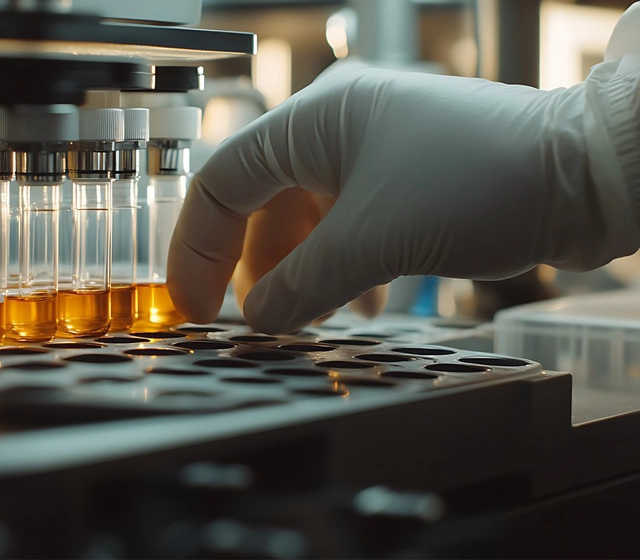
Direct inoculation method: inoculate into both media, incubate for 14 days and observe for microbial growth.
Membrane filtration method: The solution was passed through a sterile filter membrane (pore size 0.22 μm), microorganisms were trapped on the membrane, which was transferred to the culture medium for incubation.
ATP bioluminescence: Detection of ATP produced by microbial metabolism, rapid (teev) but requires validation.

Purity
RP-HPLC: Based on the difference in hydrophobicity of the peptides, separation on a C18/C8 column and detection by UV or MS.
MS: Determination of peptide molecular weight (MALDI-TOF or ESI-MS), verification of agreement with theoretical values and detection of modifications or impurities.
Amino acid analysis principle: after acid hydrolysis of the peptide, quantify the composition of each amino acid and verify the purity by comparing with the theoretical value.
SDS-PAGE: Separation by electrophoresis and observation of single bands by Caulmers Brilliant Blue or Silver staining.

cov ntsiab lus
Elemental tsom xam: By decomposing complex physical processes into many tiny “meta-processes”, each “meta-process” follows the same law, the problem is simplified by analyzing these “meta-processes” and applying necessary mathematical methods.
Conservation of mass: Nyob rau hauv tej yam tshuaj tiv thaiv lub cev los yog tshuaj, cov sum ntawm cov masses ntawm cov tshuaj koom nyob rau hauv cov tshuaj tiv thaiv yog sib npaug zos rau tag nrho cov loj ntawm cov khoom tom qab cov tshuaj tiv thaiv.
Area normalisation:Qhov no yog ib txoj kev uas yog lej txhais raws li kev hloov pauv tus nqi ntawm lub cev mus rau qhov kev sib raug zoo ntawm tus nqi.. Los ntawm normalization, Kev suav tuaj yeem yooj yim thiab tus nqi tuaj yeem txo qis.
