What is melittin and why is a membrane-active peptide being considered against HIV-1?
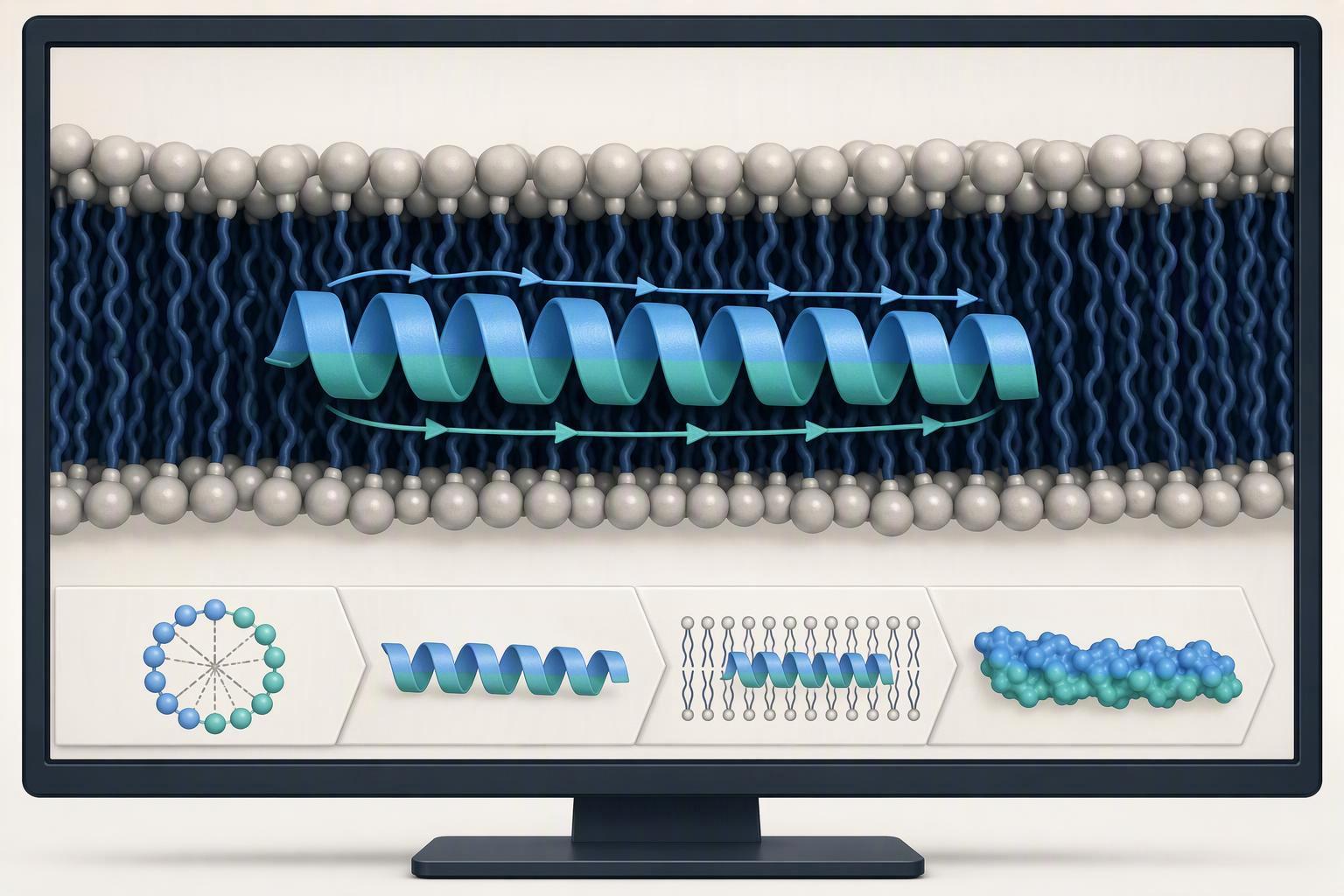
Melittin is a 26-residue cationic amphipathic peptide with the sequence GIGAVLKVLTTGLPALISWIKRKRQQ-NH2 and a molecular weight of about 2840 និង (Frontiers in Immunology, 2024). Its N-terminal region is predominantly hydrophobic while the C-terminal region is polar and cationic, so the peptide partitions into lipid bilayers and folds into an amphipathic α-helix (PMC7224078, 2019).
That structure produces a concentration-dependent outcome: insertion into the membrane, oligomerization, and pore formation that leaks ions and intracellular contents. The exact pore architecture remains debated, but the functional result is membrane disruption (PMC7224078, 2019). For an enveloped virus, a peptide that ruptures membranes is a plausible antiviral, and three anti-retroviral mechanisms have been proposed: direct virolysis of the viral membrane, permeabilization of the envelope, and suppression of viral gene expression (PMC7224078, 2019).
The problem is selectivity. Melittin is not intrinsically selective for viral membranes; it disrupts mammalian plasma membranes, especially erythrocytes (Frontiers in Immunology, 2024). Its reported HC50 against human red blood cells is 16.28 ± 0.17 µg/mL in a 2% suspension over 24 hours, and its LC50 against immature human dendritic cells is 43.42 ± 0.86 µg/mL (Frontiers in Immunology, 2024).
That is the whole evaluation problem in one number. A membrane-active peptide has no useful potency figure without a paired host-membrane toxicity figure, which is why any membrane-active peptide formulation has to be judged on the ratio, not the antiviral value alone.
The translation record for this peptide class is sobering. More than 3,000 antimicrobial peptides have been identified, but only 7 have reached FDA approval, 5 of them membrane-active: gramicidin, daptomycin, oritavancin, telavancin, and colistin (PMC7168295, 2020). That count comes from a single review and should be read as an order-of-magnitude picture rather than a precise attrition rate.
What did the melittin-nanoparticle HIV-1 study actually show in vitro?
The original nanoparticle study reported an IC50 of 2.4 µM and an IC90 of 6.9 µM against CXCR4-tropic HIV-1 (strain NLHX), និង 3.6 µM and 11.4 µM against the CCR5-tropic strain NLYU2 (PubMed 22954649, 2013). The assay used TZM-bl reporter cells carrying luciferase under the HIV-1 promoter, with soluble CD4 as the positive control, which itself gave IC50 values of 3.7 µg/mL against CXCR4-tropic virus and 0.03 µg/mL against CCR5-tropic virus (PubMed 22954649, 2013).
Two absences matter as much as the numbers. ទីមួយ, the antiviral review that tabulates these EC50 values records CC50 and selectivity index as not determined (PMC7224078, 2019). No selectivity index was ever published for this particle, so anyone quoting a therapeutic window is computing something the authors did not. ទីពីរ, no second laboratory has reproduced the values in the sources reviewed here; នេះ។ 2.4 µM and 3.6 µM pair appears in press coverage and downstream reviews, but all of it traces to this one paper.
The formulation itself is specific and worth stating precisely. The carrier is an inert perfluorooctyl bromide core with a unilamellar lipid surfactant shell, and melittin binds and inserts into that shell (PLoS ONE, 2014). The lipid surfactant co-mixture was 98.9 mol% egg lecithin, 0.1 mol% DiI, និង 1 mol% carboxy-PEG-DSPE, with a lipid film at 2.0% w/v combined with perfluorooctyl bromide at 20% w/v (PLoS ONE, 2014).
Free melittin below 2 µM was not cytotoxic to the reporter cells and was highly effective against both strains, while the nanoparticle was reported as safe against VK2 vaginal epithelial cells at the doses tested (PubMed 22954649, 2013). The authors’ own framing was that future investigations appeared warranted to explore prophylactic potential, which is the correct register for a first in vitro result (PubMed 22954649, 2013).
How do you judge whether the antiviral effect is separable from host-membrane damage?
The companion study supplies the paired values that make the judgment possible. Free melittin had a VK2 vaginal epithelial cell viability IC50 of 1.3 µM, reduced vaginal cell viability at 1 µM and above, and reduced sperm motility and viability above 2 µM, ជាមួយ 8 µM or more eliminating both (PLoS ONE, 2014).
Compare antiviral activity with host-cell viability using matched formulation, concentration basis, exposure duration and relevant cells. Values from different studies cannot establish a definitive selectivity index or prove that free peptide fails in every context.
Isotope Labeled Peptides Manufacturer Neoantigen Synthesis Nanoparticle incorporation shifts the toxicity threshold, and that shift is the actual finding. Melittin nanoparticles were toxic to vaginal epithelium only at equivalent melittin concentrations of 20 µM or above, and to sperm only at 40 µM or above, a fivefold reduction in cytotoxicity relative to free melittin (PLoS ONE, 2014). The same paper reports no cytotoxicity to sperm or vaginal epithelium at an equivalent melittin concentration of 10 µM, which is above the 2.4 µM and 3.6 µM antiviral values.
The sources quantify that protection differently, and the difference is worth knowing. នេះ។ 2013 abstract states VK2 viability was unaffected at any dose of melittin-loaded nanoparticles tested, while the 2014 companion paper gives the specific figures of 10 µM tolerated and 20 µM as the first toxic concentration (Neuropeptide Y Synthesis href=”https://pubmed.ncbi.nlm.nih.gov/22954649/”>PubMed 22954649, 2013; PLoS ONE, 2014). The later, more specific source is the one to quote, because “any dose” is broader than the data support.
A fivefold shift is not a therapeutic index. It is a shift in one assay on one cell type, and the same paper states that further testing is needed to determine cytotoxicity in a more physiologically relevant model system (PLoS ONE, 2014). Treat the fivefold figure as a formulation effect worth pursuing, not as a safety margin.
What formulation attributes define the product, not just the experiment?
The attributes that define the product are the ones a regulator would ask you to control, and the FDA guidance for liposome drug products lists them directly: mean particle size and size distribution, morphology and lamellarity, zeta potential or net charge, encapsulation efficiency, free drug controlled separately from encapsulated drug, and validated in-vitro release testing (FDA, 2018).
That guidance is written for liposomes, and the melittin carrier is a perfluorocarbon emulsion with a lipid monolayer, not a bilayer liposome (PMC2710241, 2008). Applying it here is an analogy a reviewer would expect you to justify, not a stated requirement. The attribute list still holds, because each item changes what the product is.
Size and surface charge were characterized during formulation development: the core-shell particle diameter was about 290 nm with no change after melittin addition (289.8 nm), and zeta potential shifted from −17.2 mV without melittin to +17.82 mV at a lipid-to-melittin ratio of 30 (PMC2710241, 2008). Those are development values, not a release specification, and presenting them as one would misstate what was measured.
The monolayer explains why the carrier survives. Melittin binds the perfluorocarbon nanoparticles with a dissociation constant of about 3.27 nM, adopts α-helical structure with circular dichroism minima at 208 និង 220 nm, and buries Trp-19 near the perfluorocarbon interface (PMC2710241, 2008). The same source reports intact monolayer structure on electron microscopy after melittin addition, in contrast to bilayer liposomes that show disruption.
Size cuts both ways, and the sources disagree about which way. The companion paper argues the 250 ទៅ 300 nm diameter may prevent penetration of the vaginal epithelial barrier and so minimize systemic absorption (PLoS ONE, 2014), while a delivery-system review states the same size may not be conducive to diffusion and cellular uptake at the site (PMC8773652, 2022). The same measurement is protective in one reading and an obstacle in the other, and a product team has to decide which it is for the intended route.
Why doesn’t a reporter-cell assay predict mucosal or repeated-dose performance?
A reporter-cell assay measures one thing well and several things not at all. The TZM-bl system quantifies infection through luminescence and is quick and cost-effective, but the microbicide preclinical review states that efficacy should always be confirmed in primary cells, especially CD4 T cells, which are the principal early targets of HIV infection (PMC4818646, 2015).
Strain choice is the second gap. The melittin nanoparticle was tested against NLHX and NLYU2, both laboratory-adapted strains (PubMed 22954649, 2013). The same review states that use of CCR5-tropic transmitted/founder strains, and not just laboratory-adapted strains, is important because transmitted/founder viruses have unique features (PMC4818646, 2015). Read together, the particle has not been tested against the strain class the field considers most relevant to transmission.
Seminal plasma is the third gap, and it bears directly on a virus-targeting virucide. Seminal plasma increased the IC50 of inhibitors against reverse transcriptase, integrase, and protease by 8 ទៅ 21 fold, while the CCR5 inhibitor maraviroc, which targets a cellular component, remained potent (PMC4818646, 2015). Melittin nanoparticles are described as capturing and disrupting the virion, which makes them virus-targeting, and no source reviewed here reports melittin activity in the presence of seminal plasma.
The review also notes that explant studies require exceedingly high viral doses to establish infection and are therefore unsuitable for low, physiologically relevant inocula, and that toxicity induced by a candidate can be mistaken for antiviral activity (PMC4818646, 2015). That last point is the trap for any membrane-active agent: a peptide that kills the cells can look like a peptide that stops the virus.
Repeated-dose mucosal exposure adds a regulatory layer the single-dose assay does not touch. Topical prevention products are assessed with repeated-dose vaginal toxicity in two species, fertility and reproductive toxicity studies, and local-irritation testing (FDA, Peptide Manufacturers Wholesale 2005), and the vaginal microbicide guidance recommends assessing cervicovaginal inflammation and epithelial disruption (FDA, 2014). A 48-hour luciferase readout says nothing about any of it.
What analytical characterization and records does a reviewer need?

Start with the specification framework, because it is easy to get wrong. For a chemically synthesized peptide the principal framework is ICH Q6A, since ICH Q6B expressly excludes synthetic peptides (ខ្ញុំ, 1999). Confirm the Q6A scope sentence against the current text before filing, because the applicability statement is the part reviewers check first.
Design stability studies for the intended formulation, container, route and storage claim. General ICH chamber examples are not automatically the required conditions for a topical perfluorocarbon emulsion. Characterize peptide integrity, free and associated peptide, particle properties and activity over the justified period.
No source reviewed here reports melittin nanoparticle stability under any of those conditions. The companion paper reports only that size and zeta potential confirmed stability at vaginal pH for at least three days (PLoS ONE, 2014), which is not an ICH storage condition. That gap is the difference between a formulation that survives an experiment and one with a shelf life.
For an injectable, the sterility and endotoxin expectations are named chapters: USP <71> Sterility Tests, USP <85> ការធ្វើតេស្ត Endotoxins បាក់តេរី, និង USP <788> Particulate Matter in Injections (USP, បច្ចុប្បន្ន). The numeric limits live in the chapter text and should be cited from there rather than from a summary.
The FDA liposome guidance adds a manufacturing expectation that is easy to miss: sterility and absence of pyrogens or bacterial endotoxins should be demonstrated, validated product-specific purification and sterilization methods must show sterilizing filters function without compromising particle integrity, and endotoxin control should be addressed in the manufacturing process rather than only by finished-product testing (FDA, 2018).
A research package should connect identity, មាតិកា peptide, free versus associated peptide, particle size and distribution, surface charge, release and relevant biological controls to the tested lot. Add microbiological, endotoxin and particulate criteria according to the route, stage and formulation rather than importing all injectable requirements into a topical prototype. ក្រុមហ៊ុនផលិត Peptide
What evidence is still missing before clinical or commercial claims are justified?

The cited 2024 review did not establish clinical efficacy or safety of melittin for HIV prevention. This is a dated evidence statement, not a comprehensive current registry assessment of every melittin formulation or indication.
No source reviewed here reports an in vivo efficacy result for a melittin nanoparticle vaginal virucide. The companion paper states the long-term goal is a vaginal gel-based platform and that additional safety and efficacy experiments in animal models more closely simulating the vaginal environment are required (PLoS ONE, 2014). The primary paper calls its data a first proof of concept and says future investigations appear warranted (PubMed 22954649, 2013).
The mechanism is also unresolved in a way that changes what you would measure. នេះ។ 2013 abstract frames the particle as capturing and disrupting virus, while the antiviral review states the cumulative evidence indicates the dose-dependent anti-HIV effect works by suppressing HIV transcription and lowering viral gene products rather than by lysis of cellular or viral membranes (PubMed 22954649, 2013; PMC7224078, 2019). These are competing readings, not a settled one, and they imply different assays and different failure modes.
Two more gaps are worth naming. Reported drug loading for melittin carriers sits in the single-digit percent range, with one PLGA formulation reaching about 90% loading efficiency and 6 ទៅ 7% drug content after ion-pairing (PMC8773652, 2022); those values belong to that specific carrier and should never be merged into one benchmark. And the plasma half-life extension figures appear only in the review, not in any primary formulation paper reviewed here (PMC8773652, 2022). Nmm Peptide Synthesis
The evidence ladder, តាមលំដាប់: independent replication of the IC50 values, a published selectivity index, activity against transmitted/founder strains in primary CD4 T cells, activity in the presence of seminal plasma and cervicovaginal fluid, repeated-dose mucosal toxicity in two species, ICH-format stability data, and an in vivo efficacy result. Until those rungs are filled, the honest description of melittin nanoparticles and HIV-1 is an intriguing in vitro signal with a well-characterized carrier and no clinical path yet demonstrated.
សំណួរដែលសួរញឹកញាប់
Have melittin nanoparticles been tested in humans?
The cited HIV-1 nanoparticle studies are preclinical and do not establish clinical efficacy or safety. នេះ។ 2024 review’s account of human evidence is dated; it cannot by itself establish that no human melittin study exists as of October 2026. This article makes no current comprehensive clinical-trial claim.
Has the 2013 melittin nanoparticle HIV-1 result been replicated?
Not in the sources reviewed here. The original cytolytic-nanoparticle work stands as a single report, and no independent group’s confirmation of the same particle against HIV-1 appears in this evidence set. That matters for how much weight the result carries: one laboratory’s in vitro finding is a starting point for melittin nanoparticles and HIV-1 research, not a settled effect.
What is the selectivity index of melittin nanoparticles?
The sources summarized here do not establish a directly comparable selectivity index for the proposed product. Calculate one only from appropriately paired antiviral and cytotoxicity endpoints, with uncertainty and assay conditions stated.
Are melittin nanoparticles safe for vaginal use?
The honest answer is that nobody has shown they are. Nanoparticle-associated melittin was tolerated up to 20 µM in two cell types, a fivefold improvement over free melittin (PLoS ONE, 2014). That is a cytotoxicity comparison in cultured cells, and the paper itself calls for testing in a more physiologically relevant model. No repeated-dose, local-irritation or in vivo data exist.
How do melittin nanoparticles compare with approved antiretrovirals?
They have not been compared. In the primary HIV-1 study the positive control was soluble CD4, not an approved drug (PubMed, 2013). No head-to-head against any licensed antiretroviral appears in this source set, so no potency ranking against current therapy can be drawn from the available data.
Can a peptide supplier support this kind of work?
បាទ, within defined limits. A synthesis partner can contribute sequence design and modification, purity and identity documentation, sterile and low-endotoxin handling, and continuity from small-batch trial production to larger scale. What a supplier cannot do is establish antiviral efficacy or mucosal safety; those remain questions for the laboratory work described above.
សេចក្តីសន្និដ្ឋាន
The melittin nanoparticle result is real, specific, and narrow. A perfluorocarbon particle with a lipid monolayer carried melittin to IC50 values of 2.4 µM and 3.6 µM against two laboratory-adapted HIV-1 strains in a reporter-cell assay, and the same formulation shifted melittin’s cytotoxicity threshold fivefold in the companion study (PubMed 22954649, 2013; PLoS ONE, 2014).
What the evidence does not support is any claim beyond that. There is no published selectivity index, no independent replication, no transmitted/founder strain data, no seminal plasma data, no ICH-format stability, no in vivo efficacy, and no human trial. The translational evidence for antiviral peptides of this class is thin for a reason, និង 7 FDA approvals out of more than 3,000 identified peptides is the shape of that record (PMC7168295, 2020).
The practical takeaway for anyone evaluating a membrane-active peptide result is the paired-value rule. Never accept an antiviral potency figure without a host-membrane toxicity threshold measured in the same units on the relevant cell type, and never accept a formulation claim without the attribute data that define the product: size, charge, free versus associated peptide, ដោះលែង, ភាពគ្មានកូន, និង endotoxin. Apply that test to the next result you read, រួមទាំងមួយនេះ, and the in vitro signal stays in its proper place.