An Radharc Gnáth: Automation Is the Answer to the Purification Bottleneck
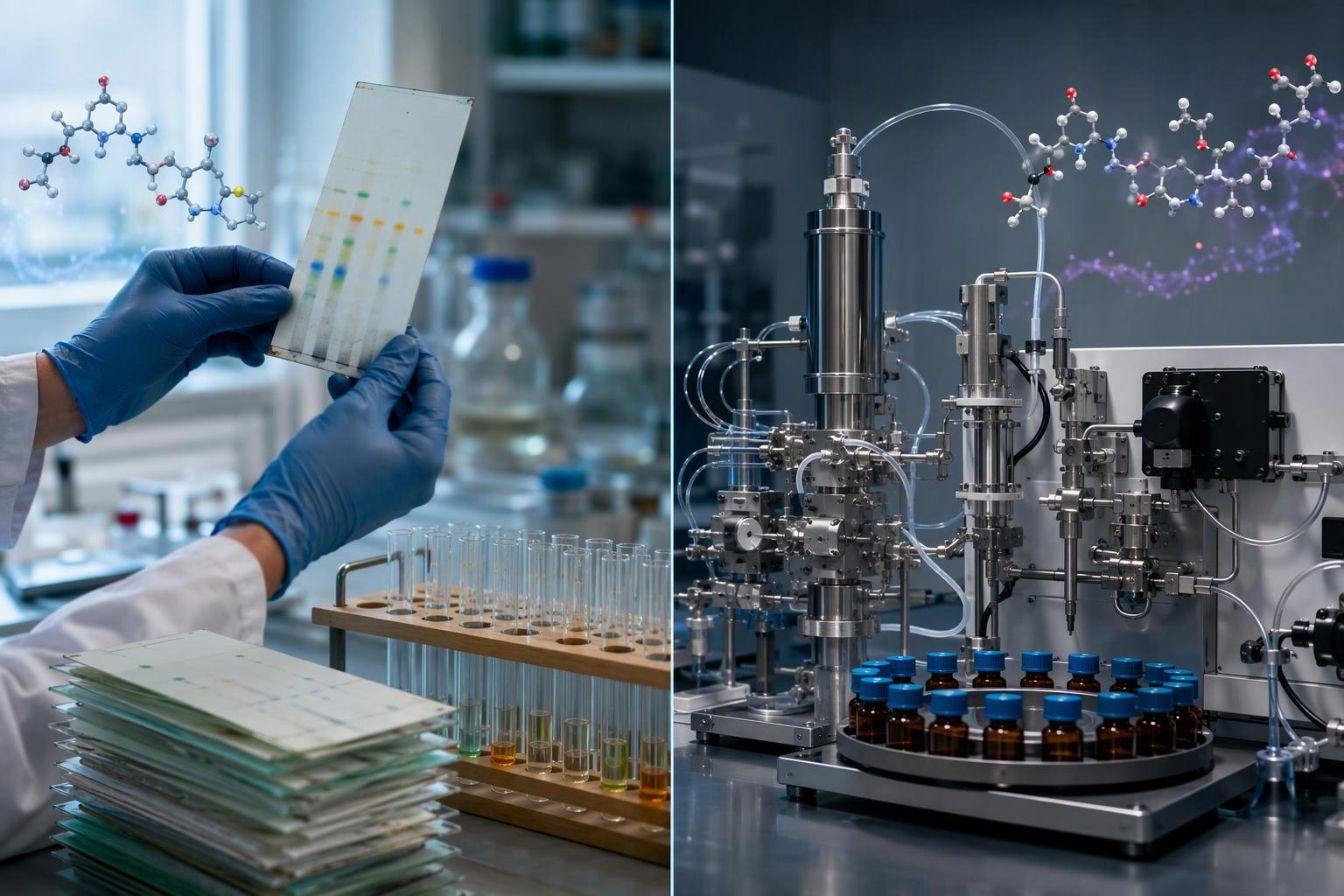
The mainstream position is straightforward: solid-phase peptide synthesis leaves crude material in that same 50–80% crude-purity range, and purification is where that impurity load has to be removed before anything downstream can proceed. That range is the honest basis for calling purification the downstream bottleneck, and it is why the labor intensity of manual fraction work and the batch-to-batch inconsistency of gradient methods get so much attention.
Why the view is popular is easy to see. Automated parallel purification genuinely solves a real high-throughput synthesis problem, and the downstream cost of slow purification is real rather than rhetorical.
Where it comes from matters more than what it says. The framing is carried mainly by vendor platform documentation and event-recap coverage, which treat purification as one step in a pipeline rather than as a problem with its own failure modes. That is also why the term peptide purification method robustness gets used loosely in the pitch, as a property the platform is assumed to have rather than one the buyer verifies.
Why the Standard Automation Pitch Breaks Down
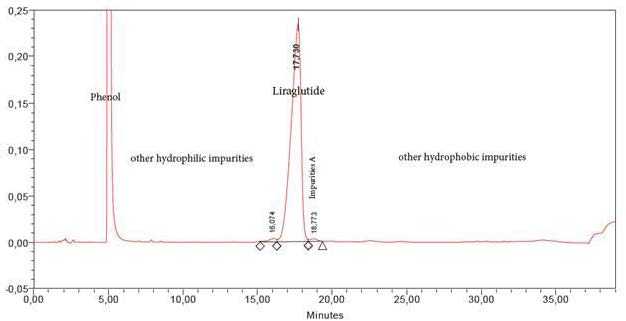
Most claims about AI in peptide purification are made at the wrong level of abstraction. They describe what a platform can do in general, not what it achieves for a specific sequence, and the gap between those two things is where method-development budgets go to die.
Retention prediction is the clearest case. DeepRT reached R² 0.996 on unmodified peptides but needed transfer learning to hold R² 0.978 on post-translationally modified ones (DeepRT, PMC, retrieved 2026-02-10). The same pattern shows in DeepLC, where transfer learning required separate fitting for a pH-shifted basic-pH dataset and an atypical TMPP-modified dataset (DeepLC transfer learning, PMC, retrieved 2026-02-10). The model does not transfer for free.
Recovery is not a platform property either. In one study, a 9.4 mm semi-preparative column averaged 90.7% recovery across 0.75–200 mg, while a 2.1 mm narrowbore column gave 82.1% at 6 mg and a 1.0 mm microbore gave 78.0% at 3.0 mg (column format and recovery, PMC, 2006). Recovery varies by column format and load, not by platform.
⚠️ Rabhadh: A platform-level capability claim is not sequence-specific performance evidence. Ask for the chromatogram for your sequence, at your load, on your column.
The hardest sequences are where autonomy has the least evidence. A 34-residue hydrophobic transmembrane fragment gave 4% yield in DMF and 12% in 80% NMP/DMSO, with no product under one Fmoc-SPPS condition (hydrophobic fragment synthesis, PMC, 2006). Peptide purification method robustness is exactly what these cases test, and it is exactly what the pitch omits. The pitch describes the easy case and generalizes to the hard one.
What the Data Actually Shows About AI in Peptide Purification
Spps Peptide The defensible contribution of AI in peptide purification is narrow, upstream, and conditional, not end-to-end. The independent work sits in method development, not in the fraction collector.
The clearest example is a sequence-aware ANN retention model trained on ~345,000 peptides from 12,059 LC-MS/MS analyses, which reached average elution-time precision of about 1.5% and placed 50% of peptides within ±1.52% error (Improved Peptide Manufacturing Companies peptide elution time prediction, 2006). More telling for modified sequences: the model separated isomeric peptides that share m/z, using sequence alone. That matters because mass-only identification cannot resolve isomers, and it is exactly the gap that stalls method development for PEGylated, fluorescent, or glycosylated targets.
The counter-examples show where the autonomy claim runs out. PEG length heterogeneity forces a purity-versus-recovery choice: purification must separate oligomers differing by 44 Agus, against the 57 Da of glycine, the smallest amino acid residue (Impact of N-terminal PEGylation on synthesis and purification of peptide epitopes, 2024). Reported purity reached 99.5% on average, but only through purity bought with narrow peak cutting, which collects less product. An optimized preparative workflow with a transferability correction model reached initial purities above 90% with yields exceeding 30% (Improvement of Analysis and Transferability in Peptide Purification, 2026). That is a transferability result, not an autonomy result.
Key Takeaway: Treat autonomy as a per-step property with an evidence gate, not a platform property. Decide automatable, not automatable, or needs a human gate per sequence class.
The Better Approach: Evidence-Gated Autonomy
Neuroscience Research Area Hand a purification step to an autonomous system only when the vendor has supplied batch-specific evidence for that step on your sequence class. That single condition separates evidence-gated autonomy from the standard automation pitch, which asks you to trust a platform and then verify the output. Merrifield Synthesis
Four principles define the approach:
-
Mass-directed fraction collection carries the strongest case. UV and MS triggers are complementary rather than redundant: UV catches poorly ionizing compounds, MS catches peptides with low UV extinction, and a combined trigger excluded impurities in a documented peptide case.
-
UV-only collection is not equivalent when coeluting impurities sit within 0.1 min of the target. In that multi-step case, MS triggering restored selectivity when UV separation was poor under standard conditions.
-
Orthogonal confirmation is a gate, not a final checkbox. FDA Q6A treats a single retention time as non-specific and accepts two different-principle procedures or a combined one, which is the Q6A decision logic that makes orthogonality a gate.
-
Recovery and purity are optimized together. Aggressive pooling fragments the product into narrow cuts.
Chun Leid: Design the orthogonal gate into the workflow, not into final QC. A confirmation step that runs after pooling cannot recover a fraction that was already mis-pooled.
The proof point to demand is a documented transferability result, such as the correction model published in the 2026 peptide purification study: a vendor who can show how a method transfers between systems has shown you the evidence standard, not just the instrument.
How to Apply This: What to Demand Before You Hand Over a Step
Start by asking for batch-specific chromatograms, not a platform capability deck. Everything below is a documentation request, not a technology question.
-
Classify your sequence against the known hard cases (one afternoon). Hydrophobic, cyclic, disulfide-containing, PEG- or label-conjugated, and isobaric species each stress a different part of the method. Flag which criteria are at risk before you talk to anyone.
-
Demand batch-specific chromatograms and MS data (one to two weeks of correspondence). The method and time window must be stated. Representative traces are not evidence about your sequence.
-
Require a defined sterility and endotoxin testing scope, not an implied one. Ask which tests, on which samples, at which stage.
-
Require validation gates tied to the intended-purpose basis of Q2(R2) agus the Q14 design space that makes “robust” a defined term. That framing treats robustness as a lifecycle property, not a claim.
-
Require at least two orthogonal methods, per the 0.10% impurity-identification threshold and the two-method rule, because identification by a single retention time is not specific.
Track recovery and purity as a pair. Test whether the design space survives a small deliberate parameter change. Expect evidence-gathering to dominate the first quarter.
Caveats and Where the Conventional View Still Holds
The strongest limitation of this assessment is that it rests on published application notes and vendor documentation, and none of the sources gathered for it publishes a co-elution frequency for deletion and truncation impurities. The claim that orthogonal confirmation cannot resolve deletion co-elution is therefore a gap Tripeptide 1 in the evidence, not a finding. The sources state co-elution qualitatively, noting that deletion-related impurities can be chromatographically similar to the target and may partially co-elute, without quantifying how often (Journal of Pharmaceutical Investigation peptide quality review, 2026, retrieved 2026-07-15).
Context matters too. For unmodified, well-behaved sequences in high-throughput screening, the conventional automated-parallel-purification pitch is largely correct, and the evidence gate is cheap to satisfy. Method development is a hybrid workflow, not model-only design: analytical scouting and rules of thumb narrow the space, then systematic optimization refines gradient, flow, and modifier (preparative RP-HPLC peptide literature, 2025). Tripeptide 1
The AI-in-chromatography material is also recent and vendor-flavored, so 2026 capability may be framed here as moving from concept to closed-loop execution when it has in fact moved further. The argument is about the burden of proof, not whether autonomy works: a vendor who supplies batch-specific evidence has met the standard this article sets.
Disclosure: MOL Changes has a commercial interest in peptide quality standards and provides HPLC and MS purity testing.
Ceisteanna Coitianta
Is mass-directed fraction collection worth the cost when UV-only works on easy sequences?
On easy sequences, often not. UV and MS as complementary triggers earn their cost when coeluting impurities share the target’s chromophore, which is exactly where UV-only collection fails silently. The honest test is your own hard method, not a vendor’s easy one.
We already bought a UV-only platform. Do we start over?
Níl. Recovery data across column formats shows the collection hardware is rarely the limiting step; the trigger logic is. Adding a mass trigger to an existing UV platform is a smaller change than replacing it, and it preserves your validated fraction handling.
Vendor application notes show strong performance. Why not take them at face value?
Because a documented transferability correction model exists precisely because retention predictions drift between instruments and gradients. Ask for the batch-specific chromatograms and MS confirmation behind the note, on your sequence class, before you treat the number as yours.
Does transfer learning close the modified-peptide gap?
Partly. Transfer learning across modification classes improves retention prediction for sequences near the training set, but the evidence thins for heavy isotope labels, glycopeptides and cyclic peptides, where the modification changes the separation mechanism itself. Treat those as gate-and-verify, not hands-off.
Conclúid: The Evidence Standard Is the Contribution
The useful question about AI in peptide purification is not whether an algorithm can improve a separation, but which steps a vendor has proven on your sequence class, with your kind of modification, at your scale. That reframing is the contribution, and it is the one thing this article asks you to carry into your next vendor conversation.
The shift it implies runs in two directions. Buyers should treat batch-specific chromatograms, MS data with a stated method and time window, a defined sterility scope, and explicit validation gates as the minimum evidence package before handing over a step. Vendors should publish that package instead of platform capability claims. The stakes are not abstract: at regulated kilogram scale, reaching above 95% purity generally requires multi-step preparative HPLC and controlled lyophilization, agus yield loss accumulates across method transfer, overlap control, drying and hold times (KNAUER peptide purification scale-up application note, 2025). Autonomy that cannot show its evidence on your sequence will not absorb that loss for you.
An industry where autonomous purification claims are as auditable as the analytical methods they depend on is a realistic near-term goal, and it starts with what buyers agree to accept as proof.
If you are evaluating an autonomous or semi-autonomous purification step, talk to an expert about the analytical documentation that should accompany it.