What the BPC-157 Enforcement Record Actually Shows
The regulatory picture changed on a dated schedule, and each step is documented. On July 23, 2026, į FDA’s Pharmacy Compounding Advisory Committee meeting pagelisted BPC-157 (free base) and BPC-157 acetate for review against the ulcerative colitis use, with briefing materials proposing the substancesnotbe added to the 503A Bulks List. The committee voted 8–6 with one abstention to recommend adding them anyway, asMcDermott’s read on the PCAC outcomerecords.
That vote does not legalize compounding. FDA told the meeting it “rarely diverges” from PCAC recommendations, but final addition requires notice-and-comment rulemaking that could land in 2027 or stretch across multiple years. Until then, BPC-157 sits outside Category 1 and off the final 503A Bulks List.
Enforcement did not wait for the rulemaking. Five CDER warning letters dated August 24, 2026 went to online peptide sellers, and all five claimed “research use only” while their sites carried dosing information, injection instructions and dose calculators. In June 2026, the Alabama Medical Board separately barred physicians from compounding, administering or dispensing research-grade peptides to patients.
Why Research-Use-Only Labeling Is Not a Governance Strategy
Research-use-only is a statement of intended use, not a legal shield. The FDA can still find an unapproved new drug where a vendor’s website as a whole shows human use, under Section 201(g)(1) and Sections 301(d) ir 505(a) of the FD&C Act, asArent Fox Schiff explainsin its September 18, 2026 analysis of the August 24, 2026 warning letters. Those letters were pure unapproved-new-drug enforcement, and the same analysis applies a net-impression standard: hedged marketing language can still render a product misbranded if the overall marketing picture implies human use.
That distinction is the whole of research use only versus therapeutic claims. A label does not govern what the surrounding page, product photography, dosing language, or customer testimonials communicate.
The failure mode is predictable. A supplier stamps RUO on the vial, then publishes a page that reads like a consumer product listing, and the label stops doing any work. Governance means controlling the label, reviewing claims before publication, controlling which channels carry the product, and taking in adverse-event reports rather than discarding them.
What a Batch-Specific Certificate of Analysis Proves and What It Does Not
A batch-specific certificate of analysis for research peptides is the minimum document a supplier should be able to produce, and it is the document most often mistaken for proof of quality. It proves that someone tested a named lot and recorded a result. It does not prove who did the testing, what method they used, or whether the material in the vial matches the material on the label.
The 2024 multifactor quality and safety analysis of semaglutide products from illegal online pharmacies, published in theJournal of Medical Internet Research, tested three vials purchased from online sellers. Measured semaglutide content exceeded the labeled amount by +28.56%, +38.69% ir +33.58%, against +5.05% for a reference Ozempic 1 mg pen (JMIR, 2024). The same three lyophilized samples were devoid of viable microorganisms at the time of testing, which shows how narrow a single passing result is: a clean microbial count says nothing about how much active material the vial contains.
Scope matters here. Three vials, one compound, purchased from online sellers, tested in 2024. The finding is not generalizable to every gray-market product, and it does not describe supplier-issued CoAs in general. It shows what a label figure and the physical material can separately be.
The Limits of HPLC Purity Testing for Peptides
A 98% or 99% HPLC purity figure measures one method under one set of conditions. It is not a statement about what else is in the vial. The documented limits of single-method HPLC purity determinationare structural rather than incidental: co-eluting impurities can hide under the main peptide peak, and UV detection near 214 į 220 nm misses species that absorb weakly or not at all, including sugars, glycols, lipids, salts and buffer residues (PMC, “HPLC Analysis and Purification of Peptides”; the article is undated, retrieved for this review).
The number is also method-dependent. Column chemistry, gradient, mobile phase, detection wavelength, flow rate and integration parameters all shape the result, so two laboratories can report different purities for the same lot without either being wrong.
That is why a purity percentage establishes neither identity nor safety. Orthogonal mass-spectrometric confirmation is what ties the peak to the intended sequence, and it says nothing about residual trifluoroacetate counterion content, residual solvents, water content or bioburden. Those are separate measurements, reported separately, or not reported at all.
Endotoxin and Sterility Documentation: Two Different Questions
A supplier that reports “sterility tested” has answered one question and left another open. Endotoxin and sterility documentation for research peptides are two separate records, and a lot can pass one while failing the other. USP <85> bacterial endotoxins testing, usually run as a Limulus amebocyte lysate (LAL) assay, is quantitative for endotoxin only, reported in endotoxin units (EU) or EU/mg, and it does not detect viable microbes. USP <71> sterility testing is growth-based instead: the standard’s described method uses membrane filtration or direct inoculation into two media, fluid thioglycollate and soybean-casein digest, incubated for not less than 14 days, with the primary USP <71> document as the authority to check rather than a lab summary.
That distinction matters because a clean endotoxin figure is not a clean lot. In the three BPC-157 vials tested by researchers and published in JMIR, endotoxin ranged from 2.1645 į 8.9511 EU/mg, which is a quantitative endotoxin result, not a sterility result.
Raktų išsinešimas: LAL versus USP <71>
| Method | Detects | Cannot detect | | LAL (USP <85>) | Endotoxin, quantitatively, in EU or EU/mg | Viable bacteria, fungi, or any non-endotoxin contaminant | | Sterility (USP <71>) | Viable microorganisms that grow under the test conditions | Endotoxin, and any organism that does not grow in the two media used |
A lot-matched result requires both tests run on the same lot number, with the lot number printed on each report.
A Peptide Supplier Quality and Governance Framework
A peptide supplier quality and governance framework is a set of auditable evidence requests, not a certificate you file once. Each dimension below works the same way: you request a specific record, it proves one bounded thing, and past that boundary it proves nothing. Run the six dimensions as a checklist before qualification and at every re-qualification.
Audit report or questionnaire response, ISO 9001 scope, site and contact details
The quality system behind the batch exists and can be inspected
Nothing about the specific lot’s analytical results
The peptide supplier quality and governance framework only holds if the records stay attached to the material. One caution on the first row: a batch-specific certificate of analysis for research peptides is only as strong as its lot linkage. A CoA without the shipped lot number is a marketing document, not a release record. Custom Peptide Synthesis Companies
Documentation Expectations in Practice
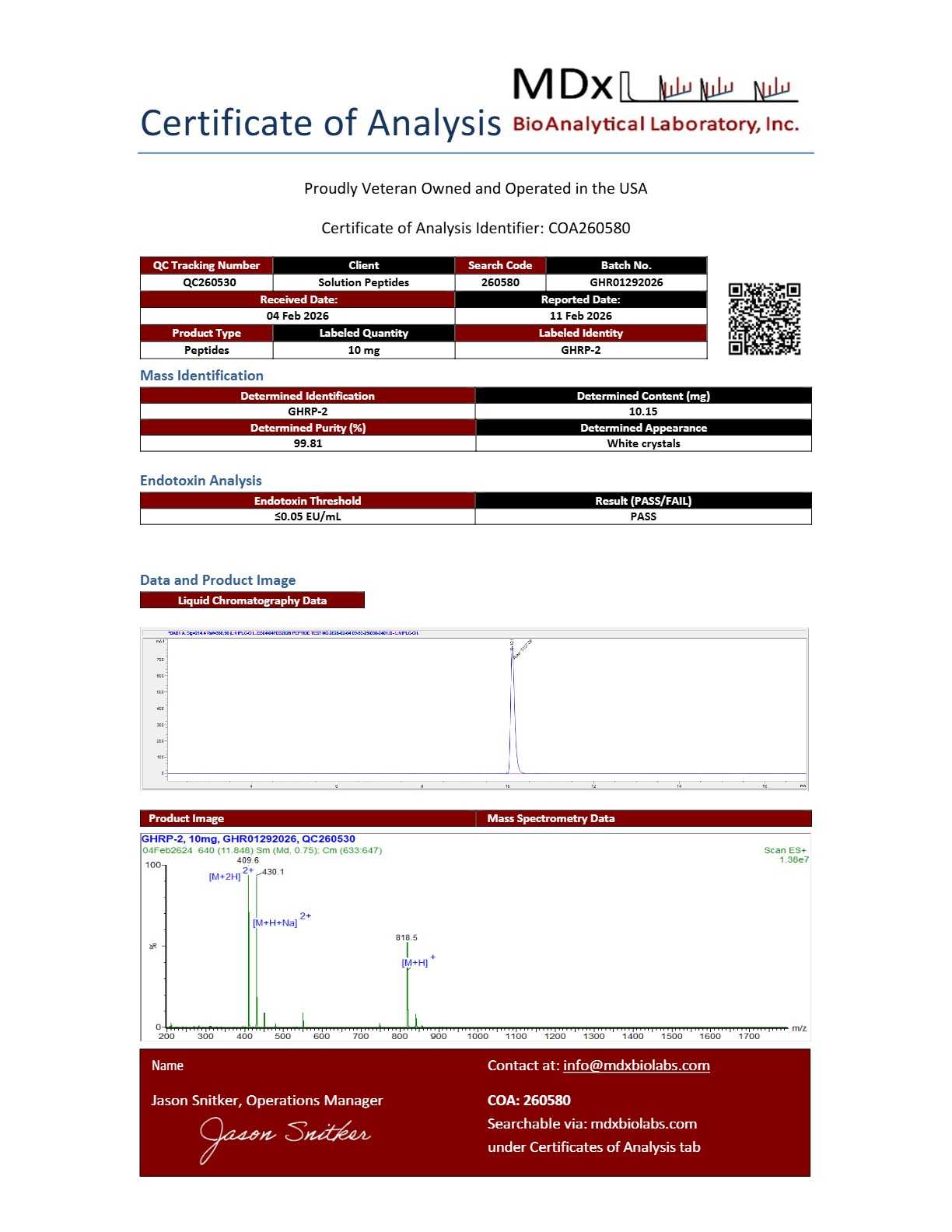
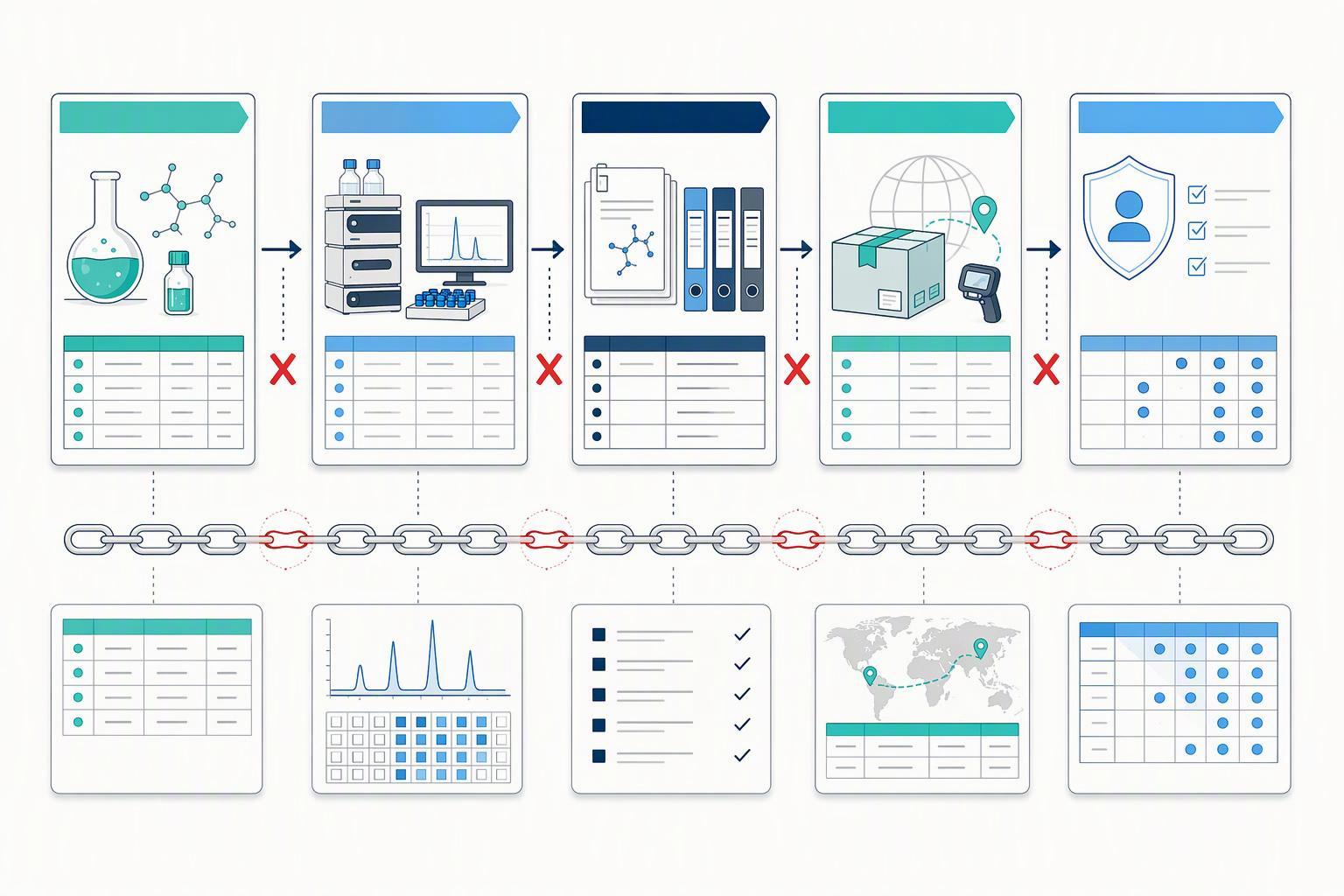
A lot-matched release package is a set of documents that all carry the same lot number and all describe the same physical material. In practice it usually contains four things: a batch-specific certificate of analysis, the chromatogram that produced the purity figure, the mass spectrum that confirms identity, and any endotoxin or sterility result claimed for that lot. The chain breaks when one of those documents is generic rather than lot-specific.
Three failures show up repeatedly. A supplier reuses a single CoA across multiple lots, so the purity figure describes a reference batch rather than the vial in hand. A chromatogram is supplied without its integration table, which means the reader cannot see how the purity percentage was calculated or which peaks were excluded. Endotoxin testing is claimed on the CoA but the supporting report is not lot-matched, leaving no way to connect the result to the material shipped.
MOL Changes operates Class 100 ultra-sterile cleanroom production with per-lot analytical release documentation including batch chromatogram and MS. Two gaps remain unresolved in the material available for this article: the specific cleanroom and environmental-monitoring evidence behind that production claim, and the exact wording of the brand’s research-use-only label. Neither should be inferred. Ask for both directly, and treat a supplier who cannot produce them as a supplier whose documentation chain has not been demonstrated.
Getting Started: Qualifying a Supplier Before the First Order
Start with one request: a lot-matched release package for a specific catalog number. Ask for the certificate of analysis, chromatogram and spectrum tied to the lot number printed on the vial you would actually receive. If the CoA references a different lot, or a “representative” lot, you have learned something useful before spending anything.
Then check that identity confirmation is orthogonal to the purity method. A mass spectrometry result and an HPLC purity figure answer different questions; two readings of the same chromatogram answer one. Where a supplier cannot show a second, independent method, treat identity as unconfirmed.
Third, get change-control and deviation handling in writing before scale-up. Ask how you will be notified if a synthesis route, column, or testing laboratory changes, and who signs off on a deviation. A supplier who answers this in a document is easier to qualify than one who answers it in a call.
Pro Tip:Run these three checks on a small first order. The documentation package costs the supplier little and tells you more than any capability page.
To work through the full framework with your own catalog numbers, request a documentation package or talk to an expert. This article is published by a peptide supplier, so treat the criteria here as a buyer’s checklist rather than neutral advice.
Frequently Asked Questions
What should a batch-specific certificate of analysis for research peptides contain?
It should tie one document to one lot number and report methods, not just results. At minimum: peptide sequence and lot number, the purity method (typically HPLC-UV or HPLC-CAD), the identity method (mass spectrometry), the quantity method (amino acid analysis or UV content), and the acceptance criteria each result was judged against. A purity figure with no method, no lot and no specification is a number, not documentation.
Does research use only labeling protect a supplier?
Nr. RUO is a distribution control, not a legal shield. It tells the buyer the material is not intended for human or veterinary use, but it does not protect a supplier from responsibility for misleading therapeutic claims or marketing that implies clinical benefit. A supplier that stamps RUO on the vial while implying therapeutic use elsewhere has created a contradiction, not protection.
What does HPLC purity testing not tell you?
An HPLC purity figure tells you the proportion of the main peak by the detector’s response, and nothing about what the remaining percentage is. It does not identify residual counterions such as trifluoroacetate, residual solvents, water content, or the impurity peaks themselves. Independently tested research peptides have measured as low as 7.70% purity against 99% label claims, which shows how far a headline number can sit from the underlying reality.
Are endotoxin and sterility testing the same thing?
Nr, and treating them as interchangeable is a common documentation error. Endotoxin testing measures lipopolysaccharide, typically by the LAL method in USP <85>. Sterility testing looks for viable microbial contamination, typically by membrane filtration or direct inoculation under USP <71>. A product can pass one and fail the other.
How do you tell a legitimate research supplier from a questionable one?
A legitimate research supplier answers specific questions with specific documents. Ask for the batch-specific certificate of analysis with lot number and methods, the chromatogram and mass spectrum for that lot, the endotoxin and sterility methods by name, and the facility’s quality certification. A supplier that responds with a generic brochure, a purity percentage with no method, or a refusal to name the testing laboratory is telling you what its documentation is worth.
Išvada
The single most important thing to carry away is that documentation is a chain the buyer has to test, not a document the supplier hands over. A certificate of analysis, a chromatogram, an endotoxin result and a sterility statement each answer a narrower question than the folder they arrive in suggests, and the gaps between them are where risk accumulates. The peptide supplier quality and governance framework in this guide exists to make those gaps visible before an order is placed, not after a batch is in hand.
The enforcement record is moving quickly. The August 2026 warning letter set reflects the state of regulatory attention at that moment and may be superseded as further actions are published, so treat it as a dated snapshot rather than a settled position. Re-check the primary sources directly when a qualification decision depends on them.
The next step is small and concrete: pick one supplier already on your list, request the batch-specific records for a single lot, and trace each claim back to the method that produced it.
Chief Technology Officer; Peptide Synthesis ExpertPagrindinė kompetencija: Complex peptide synthesis, non-natural amino acid modifications, and the construction of cyclic peptides and stapled peptides.
Biography:Zejun Peng has extensive experience in organic chemistry and peptide synthesis. He is proficient in the combined application of solid-phase peptide synthesis (SPPS) and liquid-phase peptide synthesis (LPPS), and is particularly skilled at overcoming “extremely difficult-to-synthesize sequences” (such as ultra-long-chain peptides, highly hydrophobic sequences, and multiple disulfide bond folding). Under his leadership, the team has successfully overcome technical bottlenecks in several specialized modifications (such as N-methylation, PEGilinimas, and fluorescent labeling), maintaining a synthesis success rate of over 98%.
Sveiki čia! 👋 Welcome to MOL Changes. Kaip mes galime jums padėti šiandien? Nedvejodami klauskite apie mūsų peptidų sintezę, CRO paslaugos, or any product inquiries — just type your message below and we'll continue the conversation on WhatsApp.