Why macrocyclic peptide analytical challenges decide whether a deal survives diligence
The Novartis and Unnatural Products collaboration announced in February 2026 committed up to $100 million in upfront and pre-IND milestone payments, with a further $1.7 billion tied to development, regulatory and commercial milestones, a headline total of more than $1.8 billion (GEN, 2026). A second, similarly sized macrocycle collaboration later the same year, between Novo Nordisk and Orbis Medicines, carried a $1.4 billion headline (Fierce Biotech, 2026). Both figures are headline totals that include contingent milestones, so they are not comparable cash values.

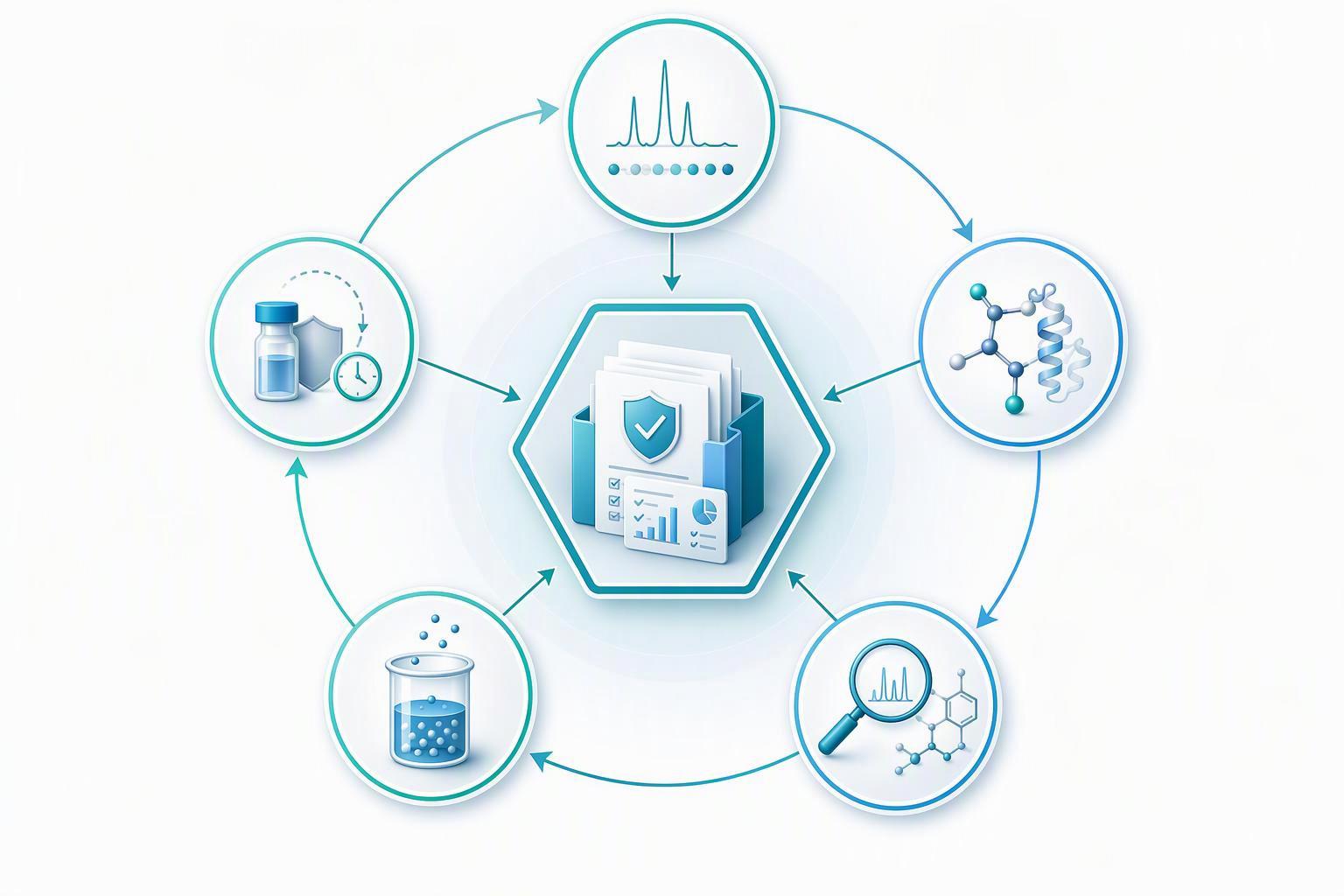
What transfers at signing is not the headline. Under the Novartis terms, Novartis will run IND-enabling work and everything after it, including clinical development, manufacturing and global commercialization (GEN, 2026). The asset that has to stand on its own is the analytical package, and five disciplines carry it in a fixed order: purity profiling, structural confirmation, impurity characterization, уусах чадвар, then stability. Each depends on the one before it.
What makes macrocyclic peptide analytical challenges different from linear peptide work
A macrocycle is a peptide whose backbone has been closed into one or more rings, and that ring is the reason the analytical work changes. Macrocyclic peptides are positioned as combining biologic-like selectivity with small-molecule-like properties, a dual profile that has drawn large partnership investment into the class (GEN, 2026).

The constrained scaffold reduces conformational freedom. That constraint is where the therapeutic advantage comes from, and it is also where the analytical difficulty starts: fewer accessible conformations mean the molecule’s behavior in a separation or a mass spectrometer is no longer predictable from the linear sequence it was built from.
Two consequences follow, and they shape every section below. First, a correct intact mass does not by itself confirm ring closure; the mass tells you the composition, not the topology. Second, the impurity classes a macrocycle route produces are broader than those of a linear sequence, because cyclization, bridge formation, and the protecting-group chemistry around them each contribute their own failure products.
Treat the ring, not the sequence, as the analytical object.
Purity profiling: why a single HPLC percentage assigns no peaks
Macrocycle purity profiling starts with a distinction that a single chromatographic number hides: the percentage is a relative area response, not a statement of identity or content. Reversed-phase HPLC or UPLC separates components and reports how much UV-absorbing material eluted in each window. It does not tell you what those components are, and it does not tell you how much of the vial is peptide.
Net peptide content is measured separately from chromatographic purity, by elemental analysis, amino acid analysis or UV spectrophotometry, and typically falls between 60% болон 90% of total gross peptide weight, with counterions and water making up the balance (Ambiopharm, undated, retrieved 2026-06-11). An illustrative certificate of analysis shows the gap: HPLC purity 98.7% alongside peptide content 76.4%, water 6.2% and counterion 15.8% (Purely Peptides, undated; third-party example, not a verified network figure).
The limitation matters more than the number. A single RP-HPLC purity percentage assigns no peaks and cannot distinguish a truncated sequence from a correctly cyclized regioisomer eluting in the same window. What a diligence reviewer wants is peak assignment: which peaks were integrated, what each was identified as, and by what orthogonal method.
Structural confirmation: proving ring closure and bridge pattern, not nominal mass
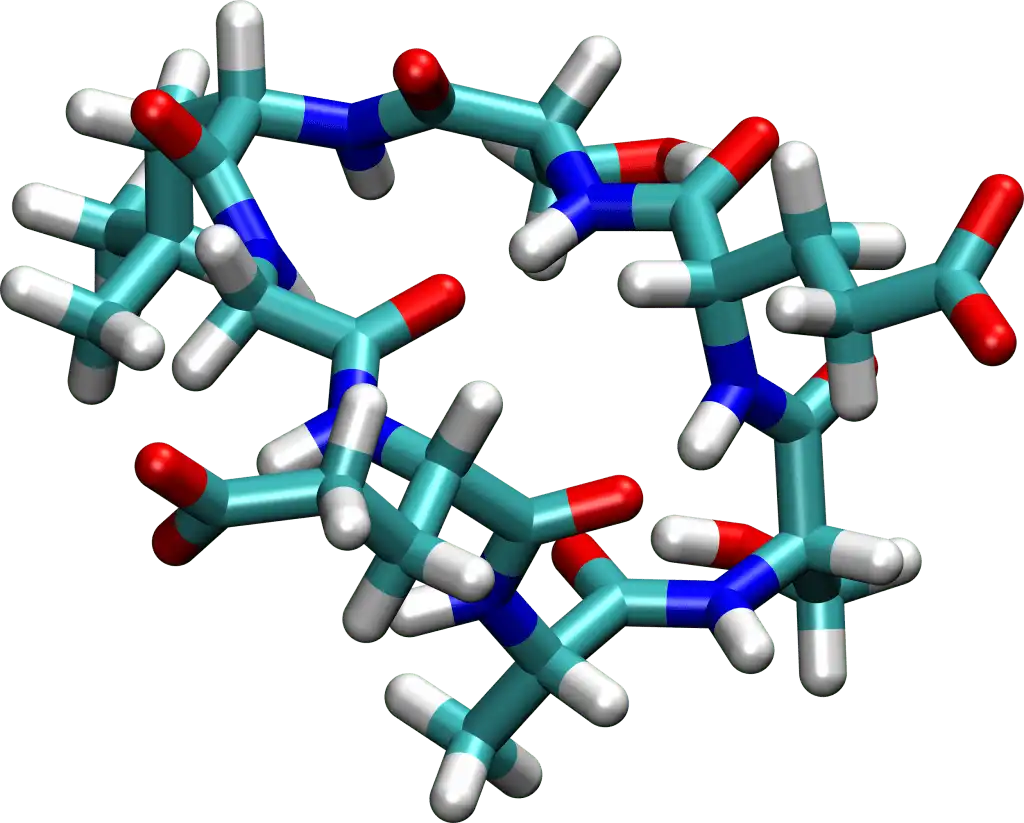
An intact mass that matches the expected value confirms composition, not topology. Two macrocycles can share a molecular formula, an identical intact mass, and entirely different ring connectivity, so macrocyclic peptide structural confirmation has to answer a question mass alone cannot: which residues actually close the ring, and in what bridge pattern.
The failure mode is concrete. A head-to-tail cyclization and a side-chain-to-side-chain bridge can produce the same nominal mass while placing the macrocyclic constraint in different regions of the scaffold. Those two molecules are regioisomers, and they behave differently in receptor binding, in chromatographic retention, and in stability. A correct intact mass with an unresolved regioisomer is a release decision made on incomplete evidence.
Epimerization compounds the problem, болон the epimerization risk profile reported by Bachem explains why it is a structural question rather than a purity question. Formation of an oxazolone-activated intermediate lets the α-carbon racemize, and the risk rises with extended activation time, reactive coupling reagents, accumulation of activated intermediates, and higher temperature. The same source notes that phenylglycine, cysteine, histidine, and residues with electron-withdrawing side chains are more epimerization-prone. A D-residue at a single position changes the three-dimensional shape without changing the mass.
Two techniques carry the confirmation work, and each has a boundary worth stating plainly. Tandem mass spectrometry resolves sequence and, with adequate fragmentation coverage, can localize where a bridge sits, but coverage depends on how the constrained scaffold fragments, and a macrocycle that fragments poorly leaves gaps exactly where the answer is needed. NMR resolves connectivity and stereochemistry directly, including ring closure and bridge assignment, but its sensitivity limits mean low sample mass can put the experiment out of reach. Neither method is sufficient on its own for every scaffold.
Impurity characterization: mapping what the route actually produces
Peptide impurity characterization is a chemistry deliverable, not a QC afterthought: the impurity map should name the byproducts the synthetic route can actually produce, and the route determines which ones to expect. The aspartimide-prone motifs are well documented. According to Bachem’s overview of aggregation, racemization and side reactions in solid-phase peptide synthesis, aspartimide formation is especially prevalent in peptides containing Asp-Gly, Asp-Ala or Asp-Ser sequences, can occur under acidic or basic conditions, and reopens to give a mixture of α- and β-linked peptides; in Fmoc synthesis, piperidine can open the aspartimide to yield piperidides (2019). Diketopiperazine formation is a dipeptide-stage risk, more likely in Fmoc-based synthesis and especially prevalent when proline is one of the first two residues, with HOBt added to the piperidine deprotection solution as the cited mitigation (peptide.com, 2019). Base-driven epimerization during deprotection is a second, distinct route: Bachem’s knowledge-center page on epimerization risk attributes it to strong bases, harsh deprotection conditions and prolonged base exposure, and describes an aspartimide/glutarimide pathway when Asp-Gly-like motifs meet basic conditions and heat (2026). Recent reviews of aspartimide-related byproducts treat the class as a defined structural problem with known mechanisms and prevention strategies (Aucagne et al., 2025).
Peptide Nucleic Acid Synthesis The full set to demand is wider than those three: residual linear precursor, truncated sequences, epimers, oligomers and aggregates, plus oxidation and deamidation products. For a macrocycle, residual linear precursor matters most, because it is the species that most closely resembles the product on a nominal-mass readout.
Түлхүүр авах: A nominal-mass release test cannot see aspartimide byproducts, epimers, or linear precursor. Demand orthogonal methods that can: chromatographic Spps Peptide Synthesis separation of the related substances, high-resolution mass spectrometry, болон, where topology is in question, the structural techniques covered in the previous section.
The analytical-to-purification handoff is where this work pays for itself. Separation conditions developed to resolve the impurity map analytically become the basis for large-scale chromatographic purification conditions, so an impurity method built only to pass a specification wastes the resolution it already achieved.
Solubility and aggregation: the developability risk that changes assay design
Gku Cu Peptide Solution behavior belongs in the first characterization package, not in a formulation file opened eighteen months later. Aggregation is the reason: it cannot be predicted reliably from sequence data, according to peptide.com’s 2019 review of solid-phase synthesis side reactions. Hydrophobic sequences are more prone to it, and the same review places the vulnerable chain-length window at roughly the fifth or sixth residue through the twenty-first, which is the length band most macrocyclic drug candidates occupy.
That unpredictability has two operational consequences. First, an aggregating species can elute as a broadened or shifted peak, so a purification method developed on a monomeric standard may not transfer. Second, and less often anticipated, aggregation changes the conditions under which purity itself is measured: buffer, температур, and concentration can move the apparent result without any change in the material.
Conformational heterogeneity in a constrained scaffold compounds this. A macrocycle can populate more than one solution conformation, and each may interact differently with the stationary phase, so chromatographic behavior reflects the conformational ensemble rather than a single defined species.
The practical demand is therefore early solution-behavior data, generated under stated conditions, before purification scale-up and before assay conditions are locked.
Stability: designing stability-indicating methods at program start
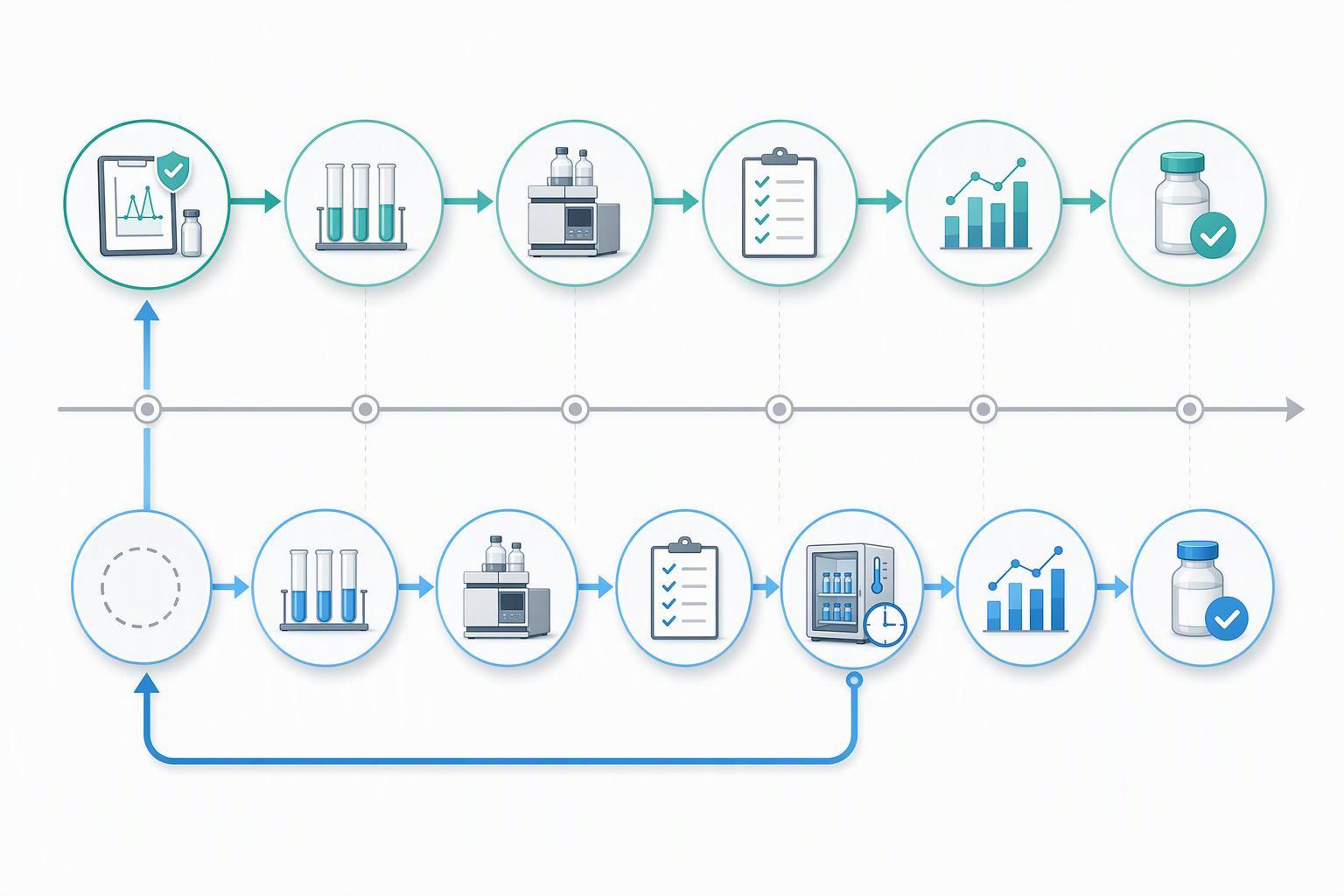
Macrocyclic peptide stability is a method-design decision, not a shelf-life exercise. A release method validated against the specification confirms that a batch meets a defined limit; a stability-indicating method Peptide 1 must additionally resolve the degradation products that form over time and separate them from the parent peak, which is why the two are designed differently and why the second cannot be retrofitted late.
That distinction matters because macrocycles degrade through several concurrent routes. Peptide stability strategies reviewed in the literature cover hydrolysis, oxidation, and epimerization, with backbone cyclization and D-amino acid substitution among the structural changes used to slow them (Al Musaimi et al., 2022). A method built only to the release limit will not see a co-eluting epimer or an oxidized species that grows on storage.
Synthesis route choice feeds directly into what the method must resolve. On one GLP-1 agonist target of more than 40 cycles, the epimerization risk profile reported by Bachem showed 13% epimer formation on one fragment route, and the route was discontinued; a second fragment route showed a different epimerization profile, at 2 руу 3% in the crude, rising to roughly 5% after purification, while linear SPPS avoided the epimerization issues on this target and gave the highest overall yield (Бахем, 2026).
[VISUAL: Workflow diagram contrasting two program paths. Path one places stability-indicating method design at program start, ahead of release testing. Path two places it at late-stage shelf-life testing, with a rework loop returning to method development once degradation products are found that the release method cannot resolve.]
The practical demand for a diligence package is therefore a dated record of when the stability-indicating method was designed, what forced-degradation conditions it was challenged with, and whether it separates the epimer and oxidation products the chosen route is known to produce.
Common misconceptions in macrocyclic peptide analytical challenges
Five misreadings recur in diligence reviews, and each one traces back to a mechanism rather than to a vendor’s shortcoming.
A correct intact mass does not confirm ring closure. Mass spectrometry reports the summed composition of the molecule, so a linear precursor, a head-to-tail cyclized product, and a side-chain-bridged regioisomer can return the same nominal mass. Topology needs orthogonal evidence: fragmentation that spans the bridge, or NMR where sample mass allows. Fmoc Peptide Synthesis
A high HPLC purity percentage does not establish peptide content. Purity is a relative measure of peak area against everything else eluting in that method, so a chromatogram can read 98 percent while the actual peptide content, measured by amino acid analysis or UV, sits materially lower. Counterions, residual water, and salts are invisible to the purity number.
Solubility is not a formulation-stage concern. Aggregation and poor dissolution change assay design, sample handling, and the validity of the very methods used to generate the earlier data.
Stability is not a late-stage exercise either. A method that was never shown to be stability-indicating cannot distinguish a degradation product from a process impurity, and that distinction is what a reviewer is looking for.
Synthesis success is the entry point to analytical work, not the finish line.
Building the evidence package a buyer actually reviews
Diligence teams do not score capability statements. They score lot-specific data, because a statement describes what a supplier says it can do while a certificate of analysis describes what happened to the material in front of them. The practical test is whether the documents let an independent reviewer reconstruct the result.
A complete package for a macrocyclic peptide typically contains a certificate of analysis, the HPLC chromatogram behind the reported purity, and the mass spectrum behind the identity call, with method conditions traceable from analytical development through to preparative scale. Release testing should use techniques complementary to assay and purity by HPLC or UPLC, since a single separation method cannot confirm what it does not resolve. Peptide 1
MOL Changes operates an integrated peptide R&D platform with Class 100 ultra-sterile cleanroom manufacturing, QC covering MS, HPLC, amino acid analysis, эндотоксин, counterion, optical rotation and UV content, and issues a CoA, chromatogram and MS spectrum per lot across scales from mg to kg.
Disclosure: MOL Changes has a commercial interest in peptide quality standards. The evidence-package structure above is a general diligence framework, not a claim about any single supplier’s solubility or stability services.
Next steps: what to demand from a characterization partner
The fastest way to evaluate a characterization partner for macrocyclic peptide analytical challenges is to ask four questions and listen for specifics rather than assurances.
First, ask for the impurity map and the route it came from. A partner who can name which impurities the synthesis route generates, and where in the process they arise, is working from your chemistry rather than a template. Second, ask which method confirms topology rather than mass. If the answer stops at intact mass, ring closure and bridge pattern are still unproven. Third, ask when the stability-indicating method was designed. A method built at program start, before forced degradation, behaves differently from one retrofitted after a stability failure. Fourth, ask for lot-specific data rather than a representative lot. A chromatogram from a single qualification batch tells you about that batch, not about yours.
MOL Changes supports this kind of diligence with per-lot CoA, HPLC chromatogram, and MS spectrum documentation, and analytical HPLC, масс спектрометр, and amino acid analysis across mg to kg scale. If your program needs a partner who can walk through these questions against your route, talk to an expert about your characterization package.
Frequently Asked Questions
How do macrocyclic peptide analytical challenges differ most from linear peptide work?
The biggest difference is that the constrained scaffold removes the assumptions linear methods rely on. A linear peptide’s sequence usually predicts its chromatographic behavior and fragments cleanly in MS/MS, while a macrocycle’s ring closure, bridge pattern, and conformational flexibility mean two molecules with identical mass can behave differently on column and in the gas phase. Purity, identity, and impurity work therefore need methods built for the macrocycle, not adapted from a linear template.
Can intact mass alone confirm a macrocycle?
Үгүй. A correct intact mass confirms the molecular formula, not the topology. It cannot distinguish a properly closed ring from a linear precursor, a mis-bridged regioisomer, or an alternative bridge pattern with the same composition. Structural confirmation of a macrocycle requires orthogonal evidence such as fragmentation data, NMR, or enzymatic or chemical probes that report on ring closure specifically.
Why do HPLC purity and peptide content differ?
HPLC purity measures the proportion of UV-absorbing material in the peaks, while peptide content measures how much of the sample is actually peptide. Counterions, residual water, давс, and UV-silent impurities contribute to mass but not to the chromatogram, so a high HPLC percentage can sit alongside a lower peptide content. Amino acid analysis or UV-based peptide content closes that gap.
When should stability-indicating methods be designed?
At program start, not at late-stage development. A stability-indicating method has to resolve the degradation products the molecule actually forms, and for a macrocycle those can include ring-opened species, isomerized bridges, and aggregates. Designing the method once the route and formulation are locked means re-validating late, when changes are expensive.
Can solubility be predicted from sequence?
Not reliably for macrocycles. Sequence-based predictors were built largely on linear peptides, and a macrocycle’s solubility depends on how the constrained scaffold presents its side chains, on aggregation propensity, and on the counterion form. Solubility is best established empirically, early, with the assay designed around the molecule’s aggregation behavior.
Дүгнэлт
Macrocyclic peptide analytical challenges are the diligence subject behind every headline deal, and the evidence package is what a buyer actually reviews. The five disciplines build on each other in a fixed order: purity profiling establishes what is in the sample, structural confirmation proves the scaffold and bridge pattern that a nominal mass cannot, impurity characterization maps what the synthetic route genuinely produces, solubility and aggregation work determines whether the assay design holds at relevant concentrations, and stability-indicating methods carry the program through to release. Skip a step and the later ones rest on an assumption no reviewer can check.
Expect characterization expectations to tighten as macrocycle programs move toward IND-enabling work, where regulators and partners ask for method detail, per-lot data, and stated limits rather than summary percentages. The practical next step is to ask a characterization partner what they measure, how they document it, and where their methods stop resolving.