Semaglutide and Longevity: What the Mouse Study Actually Measured

The headline figure comes from a single lifespan arm, and the scope of that arm is what determines how far the number travels. The study, published in Nature on 2 September 2026 by the Chen lab at UC Berkeley, used female C57BL/6J mice on a daily subcutaneous dose of 10 nmol/kg, with treatment beginning at 20 months of age and continuing for the rest of the animals’ lives. The lifespan arm enrolled 39 saline and 40 semaglutide mice (အဆိုပါ Nature lifespan study in female C57BL/6J mice, 2026). Median survival was 742 days on saline and 834 days on semaglutide. ဟိ 12% figure is an arithmetic derivation from those two medians; the paper reports the medians themselves, not the percentage. Treated animals also ate 24% less food (the peer-reviewed paper, 2026).

Why the endpoint is median lifespan, not maximum lifespan
A median shift moves the middle of the survival curve; it says nothing on its own about the oldest animals. The endpoint reported is median lifespan, and neither the retrieved Nature text, the Berkeley releases, nor the C&EN trade report states a maximum or 90th-percentile lifespan effect (the peer-reviewed paper, 2026). Geroscience treats maximum-lifespan extension as the harder bar because it is harder to produce by improving husbandry or disease management alone.
What the calorie-restriction comparator does and does not settle
The obvious objection, that this is calorie restriction delivered by injection, is one the authors raise themselves. The paper describes semaglutide phenocopying caloric restriction, and Chen notes that the differences between the two groups “point to the possibility that GLP-1 drugs tap into a biological pathway independent of calorie restriction” (the same group’s public explanation, 2026). The design cannot settle it: there was no lifespan arm with matched caloric restriction, so the survival effect cannot be partitioned between reduced intake and direct GLP-1R signaling (the peer-reviewed paper, 2026). The comparator that does exist ran for five months, and in it calorie-restricted mice had a slower metabolic rate while semaglutide mice did not (the university’s own summary of the experiment, 2026). A matched-pair lifespan arm is the missing experiment.

How Strong Is the Human Evidence for Semaglutide and Longevity?

The human evidence for semaglutide and longevity is strong on cardiovascular outcomes and weak on aging itself. Two datasets carry almost all the weight: a 17,604-person outcomes trial and a 32-week epigenetic substudy of 84 participants. Neither was designed to measure lifespan, and the gap between them and the mouse survival data is the point.
What SELECT does and does not tell us about aging
the SELECT cardiovascular outcomes trial enrolled 17,604 adults with overweight or obesity and established cardiovascular disease but no diabetes, and followed them for a mean of 40 months. Major adverse cardiovascular events occurred in 6.5% of the semaglutide group versus 8.0% on placebo (HR 0.80, 95% CI 0.72–0.90, p < 0.001). the trial’s headline result in people without diabetes တစ်ခုပါ။ 20% relative risk reduction in cardiovascular death, nonfatal myocardial infarction, or nonfatal stroke.
That is a cardiovascular endpoint in a secondary-prevention population. SELECT was not powered or designed to detect a lifespan or healthspan effect, and because every participant had established cardiovascular disease, its results cannot be extended to healthy-weight adults. The specific gap: no human trial has measured whether semaglutide extends life.
Reading the epigenetic-clock result at the right strength
the 32-week randomized trial’s epigenetic substudy was a post hoc analysis of 84 adults with HIV-associated lipohypertrophy (45 semaglutide, 39 placebo). Clocks moved: PCGrimAge by −3.1 years (P = 0.007), PhenoAge by −4.9 years (P = 0.004), DunedinPACE by −0.09 units, roughly 9% slower (P = 0.01), and OMICmAge by −2.2 years (P = 0.009).
These are biomarkers of aging, not survival time, and the units are not interchangeable. A post hoc result in a small, specific population over 32 weeks is hypothesis-generating. No GLP-1 receptor agonist is approved for longevity, and the mouse result does not license a human claim. Consult a qualified healthcare professional before making medical decisions.
Why the Finding Is Contested: What the Geroscience Bar Requires
The geroscience field’s own bar for a translatable lifespan claim is higher than a single positive survival curve. တစ် 2021 review in PMC states that to reasonably expect a drug to extend lifespan in humans, it must extend median and maximum lifespan in genetically heterogeneous mice, across multiple strains, and in cancer-prone mice, and adds that “a mere extension of healthspan is not enough” (The goal of geroscience is life extension, 2021-02-02). The same review records rapamycin as the reproducibility outlier, extending median and maximum lifespan across strains and both sexes since 2009, while most other agents do not clear that bar.
သော့ယူသွားပါ။: By the field’s own criterion, one mouse study in one sex and one strain is a signal worth following, not a lifespan claim.
Independent researchers reacting to the paper raised the same structural objections. Dr Laura Sinclair of the University of Exeter listed three limitations: it is an animal model, it is only in females, and dosing started in later life. Prof Naveed Sattar of the University of Glasgow noted that not all findings in mice translate to people, and Prof Tara Spires-Jones of the UK Dementia Research Institute at the University of Edinburgh pointed to the female-only design and the constrained laboratory environment (Science Media Centre expert reaction, 2026-09-02). Sinclair separately flagged that the model is deliberately not genetically diverse, so a genetically diverse population can respond differently.
The three limitations, stated plainly
-
Species. The result is in mice. Sattar’s point is that mouse findings frequently fail to translate, which is why the field’s criterion demands replication before a human expectation is reasonable.
-
Sex. Only female mice were studied. Resolving this requires both sexes, since survival responses can differ by sex.
-
Peptide ရောင်းချသူ Treatment window. Dosing began in later life. A dose- and window-response design would show whether earlier or later intervention changes the effect.
Chemical Synthesis Of Polypeptides Each limitation maps to a specific design change, and together they define what a follow-on study has to include: a genetically heterogeneous stock, both sexes, and a dose- and window-response arm.
Purity, Identity, and Counterion: The Variables That Decide Whether a Replication Works
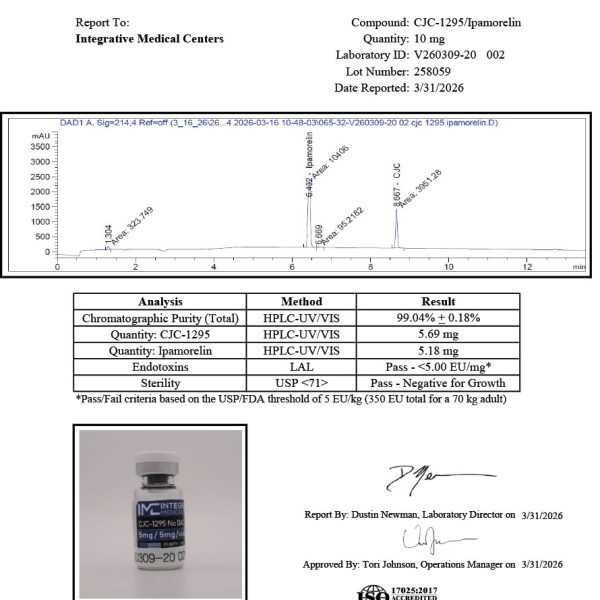
If a replication fails, the first question is whether the biology or the material is responsible. One testing provider’s specification table shows how hard that is to answer from a certificate alone: net peptide content runs roughly 65.0–85.0% by weight for a stated-purity product and 75.0–88.0% for a verified-purity product, RP-HPLC purity sits at ≥ 95.0% area for a research tier against ≥ 98.0–99.0% area for a higher tier, and the counterion is typically 10.0–20.0% TFA unless an acetate or HCl salt is specified at under 1.0% TFA (MOL Changes analytical audit guide, retrieved 2026-08-11). These are vendor-stated figures from a vendor that sells the testing, so treat them as a checklist rather than an industry standard. The arithmetic still matters: 10.0 mg of material at 98.5% HPLC purity can deliver only 7.50 mg of peptide once counterion and water content are accounted for, so a dose calculated from vial weight is not the dose the animal received.
Counterion choice compounds this. The Role of Counter-Ions in Peptides, An Overview (2020) reports that TFA “may interfere not only with physio-chemical characterization, Peptide အော်ဒါ but it also affects the in vivo experiments through influence on mammalian cells,” can be toxic or inhibit cell proliferation, and that TFA-modified proteins can drive proinflammatory T-cell and antibody responses. Most peptide drugs are supplied as acetate salts.
The characterization chain a research-grade material should ship with
A certificate of analysis is the last link in a chain, not the chain itself. Purity by analytical HPLC establishes how much of the peak area is the target species; mass spectrometry confirms molecular identity; LC-MS/MS sequencing confirms amino-acid order; Neoantigen Peptide Synthesis NMR confirms functional groups and can distinguish counterion forms; impurity and degradation-product profiling shows what else is present and how it changes on storage. A supplier that performs only the first step leaves the rest to the buyer.
MOL Changes documents an integrated peptide synthesis platform with Class 100 ultra-sterile manufacturing and a QC chain covering HPLC, ဒေါ်, peptide content and a CoA, with optional endotoxin, counterion, Karl Fischer and optical rotation testing. That is the vendor’s own documentation, not an independently audited standard; no third-party confirmation of these capability statements was located for this article.
Lot-to-lot drift and why it changes a survival result
Purity is a range, not a fixed property, so two lots of the same catalog number can differ in net peptide content, counterion load and degradation profile. In a survival study that variation enters the dose directly: if lot A delivers 7.5 mg of peptide per 10 mg vial and lot B delivers 8.4 မီလီဂရမ်, the high-dose arm may receive materially different exposure than the design assumed, and the difference is invisible in a survival curve. Counterion effects add a second channel, since TFA’s reported interference with in vivo readouts means a formulation change between lots can shift a biological result without any change in peptide sequence. Specify the lot, the counterion form and the net peptide content in the methods, and hold material from a single lot for the full treatment window.
Formulation, တည်ငြိမ်မှု, and Dosing: The Confounders Nobody Reports
Vehicle, reconstitution, storage and dosing schedule deserve the same scrutiny as the dose itself. A survival study can report 10 nmol/kg and still deliver a different amount of intact peptide than the next lab, because nominal vial mass is not delivered peptide. Water content dilutes the net peptide fraction, and counterion identity shifts it again: the standard review of peptide counterions describes how residual trifluoroacetate or acetate changes mass balance and can interfere with in vivo readouts (Frontiers in Pharmacology, retrieved 2026-02-14). One testing provider’s specification table lists net peptide content, water content and counterion ranges as separate release fields (MOL အပြောင်းအလဲများ), which is the point: they are separate numbers, and only one of them is the dose.
Warning: A vial labelled 5 mg may contain materially less than 5 mg of the target peptide once water content, counterion mass and impurity load are subtracted. Dosing from the label rather than the measured net peptide content introduces an error that no statistical model will recover.
What a methods section should report for a peptide survival study
A replication-ready methods section reports, at minimum: identity confirmation method; purity method and tier; net peptide content; counterion identity and percentage; water content; endotoxin result; vehicle composition; reconstitution protocol; storage conditions; and dosing schedule with the actual delivered dose rather than the nominal one. The specification fields in one testing provider’s specification table map directly onto that list (MOL အပြောင်းအလဲများ), and the standard review of peptide counterions treats counterion identity and percentage as reportable, not optional (Frontiers in Pharmacology, retrieved 2026-02-14). Report the delivered dose, and the biomarker question becomes answerable. Ninhydrin Synthesis
Biomarkers of Aging: What to Measure Before Claiming a Longevity Effect
A clock change and a survival change are different measurements, and neither substitutes for the other. The peer-reviewed paper reported median lifespan as its survival endpoint, with no maximum-lifespan effect stated, so a molecular clock reading cannot inherit that result. In the 32-week randomized trial’s epigenetic substudy, the clock effect sizes were measured in a defined human population over a fixed treatment window, which makes them a short-horizon molecular signal, not a longevity finding.
The three questions to resolve before designing a follow-on study
Three questions decide whether a follow-on study is interpretable, and each maps to a gap the current record leaves open.
First, is the material characterized well enough that the delivered dose is known? One testing provider’s specification table lists identity, purity tier, net peptide content, counterion, water content, endotoxin, and lot-to-lot as the fields a research-grade peptide should ship with, and those are vendor-stated figures rather than independent industry standards. Without them, a null or positive survival result cannot be attributed to the peptide. Solid Phase Chemical Synthesis
Second, does the design include a matched caloric-restriction lifespan arm? The peer-reviewed paper leaves that comparator unresolved, so the survival effect cannot yet be partitioned between the compound and reduced intake.
Third, which endpoints will be pre-specified, and in which population? The 32-week randomized trial’s epigenetic substudy shows clocks can move in a defined cohort; ရှင်သန်မှု, physiological function, and molecular clocks each answer a different question, and choosing one before the study starts is what makes the answer usable.
အမေးများသောမေးခွန်းများ
Does the 12% figure appear in the paper?
မရှိ. ဟိ Nature lifespan study in female C57BL/6J mice reports median lifespans of 742 days in saline controls and 834 days in treated animals (Nature, 2026). ဟိ 12.4% is derived from those two medians, not printed by the authors.
Does this mean semaglutide extends human lifespan?
မရှိ. No GLP-1 receptor agonist is approved for longevity, and the SELECT cardiovascular outcomes trial measured major adverse cardiovascular events, not lifespan: 6.5% versus 8.0%, hazard ratio 0.80 (SELECT trial). A cardiovascular benefit is not a lifespan benefit.
Why female mice only?
The peer-reviewed paper used female C57BL/6J mice exclusively, treated from 20 months of age with 10 nmol/kg daily subcutaneous injection (Nature, 2026). Sex-generalizability is untested.
What is the difference between median and maximum lifespan?
Median lifespan is the age at which half a cohort has died; maximum lifespan is the oldest individual. The peer-reviewed paper reports a median endpoint and states no maximum-lifespan effect (Nature, 2026). A median shift means more animals reached old age, not that the ceiling moved.
Does the calorie-restriction comparator explain the effect?
Not conclusively. The peer-reviewed paper’s caloric-restriction comparison was a separate five-month cohort, not a matched lifespan arm (Nature, 2026). Without a concurrent CR group run to death, the survival effect cannot be separated from reduced food intake.
What purity and counterion specifications matter for a replication?
Purity, identity, counterion, water content, and endotoxin are the variables that most often differ between a published protocol and a failed replication. One testing provider’s specification table lists purity and counterion ranges as vendor-stated targets (MOL အပြောင်းအလဲများ, Beyond the COA), and the standard review of peptide counterions notes that TFA interferes with some assays while acetate is the clinical norm (counterion review). Treat vendor ranges as claims to verify.
Which biomarkers should a follow-on study pre-specify?
Pre-specify the endpoint before dosing starts. The 32-week randomized trial’s epigenetic substudy reported clock effects in a post hoc analysis of 45 နှင့် 39 participants (epigenetic substudy), which is hypothesis-generating rather than confirmatory. Lock the primary biomarker, timepoints, and sample size in advance.
What does the geroscience bar require before a human claim is reasonable?
The geroscience field’s own bar for a translatable lifespan claim requires replication across independent laboratories, both sexes, and a mechanism that survives a matched caloric-restriction control (geroscience consensus). The mouse result meets none of those conditions yet.
နိဂုံး
The mouse result behind the semaglutide and longevity headline is a median-lifespan finding in one inbred female cohort, and the widely repeated 12% figure is a derived percentage the paper itself does not print. The human evidence base is real but measures different endpoints, MACE in SELECT and epigenetic pace in the post hoc marker analysis, and neither licenses a longevity claim. The variables that decide whether a replication works are analytical and formulation variables, not just dose.
သော့ယူသွားပါ။
What was the median lifespan in the treated cohort versus control, and in which strain, sex, and treatment window?
Which comparator was used, and does it isolate the drug from the calorie-restriction effect?
Which biomarkers were pre-specified, and at what timepoints?
Before designing a survival study, it is worth a characterization-requirements conversation with a technical specialist about what a research-grade material should document. MOL Changes has a commercial interest in peptide quality standards, which is disclosed here so you can weigh the source accordingly.
This article is for research and educational purposes only and is not medical advice. Consult a qualified healthcare professional before making any medical decision.