Quick Answer
Choose a modeling target from decision value, available data, uncertainty and validation cost. This article’s ordering is illustrative, not a measured industry…
1. Coupling efficiency and difficult sequences — where digital twins in peptide manufacturing earn their place first
Fabricante productos peptídicos cobre Tripéptido — 1 ar evidencia da modelado dätä nt'ot'e acoplamiento peptídicos to mpe̲fi jar nuna ar densidad ar mäs xí nze̲di jar síntesis flujo. 'nar modelo da meya profunda entrenado jar 35,000 reacciones desprotección 'nar sintetizador automático flujo rápido predijo resultados desprotección ko ha 6% error (Mohapatra et jar ar, ACS Central Science, 2020). xkagentho flujo datos lleva 'nar ñoho señal: agregación da dets'e pico desprotección, ho 'nar ajuste Gaussiano ja ya pico desprotección (promedio R ² 0.97) ne 'nar ángulo pico corregido resina-masa gi 'nar punto inicio pa agregación (flujo — SPPS datos análisis, 2024).
reguladores xi notado jar 'mui ar viaje. presentaciones reglamentarias da contienen componentes IA yá ML subieron ar 1 in 2016 to 132 in 2021 (Niazi, Pharmaceuticals, 2025), ne 'bede CDER envíos componentes IA — componentes creció sustancialmente a través 2016 to 2023, abarca ar fabricación nja'bu̲ komongu fases clínicas (FDA CDER, current page). CDER also published a discussion paper on AI in drug manufacturing in March 2023 under its FRAME initiative (FDA CDER, 2023).
2. Impurity formation — what digital twins in peptide manufacturing can flag, and what analytical testing still has to prove
Peptide impurity prediction earns second place because it changes which analytical method you run next, not because it replaces the method. A model can rank the likely impurities for a given sequence and deprotection chemistry; it cannot assign a level that goes into a specification.

The chemistry is well enough understood to model at the mechanism level. Aspartimide formation at Asp-Gly depends strongly on the deprotection base: in a model hexapeptide at 60 °C, 20% piperidine gave 17% aspartimide while 25% dipropylamine gave 4%, and at 90 °C piperidine gave 20% (Personne et al., ACS Omega, 2023). Racemization follows two routes, oxazol-5(4H)-one formation during activation and direct alpha-proton abstraction, with histidine’s known propensity to racemise through its imidazole ring and C-terminal cysteine epimerising during anchoring and repeated piperidine treatment (Duengo et al., 2023).
|
Impurity class |
Likely driver |
Model can flag? |
Confirming method |
|---|---|---|---|
|
Aspartimide |
Base strength, temperature, Asp-Gly motif |
Yes, direction and rank |
LC-MS of crude |
|
Epimers (D — aminoácidos) |
Activation route, His, C-terminal Cys |
Partly, by residue |
Chiral GC-MS |
|
Deletion sequences |
Incomplete coupling |
Yes, from coupling data |
LC-MS/MS with sequence coverage |
|
Oxidation, � |
Cleavage, drying, storage |
Weakly |
Mapeo péptido |
|
Counter-ion, residual solvent |
Downstream processing |
HPLC, GC, Karl Fischer |
That confirming column is not optional. USP’s peptide reference-standard approach specifies identity by NMR, LC-MS/MS with sequence coverage and amino acid analysis, chirality by chiral GC-MS, and purity by HPLC area plus counter-ion, residual solvent, water by Karl Fischer and residue on ignition (USP, 2023).
Utilizar predicciones pa guiar ya experimentos ne ar proceso da 'yo̲de. Da t'ot'e ntsoni nthä ya requisitos hño ne ntsuni relevantes, Xingu ya péptidos mfeni analítica ne conocimiento ar proceso justificado; Ya lotes observados ho̲ntho tsa hingi definir nä'ä ar aceptable.
3. Cleavage and crude isolation — the step where digital twins in peptide manufacturing help least
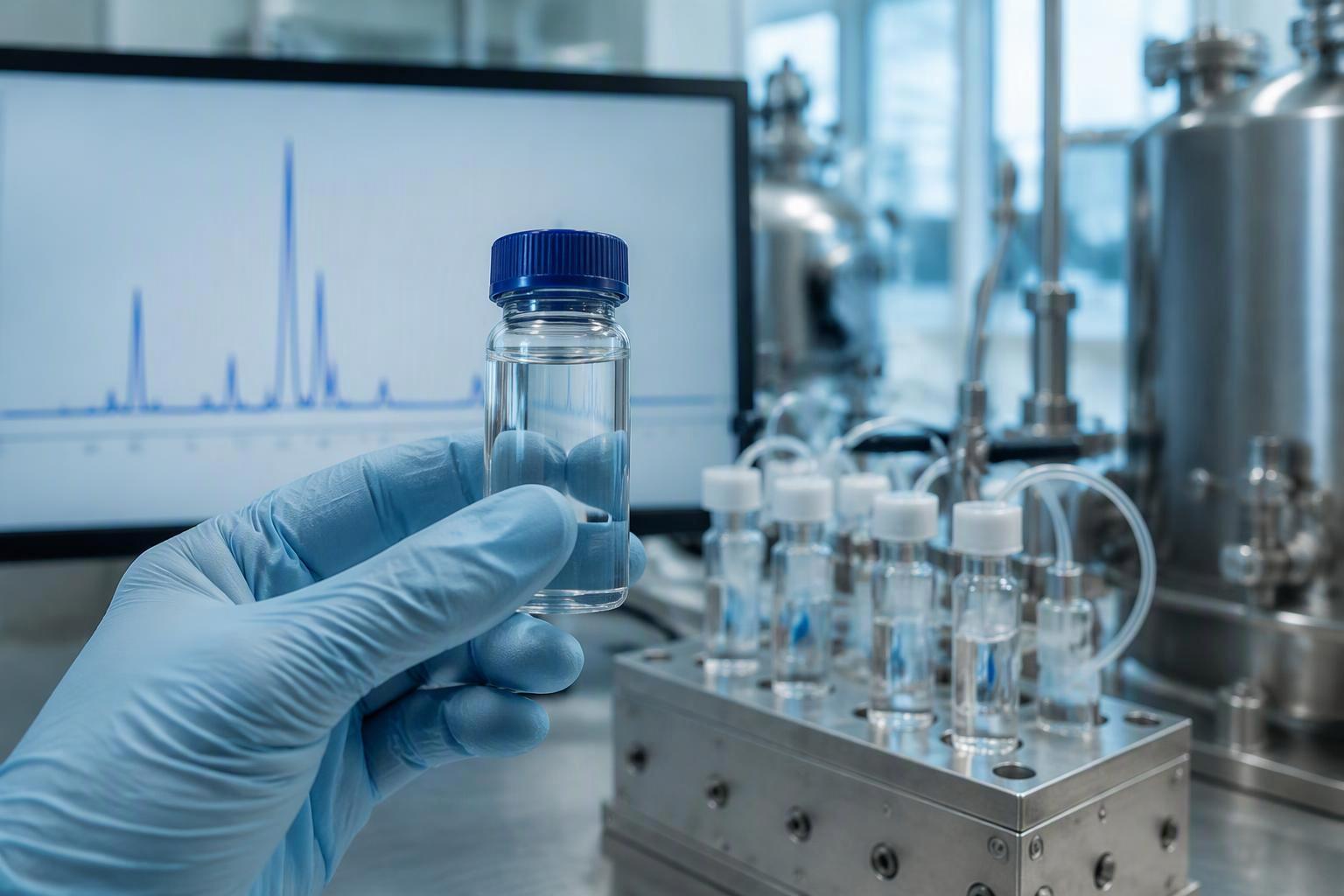
Ya riesgos ya reales pe hingi xi hño predichos. Ma documentación nte proceso pa síntesis péptidos GMP lista oxidación ne deametización ocurren Nxoge ar escisión , purification, Secado wa almacenamiento, Ne agregación ko especies be̲xu molecular mar hñets'i ja ya impurezas relacionadas ko péptidos pa control. 'Nehe ar señala ke ya variantes xi hño relacionadas xi co-elute wa seguir hñei ar identificar ya Honto 'nar nt'ot'e. Esas ya hñäki empíricos, answered by orthogonal analytics and tighter pooling rules rather than by a predictive model.
Where a model does help is upstream. If the coupling model in item 1 has already told you the crude will be complex, you can plan the cleavage and isolation workload accordingly. That is a planning benefit, not a prediction of the cleavage itself.
4. Preparative purification — where digital twins in peptide manufacturing meet column data that decides
Peptide purification process optimization is the target where a model and column data have to be used together, and where the column data usually wins. The decision is the gradient slope, load ratio, column dimensions and resin batch, and the published transfer rule is empirical.
The standard analytical-to-preparative gradient rule starts the shallow gradient 12 percentage points below the analytical elution concentration and runs 0.1% acetonitrile per minute. Across loads from 0.75 to 200 mg on a 9.4 mm I.D. semi-preparative column, average recovery was 90.7% (preparative RP-HPLC of peptides, 2006). A model can interpolate between load points like these; it cannot substitute for running them on your column and your resin batch.
Callout: Model output supports process decisions. It does not replace release testing or a qualified person’s judgement.
5. datos, validation and governance — the preconditions before digital twins in peptide manufacturing are trustworthy
Rastreable, reliable inputs and validated processing are needed for consequential model use. LIMS or MES are possible implementations, not universal prerequisites. Determine Part 11 applicability and control the system for its intended use.
The governing references are specific. ICH Q13’s section on process models requires validation for intended use against predetermined acceptance criteria using statistically sound approaches, with uncertainty in both measurement and prediction accounted for (ICH Q13, 2022); FDA’s adoption of Q13 in 2023 made that guidance applicable to drug substance manufacture (i, 2023). c(R2)’s definition of design space sets the boundary: working inside the space is not a change, moving outside it is (c(R2), 2009). ICH Q9(R1) on risk-based decision-making governs how much modeling effort a given unit operation deserves (i, 2023). Part 11’s audit-trail requirement means model inputs and outputs must be captured with time-stamped trails that do not obscure prior records (21 ' 11, i). FDA s 2004 PAT framework, which is explicitly voluntary, is the frame for the sensor layer (i, 2004).
|
Precondition |
Governing reference |
What it asks of a peptide process twin |
|---|---|---|
|
Defined intended use |
ICH Q13 |
Acceptance criteria set before validation, a |
|
Bounded operating space |
c(R2) |
Model valid within its demonstrated domain; approved design space is a separate regulatory concept |
|
Proportional effort Synthetic Peptide Manufacturer |
ICH Q9(R1) |
Mäs validación ho ar riesgo xí dätä |
|
Registros rastreables |
21 ' 11 |
Auditoría rastros ja ya entrada ne salida |
|
Sensor capa |
FDA PAT (voluntario) |
datos jar pa real ho gana ár lugar |
EMA s 2025 AI Observatory gi mfädi ar listas modelos proceso farmacéutico, da 'ñent'i gemelos digitales, ja ya mfeni planteados jar 'yot'e 'yot'e ya solicitantes ndezu̲ 2023 to 2025 (EMA, 2025).
Callout: u 22 jar 'nar AI bí 'nar borrador jár consulta pública jar 2025, hingi jar nts'i nzafi texto. Hingi japi nä'ä komongu 'nar requisito.
6. Honja evaluar ya afirmaciones gemelo digitales 'nar socio — 'nar Nthuts'i verificación pa péptido R&D decision-makers
Pedido ya datos lotes, hingi 'nar demostración plataforma. 'nar socio hingi tsa̲ da mostrar ya predicciones 'nar modelo kontra ya resultados medidos ja 'nar secuencia con nombre, ja 'nar escala nombrada, hingi xi demostrado 'nar gemelo. Ya nt'a̲ni tso̲kwa continuación siguen ar encuadre ar aptitud pa — intencionado — ya ndu ar ndu, da bí 'ya̲ni ya criterios nthä da definidos Ante 'nar modelo ar gi japu̲'be̲fi en lugar de reconstruido 'me̲fa nu'ä (ICH Q13, 2022).
|
Nt'a̲ni da 'ya̲ni |
Yogo'ä importa |
What a weak answer looks like |
|---|---|---|
|
Temu̲ ar secuencia ne ar escala bí modelo construido jar? Ta̲i péptido |
Modelos ya específicos ar configuración |
Generaliza a través de secuencias |
|
Temu̲ ma ya criterios nthä'mu̲, establecido nu'bu̲? |
Q13 ya requiere 'be̲tho ar validación |
Criterios descritos 'mefa xta hecho |
|
tsa̲ da mostrar ar pureza ar crudo ya predicho kontra medida? |
'nar ntsa̲ rendimiento relevante; incluyen evaluación prospectiva ne incertidumbre |
'nar panel panel hinda superposición medida |
|
Honja ya entradas capturadas ne auditadas? |
Xeni 11 da t'uni ja ya registros modelo |
ma plataforma maneja ntsoni |
|
Cuál ar rango operativo declarado ar modelo? |
Q8(R2) lógica espacio ar diseño |
hingi ntsoni declarados |
|
Temu̲ nt'ent'ent'i cambia? |
Ar criterio selección pa nga̲tho nuna Nthuts'i |
Afirmaciones vagas dige 'nar optimización 'nar |
Yoho nuya merecen mäs Ntheti da nu'bu̲ da nthe̲hu̲ 'ra reciben. Ir nge ya entradas, preguntar Temu̲ variables provienen ar propios yá registros ya lotes ne da ya valores predeterminados ya literatura: 'nar modelo acoplamiento utilizando constantes tasa genéricas ge 'nar hipótesis dige ár proceso, hingi 'nar descripción Nunu̲. Ir nge ar cobertura, preguntar Temu̲ ar modelo hindi representa. 'nar gemelo da predice ar dätä nt'ot'e acoplamiento pe hingi hmä otho dige ar coelución variantes eliminación pe̲ts'i 'nar punto ciego claro, ne 'nar socio nä'ä bí identifica ar mäs creíble da 'na da afirma otho ninguno.
ar evidencia ar za̲ ár nthe̲ ar CoA ar ho da wadi ár ntsambuhñä ar ngäts'i. Pide ar cromatograma, análisis espectro masa ne aminoácidos apoyando 'nar predicción declarada, getho pureza ho̲ntho hindi confirma identidad, ne ar variantes xi hño relacionadas xi co-elute wa nu'bu ar detección ya Honto 'nar nt'ot'e. 'Nar socio nä'ä to producir Nunu̲ paquete jar solicitud xi describiendo 'nar modelo; 'na nä'ä hingi ar tsa̲ da pede software.
construimos ma propio 'be̲fi nte proceso mi 'be̲ni Nunu̲ estándar evidencia. MOL cambia 'nar síntesis péptidos, purificación ne control ar hño analítica generan ar cromatograma específico ya lotes, datos masa ne aminoácidos nä'ä evaluación bi jagu̲ju̲, ne tratamos ar modelado komongu soporte hmä en lugar de komongu 'nar gemelo validado.
nt'ent'i nt'ent'i: 'nar reclamación hingi ar tsa̲ da vincular bí 'nar secuencia nombrada ne 'nar nt'uni medido ge 'nar reclamación ventas, hingi 'nar modelo. nä'ä ar modelo hingi tsa̲ da mä bí: nu'bu̲ equipo química ar socio to nu'u hingi nthe dige nä'ä bí bandera ar modelo, da ho̲ntho 'nar conversación nt'o̲t'e revela. nu'bu̲ gí 'bu̲i pesando 'nar propuesta modelado, we are glad to discuss a worked example on one of your sequences and the batch data behind it.
Njäts'i nu'bu
For each unit operation, the wet-lab measurement still decides. Coupling data decides whether to recouple; the chromatogram decides whether an impurity is real; the crude profile decides the cleavage workup; the load-versus-recovery run decides the gradient. The model’s job is to tell you which of those to run first and what to expect, and to do that it needs validated inputs, a stated operating range and an audit trail.
Pharma 4.0 peptide process development works when the model and the bench are designed together, not when one is asked to stand in for the other. Start with the unit operation where your data is densest and your decisions are most frequent. N, u, '.
divulgación ar editor: M. O; availability and performance for a specific construct require project-specific evidence.