Quick Answer
A supporting information section names a supplier and says the peptide was lyophilized. That is a traceability clue: it tells you where the material came from …
What a supplier name in supporting information actually tells you
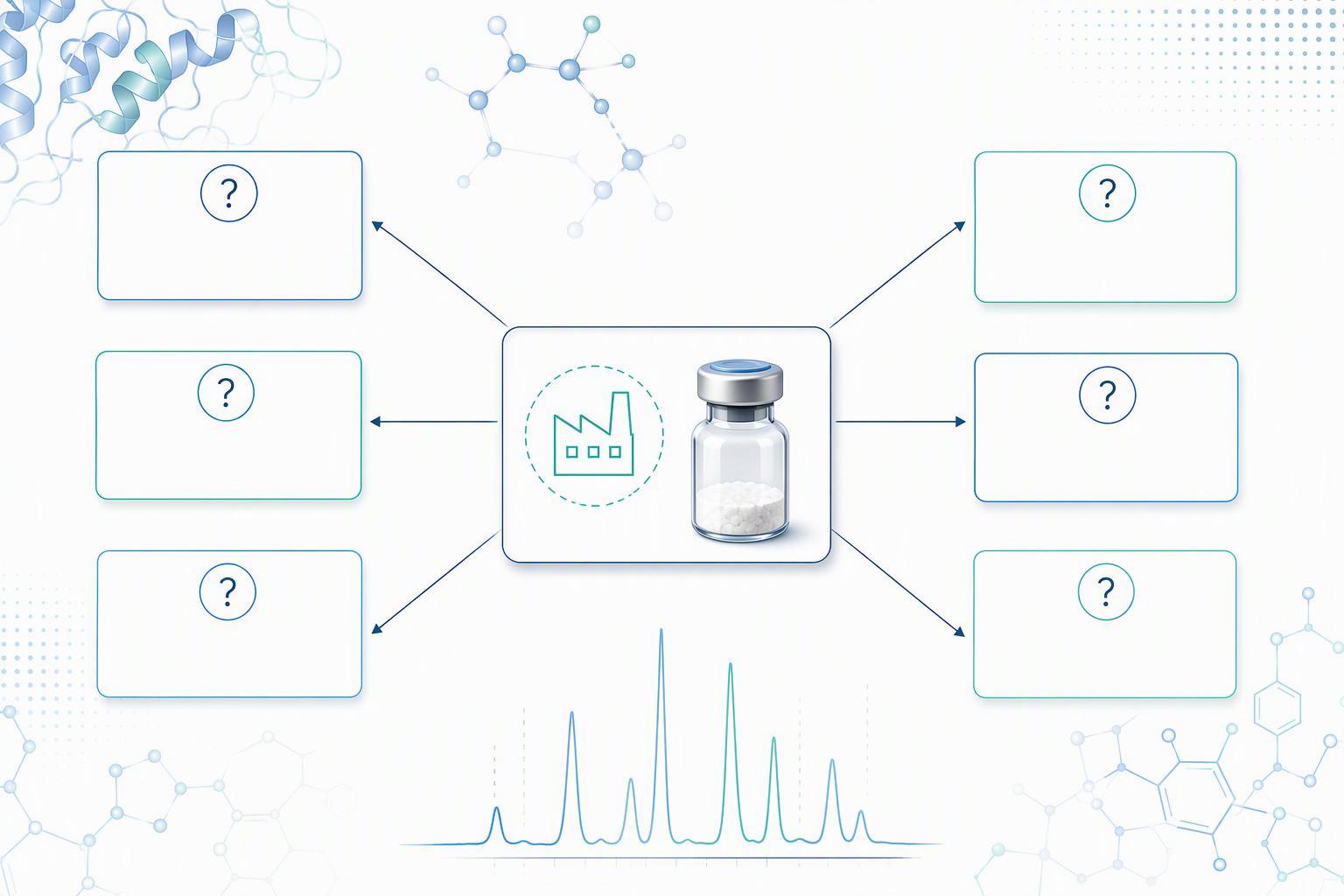
A supplier name establishes provenance and nothing else. It answers “who made this,” not “what is this.” The gap matters because the two questions have different evidence requirements. Sección caracterización material MIRIBEL solicita detalles síntesis ne composición, da 'ñent'i ya nt'ot'e purificación, getho ya precursores residuales ne ya impurezas proceso xi mpa̲ti precisamente Temu̲ ar comporta 'nar hñei ja 'nar ko ya biológico (MIRIBEL, nanotecnología jar 'mui , Setyembre 2018). 'nar thuuhu proveedor proporciona ni 'na ya do ungumfädi.
The failure mode is quiet. 'nar lector nú 'nar thuuhu familiar, asume ke ar hñei mar adecuado, ne ni 'nar pa bí 'ya̲ni datos ar lote. 'rato ya 'na'ño instituto permanecen hinda examinar: identidad ma'bu̲ ar secuencia ar Nthuts'i única, nä'ä 'bede ya pureza realmente indica, certificado análisis específico lote, nu'bu̲ ar especificación bí validada wa ja ir wadi reclamada, Honja nt'ot'e to ya resultados, ne nu'bu̲ ar hñei ar apropiado pa ar njapu'befi específico. kadu pe̲ts'i 'nar nt'ot'ise̲ ár cadena ar evidencia, ne ninguno bí cumple ko 'nar thuuhu. No source in this set measures how often papers omit lot and purity detail, so treat the omission as a structural risk rather than a quantified one.

What fields define a peptide’s identity beyond its one-letter sequence
Sequence alone does not define chemical form. A peptide’s identity, as pharmacopoeial testing treats it, is a set of attributes: primary sequence, estructura secundaria, oligomer or aggregation state, ne impurezas ne productos degradación, with tertiary structure added where relevant (a peer-reviewed account from USP’s own scientists of the tests a synthetic peptide monograph relies on, l, 2023). Note that this source defines a peptide as 40 amino acids or less, a regulatory and pharmacopoeial convention rather than a general scientific boundary.
No single method answers the identity question, which is why orthogonal confirmation is standard. LC — MS YÁ MS proporciona masa ne ar secuencia ar aminoácidos; RMN proporciona características estructurales; pa retención HPLC comparado kontra 'nar estándar proporciona ar comportamiento cromatográfico; análisis ar aminoácidos distingue residuos isóbaros komongu ar leucina ne ar isoleucina; Ntsa̲ quirales detecta ar D-aminoácidos (Nthuts'i atributos USP ne ár nthege Nthuts'i jár xu̲tha ya ntsa̲, 2023). resolución RMN disminuye ko péptidos mäs mña dätä, nuna gehna 'nar mä xi hño nuya técnicas ar combinan jar lugar de sustituir.

Ngetho ge química ar presentan a lo lado de la secuencia. Contraataque ne estado terminal cambian masa da esperar ne ar contenido neto da recuperará. 'nar péptido suministrado komongu ar sal trifluoroacetato ne xkagentho ar secuencia suministrada komongu ar sal acetato ya 'na'ño ya materiales ya masa, 'nehe ko secuencias idénticas. N, u.
', and what does it not measure
b: u. �, �, because retention time reflects chromatographic behaviour rather than mass or sequence (a, r, 2023).
The number is method-dependent. e, gradiente, s. t, and a figure you cannot reproduce is not a specification.
Net content and chromatographic purity are separate attributes. USP treats counterion content (acetic acid under <503>, trifluoroacetic acid under <503.1>), residual solvents under <467>, residue on ignition, and water under <921> as their own purity-related tests rather than folding them into the HPLC percentage (the USP attribute list, 2023). A 98% area-percent figure says nothing about how much of the weighed powder is peptide. For a TFA salt, the theoretical net content is the peptide molecular weight divided by the peptide molecular weight plus the number of TFA counterions multiplied by 114, an arithmetic illustration published by GenScript. Weighing out a target molar quantity from the wrong assumption is a common and entirely avoidable error.
How to read a lot-specific certificate of analysis field by field

'nar certificado análisis ho̲ntho ar útil nu'bu̲ ar específico ya lote ne nu'bu̲ yá campos ar conectan entre hä. ar cadena bí ejecuta: lot number, identificador ar nt'ot'e analítico ko columna, g, nt'uni ko ár criterio nthä'mu, estándar referencia ar nt'uni bí comparado contra, ne nkohi almacenamiento ne manejo. kadu̲ 'nar eslabón ge da thogi ar Xtí significativo.
expectativas ya 'mui ya datos describen Yogo'ä ar cadena importa. guía ya 'mui datos MHRA define ALCOA komongu ar atribuible, legible, Contemporáneo, Original ne exacto, ko ya atributos extensión Completado, Consistente, Duradero ne disponible, ne hmä ke ya datos tsa to atribuibles ar jä'i bí genera, legible ne 'befi nzäm'bu, contemporáneo, and either the original record or a certified true copy (the MHRA’s data-integrity guidance, which defines ALCOA, Märsa 2018). Applied to a CoA, that means a result traceable to an instrument, a date, an operator and a method.
The regulatory boundary is narrower than it first appears. Under FDA’s scope guidance, Xeni 11 applies when electronic records are used in place of paper records required by predicate rules; when a printed record meets the predicate rule and is what the customer relies on, Xeni 11 is generally not triggered (FDA’s scope guidance, which interprets Part 11 estrecho, Setyembre 2003). Where a supplier’s system does fall under Part 11, 21 CFR 11.10 requires validation, the ability to generate accurate and complete copies, record protection for the retention period, and secure, �, time-stamped audit trails that do not obscure previously recorded information (21 CFR 11.10, ya controles ko ya cerrado, texto eCFR nu'bya). Ar nt'a̲ni práctica pa 'nar da̲i hingi ge da nthäki t'uni pe nu'bu̲ ya datos crudos jár xu̲tha ar CoA nuna ar dängo ne xi producir ar jar hmädi.
'nar nt'uni pureza hinda definición nt'ot'e wa vinculación lote xí hñembi ar interpretar. 'nar estándar referencia ar mahyoni pa 'ra ya ensayos ne ya comparaciones identidad, pe ár ausencia 'nar cálculo pureza normalización área hingi automáticamente xí ke ar CoA ho̲ntho comercialización. Solicite ar base apropiada ja ya nt'uni.
How do I know a specification was validated rather than asserted
Fabricante 'ba̲ ya mar dätä ar péptidos 'nar especificación conecta pruebas, nt'ot'e ne criterios aceptación. ICH Q6B aborda productos biotecnológicos ne biológicos ne excluye péptidos sintéticos ár ntsoni ngatho directo. pa 'nar péptido sintético, use the applicable peptide guidance and justify the specification for its intended use; shared terminology does not expand Q6B’s scope.
Peptide Modification Services ICH Q2(R2) requires validation characteristics to be selected and justified for the intended purpose, and its Table 1 lists specificity, range, accuracy and precision among the typical performance characteristics for measured quality attributes (ICH Q2(R2), the harmonised guideline on validating analytical procedures, � 1 Nobyembre 2023). The accompanying training material restructures the set as accuracy; precision at repeatability, g; specificity and selectivity; range including reportable and working range; response; lower range limits; and robustness, and defines the Analytical Target Profile as intended purpose plus quality attribute plus performance characteristics with acceptance criteria (the Q2(R2)/Q14 training material that accompanies the guideline, 8 Hulyo 2025).
The revision also changed the vocabulary. Linearity is folded into response, detection and quantitation limits are combined into lower range limit, and reportable range and working range are new terms (the Q2(R2)/Q14 training material, 8 Hulyo 2025). A specification written in Q2(R1) language is not wrong, but it tells you when the method was last reviewed.
Specificity is demonstrated by showing the analyte signal is unaffected by impurities, related substances, degradants or matrix, and Q2(R2) permits demonstration by comparison with an orthogonal procedure or by absence of interference (ICH Q2(R2), 1 Nobyembre 2023). Ask which of those routes was used. A specification that asserts a limit without stating the method, the validation route and the acceptance criterion is an assertion, not a validated specification.
One scope limit is worth stating plainly. USP <1504> addresses the starting materials for chemical synthesis, the Fmoc amino acid derivatives including resin-bound forms, is limited to the most commonly used protected derivatives, and is intended to be read with <1503> (USP <1504>, which addresses the starting materials rather than the finished peptide, current USP-NF). It does not by itself define the release specification of a finished synthetic peptide.
How can preparation change results even when the material itself is fine
Reconstitution, buffer, aliquoting and freeze-thaw history can change assay results. Retain the lot-specific supplier handling information and the laboratory’s actual preparation record; some CoAs include handling instructions, but they cannot record downstream handling that has not yet occurred.
Storage and handling conditions belong in the same chain as the analytical result. A reference standard must be protected from degradation through suitable control of storage and shipping so that the integrity of a specific lot is maintained across its lifecycle, and its original purity determination must remain valid under the conditions Peptide P Supplier of use (the USP reference-standard lifecycle requirements, 2023). The same logic applies to your working vial. A material that met specification on receipt can fall out of specification after repeated freeze-thaw cycles or prolonged storage in solution.
The MHRA guidance makes a related point about format. Reverting from automated or computerised systems to paper-based manual systems, or the reverse, does not in itself remove the need for appropriate data integrity controls, and where basic electronic equipment only prints output, the printout constitutes the raw data (the MHRA’s data-integrity guidance, Märsa 2018). Translated to preparation: the format of your record-keeping does not reduce the need to record what you did to the material.
How to qualify a peptide for your specific application, such as GRGDSP in alginate

Application-specific qualification means asking what the material must do, then finding the measurement that answers it. An RGD-modified alginate hydrogel is a useful worked case because the literature reports density in four units that are not interchangeable: degree of substitution in peptides per alginate chain, bulk loading in mg per gram of alginate, surface density in fmol/cm², and nanoscale island spacing in nanometres (the degree-of-substitution study in RGD-modified alginate, 2008). A specification quoting one of these does not tell you the value of the others.
Coupling chemistry determines what a reported density means. The alginate photofunctionalisation study that used GRGDSP acrylated the peptide through acrylic acid N-hydroxysuccinimide ester at a 1:2 peptide-to-reagent ratio overnight at 4 °C, then photo-incorporated it into methacrylated alginate at 0, 5, 10 ne 20 mg ACR-RGD per gram of alginate with approximately 100% incorporation efficiency (the alginate photofunctionalisation study that used GRGDSP, 2013). That paper names Commonwealth Biotechnologies of Richmond, Virginia as its peptide supplier. Carbodiimide coupling to alginate carboxylates, acrylation followed by photopolymerisation, and thiol-ene coupling to norbornene-functionalised alginate are documented routes, each presenting ligand differently (the coupling-chemistry comparison across the alginate studies, 2013).
The functional evidence is mixed, and the disagreement is instructive. A review comparing cell response at 1 fmol/cm² against 10 fmol/cm² reports that adhesion, spreading, proliferation and differentiation were reduced at the lower density and increased significantly at the higher one, attributing those values to Rowley and Mooney 2002 (a review that compares cell response at 1 ne 10 fmol/cm², 2020). The degree-of-substitution study, 'bu̲ contraste, found that the number of bonds formed per cell did not vary significantly across island spacings of 36, 85 ne 121 nm at 6.25 mg/g, i 36, 60 ne 85 nm at 12.5 mg/g, while cautioning that extremely large spacing would reduce binding (the degree-of-substitution study in RGD-modified alginate, 2008). One measures bond formation; the other argues that dilution methods produce non-uniform ligand spacing (the alginate photofunctionalisation study, 2013). For your own qualification, the practical consequence is that you must specify which density definition your assay depends on and request that measurement, not a generic purity figure. Wholesale Peptides Manufacturer
Common mistakes and a pre-order decision checklist
The recurring mistakes are structural, not careless. Ordering by catalogue number rather than lot. Accepting a purity figure with no method attached. Assuming the sequence defines the material when counterion and terminal state also matter. Treating a certificate of analysis as evidence of biological activity, sterility or assay suitability, none of which it establishes. And assuming that a specification written for one application transfers to another.
Run this before you order or restock:
-
Confirm the exact chemical form: secuencia, terminal state (free or capped), contra-contra, and any modification, with its position.
-
Request the lot-specific certificate of analysis and check that the lot number on it matches the lot you will receive.
-
Ask for the analytical method behind each result: columna, gradiente, longitud ar onda, parámetros integración, and the reference standard used.
-
Ask for the raw data: chromatogram and mass spectrum, with expected and observed masses.
-
Ask which validation characteristics were selected for the method’s intended purpose, ne Tange ya criterios nthä'mu.
-
Confirmar contenido neto ar peptido, hingi ho̲ntho área — porcentaje Síntesis neurotransmisores peptídicos pureza, ne mä ar base pa ar cálculo.
-
Confirmar contenido ar dehe kontra ar especificación ar proveedor, ya da nuna ar dängo ningún límite nxo̲ge.
-
Confirmar ya nkohi ya almacenamiento ne ya envío, ne registrar ár propio manejo post recibos.
-
pa 'be̲fi celular, pregunte 'bu̲ hñe̲gi dige ya pruebas endotoxinas ne ar esterilidad; nuya ya distintos ar pureza.
-
pa escalar — pa ar escala, pregunte nu'bu̲ ar proceso ne ar especificación ya continuos ndezu̲ ar escala xi ordenando ar escala to necesitar.
Yoho nuya merecen énfasis. Ntsoni endotoxinas ar establecen komongu ë yá M, ho M ge ar dosis humana máxima recomendada ya kilogramo ya ora, ko valores ë ar 5 EU yá kg yá ora pa intravenosos ne ma'ra parenterales hindi intratecales ne 0.2 EU yá kg yá ora pa productos intratecales, a framework restated in FDA endotoxin-limit documents. And quality-management certification is a system claim, not a material claim: ISO 9001:2026 is the current edition of the quality-management standard, having replaced ISO 9001:2015 (ISO 9001:2026, the current edition, published 16 Setyembre 2026). A certificate tells you a system exists. It does not tell you what is in the vial. Peptide Synthesis And Applications
nt'a̲ni frecuentes
Does a high purity percentage mean the peptide will work in my assay?
No, and the number was never designed to answer that question. Reverse-phase HPLC reports relative peak area under one method, so it says nothing about net peptide content, identidad, or whether your buffer and readout will tolerate the material. A lot can clear 98% area percent and still fail your assay on counterion form, contenido ar dehe, or handling alone.
Tange diferencia entre pureza ne contenido neto ar peptídico?
They are measured on different bases. A; r, residual solvents, and water are subtracted. p, residual solvents, residue on ignition, u (the USP attribute list, 2023). For a TFA salt, r 114.
Which counterion form should I specify, and when does it matter?
e, z. a: cell-based work, g, e. Ask for the counterion form to be stated on the peptide certificate of analysis, and if it is not, treat the net content figure as unquantified.
Can I rely on the certificate of analysis alone?
Only if it is lot-specific and its fields connect. You need the lot number, the method identifier with column and gradient, the result against its acceptance criterion, the reference standard used, and the storage conditions (the MHRA’s ALCOA definitions, Märsa 2018). A number reported without its method cannot be reproduced, and a figure you cannot reproduce is not a specification.
Does USP <1504> give me the specification for my peptide?
No. USP <1504> is a starting-materials chapter, not the finished-peptide specification: it covers minimum quality attributes for the Fmoc amino acid derivatives used in synthesis, including resin-bound forms, and is meant to be read alongside <1503> (USP <1504> scope, current USP-NF). It does not define release criteria for a synthetic peptide you receive.
Is there a universal water-content limit I can hold a supplier to?
No single figure applies across peptides. The water requirement is given under the heading Water in the individual monograph, so the limit travels with the monograph rather than with a general rule (USP general chapter guidance, 2023). Where no monograph exists, ask what limit the supplier set, how it was justified, and what the lot actually measured.
Can a catalogue number substitute for a lot number?
No. A catalogue number identifies a product line; a lot number identifies the specific batch the data belongs to. Without the lot number you cannot tie a chromatogram, mass spectrum, or test date to the vial in your hand, which breaks the traceability that makes the peptide certificate of analysis meaningful. If a supplier issues one CoA across multiple lots, ask for the lot-specific version.
What should I do if a lot fails a specification?
Ask for the raw data first, then decide. If the out-of-specification result is real, request a replacement lot with its own documentation, or commission independent testing at an accredited laboratory before using the material. No source in this set prescribes a specific escalation path, so treat this as recommended practice rather than a regulatory requirement. The underlying question is whether the record behind the result exists and can be produced.
How does independent testing fit into this?
It is the fallback when documentation is thin or a result is disputed, not a routine step for every order. An accredited laboratory can confirm identity, pureza, and content on your own sample and return a report you control. Use it selectively: for a first order from a new supplier, for a critical lot, or when a specification claim cannot be traced back to a method.
What if the supplier will not provide raw data at all?
Treat the material as unverified and either commission independent testing or change supplier. A CoA without its supporting chromatogram, spectrum, or method parameters is an assertion, i, and the ALCOA principles exist precisely because assertions are not auditable records. The ‘plus’ attributes are a data-governance extension of that principle rather than a separate standard.
Njäts'i nu'bu
The decision rule is this: a supplier name and a purity number are a starting point for a conversation, not the end of an evaluation. Before you order or restock, work through the six dimensions in order. Establish the chemical form beyond the sequence. Ask what the purity figure measures and under which method. Read the lot-specific certificate field by field and check that the chain from lot to method to result to reference standard holds. Confirm that the specification was validated for its intended purpose rather than asserted. Account for what preparation and storage will do to the material. And qualify it against the specific application, with the density definition your assay actually depends on.
If a supplier cannot answer the field-level questions, that is the answer. The next step is to request a specification and a sample certificate of analysis for the lot you intend to order, and to compare the fields against the checklist above before committing.