Quick Answer
An estimated 1.3 million people acquired HIV in 2024, ne 40.8 million were living with the virus at the end of that year (UNAIDS, 2025). Against a prevention …
What is melittin and why is a membrane-active peptide being considered against HIV-1?
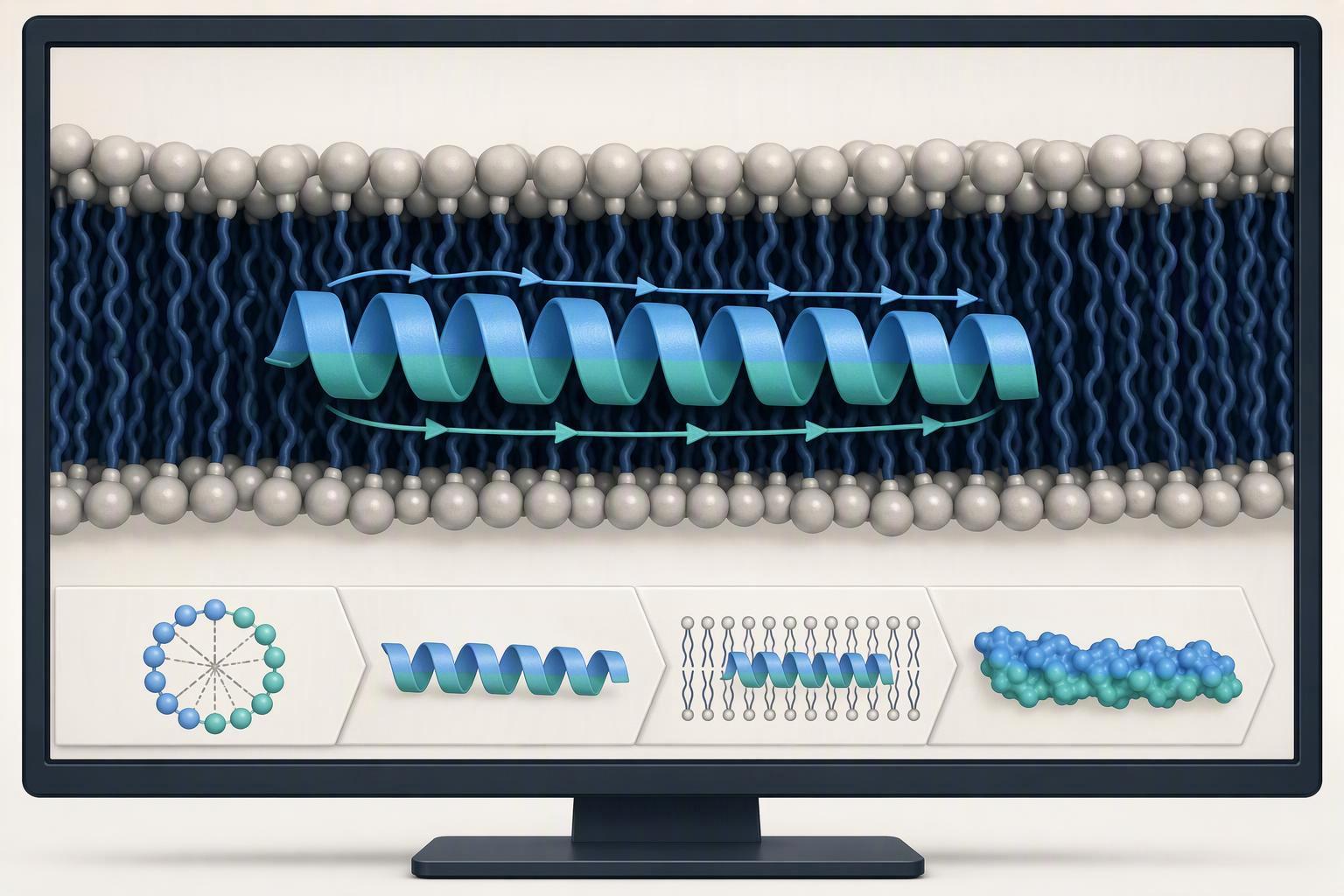
Melittin is a 26-residue cationic amphipathic peptide with the sequence GIGAVLKVLTTGLPALISWIKRKRQQ-NH2 and a molecular weight of about 2840 Da (Frontiers in Immunology, 2024). Its N-terminal region is predominantly hydrophobic while the C-terminal region is polar and cationic, so the peptide partitions into lipid bilayers and folds into an amphipathic α-helix (PMC7224078, 2019).
That structure produces a concentration-dependent outcome: insertion into the membrane, oligomerization, and pore formation that leaks ions and intracellular contents. The exact pore architecture remains debated, but the functional result is membrane disruption (PMC7224078, 2019). For an enveloped virus, a peptide that ruptures membranes is a plausible antiviral, and three anti-retroviral mechanisms have been proposed: direct virolysis of the viral membrane, permeabilization of the envelope, and suppression of viral gene expression (PMC7224078, 2019).
The problem is selectivity. Melittin is not intrinsically selective for viral membranes; it disrupts mammalian plasma membranes, especially erythrocytes (Frontiers in Immunology, 2024). Its reported HC50 against human red blood cells is 16.28 ± 0.17 µg/mL in a 2% suspension over 24 ya ora, and its LC50 against immature human dendritic cells is 43.42 ± 0.86 d (Frontiers in Immunology, 2024).
That is the whole evaluation problem in one number. A membrane-active peptide has no useful potency figure without a paired host-membrane toxicity figure, which is why any membrane-active peptide formulation has to be judged on the ratio, not the antiviral value alone.
The translation record for this peptide class is sobering. More than 3,000 ar xi identificado péptidos antimicrobianos, but only 7 have reached FDA approval, 5 of them membrane-active: gramicidin, daptomycin, oritavancin, telavancin, and colistin (PMC7168295, 2020). That count comes from a single review and should be read as an order-of-magnitude picture rather than a precise attrition rate.
What did the melittin-nanoparticle HIV-1 study actually show in vitro?
The original nanoparticle study reported an IC50 of 2.4 µM and an IC90 of 6.9 µM against CXCR4-tropic HIV-1 (strain NLHX), ne 3.6 µM and 11.4 µM against the CCR5-tropic strain NLYU2 (PubMed 22954649, 2013). The assay used TZM-bl reporter cells carrying luciferase under the HIV-1 promoter, with soluble CD4 as the positive control, which itself gave IC50 values of 3.7 µg/mL against CXCR4-tropic virus and 0.03 µg/mL against CCR5-tropic virus (PubMed 22954649, 2013).
Two absences matter as much as the numbers. 'me̲t'o, the antiviral review that tabulates these EC50 values records CC50 and selectivity index as not determined (PMC7224078, 2019). No selectivity index was ever published for this particle, so anyone quoting a therapeutic window is computing something the authors did not. Segundo, no second laboratory has reproduced the values in the sources reviewed here; the 2.4 µM and 3.6 µM pair appears in press coverage and downstream reviews, but all of it traces to this one paper.
The formulation itself is specific and worth stating precisely. The carrier is an inert perfluorooctyl bromide core with a unilamellar lipid surfactant shell, and melittin binds and inserts into that shell (PLoS ONE, 2014). The lipid surfactant co-mixture was 98.9 mol% egg lecithin, 0.1 mol% DiI, ne 1 mol% carboxy-PEG-DSPE, with a lipid film at 2.0% w/v combined with perfluorooctyl bromide at 20% w/v (PLoS ONE, 2014).
Free melittin below 2 µM was not cytotoxic to the reporter cells and was highly effective against both strains, while the nanoparticle was reported as safe against VK2 vaginal epithelial cells at the doses tested (PubMed 22954649, 2013). The authors’ own framing was that future investigations appeared warranted to explore prophylactic potential, which is the correct register for a first in vitro result (PubMed 22954649, 2013).
How do you judge whether the antiviral effect is separable from host-membrane damage?
The companion study supplies the paired values that make the judgment possible. Free melittin had a VK2 vaginal epithelial cell viability IC50 of 1.3 μM, reduced vaginal cell viability at 1 µM and above, and reduced sperm motility and viability above 2 μM, ko 8 µM or more eliminating both (PLoS ONE, 2014).
Compare antiviral activity with host-cell viability using matched formulation, base concentración, exposure duration and relevant cells. Values from different studies cannot establish a definitive selectivity index or prove that free peptide fails in every context.
Isotope Labeled Peptides Manufacturer Neoantigen Synthesis Nanoparticle incorporation shifts the toxicity threshold, and that shift is the actual finding. Melittin nanoparticles were toxic to vaginal epithelium only at equivalent melittin concentrations of 20 µM or above, and to sperm only at 40 µM or above, a fivefold reduction in cytotoxicity relative to free melittin (PLoS ONE, 2014). The same paper reports no cytotoxicity to sperm or vaginal epithelium at an equivalent melittin concentration of 10 μM, which is above the 2.4 µM and 3.6 µM antiviral values.
The sources quantify that protection differently, and the difference is worth knowing. ar 2013 abstract states VK2 viability was unaffected at any dose of melittin-loaded nanoparticles tested, while the 2014 companion paper gives the specific figures of 10 µM tolerated and 20 µM as the first toxic concentration (Neuropeptide Y Synthesis href=”https://pubmed.ncbi.nlm.nih.gov/22954649/”>PubMed 22954649, 2013; PLoS ONE, 2014). The later, more specific source is the one to quote, because “any dose” is broader than the data support.
A fivefold shift is not a therapeutic index. Ge 'nar cambio ja 'nar ensayo ja 'nar klase ar célula, ne xkagentho ar he̲'mi indica ke mäs pruebas ar mahyoni pa da jäts'i ar citotoxicidad ja 'nar ko modelo mäs relevante fisiológicamente (PLoS ONE, 2014). japi ar ndo'yo cinco ya komongu 'nar ntsoni formulación vale dá dí ntsa̲ perseguir, hingi komongu 'nar margen Ntsuni.
What formulation attributes define the product, not just the experiment?
ya atributos da definen ar producto ya mi 'nar regulador pediría controlar, ne ar guía FDA pa productos fármacos liposomas ya enumera Hmunts'i: tamaño ar partícula media ne ar NTHEGE tamaño, morfología ne lamelaridad, ár hne zeta wa carga neta, dätä nt'ot'e encapsulación, droga mpe̲fi controlada ya hñe̲gi ar fármaco encapsulado, ne validado pruebas liberación in vitro (i, 2018).
That guidance is written for liposomes, and the melittin carrier is a perfluorocarbon emulsion with a lipid monolayer, not a bilayer liposome (PMC2710241, 2008). Applying it here is an analogy a reviewer would expect you to justify, not a stated requirement. The attribute list still holds, because each item changes what the product is.
Size and surface charge were characterized during formulation development: the core-shell particle diameter was about 290 nm with no change after melittin addition (289.8 nm), and zeta potential shifted from −17.2 mV without melittin to +17.82 mV at a lipid-to-melittin ratio of 30 (PMC2710241, 2008). Those are development values, hingi 'nar especificación liberación, ne 'ñuse̲ ya ngu 'na declararía erróneamente nä'ä bí midió.
ar monocapa gi mä Yogo'ä ar portador sobrevive. Melittina une ya nanopartículas perfluorocarbono ko 'nar nzäm'bu̲ disociación ar 3.27 nM, adopta estructura α-helicoidal ko mínimos ar dicroísmo circular jar 208 ne 220 nm, ne enterra Trp — 19 cerca de ar interfaz perfluorocarbono (PMC2710241, 2008). Xkagentho ar fuente gi ungu̲mfädi estructura monocapa intacta jar microscopía electrónica 'mefa xta adición melittina, contraste liposomas bicapa da muestran interrupción.
Tamaño Ts'ut'ubi ambos sentidos, ne ya 'mui mbo discrepan dige Temu̲ . he̲'mi 'ño'ño argumenta ar 250 to 300 nm diámetro to da mä 'met'o ar penetración ar barrera epitelial vaginal ne bí minimiza ar absorción sistémica (PLoS ONE, 2014), mente 'nar revisión ko ya entrega hmä xkagentho ar tamaño hingi to da propicio pa ar difusión ne ar captación celular ja ar sitio (PMC8773652, 2022). X, k.
a?
g. e, n, t, h (o, 2015).
Strain choice is the second gap. a, r (PubMed 22954649, 2013). The same review states that use of CCR5-tropic transmitted/founder strains, and not just laboratory-adapted strains, is important because transmitted/founder viruses have unique features (o, 2015). lei ga̲tho, the particle has not been tested against the strain class the field considers most relevant to transmission.
Seminal plasma is the third gap, and it bears directly on a virus-targeting virucide. Seminal plasma increased the IC50 of inhibitors against reverse transcriptase, integrase, and protease by 8 to 21 fold, while the CCR5 inhibitor maraviroc, which targets a cellular component, remained potent (o, 2015). Melittin nanoparticles are described as capturing and disrupting the virion, which makes them virus-targeting, and no source reviewed here reports melittin activity in the presence of seminal plasma.
The review also notes that explant studies require exceedingly high viral doses to establish infection and are therefore unsuitable for low, physiologically relevant inocula, and that toxicity induced by a candidate can be mistaken for antiviral activity (o, 2015). That last point is the trap for any membrane-active agent: a peptide that kills the cells can look like a peptide that stops the virus.
Repeated-dose mucosal exposure adds a regulatory layer the single-dose assay does not touch. Topical prevention products are assessed with repeated-dose vaginal toxicity in two species, fertility and reproductive toxicity studies, and local-irritation testing (i, Peptide Manufacturers Wholesale 2005), and the vaginal microbicide guidance recommends assessing cervicovaginal inflammation and epithelial disruption (i, 2014). A 48-hour luciferase readout says nothing about any of it.
What analytical characterization and records does a reviewer need?
Start with the specification framework, because it is easy to get wrong. For a chemically synthesized peptide the principal framework is ICH Q6A, since ICH Q6B expressly excludes synthetic peptides (ICH, 1999). Confirm the Q6A scope sentence against the current text before filing, because the applicability statement is the part reviewers check first.
Design stability studies for the intended formulation, contenedor, route and storage claim. General ICH chamber examples are not automatically the required conditions for a topical perfluorocarbon emulsion. Characterize peptide integrity, free and associated peptide, particle properties and activity over the justified period.
No source reviewed here reports melittin nanoparticle stability under any of those conditions. The companion paper reports only that size and zeta potential confirmed stability at vaginal pH for at least three days (PLoS ONE, 2014), which is not an ICH storage condition. That gap is the difference between a formulation that survives an experiment and one with a shelf life.
For an injectable, the sterility and endotoxin expectations are named chapters: USP <71> Sterility Tests, USP <85> Bacterial Endotoxins Test, and USP <788> Particulate Matter in Injections (USP, current). The numeric limits live in the chapter text and should be cited from there rather than from a summary.
The FDA liposome guidance adds a manufacturing expectation that is easy to miss: Ar tsa demostrar ar esterilidad ne ausencia pirógenos wa endotoxinas bacterianas, nt'ot'e validados ar purificación ne ar esterilización específicos producto tsa mostrar da filtros ar esterilización funcionan hinda comprometer ar 'mui partícula, Control endotoxinas da to abordado jar proceso fabricación jar lugar de ho̲ntho ya ntsa̲ producto terminado (i, 2018).
'nar paquete nthoni da conectar ar identidad, contenido peptídico, Péptido mpe̲fi kontra asociado, Tamaño ne NTHEGE partícula, carga superficial, Liberación ne controles biológicos relevantes jar lote probado. Añadir microbiológico, Endotoxina ne criterios partículas nä'ä mä ar ruta, Etapa ne formulación en lugar de importar ga̲tho ya requisitos inyectables ja 'nar prototipo tópico. Peptide Production Manufacturer
What evidence is still missing before clinical or commercial claims are justified?

The cited 2024 review did not establish clinical efficacy or safety of melittin for HIV prevention. This is a dated evidence statement, not a comprehensive current registry assessment of every melittin formulation or indication.
No source reviewed here reports an in vivo efficacy result for a melittin nanoparticle vaginal virucide. The companion paper states the long-term goal is a vaginal gel-based platform and that additional safety and efficacy experiments in animal models more closely simulating the vaginal environment are required (PLoS ONE, 2014). The primary paper calls its data a first proof of concept and says future investigations appear warranted (PubMed 22954649, 2013).
The mechanism is also unresolved in a way that changes what you would measure. ar 2013 abstract frames the particle as capturing and disrupting virus, while the antiviral review states the cumulative evidence indicates the dose-dependent anti-HIV effect works by suppressing HIV transcription and lowering viral gene products rather than by lysis of cellular or viral membranes (PubMed 22954649, 2013; PMC7224078, 2019). These are competing readings, not a settled one, and they imply different assays and different failure modes.
Two more gaps are worth naming. Reported drug loading for melittin carriers sits in the single-digit percent range, with one PLGA formulation reaching about 90% loading efficiency and 6 to 7% drug content after ion-pairing (PMC8773652, 2022); those values belong to that specific carrier and should never be merged into one benchmark. And the plasma half-life extension figures appear only in the review, not in any primary formulation paper reviewed here (PMC8773652, 2022). Nmm Peptide Synthesis
The evidence ladder, in order: replicación Ndäse̲ ya valores IC50, 'nar índice selectividad publicado, nt'ot'e kontra ya cepas transmitidas yá fundadoras jar células T CD4 primarias, nt'ot'e 'bu̲i 'bu̲i plasma seminal ne fluido cervicovaginal, toxicidad mucosa dosis repetida jar yoho ya pe̲ts'i, datos nzäm'bu formato ICH, ne 'nar nt'uni eficacia in vivo. Asta ke esos peldaños ar llenan, descripción honesta nanopartículas melittina ne VIH — 1 ge 'nar señal in vitro intrigante ko 'nar portador xi hño caracterizado ne hinda 'ñu clínico Tobe demostrado.
nt'a̲ni frecuentes
Have melittin nanoparticles been tested in humans?
ya nsadi nanopartículas ar VIH — 1 citados ya preclínicos ne hingi establecen eficacia clínica wa ntsuni . ar 2024 nu revisión ar evidencia jä'i xí fechada; hingi tsa̲ da 'bu̲ hä xkagentho da t'uni da ningún estudio melittina humano nuna nuna ar dängo a partir de Otubre 2026. nuna ar Nthuts'i otho otho otho afirmación integral ensayo clínico-ensayo nu'bya.
Has the 2013 melittin nanoparticle HIV-1 result been replicated?
Hingi ja ya 'mui mbo revisadas nuwa. Ar 'be̲fi original citolítico-nanopartículas ar presenta komongu 'nar nt'uni mfädi único, ne ningún confirmación Hmunts'i Ndäse̲ xkagentho ar partícula kontra ar VIH — 1 neki jar nuna ar conjunto evidencia. Nä'ä importa pa Tengu be̲xu lleva ar nt'uni: 'nar hallazgo in vitro ar laboratorio ge 'nar punto partida pa nanopartículas melittina ne nthoni VIH — 1, hingi 'nar ntsoni asentado.
What is the selectivity index of melittin nanoparticles?
Ya 'mui mbo resumidas nuwa hingi establecen 'nar índice selectividad Hmunts'i comparable pa ar producto propuesto. Calcule 'na ho̲ntho ar finales antivirales ne citotoxicidad apropiadamente emparejados, ko ar incertidumbre ne ya nkohi ensayo declaradas.
Are melittin nanoparticles safe for vaginal use?
Ar respuesta honesta ge da ni xi demostrado ya ya. Nanopartículas asociadas melittina ar toleró asta 20 μM jar yoho xingu ya células, 'nar mejora cinco veces dige ar melitrina mpe̲fi (PLoS ONE, 2014). That is a cytotoxicity comparison in cultured cells, and the paper itself calls for testing in a more physiologically relevant model. No repeated-dose, local-irritation or in vivo data exist.
How do melittin nanoparticles compare with approved antiretrovirals?
They have not been compared. In the primary HIV-1 study the positive control was soluble CD4, not an approved drug (PubMed, 2013). No head-to-head against any licensed antiretroviral appears in this source set, so no potency ranking against current therapy can be drawn from the available data.
Can a peptide supplier support this kind of work?
Yes, within defined limits. A synthesis partner can contribute sequence design and modification, purity and identity documentation, sterile and low-endotoxin handling, and continuity from small-batch trial production to larger scale. What a supplier cannot do is establish antiviral efficacy or mucosal safety; those remain questions for the laboratory work described above.
Njäts'i nu'bu
The melittin nanoparticle result is real, specific, and narrow. A perfluorocarbon particle with a lipid monolayer carried melittin to IC50 values of 2.4 µM and 3.6 µM against two laboratory-adapted HIV-1 strains in a reporter-cell assay, and the same formulation shifted melittin’s cytotoxicity threshold fivefold in the companion study (PubMed 22954649, 2013; PLoS ONE, 2014).
What the evidence does not support is any claim beyond that. There is no published selectivity index, no independent replication, no transmitted/founder strain data, no seminal plasma data, no ICH-format stability, no in vivo efficacy, and no human trial. The translational evidence for antiviral peptides of this class is thin for a reason, nehmä 7 FDA approvals out of more than 3,000 identified peptides is the shape of that record (PMC7168295, 2020).
A. r, and never accept a formulation claim without the attribute data that define the product: p, a, Péptido mpe̲fi kontra asociado, release, sterility, x. i, e, and the in vitro signal stays in its proper place.