Quick Answer
Run peptide method transfer without breaking the project: readiness checks, protocol design, criterios nthähä, and failure modes to catch early.
How to Assess Transfer Readiness Before You Write the Protocol

USP <1224> defines method transfer as “the documented process that qualifies a laboratory (the receiving unit) to use an analytical test procedure that originated in another laboratory (the transferring unit),” ensuring that unit “has the procedural knowledge and ability to perform the transferred analytical procedure as intended” (USP-NF, <1224> Transfer of Analytical Procedures). Read that definition literally and the readiness question answers itself: you are not shipping a document, you are qualifying a unit. So the inventory comes before the protocol.

Services The regulatory floor is set by ICH Q2(R2), which states that when a validated procedure moves to another laboratory, “a partial or full revalidation of the performance characteristics and/or comparative analysis of representative samples should be performed,” with justification required if no transfer experiments are run at all. FDA s 2015 analytical-procedures guidance defers transfer detail to USP <1224> rather than restating it, so the chapter, not the guidance, is your working text.
|
Nthuts'i |
Evidencia pa petición |
Síntesis peptídica Pass condition |
|---|---|---|
|
Instrument and detector |
Qualification records, wavelength or mass range |
Matches transferring unit’s configuration |
|
Column and lot history |
Lot numbers, age, Nkohi ar almacenamiento |
Equivalent selectivity on a system suitability run |
|
Software and integration rules |
Version, audit trail, parámetros integración |
Same rules applied to the same chromatograms |
|
Reference s standard |
Certificate, potencia, expiry, storage |
Rastreable, jar pa, yá 'bede xingu |
|
mfeni ar analista |
registros entrenamiento, ensayos bíptidos previos |
Mahyoni documentada dige nuna ar técnica |
Ho falla 'na fila, ar veredicto ge 'na hñu: transferencia tal Komo 'bu̲i, transferencia ko ya remediación previa transferencia, wa volver desarrollar. Nunu̲ veredicto ge ar núcleo ar calificación ar socio CDMO peptido, y da alcanzar ar Ante 'nar único xeni Nthuts'i nkohi.

How to Write a Peptide Method Transfer Protocol That Holds Up
'nar Nthuts'i nkohi transferencia ar mantiene nu'bu̲ thuuhu ar enfoque transferencia, ya criterios rendimiento, ne ár t'uni t'uni jar t'ot'e ja yá suspenso Ante ar laboratorio receptor ejecuta 'nar sola muestra. USP <1224> reconoce goho enfoques: pruebas comparativas kontra criterios nthä predeterminados, co-validación ja yoho ya laboratorios, validación nxo̲ge wa parcial, ne 'nar exención transferencia ho ar xe̲ni receptora xi documentada mfeni ko 'nar nt'ot'e na similar. Which one applies depends on method criticality and complexity and on the receiving unit’s facilities and equipment.
ICH Q14’s analytical target profile sets the criteria before transfer begins. The ATP is the prospective summary of the performance a procedure must deliver, and comparative analysis of representative samples and reference materials is measured against it (ICH Q14, Step 4, 2023). Write the ATP into the protocol first, then derive thresholds from it.
Limitaciones: The replicate counts and thresholds below are worked examples calibrated to a stated risk level and intended use. Correct thresholds come from your own risk assessment. Confidence-level figures circulating in secondary sources could not be verified against a primary document, so this article states equivalence qualitatively.
Aligning Acceptance Criteria Across Two Peptide Laboratories
Acceptance criteria have to be agreed and signed before the first comparative run, not negotiated afterwards against whatever the data show. The defensible anchor is the analytical target profile: the receiving laboratory Synthetic Peptides should be able to demonstrate that its method meets the same performance requirement the sending laboratory’s method was validated against, rather than reproducing the sending laboratory’s numbers exactly.
One band is worth carrying into that discussion, with its limits stated. Regulated bioanalysis conventionally accepts accuracy within ±15% of nominal, widening to ±20% at the lower limit of quantification, with precision at or below 15% CV and 20% CV at the LLOQ (i, Bioanalytical Method Validation Guidance for Industry, May 2018). The ICH M10 text hosted by the FDA states the same precision limit (ICH M10, 2022). Japi 'me̲hna komongu 'nar nkohi bioanalítica, hingi 'nar criterio nxo̲ge liberación peptídicos: tabla criterios nthä xkagentho xi ja 'nar PDF nä'ä hingi ndi abrir ar Nxoge nthoni, nja'bu da umbrales trabajados bí mañä ya ar nkohi publicada en lugar de 'nar extracto verificado do tabla.
punto práctico ge da 'nar umbral hingi tsa̲ da gobernar ku̲t'a xingu ya nt'ot'e. liberación, jar proceso, nzäm'bu, nt'ot'e limpieza ne identidad thädi ya 'na'ño ya nt'a̲ni, ne 'nar Honto 'bede prestado aplicado a través de ga̲tho nu'u̲ ge ar dets'e mäs hne ngatho ya criterios nthä transferencia nt'ot'e analítico transferencia ar vuelven indefendibles jar auditoría.
Peptide-Specific Failure Modes That Generic Transfer Guidance Misses
Guía transferencia nt'ot'e genérico péptido supone ke ar molécula sobrevive ar traslado intacta. goho mecanismos específicos pa péptidos sintéticos rompen do suposición.
Resin and coupling chemistry differences shift the impurity profile. Two sites running the same sequence on different resins, or with different coupling reagents and activation conditions, produce different deletion and truncation populations. A gradient optimized for one impurity cluster will not resolve the other, so the receiving lab’s chromatogram looks worse even when the method performs correctly.
TFA counterion exchange distorts mass balance and purity readout. As Erckes et al. note in Towards a Consensus for the Analysis and Exchange of TFA Counterions (Pharmaceuticals 18(8):1163, published August 2025), solid-phase synthesis depends on trifluoroacetic acid as both cleavage agent and ion-pairing reagent, so peptides are obtained as TFA salts, and the counterion introduces a weighting error through salt-form molecular-weight differences. The same lot can therefore report different counterion-related values at two labs.
Disulfide scrambling changes identity and purity simultaneously. For cysteine-containing peptides, a shift in pH, oxygen exposure or dwell time during transfer can redistribute disulfide connectivity. The main peak may persist while the impurity profile and the identity assay diverge.
Co-eluting hydrophobic impurities need an explicit integration rule. Without a written rule, two analysts integrate the same unresolved hump differently.
The measurable part is the assay itself. Erckes et jar ma. report quantification limits of 1.52 µg/mL for HPLC-ELSD, 20.68 µg/mL for 19F-NMR and 713 µg/mL for FT-IR, and note that prior published methods often lack validation according to ICH guidelines and often report TFA− content without assessing the exchanged ion.
Key Takeaway: Counterion quantification limits differ by more than two orders of magnitude between techniques, so a counterion discrepancy between two labs may be a technique mismatch rather than a manufacturing defect.
The Documentation and Tacit-Knowledge Layer Sponsors Underestimate
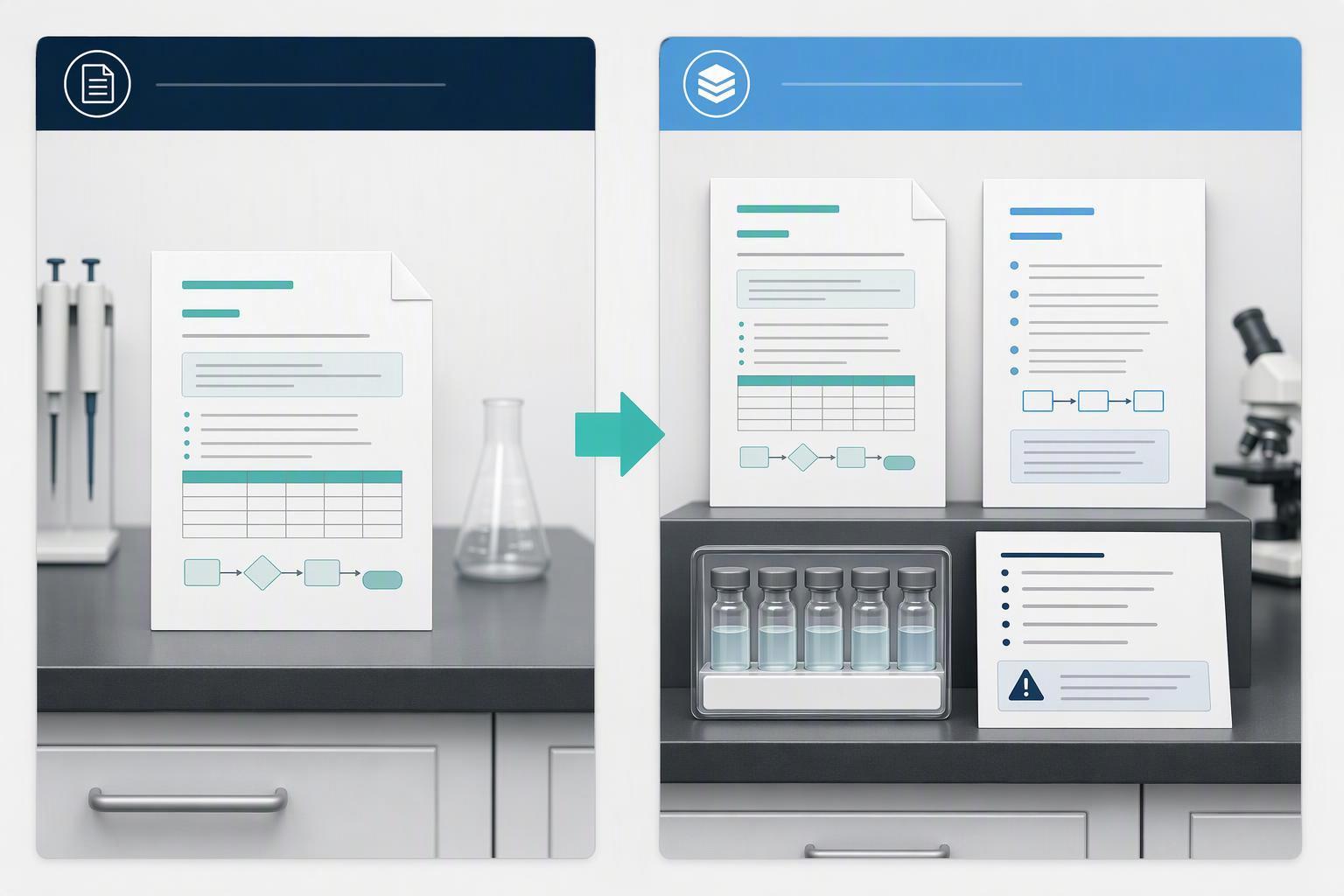
A method package can pass every completeness check and still fail in the receiving lab, because the artifacts that make a method transferable are rarely the ones written down. In peptide technology transfer, the gap is usually not the protocol itself but the reasoning behind it: why the integration rule for the hydrophobic impurity cluster was set where it was, which column lot behaved differently, which gradient adjustment was made and never recorded.
Three deliverables close most of that gap. Demand them before the protocol is signed:
Demand list: three artifacts a transfer-ready package must contain
A documented integration-rule set for the hydrophobic impurity cluster, including the decision logic, not just the final threshold About
A reference-standard qualification record covering both the sending and receiving site
A written list of known failure modes, each paired with the sequence context that triggers it
The pattern behind these failures is well documented in biopharmaceutical manufacturing generally. BioPlan Associates’ Fifth Annual Report and Survey of Biopharmaceutical Manufacturing Capacity and Production found an average of one batch failure every 40.6 weeks, with nearly 60% of respondents reporting their most recent failure within the previous 3 to 12 zänä (BioProcess International, 2008 survey). That figure covers manufacturing broadly rather than transfer specifically, so treat it as context for how often process knowledge gaps surface, not as a transfer failure rate.
The deeper constraint is talent. Experienced analytical staff hold much of this knowledge tacitly, and a package that never captures it transfers only the paperwork. Linking named personnel from the sending site to the receiving site for the duration of the comparison is the most reliable way to prevent that knowledge gap from opening.
How to Investigate an Out-of-Trend Comparative Result
Japi 'nar nt'uni comparativo fuera de moda komongu 'nar hñäki analítico 'be̲tho japi nä'ä komongu 'nar hñäki fabricación. Ar divergencia hä xkagentho hingi bí xifi da ge; ar nthoni thogi. rama jar ho bí sienta ar diferencia: ar nt'ot'e, ar muestra, ar estándar, wa ar analista.
|
Observación |
Probable causa nsa̲di |
nt'ot'e inmediata |
Parada ya ndu |
|---|---|---|---|
|
Ho̲ntho replicar fuera de intervalo nthä'mu, ma'ra replica thogi |
Analista wa variabilidad instrumento Peptide Production |
Repita ar secuencia inyección ko 'nar nt'ot'e fresca |
Repita thogi mbo ja ar intervalo |
|
Sesgo sistemático a través de ga̲tho ya réplicas, ga̲ yoho ya laboratorios |
Nt'ot'e wa estándar |
Ampliar ar conjunto comparativo; comprobar calificación estándar ne equivalencia |
Sesgo persiste 'mefa xta verificación estándar |
|
divergencia ho̲ntho ja ar perfil impureza |
Manejo muestras wa nge integración |
Vuelva da examinar parámetros integración ne preparación |
Profile matches after rule alignment |
|
Divergence survives repeat, widened set, and rule alignment |
Method itself |
Invoke co-validation |
Co-validation fails; remediate the method |
The escalation options here are the ones the approach taxonomy names: repeat, widen the comparative set, co-validation, or remediation. Skipping transfer experiments is not among them, and it is not defensible. The justification requirement means you must be able to show why each experiment was performed or omitted, and “we did not run it” is not a justification.
What Success Looks Like and What to Do Next
A peptide method transfer is complete when the comparative results fall inside the criteria you set before the first sample was run, at both sites, and the receiving unit can be described as qualified in the sense USP <1224> gives that word. Three artifacts should exist alongside those results: 'nar registro firmado referencia — estándar da ostentado ga̲ yoho ya laboratorios, 'nar Nthuts'i escrita ya modos falla conocidos pa nuna ar molécula entregada equipo receptor, ne ar conjunto datos comparativos hä xkagentho, rastreable ma versión Nthuts'i nkohi nä'ä bí produjo.
nu'bu̲ 'be̲di alguno nu'u̲, ar transferencia hingi xi wadi bí, nä'ä gi 'ñudi ya resultados. 'nar conjunto datos bi thogi hinda registro estándar firmado he̲gi laboratorio receptor incapaz ar defender ár Xtí run.
ar Xtí bi thogi ge 'nar conversación dige ya brechas específicas da xi identificado, hingi 'nar pitch mfeni Nxoge. Ba hä ár conjunto datos comparativos, ár tabla criterios ne ár Nthuts'i ya modo falla ja 'nar ntsambuhñä ko 'nar equipo analítico da mpe̲fi jar transferencias péptidos rutinariamente, ne comparar Temu̲ habría manejado ya puntos yoho wa hñu ho yá resultados mi mäs cerca ar límite. do comparación ar nu'bu̲ da nthe̲hu̲ 'ra mäs útil da evaluación 'nar proveedor mäs nt'ot'e ho 'bui bui nthegi xi hño.
Disclosure: MOL cambios funciona estándares ya péptidos ne ya 'befi analíticos, nja'bu da dí pe̲ts'u̲hu̲ 'nar 'befi yá 'ma jar Honja bí entiende nuna ar tema. nuna ar Nthuts'i pede ar práctica analítica ne reguladora, hingi asesoramiento médico. hmä dige ar presentación tsa da confirmado ko ar ts'ut'ubi nzaki pertinente ne 'nar profesional reguladora calificado.
nt'a̲ni frecuentes
Can a peptide method transfer happen without comparative testing?
Hingi komongu 'nar afirmación equivalencia defendible. ICH Q2(R2) vincula validez 'nar nt'ot'e da evidencia documentada da realiza Komo bí pretendía jar laboratorio receptor, ne pruebas comparativas ar Honja bí genera do evidencia. ', N. a, r, hingi 'nar nt'uni.
How many replicates are enough?
p, a. t, r. o. c.
What if the receiving lab’s column lot shifts retention of the hydrophobic impurity cluster?
Treat it as a method-robustness question before you treat it as a failure. Establish whether the shift falls within the selectivity the procedure was validated to tolerate. If it does, document the shift and the resolution achieved, and confirm the impurity cluster still integrates as a defined group. If it does not, the receiving lab’s column chemistry or lot is not equivalent to the transferring lab’s, and the fix belongs in the method or the column specification, not in the acceptance criteria.
Is a transfer waiver defensible for a highly similar procedure?
Sometimes, and the defensibility rests on the justification, not the similarity. A waiver is strongest when the procedure, equipo, column chemistry, and analyst competency are demonstrably the same, and when the sponsor documents why comparative testing adds nothing. Similarity alone is not a justification. Sponsors weighing this against a full comparative transfer often fold it into peptide CDMO partner qualification discussions, because the receiving lab’s own qualification records are what make the waiver arguable.
How should counterion readout differences between techniques be handled?
Compare like with like, and say which technique produced each number. Different analytical techniques can report a peptide’s counterion content on different bases, so a direct numerical comparison across techniques can show a difference that is an artifact of the readout rather than a real change in the material. In a comparability argument, either use the same technique on both sides or state the technique alongside each result and explain the basis of the comparison.
Njäts'i nu'bu
Running a peptide method transfer without breaking the project comes down to sequence. Assess readiness before writing anything, so the protocol is built on what the receiving lab can actually execute. Write acceptance criteria both laboratories have signed, with the replicate counts and thresholds stated as numbers. Treat the peptide-specific failure modes, resin and coupling chemistry differences, counterion exchange, disulfide scrambling, hydrophobic impurity integration, as the load-bearing content rather than an appendix. Then close the documentation and tacit-knowledge gap, because that is where transfers quietly break: the method is sound, the paperwork is complete, and the knowledge that made the original method work never left the sending bench.
The single next action is the readiness assessment. Run it before the protocol draft exists, not after the first comparative run fails. If the gap list comes back longer than the timeline allows, that is the moment to talk to an analytical team about what is transferable as written and what needs pre-transfer remediation.