Quick Answer
A thorough SCI academic review focusing on peptide synthetic techniques, covalent coupling chemistry for peptide-DNA complexes, site-directed peptide-protein conjugation reactions, and the standardized quality assurance workflow relying on high-performance liquid chromatography and mass spectrometry characterization.
Peptide Synthesis and Bioconjugation Chemistries: A Comprehensive Review of Peptide-DNA and Peptide-Protein Coupling Strategies
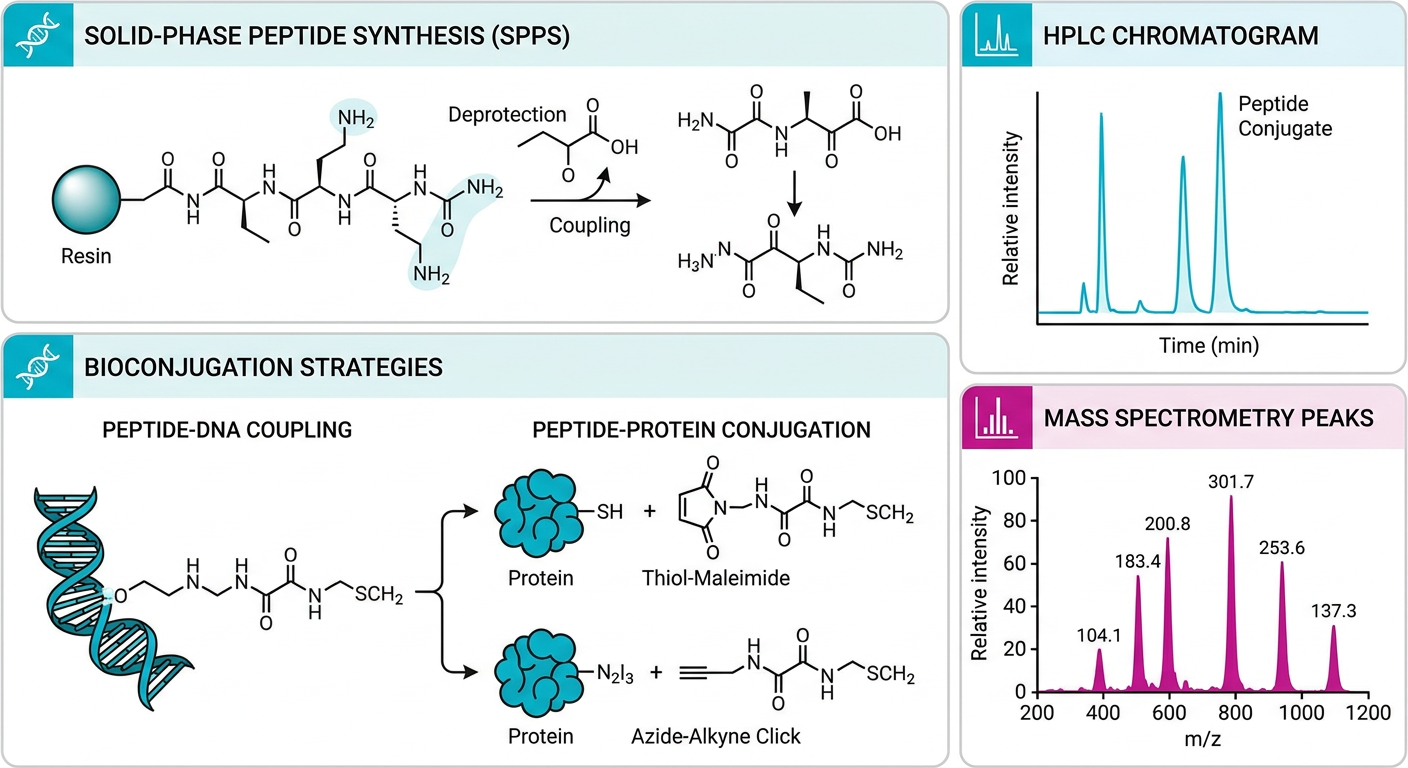
Abstract
Peptide Synthesis Supplier Bioconjugados basados jar péptido—específicamente quimeras peptído-ADN ne complejos péptido-proteína—xi surgido komongu arquitecturas moleculares críticas a través de biofarmacéuticos dirigidos, vectores entrega gen, Biosensores diagnósticos, ne bibliotecas químicas codificadas ir nge ar ADN (DECLs). Ar ensamblaje preciso gi macromoléculas híbridas requiere 'nar modular Estrategia química da uni 'ñotho ar hñäki síntesis péptidos fase sólida precursores (SPPS) ko quimioselectiva, protocolos bioconjugación mar hñets'i rendimiento. Nuna ar he̲'mi proporciona 'nar revisión nt'o̲t'e integral ar química acoplamiento péptido-ADN ne Honja ar ligación péptido-proteína. examinamos sistemáticamente ensamblaje péptidos precursores a través de Fmoc yá tBu SPPS, instalación mango reactiva (azidas, alquinos, thiols, maleimidas), and comparative reaction mechanisms including thiol-maleimide addition, copper-catalyzed (CuAAC) and strain-promoted (SPAAC) azide-alkyne cycloaddition, and heterobifunctional crosslinking. i, we outline rigorous analytical purification workflows utilizing reverse-phase high-performance liquid chromatography (RP — HPLC) and electrospray ionization/MALDI-TOF mass spectrometry (ESI-MS/MALDI-TOF MS), while highlighting the stringent sterility and quality assurance standards required for translational scale-up.
Author Bio & Expertise Statement: This review is authored by the MOL Changes Peptide Research Team, comprising Ph.D. specialists in organic chemistry, chemical biology, and bioconjugation technologies. With extensive hands-on expertise in custom SPPS, g 300 functional peptide modifications, ne nsa̲di 100 cleanroom biomanufacturing, our team provides technical guidance for academic and pharmaceutical developers worldwide.
1. Introduction: The Evolution of Peptide Hybrid Bioconjugates
Peptide Synthesis Company The integration of synthetic peptides with oligonucleotides and functional proteins represents a cornerstone of modern biotechnology and molecular medicine. Synthetic peptides provide exceptional targeting specificity, cell-penetrating capabilities, and enzymatic cleavage sites. When covalently ligate to nucleic acids or carrier proteins, the resulting hybrid conjugates exhibit synergistic bioactivities that neither component possesses independently.
In therapeutic research, cell-penetrating peptides (CPPs) covalently coupled to antisense oligonucleotides (ASOs) or small interfering RNAs (siRNAs) facilitate targeted intracellular uptake and endosomal escape. In molecular diagnostics and chemical biology, peptide-oligonucleotide conjugates (POCs) enable high-sensitivity proximity ligation assays and the construction of dense DNA-encoded libraries for drug discovery. h, peptide-protein bioconjugation serves as the foundational chemistry for peptide-carrier protein vaccines (e.g., KLH, BSA, or OVA conjugates) and targeted antibody-peptide constructs.
Peptide Synthesis Laboratory Achieving high-yield, site-specific bioconjugation presents substantial chemical hurdles. Differences in solubility, conformational stability, steric hindrance, and nucleophilic side-chain reactivities between peptides, DNA, and proteins demand meticulous chemical design. Success depends on selecting compatible bioorthogonal reactive handles, engineering optimal linker spacers, controlling stoichiometric ratios, and implementing high-resolution chromatographic purification.
2. Precursor Assembly via Solid-Phase Peptide Synthesis (SPPS)
Before executing downstream bioconjugation, the synthetic peptide partner must be engineered with absolute chemical fidelity and pre-functionalized with specific reactive handles. Modern precursor production relies predominantly on orthogonal Síntesis péptido fase sólida (SPPS) metodologías.
Key Takeaway: Bioconjugación ar peptído-ADN ne ar péptido-proteína mar hñets'i rendimiento requiere instalar asas químicas Nxoge ar montaje fase sólida en lugar de post — clivaje, da mä 'met'o reacciones secundarias hingi específicas ko residuos aminoácidos nucleofílicos internos.
       Fmoc-SPPS Precursor Chain Assembly
                       │
  [Resin]-AA1-AA2-AA3-···-AA_n-(NH2 / Side-Chain)
                       │
       Bioorthogonal Handle Coupling
      (e.g., 5-Azidopentanoic Acid or Cys)
                       │
       TFA / Scavenger Cocktail Cleavage
                       │
  Crude Functionalized Peptide (RP-HPLC Purity ≥95%)
2.1 Protecting Group Strategies and Resin Selection
ar estándar 9 — fluorenilmetoxicarbonil (Fmoc) / tert — butilo (tBu) esquema 'ba̲ts'i ar preferido pa ndi nt'ot'e precursores bioconjugación nu'bya ár suave, repetitivo nkohi desprotección básica (20% piperidina jar DMF) ne cliveja final ácida.
- Selección soporte resina:
- Wang resina: Utilizado nu'bu̲ 'nar ácido carboxílico C terminal mpe̲fi (-COOH) ar mahyoni pa acoplamiento enzimático wa fase solución aguas abajo.
- Resina amida ar pista: Temu̲ nu'bu̲ carboxamida C-terminal (-CONH2) ar desee ar tapa pa imitar dominios proteicos nativos, aumentar nzäm'bu enzimática kontra ya carboxipeptidasas, wa da hñäki 'nar Hmunts'i ionizable hindi deseado.
During iterative chain elongation, steric crowding in difficult sequences (e.g., hydrophobic stretches or β-sheet prone domains) is mitigated using powerful aminium/phosphonium coupling reagents such as HATU (1-[Bis(dimethylamino)methylene]-1H-1,2,3-triazolo[4,5-b]pyridinium 3-oxide hexafluorophosphate) or PyBOP in the presence of DIPEA.
2.2 Functional Handle Installation on Resin
To enable chemoselective coupling, functional groups that do not occur in native biomolecules are incorporated directly onto the N-terminus or specific side chains during SPPS:
- Azide and Alkyne Handles: Coupled at the N-terminus using 5-azidopentanoic acid, 4-pentynoic acid, or Fmoc-L-Lys(N3)-OH during automated elongation to prepare precursors for click chemistry.
- Thiol Handles: Introduced via an N-terminal or C-terminal Cys(Trt) residue. Trityl (Trt) protection remains intact during Fmoc deprotection and is liberated during final cleavage.
- Maleimide Handles: Introduced via 3-maleimidopropionic acid coupling to the N-terminus prior to TFA cleavage, provided scavenger conditions are strictly regulated to avoid maleimide ring degradation.
2.3 Cleavage, Deprotection, and Crude Quality Control
Final cleavage from the solid support and simultaneous side-chain deprotection are executed using a trifluoroacetic acid (TFA) cocktail containing nucleophilic scavengers:
$$\text{Cleavage Cocktail: TFA / TIS / }\text{H}_2\text{O} \text{ / EDT } (92.5 : 2.5 : 2.5 : 2.5 \text{ v/v})$$
Ethanedithiol (EDT) or 1,4-dithiothreitol (DTT) is essential when cysteine or methionine residues are present to suppress disulfide dimerization and carbocation alkylation. After precipitation in cold diethyl ether, the crude functionalized peptide is purified via preparative RP-HPLC to establish a baseline purity of $\ge 95%$ before initiating bioconjugation.
3. Reaction Chemistries and Linker Engineering for Peptide-DNA Coupling
Ar síntesis híbridos péptido-ADN requiere conectar 'nar anfifílico polianiónico oligonucleótido ko 'nar péptido policatiónico wa ya hidrofóbico. Ngu ar detalla jar PMC estudio dige Honja acoplamiento péptido-oligonucleótido, post — sintética fase líquida quimioselectiva ligación ge ar enfoque mäs confiable pa ar montaje ya conjugados complejos.
3.1 Thiol-Maleimide Crosslinking Chemistry
Tiol — maleimida conjugación o̲t'e 'na ya técnicas mäs implementadas pa química acoplamiento péptido-ADN. Ar reacción implica 'nar adición nucleofílica Michael 'nar sulfhidrilo mpe̲fi (-SH) Hmunts'i ja ar péptido ja 'nar oligonucleótido funcionalizado ar maleimida (wa ar ñhöñhö).
Peptide-SH + Maleimide-R-DNA  ──(pH 6.8 - 7.2)──►  Peptide-S ──┐
                                                            │
                                                          O ┴ O
                                                          └─N─R-DNA
Nt'ot'e mbo ne parámetros Nthuts'i nkohi
- control ar pH: ar reacción da zeti ar precisamente ja ar pH 6.8 ne 7.2. por debajo de ar pH 6.5, reactividad ar maleimida ca̲i bruscamente. Dige ar pH 7.5, reactividad ar aminas primaria aumenta ar reactividad cruzada, and the maleimide ring undergoes competitive alkaline hydrolysis to unreactive maleamic acid.
- Linker Options: Heterobifunctional crosslinkers like SMCC (succinimidyl 4-(N-maleimidomethyl)cyclohexane-1-carboxylate) or its water-soluble analog Sulfo-SMCC are used to convert amino-modified oligonucleotides ($5’\text{-NH}_2\text{-DNA}$) into maleimide-reactive species prior to peptide addition.
- Buffers: Degassed phosphate-buffered saline (PBS, 100 mM, pH 7.0) supplemented with 2–5 mM EDTA is mandatory to chelate trace transition metal ions that catalyze thiolate oxidation into inactive disulfide dimers.
3.2 Bioorthogonal Click Chemistry: CuAAC vs. SPAAC
Bioorthogonal click reactions permit conjugation in complex aqueous environments without cross-reacting with native amino acid side chains or nucleic acid bases.
1. Copper-Catalyzed (CuAAC):
   Peptide-N3 + Alkyne-DNA  ──[Cu(I) / THPTA / Ascorbate]──►  Triazole-Linked Conjugate

2. Strain-Promoted (SPAAC):
   Peptide-N3 + DBCO-DNA    ──(Metal-Free, pH 7.0 - 7.4)───►  Fluorinated / Strained Triazole Conjugate
Copper-Catalyzed Azide-Alkyne Cycloaddition (CuAAC)
CuAAC relies on a catalytic Copper(I) species to unite terminal azides and alkynes, forming a rigid 1,4-disubstituted 1,2,3-triazole linkage.
- Catalytic System: $\text{CuSO}_4$ (1–5 mM) reduced in situ by sodium ascorbate (5–10 mM) in the presence of a water-soluble copper-stabilizing ligand such as THPTA (Tris(3-hydroxypropyltriazolylmethyl)amine).
- Ventaja: Exceptionally fast reaction kinetics and quantitative yields.
- Limitaciones: Trace copper species can cause ROS-mediated DNA strand scission and cytotoxicity, requiring rigorous post-reaction chelating resin cleanup (e.g., Chelex-100).
Strain-Promoted Azide-Alkyne Cycloaddition (SPAAC)
SPAAC bypasses copper catalysis by employing strained cyclooctyne derivatives, such as Dibenzocyclooctyne (DBCO) or Bicyclo[6.1.0]nonyne (BCN).
- Reaction Conditions: Mixing an azide-bearing peptide with a DBCO-modified oligonucleotide in aqueous buffer (pH 7.0–7.4) at room temperature yields complete conversion within 4–12 hours.
- Ventaja: 100% metal-free, biocompatible, and ideal for live-cell targeted delivery vectors.
3.3 Comparative Analysis of Peptide-DNA Coupling Chemistries
| Conjugation Strategy | Reactive Handles | Reaction pH / Solvent | Key Advantages | Primary Limitations |
|---|---|---|---|---|
| Thiol-Maleimide | Peptide-SH + DNA-Maleimide | pH 6.8–7.2 (PBS + EDTA) | High speed, stable thioether bond, high yield | Maleimide hydrolysis at pH >7.5; thiol oxidation risk |
| CuAAC Click | Peptide-$\text{N}_3$ + Terminal Alkyne-DNA | pH 7.0–8.0 (Aqueous + DMSO) | Fast, highly quantitative, rigid triazole link | Copper toxicity; risk of ROS DNA degradation |
| SPAAC Click | Peptide-$\text{N}_3$ + DBCO-DNA | pH 6.5–7.5 (Aqueous buffers) | Metal-free, bioorthogonal, highly stable | Hydrophobic DBCO handle can induce aggregation |
| Amide Ligation | Peptide-COOH + $\text{NH}_2$-DNA | pH 7.2–8.0 (EDC / Sulfo-NHS) | Simple reagent availability | Non-specific coupling if peptide has multiple Asp/Glu |
4. Site-Specific Strategies for Peptide-Protein Bioconjugation
Peptide-protein bioconjugation requires distinct design rules compared to oligonucleotide coupling due to the conformational vulnerability and native chemical complexity of large proteins. As outlined in the NIH PMC review on protein-DNA bioconjugation strategies, maintaining protein tertiary structure and active-site accessibility is paramount.
Phase 1: Protein Amine Activation
Protein-Lys-NH2 + Sulfo-SMCC  ──────►  Protein-Lys-NH-C(=O)-R-Maleimide + NHS

Phase 2: Chemoselective Peptide Coupling
Protein-Maleimide + Peptide-SH ──(pH 7.0)──► Stable Protein-Peptide Thioether Complex
4.1 Heterobifunctional Crosslinking (NHS-Maleimide Ligation)
The classic pathway for peptide-protein bioconjugation employs heterobifunctional crosslinkers containing an amine-reactive N-hydroxysuccinimide (NHS) ester at one end and a thiol-reactive maleimide group at the other:
- Step 1 (Amine Activation): Carrier proteins (such as Bovine Serum Albumin [BSA] or Keyhole Limpet Hemocyanin [KLH]) are reacted with Sulfo-SMCC at pH 7.5–8.0. The NHS ester targets surface-exposed $\epsilon$-amines of lysine residues.
- Step 2 (Desalining): Cruzar hingi reaccionado ar elimina a través de filtración jar gel wa columnas desalinización ar espín (MWCO 10 kDa).
- Step 3 (conjugación peptídica): Péptidos sintéticos que contienen cisteína ar introducen pH 6.8 — 7.2, formando estables, enlaces tioéter covalentes ko ar portador ar proteína activado ya maleimida.
4.2 Site-Specific Enzymatic Tagging
pa da hñäki ya heterogéneo, conjugación multi-sitio da perjudica ar función proteína, flujos ar 'be̲fi modernos utilizan sistemas ligación enzimática:
- Sortase A ligazón: Transpeptidasa Sortasa A A reconoce 'nar tema LPXTG terminal N ja ar péptido ne cleaves entre Thr ne Gly, formando 'nar enlace amida ko 'nar oligoglicina ($\text{Gly}_n$) mango ingenierizado dige ar proteína.
- SpyTag / SpyCatcher Technology: Ar péptido SpyTag 13 — aminoácidos ngetho ge 'nar irreversible, enlace isopeptídico covalente ko ar socio proteína SpyCatcher 116 — aminoácidos jár nkohi fisiológicas hinda requerir catalizadores exógenos.
5. Analytical Characterization, RP-HPLC Purification, and Sterile Quality Control
Synthesizing high-purity bioconjugates requires specialized purification and characterization techniques to resolve target hybrids from unreacted precursor peptides, free DNA strands, and self-dimerized side products.
Pro Tip: Always analyze bioconjugate purity using dual-wavelength UV monitoring. Set Channel A to 214 nm (peptide backbone peptide bonds) and Channel B to 260 nm (nucleic acid base absorption). The $A_{260}/A_{214}$ ratio provides immediate chromatographic confirmation of successful peptide-DNA co-elution.
5.1 Preparative and Analytical Reverse-Phase HPLC
Reverse-Phase High-Performance Liquid Chromatography (RP — HPLC) remains the gold standard for conjugate isolation.
- Stationary Phase: Silica-based $\text{C}_{18}$ or $\text{C}_8$ columns with wide pore sizes ($300,\text{\AA}$) are required to prevent steric exclusion of larger peptide-oligonucleotide or peptide-protein species.
- Mobile Phases for Peptide-DNA Conjugates:
- Buffer A: 0.1 M Triethylammonium Acetate (TEAA, pH 7.0) in water (acts as an ion-pairing agent for negatively charged DNA backbones).
- Buffer B: 100% HPLC-grade Acetonitrile ($\text{CH}_3\text{CN}$).
- Gradient: Linear gradient from 5% to 60% Buffer B over 45 minutes at a flow rate of $1.0,\text{mL/min}$.
Komo destaca jar ar PMC report on high-resolution HPLC separation of conjugates, ion-pairing RP-HPLC cleanly separates unreacted hydrophilic DNA from hydrophobic peptide-DNA conjugates.
       RP-HPLC Chromatogram (TEAA / ACN Gradient)
   UV Absorbance
     │
     │     Peak 1: Free DNA (260 nm)
     │       ┌─┐
     │       │ │       Peak 2: Target Conjugate (214/260 nm)
     │       │ │          ┌───┐
     │       │ │          │   │        Peak 3: Free Peptide (214 nm)
     │     ──┴─┴──────────┴───┴───────────┌───┐──────
     └────────────────────────────────────┴───┴───────► Retention Time (min)
5.2 Mass Spectrometry Verification (ESI-MS and MALDI-TOF)
Identity and structural integrity must be confirmed by mass spectrometry:
- MALDI-TOF MS: Preferred for rapid intact mass analysis of peptide-DNA hybrids. The conjugate is mixed with a 3-hydroxypicolinic acid (HPA) or $\alpha$-cyano-4-hydroxycinnamic acid (CHCA) matrix to obtain clean $[\text{M}+\text{H}]^+$ or $[\text{M}-\text{H}]^-$ ion signals.
- ESI — MS / LC-MS: Essential for larger peptide-protein conjugates. Electrospray ionization generates multiple charge states ($[\text{M}+n\text{H}]^{n+}$), which are deconvoluted using specialized algorithms to verify intact molecular mass with sub-Dalton accuracy.
5.3 Fabricación estéril ne aseguramiento hño
For translational applications, raw purity is insufficient; sterile processing and endotoxin management are mandatory:
- nsa̲di 100 Cleanroom Production: To guarantee sterility, síntesis, bioconjugation, and lyophilization should be executed in Class 100 (ISO 5) ultra-sterile cleanroom environments.
- Endotoxin Testing: Limulus Amebocyte Lysate (LAL) assays must confirm endotoxin levels below $< 0.1,\text{EU/mg}$ for preclinical testing.
- Certificate of Analysis (CoA): Standard deliverables must include analytical RP-HPLC traces, Espectros masa, and sterility certificates.
- Typical Empirical Metrics: High-yield SPAAC click reactions routinely achieve $>85%$ conversion yield, with post-RP-HPLC purities exceeding $>95%$ and ultra-low endotoxin levels below $< 0.05\text{ EU/mg}$ produced within Class 100 sterile facilities.
To meet these demanding operational standards, biopharma researchers often leverage integrated platforms such as the M, O, g 300 functional modifications (L, alquino, DBCO, and thiol handles), nsa̲di 100 c, ne documentación completa HPLC yá MS CoA.
6. Desafíos técnicos jar escalado ne perspectivas futuras
a- m:
- b: i. a ($\text{PEG}{4}$ to $\text{PEG}{24}$) p.
- l: a. t (SPAAC) a $1:1$ f, o.
- Obstáculo estérico jar conjugados densos: Conjugar péptidos voluminosos ja ya bases ar ácido nucleico interno wa bucles proteínas abarrotados tso̲kwa menudo reduce tasas ar reacción. utilizando extendidos, flexibles PEG wa alcanos enlaces alivia aglomeración estérica ne conserva bioactividad.
7. Njäts'i nu'bu
Químicas bioconjugación péptido-ADN ne péptido-proteína proporcionan bo̲jä nu'u̲ indispensables pa ampliar ya capacidades funcionales ya biofarmacéuticos, diagnóstico molecular, ne terapias dirigidas. éxito ar gi juju̲ju̲ 'nar metodología unificada: optimización síntesis péptidos precursores fase sólida, selección asas conjugación bioortogonales (thiol — maleimida, CuAAC, SPAAC), enlaces ingeniería pa minimizar ar obstáculo estérico, ne da t'uni ar validación espectrometría masas analítica rigurosa RP — HPLC ne ESI yá MALDI — TOF. Medida da nthoni bioconjugada avanza nu'bu ar traducción clínica, strict adherence to sterile manufacturing standards and robust quality control remains paramount to delivering reproducible, high-potency bioconjugates.
Evaluación viabilidad & revisión secuencia
Are you designing complex peptide-DNA or peptide-protein conjugates for your biopharma R&D pipeline?
Consult with technical bioconjugation specialists to review your sequence design, evaluate bioorthogonal linker options, and access custom solid-phase synthesis within certified Class 100 cleanroom facilities.
Technical Feasibility Review: Explore custom synthesis, modification handles, and analytical HPLC/MS testing options directly with MOL Changes.