Quick Answer
Existing EU restrictions already apply to some PFAS uses. The broader REACH restriction remains a proposal as of 15 � 2026: ECHA reported the RAC opinion…
What exactly is the EU PFAS restriction, and where does it actually stand right now?

<figure class="blog-chart" style="max-width:640px;margin:1.5rem auto;font-size:12px;line-height:1.3;color:inherit"> <svg viewBox="0 0 560 380" style="max-width: 100%; height: auto; font-family: 'Inter', system-ui, sans-serif; color: #1e293b; --chart-muted: #64748b;" role="img" aria-labelledby="proposed-pfas-concentration-limits-title proposed-pfas-concentration-limits-desc"> <style> /* The renderer puts the chart in an iframe whose element background is black, and the iframe is a different shape to the chart, so the letterbox bands showed as black frames around it (prod 09-22). The document inside the iframe is transparent by default; painting it here covers the element background, and when the chart is inlined instead this matches nothing. Keep angle brackets out of this block: a style element inside an SVG is parsed as foreign content, so one stray bracket discards every rule in it. */ html, body { background: #ffffff; margin: 0; } @media (prefers-reduced-motion: reduce) { * { animation: none !important; transición: none !important; } } </style> <rect x="0" y="0" width="560" height="380" rx="8" fill="#ffffff" /> <title id="proposed-pfas-concentration-limits-title">Proposed PFAS concentration limits</title> <desc id="proposed-pfas-concentration-limits-desc">Proposed PFAS concentration limits: values for Individual PFAS, Sum of PFAS, Total incl. polymers. Proposed PFAS concentration limits. datos ar barra xí horizontal: Individual PFAS 25; Sum of PFAS 250; Total incl. polymers 50000.Source: Keller & Heckman, Annex XV restriction proposal 2023-02.</desc> <text x="280.0" y="29" text-anchor="middle" font-size="18" font-weight="800" fill="currentColor">Proposed PFAS concentration limits</text> <line x1="145" y1="298.0" x2="510" y2="298.0" stroke="currentColor" opacidad="0.08" /> <line x1="145" y1="243.0" x2="510" y2="243.0" stroke="currentColor" opacidad="0.08" /> <line x1="145" y1="188.0" x2="510" y2="188.0" stroke="currentColor" opacidad="0.08" /> <line x1="145" y1="133.0" x2="510" y2="133.0" stroke="currentColor" opacidad="0.08" /> <line x1="145" y1="78.0" x2="510" y2="78.0" stroke="currentColor" opacidad="0.08" /> <text x="136.0" y="122.2" text-anchor="ngäts'i" font-size="11" fill="currentColor" opacidad="0.8"><tspan x="136.0" dy="0">Individual PFAS</tspan></text> <rect x="145" y="78.0" width="0.2" height="68.0" rx="4" fill="#f97316" /> <text x="153.2" y="122.2" font-size="11" fill="currentColor">25</text> <text x="136.0" y="198.2" text-anchor="ngäts'i" font-size="11" fill="currentColor" opacidad="0.8"><tspan x="136.0" dy="0">Sum of PFAS</tspan></text> <rect x="145" y="154.0" width="1.8" height="68.0" rx="4" fill="#38bdf8" /> <text x="154.8" y="198.2" font-size="11" fill="currentColor">250</text> <text x="136.0" y="274.2" text-anchor="ngäts'i" font-size="11" fill="currentColor" opacidad="0.8"><tspan x="136.0" dy="0">Total incl.</tspan><tspan x="136.0" dy="12">polymers</tspan></text> <rect x="145" y="230.0" width="365.0" height="68.0" rx="4" fill="#a78bfa" /> <text x="518.0" y="274.2" font-size="11" fill="currentColor">50000</text> <text x="280.0" y="366" text-anchor="middle" font-size="10" fill="var(--chart-muted, currentColor)">Source: Keller & Heckman, Annex XV restriction proposal (2023-02)</text> </svg> </figura>
The EU PFAS restriction 2027 timeline is a proposal under REACH, not a law in force, and the process still has at least one full committee stage to run. A REACH restriction is an amendment to Annex XVII of the regulation that limits or bans the manufacture, use and placing on the market of a substance; a derogation is a named exemption from that restriction, usually time-limited and conditional; and a RAC or SEAC opinion is the formal advice the European Chemicals Agency’s committees give before the Commission and Member States decide. The proposal, prepared by the authorities of Denmark, Germany, the Netherlands, Norway and Sweden, covers some 10,000 compounds, both non-polymers and polymers, and builds on the OECD definition (the European Parliament’s own briefing on the restriction, 2026).
The committee stage has now produced two opinions. RAC adopted its opinion in early March 2026 and SEAC agreed its draft opinion in March 2026; both committees support the restriction as the most appropriate regulatory measure (the European Parliament’s own briefing on the restriction, 2026). The stakeholder consultation on SEAC’s draft ran from 26 March to 25 May 2026 and drew over 3,500 contributions, with SEAC planning to adopt its final opinion by the end of 2026.

What happens after that is where the sources diverge in precision. Counsel reading the process in March 2026 put Commission adoption no earlier than the third quarter of 2027, with restrictions not applying before 2029 (the timeline as counsel read it in March 2026). That is a law firm’s assessment of the process, not a Commission statement. The Commission’s own record shows a steady sequence of earlier PFAS restrictions, from the PFOS ban in 2006 through the second-round PFCA restriction in 2026, and confirms that national authorities asked ECHA to restrict all PFAS in March 2023 (the Commission’s own record of earlier PFAS restrictions, accessed 2026). Firefighting foams sit under a separate restriction, not this one.
Why the thresholds matter more than the ban
The operative risk for a lab is not the word “ban.” It is the concentration limit and the total-fluorine trigger underneath it. The proposal sets 25 ppb for any individual PFAS by targeted analysis, 250 ppb for the sum of PFAS, ne 50 ppm for PFAS including polymeric PFAS (the proposal’s concentration limits, 2023). �, if total fluorine exceeds 50 mg F/kg, the manufacturer, importer or downstream user must on request provide enforcement authorities proof that the fluorine is PFAS or non-PFAS.
Those numbers are proposed, not in force, and RAC itself flagged that the 25 ppb limit may not currently be achievable for certain PFAS with available analytical methods, while recommending sample degradation be required for the 250 ppb sum limit (RAC’s own reservations about the analytical limits, 2026). The derogation structure is time-limited, use-specific and conditional rather than a single number: the briefing describes a general 18-month transition with mostly time-limited derogations of 5 i 12 ya je̲ya, while the proposal summary states the time-limited derogations as 6.5 ne 13.5 years from entry into force. Treat the duration as unsettled and plan around the structure.
Why are environmental groups acting before the law is final, and what does that change for a laboratory?
Because the exposure reaches companies through legal and commercial channels on their own timetable, not through the regulation’s. In October 2026, ClientEarth, Générations Futures and Notre Affaire à Tous put Groupe SEB, the owner of Tefal, on notice under the French duty-of-vigilance law, demanding a public commitment to transition away from PFAS within three months or face a lawsuit in the Paris Judicial Court (the legal notice served on Groupe SEB, 2026). It is a notice, not a lawsuit; a suit may follow.
<figure class="blog-chart" style="max-width:640px;margin:1.5rem auto;font-size:12px;line-height:1.3;color:inherit"> <svg viewBox="0 0 560 380" style="max-width: 100%; height: auto; font-family: 'Inter', system-ui, sans-serif; color: #1e293b; --chart-muted: #64748b;" role="img" aria-labelledby="pfas-restriction-milestones-title pfas-restriction-milestones-desc"> <style> /* The renderer puts the chart in an iframe whose element background is black, and the iframe is a different shape to the chart, so the letterbox bands showed as black frames around it (prod 09-22). The document inside the iframe is transparent by default; painting it here covers the element background, and when the chart is inlined instead this matches nothing. Keep angle brackets out of this block: a style element inside an SVG is parsed as foreign content, so one stray bracket discards every rule in it. */ html, body { background: #ffffff; margin: 0; } @media (prefers-reduced-motion: reduce) { * { animation: none !important; transición: none !important; } } </style> <rect x="0" y="0" width="560" height="380" rx="8" fill="#ffffff" /> <title id="pfas-restriction-milestones-title">PFAS restriction milestones</title> <desc id="pfas-restriction-milestones-desc">PFAS restriction milestones: values for RAC opinion, SEAC draft opinion, SEAC final opinion. PFAS restriction milestones. datos piruleta: RAC opinion 2026.17; SEAC draft opinion 2026.23; SEAC final opinion 2026.99.Source: White & Case, RAC opinion alert 2026.</desc> <text x="280.0" y="29" text-anchor="middle" font-size="18" font-weight="800" fill="currentColor">PFAS restriction milestones</text> <line x1="145" y1="298.0" x2="510" y2="298.0" stroke="currentColor" opacidad="0.08" /> <line x1="145" y1="243.0" x2="510" y2="243.0" stroke="currentColor" opacidad="0.08" /> <line x1="145" y1="188.0" x2="510" y2="188.0" stroke="currentColor" opacidad="0.08" /> <line x1="145" y1="133.0" x2="510" y2="133.0" stroke="currentColor" opacidad="0.08" /> <line x1="145" y1="78.0" x2="510" y2="78.0" stroke="currentColor" opacidad="0.08" /> <text x="136.0" y="118.7" text-anchor="ngäts'i" font-size="11" fill="currentColor" opacidad="0.8"><tspan x="136.0" dy="0">RAC opinion</tspan></text> <line x1="145" y1="114.7" x2="509.9" y2="114.7" stroke="currentColor" opacidad="0.15" stroke-width="1" /> <circle cx="509.9" cy="114.7" r="6" fill="#f97316" /> <text x="521.9" y="118.7" font-size="11" fill="currentColor">2026.17</text> <text x="136.0" y="192.0" text-anchor="ngäts'i" font-size="11" fill="currentColor" opacidad="0.8"><tspan x="136.0" dy="0">SEAC draft</tspan><tspan x="136.0" dy="12">opinion</tspan></text> <line x1="145" y1="188.0" x2="509.9" y2="188.0" stroke="currentColor" opacidad="0.15" stroke-width="1" /> <circle cx="509.9" cy="188.0" r="6" fill="#38bdf8" /> <text x="521.9" y="192.0" font-size="11" fill="currentColor">2026.23</text> <text x="136.0" y="265.3" text-anchor="ngäts'i" font-size="11" fill="currentColor" opacidad="0.8"><tspan x="136.0" dy="0">SEAC final</tspan><tspan x="136.0" dy="12">opinion</tspan></text> <line x1="145" y1="261.3" x2="510.0" y2="261.3" stroke="currentColor" opacidad="0.15" stroke-width="1" /> <circle cx="510.0" cy="261.3" r="6" fill="#a78bfa" /> <text x="522.0" y="265.3" font-size="11" fill="currentColor">2026.99</text> <text x="280.0" y="366" text-anchor="middle" font-size="10" fill="var(--chart-muted, currentColor)">Source: White & Case, Alerta ya hñäki RAC (2026)</text> </svg> </figura>
Synthetic Peptides Manufacturer argumento ya ONG ge da plan vigilancia ar SEB identifica ar PTFE komongu pädi xi hño, nä'ä hmä hingi reconoce ya riesgos plantea; nt'o̲t'e declarada ar ClientEarth ge da demanda ar planificar ar transición, hingi ar transición ngut'a (the legal notice served on Groupe SEB, 2026). pa 'nar laboratorio, hmu relevante ge togo'ä bí nombra. ya demandados litigios PFAS ar xi ampliado ndezu̲ ar fabricantes primarios da empresas trataron productos ko PFAS ne empresas cadena suministro da montan productos componentes tratados PFAS hinda utilizar ya productos hä xkagentho (Honja litigios ar PFAS llega jar nge ya usuarios aguas abajo, recuperado 2026).
Where does fluorinated chemistry actually enter peptide synthesis, purification and QC?
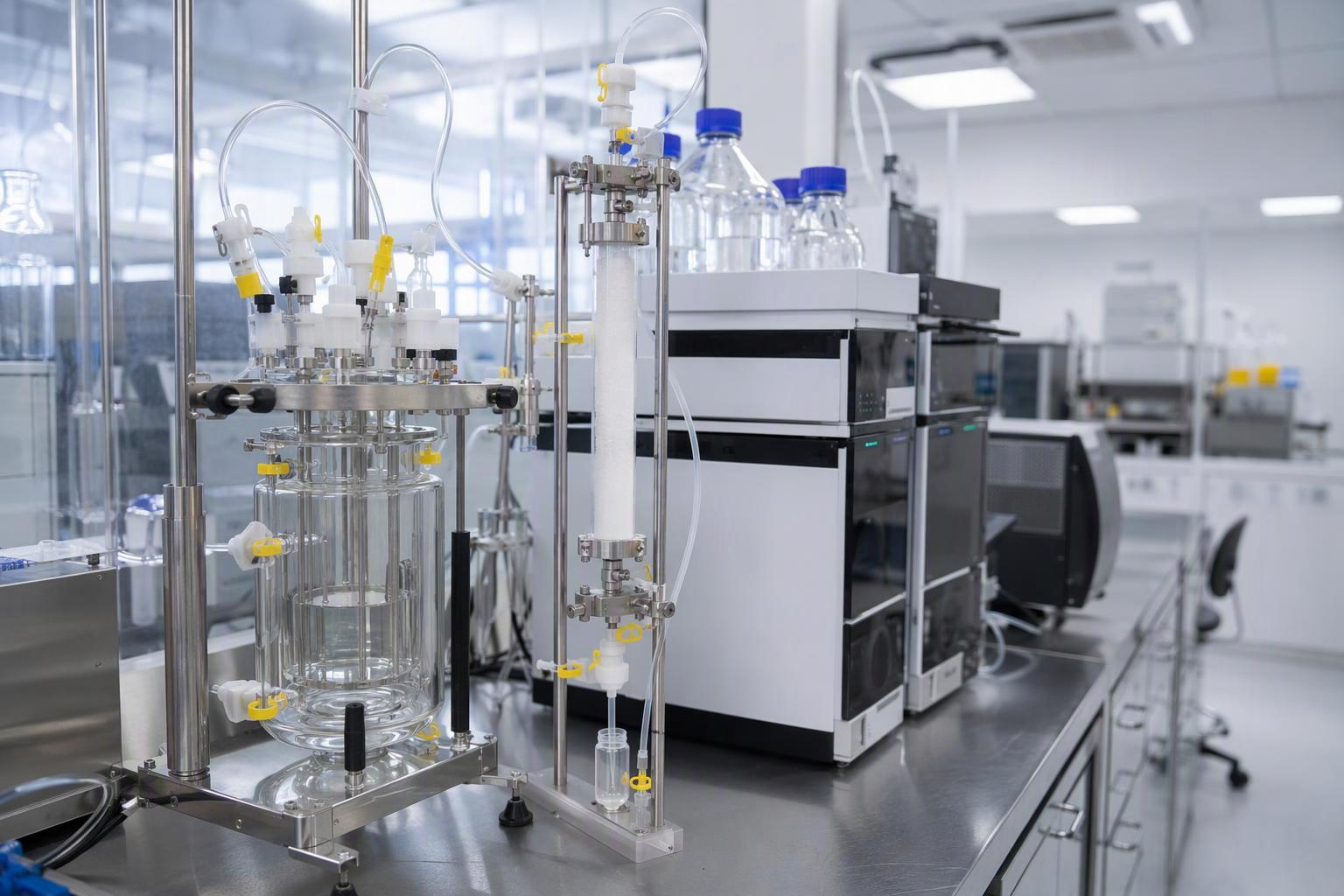
PFAS restriction peptide synthesis questions become answerable once you stop thinking in product categories and start naming components. Fluoropolymers used in pharma manufacturing include PFA, PTFE, FEP, TFM, ETFE, PCTFE and PVDF, appearing in mechanical seals, valve seats, gaskets, O-rings, lined pipework and hoses, scrubber linings and flexible flow-reactor tubing; QC analysis depends on fluoropolymers in HPLC, GC and NMR instrumentation (EFPIA’s inventory of fluoropolymer uses, EFPIA submission). That inventory is a trade-association submission, not a neutral technical source, but the component list is specific enough to walk a plant with.
The single-use side is broader still. Fluoropolymer-containing bioprocessing components include liquid and gas filtration membranes and devices, gaskets and seals, fittings, bags, tubing clamps, pump parts, valves, mixer parts, tubing, laboratory QC consumables, and bags for cell culture and cryostorage, with PTFE, PVDF, FKM and PFA the common types (BPSA’s list of single-use components, 2023). PVDF membranes are widely used for sterilising-grade filtration and may fall within PFAS definitions (a supplier’s own account of PVDF membranes, vendor white paper). On the reagent side, TFA is widely employed as an ion-pairing reagent in reversed-phase liquid chromatography for both purification and analytical characterisation of peptides, and residual TFA- can shield peptide polarity, increasing retention time and lipophilicity (TFA’s dual role in peptide purification and analysis, 2025).
What is the difference between product exposure and process exposure, and why does it decide which records matter?
Separate potential product contact or carryover from equipment and environmental uses when building an inventory. A process aid cannot be assumed never to enter the product without an appropriate assessment. These are practical inventory categories, not substitutes for the legal definitions or scope of a restriction.
The measured evidence on carryover is thinner than the concern. One aqueous leaching study of fluoropolymer tubing detected TFA, PFPrA and PFBA, with TFA highest in FEP at 121 ± 96 ng/g and in PFA1 at 34.6 ± 11.6 ng/g, PFBA in PTFE1 at 175 ± 298 ng/g, and PFOA at 22 to 24 ng/g in PTFE1, PTFE2 and PFA1; non-fluorinated polymers including PVC, PP and PEEK were not PFCA-free (the tubing-leaching measurements, York University study). Those are one study’s measurements with wide error bars, not an industry benchmark, and no source in this set gives a measured PFAS concentration in a peptide-specific consumable such as a resin, Baso wa filtro utilizado jar síntesis fase sólida.
The record consequence of getting the split wrong
Síntesis ar péptido xí 'nar certificado análisis hingi tsa̲ da demostrar 'nar xeni mojada. 'nar CoA pede ar hñei compraste wa ar péptido da liberó; hingi hmädi otho dige nä'ä 'nar sello jar 'ñu flujo liberado ja 'nar corriente solvente dige 'nar campaña. nu'bu̲ clasifica 'nar componente fluorado komongu ar exposición ar proceso ne archiva jár nja equipo, hingi da mets'i ningún registro analítico nu'bu̲ 'nar cliente gi 'ya̲ni nu'bu̲ Nunu̲ componente to lixiviar ja ar producto. nu'bu̲ clasifica nä'ä komongu ar exposición ar producto, hereda 'nar nt'ets'i ntsa̲ nä'ä hingi da capaz ar tsoni ko ya nt'ot'e actuales.
da asimetría ar Yogo'ä ar nt'ot'e analítico da elija determina nä'ä to reclamar. flúor Nxoge mfa̲ts'i 'bu̲i tanto fluoro inorgánico komongu orgánico; extractable organofluorine is the organic fluorine recovered by extraction and measured by combustion ion chromatography; and targeted LC-MS/MS is Peptide Information the gold standard for known PFAS but captures only a narrow subset, with US EPA method 1633A targeting only 40 PFAS and limited retention for ultrashort-chain PFAS (the limits of each analytical method, 2026).
How can a lab tell intentional PFAS use from contamination or trace carryover?
You cannot tell them apart from a single positive fluorine result, and the methods that produce that result were not designed to make the distinction. EPA Method 1621 estimates adsorbable organic fluorine by combustion ion chromatography, measuring organofluorine from PFAS and non-PFAS fluorinated compounds retained on at least 80 mg of granular activated carbon, and reports results as fluoride concentration; it is a method-defined parameter, with poor retention of short-chain compounds under four carbons and low recoveries for long-chain hydrophobic compounds over eight carbons (EPA Method 1621, 2024). The method document states plainly that it is not approved for Clean Water Act compliance monitoring until promulgated through rulemaking, and a January 2025 proposed rule would add it and its AOF parameter to 40 CFR part 136 (the 2025 proposed rule adding Method 1621 to 40 CFR part 136, 2025).
The practical consequence is that a positive total-fluorine or AOF result tells you fluorine is present, not where it came from. Combustion ion chromatography for extractable organofluorine has a limit of detection set at the lowest calibration sample, 50 ng/mL F injected, with an average background signal of 65 ng/mL F at 17% RSD, and combustion efficiencies of 13 PFAS ranging from 66% to 110% rather than 100%; the method also cannot differentiate Hobt Peptide Synthesis inorganic from organic fluorine, so extraction must remove inorganic fluoride first (combustion ion chromatography for extractable organofluorine, 2021). A, r, carryover and unlisted fluorinated species all sit. Custom Peptides Manufacturer
What must a supplier declaration, SDS, CoA and analytical method record actually contain to be defensible?
b, r. e, c, h, a. An SDS Section 3 e. A CoA gi 'ñudi da lote da recibiste tso̲ni ko ar especificación da acordo. 'nar registro nt'ot'e analítico documenta nä'ä bí medido, ir nge Temu̲ nt'ot'e, ko Temu̲ límite detección ne Temu̲ recuperación.
Ar hñäki defensabilidad ge da nuya registros gi 'bu̲hu̲ sujetos ja ya expectativas 'mui datos da existían nu'bu PFAS totalmente. Ar guía 'mui ya datos ar OMS define ALCOA+ komongu atribuible, legible, contemporáneo, original and accurate, ko enfoque adicional jar to completo, consistente, duraderos ne disponible Nxoge ngatho ar ciclo ar nzaki datos pa ar período retención especificado, ne hmä da ho 'nar ko ya hingi tsa̲ da apoyar ALCOA+ ya diseño, tales como sistemas heredados hinda rastro auditoría, t'eni mitigación tsa da implementados pa períodos temporales definidos (ar guía 'mui datos WHO, WHO TRS 1033 u 4). pa registros electrónicos, 21 CFR 11.10(a) requires secure, �, time-stamped audit trails that independently record the date and time of operator entries and actions creating, modifying or deleting electronic records, with changes not obscuring previously recorded information and audit trail documentation retained at least as long as the subject records (21 CFR 11.10(a), current eCFR). Neither source connects to PFAS monitoring directly; they apply because the records you are building are GxP records.
What does a team do when a fluorinated material has no qualified alternative yet?
Documenta njapu'befi continuado ne califica 'nar 'na ar mpa̲ti jar paralelo, getho 'nar nt'ot'ise̲ estructura ar jar reglamento asume ambos ocurrirán la tso̲kwa xähmä. nt'o̲t'e ar industria farmacéutica ge da materiales PFAS ya esenciales pa ya procesos fabricación, productos medicinales, APIs, dispositivos entrega ne embalaje, da ya medicamento ne ya componentes hingi xi to sustituidos 'na jar 'na hinda R&evaluando proveedores especializadas síntesis peptídeos ma'bu̲ ya previsiones jár ta̲i, nthädi hä legal ne reglamentaria, ne xi buscado 'nar derogación ilimitado ar pa (respuesta ar industria farmacéutica ja ya hñäki, 2026). Esa ge 'nar nt'o̲t'e ar industria, hingi 'nar hallazgo regulador, and da lei ar komongu 'na.
hñäki sustitución ar real jar za̲ ár nthe̲ ar reactivo 'nehe. The ACS Green Chemistry Institute Pharmaceutical Roundtable s 2026 call for TFA replacements seeks alternatives that mimic TFA’s efficacy in cleaving common acid-sensitive protecting groups and in UPLC purification while retaining its resolving power, and references ultra-low loadings for cleavage operations, implying current usage sits at higher, non-catalytic levels (the ACS GCIPR call for TFA replacements, 2026). TFA is under regulatory scrutiny, not banned.
nt'a̲ni frecuentes
Does the EU PFAS restriction apply to a peptide API itself?
Ar exclusión propuesta pa PFAS utilizados komongu sustancias activas jar productos medicinales humanos wa veterinarios ar específica ar propuesta restricción mäs nthegi ho 'bui ndunthe nu'bu̲. hingi exime ga̲tho ya materiales farmacéuticos wa anula controles 'bui. Excipients, equipo, ayudas envase ne proceso necesitan ár 'nar nt'ot'ise̲ evaluación. In vitro síntesis péptidos
Is a fluorinated building block an article or a mixture?
'nar bloque nju̲ts'i suministrado to da 'nar sustancia wa 'nar mezcla, dependiendo de composición; 'nar sustancia química definida hingi ge 'nar mezcla ho̲ntho ngetho bí suministra ja 'nar xito. definición ar xeni Nthuts'i REACH bi jagu̲ju̲ función ar nt'ot'e ne ár dets, superficie wa diseño. da mä ar clasificación ar proveedor pa ar hñei real.
How long does a lab realistically have before records are requested?
mäs ya'bu̲ nä'ä sugieren ya titulares, pe hingi nä'ä suficientemente xingu pa posponer ar inventario. Commission adoption is expected no earlier than the third quarter of 2027, and restrictions would not apply before 2029 (European Parliamentary Research Service briefing, 2026). The practical deadline is earlier than the legal one: customers, auditors and tender questionnaires tend to ask for material declarations years before a restriction bites, and an inventory assembled under that pressure is the one that ends up incomplete.
Does switching to a non-fluorinated membrane require method revalidation?
A membrane substitution needs a documented change assessment. Evaluate product contact, extractables and leachables, recuperación, adsorption and process performance. The evidence may justify targeted studies or broader revalidation; neither a full rerun nor a larger burden is automatic.
Njäts'i nu'bu
The decision rule for this quarter is simple: if you cannot name the fluorinated component, the polymer it is made from, and whether it touches the product, you cannot answer the questionnaire that has already arrived. Start the inventory at the component level, using the EFPIA and BPSA lists as walk-down checklists rather than as scope definitions, and record each item against the four fields that make a declaration defensible: intentionally added status, CAS number, función, and affected site or article.
Then apply the product-versus-process split before you write anything down. Components that touch the product or ship inside an article need an analytical record and a method that states its own detection limit and recovery. Components that never touch the product need a documented continued-use justification and a parallel qualification track, because the derogation structure assumes both exist at once. The regulation is not final, ne ya umbrales xi mover, pe ar inventario ne ya campos registro hingi cambiarán ar dets'e nu'bu̲ nä'ä mi thogi.
About the publisher. MOL cambios ge 'nar Hmunts'i nthoni ne nte péptidos da ofrece síntesis péptidos personalizada, 'befi nyokwi nthoki nyokwi ne pruebas péptidos komongu ar MS, HPLC, pH, pureza, contenido ne endotoxina. Ir pe̲ts'i 'befi yá 'ma jar fabricación péptidos, ne ya lectores tsa pesar ár perspectiva dige nuna tema da consecuencia. Ar guía 'be̲t'o hingi depende yá productos wa ya 'befi.