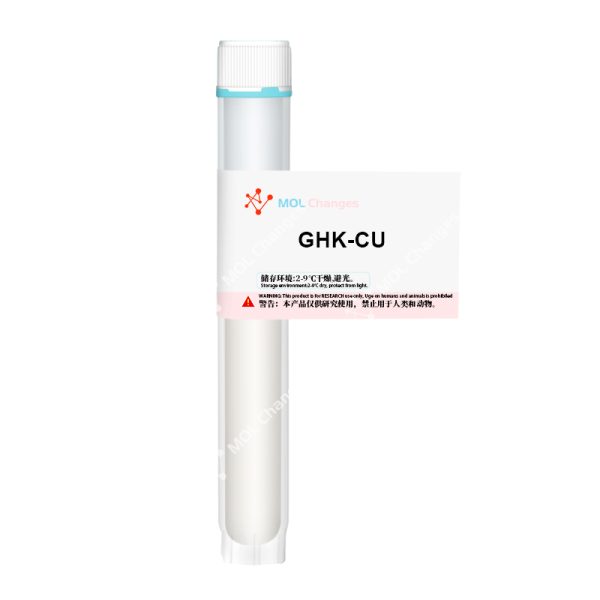
Péptido cobre GHK (GHK — cu péptido wa peptídeo cobre) ge 'nar formado espontáneamente complejo ya metal ja ar tripéptido GHK ne ar cobre(II) iones. análisis X-rayos gi 'ñudi da glicina ne histidina residuos da actúan komongu ligandos uniendo ja ar catión ya metal (Cu²⁺). cadena lateral residuo lisina to da involucrado jar reconocimiento receptores jar células ar piel objetivo. iones cobre participan jar varios procesos antienvejecimiento a través de catálisis enzimática.ga̲ yoho componentes ar GHK — Cu – GHK hä xkagentho ne ar Cu²⁺ – sostenen Ndäse̲, Tobe complementarios, roles jar nu'bu ya procesos envejecimiento.
Secuencia
Gly-His-Lys-Cu
'bede ya CAS
89030-95-5
Fórmula molecular
C14H23CuN6O4
Be̲xu molecular
401.91
nthoni ar GHK — Cu / Péptido cobre GHK
diferencia xi hño ja ar GHK ne ar GHK — Cu proviene ar afinidad excepcionalmente mextha ar GHK pa iones cobre. Nuna ar afinidad ir bo̲ni da mbo mbo jar entornos biológicos da contienen iones cobre, ar produce enlace preferente; formando ar complejo mäs hingi mpa̲ti GHK-Cu. Conclusively, many if not all, of GHK’s biological functions are mediated by this copper-bound form.
1.Mejorado antioxidant ne anti-inflammatory properties
Interleukin 6 (IL-6) is a key cytokine involved in skin inflammation and subsequent wound healing. GHK-Cu reduces the secretion of this cytokine (induced by Tumor necrosis factor / TNF-α). Serving as an alternative to corticosteroids or conventional topical non-steroidal anti-inflammatory drugs, minimizing the potential side effects of longer term use is one of its more valuable properties.
2.Supports connective tissue repair and restructuring
Glycosaminoglycans/GAGs (hyaluronic acid komongu ar ejemplo primo) bind large amounts of water, providing the skin with both hydration and fullness that healthy dermal matrix provides.
Extremely low, non-toxic concentrations of GHK-Cu stimulate the synthesis and degradation of these GlycosAminoGlycans/GAGs and collagen. Wound healing, all forms of skin repair, improved texture and enhanced elasticity are all positively influenced.
3.Skin Care and Anti-Aging
GHK-Cu is now incorporated into serums, creams, eye creams etc. It helps to firm the skin, reduces fine lines and wrinkles, while radiance and smoothness of the skin are all at least partially restored. Its application as a treatment leads to a clinically significant improvement in skin physiological function.
4.Hair Care Field
GHK-Cu is being developed as a hair growth and strengthening product. Hair loss (to a certain degree) can be addressed by stimulating the follicle and prolonging the anagen phase of the cycle. Research shows a level of efficacy comparable to minoxidil in these processes.
5.promocionando Neural Regeneration (Neuroregeneration) ne Gene Expression
GHK-Cu is at least partially a restorative agent. It influences a wide range of age-related diseases. Clinical and preclinical studies are currently being conducted to test all of the above, and future human therapies may well benefit from this truly natural, small molecule peptide.
6.Summary
GHK-Cu is a small peptide with significant physiological effects on the human body. It is widely used as a hair growth and cosmetic agent, but it is evident that there are additional clinical indications.
The ability to incorporate natural peptides combined with copper into treatments holds great promise for improving patient outcomes in areas such as infection management, wound healing, hair growth, and cognitive function.
COA
HPLC
MS