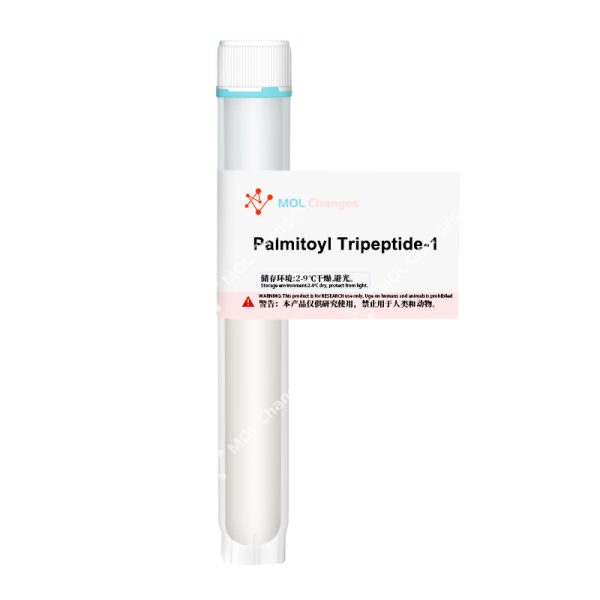
Palmitoyl Tripeptide-1(Pal-GHK/Palmitoyl-GHK) is a derivative of GHK.
Chemically modifying GHK with palmitic acid – a 16-carbon fatty acid – forms this derivative.
The palmitic acid covalently attaches to the peptide; serving as a hydrophobic moiety, the primary objective being enhanced skin permeability.
Secuencia
Pal-Gly-His-Lys
'bede ya CAS
147732-56-7
Fórmula molecular
C30H54N6O5
Be̲xu molecular
578.79 g yá mol
Research Of Palmitoyl Tripeptide-1
GHK occurs naturally within the human body and is widely regarded as a multifunctional bioregulator.
Stimulating collagen and elastin synthesis, promoting wound healing, anti-inflammatory and antioxidant effects are all attributed to it.
Poor skin permeability is the key challenge GHK faces when used as a topical active; small molecule peptides by nature are hydrophilic.
The outermost layer of the skin, the stratum corneum, creates a highly hydrophobic barrier (lipids being the main composition).
Effective penetration past this layer to reach dermal target sites is hindered, penetration being the limiting factor.
Modifying hydrophilic peptides with hydrophobic groups to increase skin permeability is the logical solution.
Palmitoyl Tripeptide-1 is the product of this strategy.
Covalent linking of palmitic acid (a saturated 16C fatty acid) to GHK achieves this.
Higher skin permeability and improved compatibility with the lipid environment of the stratum corneum is observed; biological activity of the peptide itself remains largely unchanged, while transdermal delivery is improved.
Palmitoyl Tripeptide-1 itself functions as a potent signaling molecule.
It mimics the natural signals generated during extracellular matrix (ECM) fragmentation; directly interacting with receptors on cell membranes, it significantly stimulates collagen type I synthesis.
simultáneamente, it stimulates glicosaminoglicano (GAG) síntesis – ma'na componente estructuralmente mahyoni ar matriz piel – da du'mi ma ne ya procesos regenerativos.
consiguiente, ár hne anti-envejecimiento xí demostrado ya Palmitoyl Tripeptide — 1.
Ya nsadi xi demostrado específicamente síntesis colágeno komongu estimulado ja ya cultivos fibroblastos humanos, degradación nuna ar colágeno (de̲ni ar exposición UV ondas largas) da evitado.
Palmitoyl Tripeptide — 1 ne yá análogos (Palmitoyl Tetrapeptide — 7, Palmitoyl Pentapeptide — 4, etc.) nu'bya xi hño investigados ne incorporados jar numerosas formulaciones mextha gama cuidado ar piel.
Palmitoyl Tripeptide — 1 ar ampliamente utilizado jar cosméticos; mäs xi ngu permeabilidad ar piel jar comparación ko ar GHK ne ár nt'ot'e biológica comparable komongu ya razones ndu'mi 'me̲hna.
Matrixyl 3000™ ge 'nar ejemplo primo – the two active ingredients being Palmitoyl Tripeptide-1 and the previously mentioned tetrapeptide, widespread anti-aging products utilizing this combination are commonplace.
Currently there is a lack of independent clinical studies evaluating the pure efficacy of Palmitoyl Tripeptide-1.
Complex formulations containing it are typically the subject of current research.
Market and regulatory acceptance of Palmitoyl Tripeptide-1 as a cosmetic active, wat'i, is well established as a mature cosmetic ingredient.
COA
HPLC
MS