What Peptide Design Challenges Beyond GLP-1 Actually Are
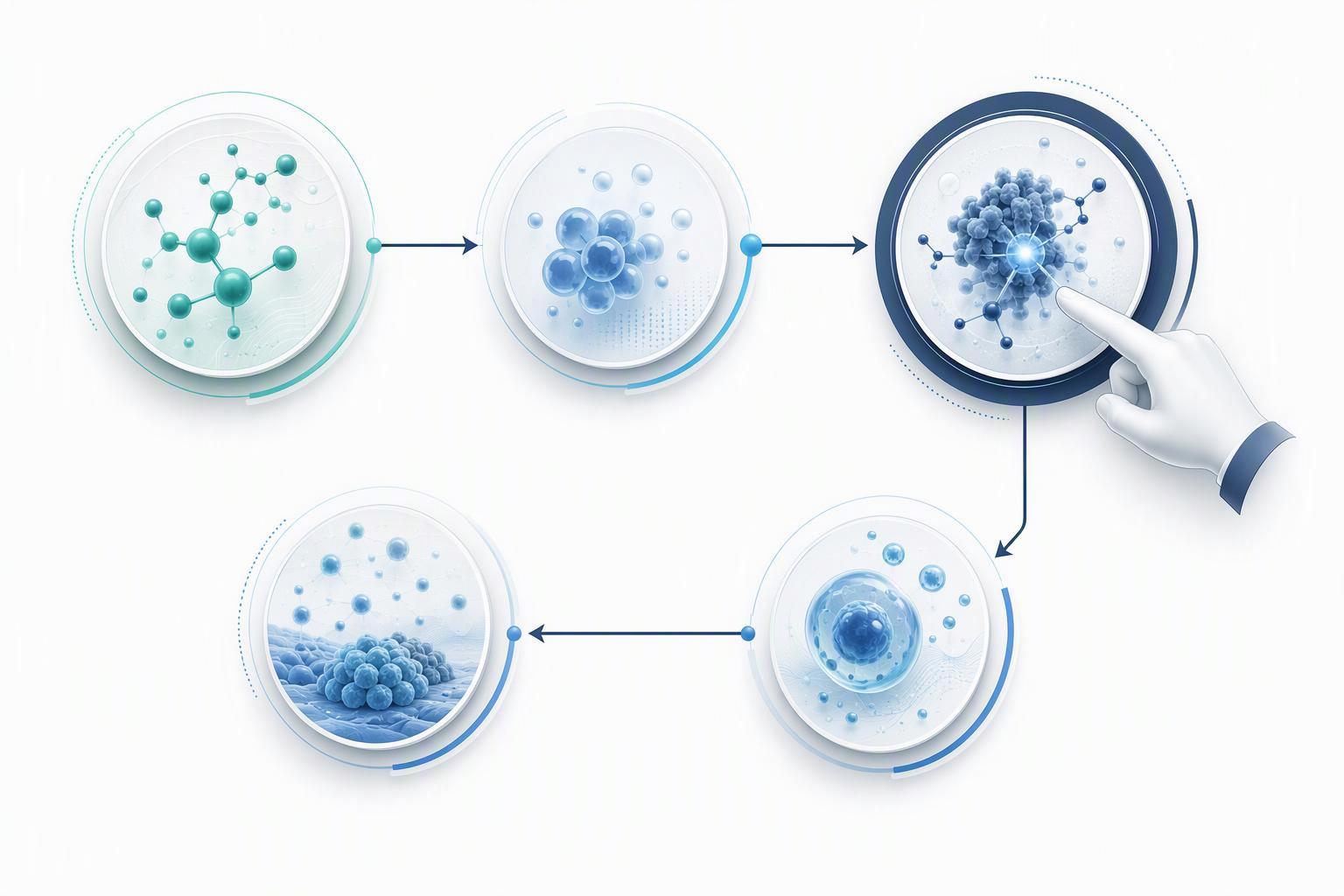
Peptide design challenges beyond GLP-1 are the linked set of chemistry and manufacturing constraints that decide whether a next-generation anti-obesity peptide is deliverable, not just potent. They behave like a fixed budget: every modification that buys one property spends another. Fatty-acid acylation, the attachment of a lipid chain that lets a peptide ride on albumin and clear the body slowly, is the clearest example. Stapling, which locks a helix with a covalent bridge, is another. Neither is free.

Semaglutide itself shows the arithmetic. Its design combines two amino-acid substitutions (Aib8, Arg34), derivatization at Lys26, and a fatty-diacid albumin binder built for high albumin affinity and full stability against metabolic degradation (Lau et al., J Med Chem 2015). That same molecule binds the GLP-1 receptor at 0.38 ± 0.06 nM, roughly three-fold weaker than liraglutide (Lau et al., J Med Chem 2015). The reference product on the market is a compromise, not an optimum.
Five trade-offs follow from that starting point, and they form a chain rather than a checklist: half-life extension, moc, stability, route of administration, and manufacturability. A decision on the first propagates into the rest. Hydrophobic sequences, for instance, punish solid-phase synthesis in ways that show up later as purity problems (Frontiers review, 2020).
They cannot all be optimized at once. A program concedes one, chosen against its target product profile. This is a mechanism-level explainer, not clinical guidance.
Why Half-Life Extension Is Where the Trade-Off Chain Starts
Half-life extension is the first decision in a peptide program because it dictates the modification, and the modification dictates everything downstream. Among peptide half-life extension strategies, lipidation is the one that reshaped the field. A fatty-acid chain added to the backbone binds albumin reversibly in circulation, creating a depot that slows renal clearance and stretches exposure from minutes to days.
The payoff is measurable. A design paper behind semaglutide reported a mini-pig intravenous half-life of 46.1 h and a subcutaneous mean residence time of 63.6 h, though mini-pig values do not translate directly to humans (PMC, 2024). In humans, subcutaneous semaglutide reaches a terminal half-life of 145–168 h and is dosed once weekly; that figure comes from a systematic review summarizing the FDA label, not from the label PDF itself (PMC, 2024). Tirzepatide sits at roughly five days, subcutaneous only (StatPearls, updated 2026-09-14).
The cost arrives with the benefit. Every added fatty-acid chain raises hydrophobicity, which increases aggregation tendency and changes on-column behavior during reversed-phase purification. The half-life a program targets therefore sets how much hydrophobicity it must accept, and that acceptance is what the next decisions inherit.
Potency, Stabilność, and the Cost of Engineering Both
Potency and stability are usually bought with the same modifications that later complicate purification, which is why they belong in one section rather than two. The levers are well established: substituting a single amino acid can shift receptor affinity, and engineering dual GLP-1/GIP agonism recruits a second incretin pathway to strengthen the metabolic effect. Stability is engineered separately, by blocking the sites where the molecule degrades fastest.
The semaglutide design shows both moves at once. An Aib8 substitution and an Arg34 change reduce cleavage by DPP-4, while Lys26 derivatization with a fatty-diacid albumin binder extends circulation time through albumin binding. The honest trade-off sits inside that package: semaglutide’s receptor affinity is roughly three-fold weaker than liraglutide’s, so potency was traded for duration rather than maximized.
Read that as a mechanism, not a ranking. Affinity and half-life figures of this kind vary by molecule and by assay conditions, so no cross-molecule potency comparison should be drawn from this section.
Key Takeaway: A clean in-vitro potency result is not evidence of a deliverable molecule. The two points where otherwise promising designs fail are purification and scale-up, and the rest of this article addresses both.
Route of Administration and the Bioavailability Ceiling
Oral peptide delivery bioavailability is not a formulation problem waiting for the right excipient. It is an absorption ceiling that a program designs around, and the gap between peptides and small molecules shows how low that ceiling sits.
Subcutaneous injection remains the default for peptide therapeutics because it bypasses the gut entirely. The oral route has to cross a barrier built to break peptides down, and the numbers show the cost. A systematic review of semaglutide’s clinical pharmacokinetics reports absolute bioavailability of 0.4% to 1% for the original oral formulation and 1% to 2% for the SNAC-containing R2 formulation. Those figures are corroborated by the review rather than confirmed against the FDA label itself, which is the limit of what the published record supports here.
Those figures are also specific to one molecule and one formulation. Oral bioavailability varies widely across peptides and delivery technologies, and generalizing from semaglutide to an arbitrary sequence is not supported. Delivery-side work responds to the same ceiling rather than removing it: hydrogel depots and sustained-release formats trade a lower peak for a longer window.
Glikozylacja peptydów The practical consequence is that route choice feeds back into the half-life target, which feeds back into the modification budget. A program that commits to oral delivery is not choosing a formulation; it is choosing a constraint that every later design decision has to absorb.
Manufacturability: Where a Design Problem Becomes a Purity Problem
Peptide manufacturability and scale-up is where a design choice stops being a cost question and becomes a purity question. The route you pick and the sequence you designed decide each other, and most programs meet that constraint only after the first scale-up batch fails.
Three routes cover the field. Solid-phase peptide synthesis (SPSS) handles medium-to-long and modified sequences, recombinant expression suits long unmodified chains, and hybrid approaches combine liquid- and solid-phase steps. On difficult sequences, the choice of chemistry matters as much as the route: Boc-based synthesis generally outperforms Fmoc, and non-polar polystyrene resins tend to give cleaner crude material for hydrophobic peptides.
Synteza kombinatoryczna The hard-sequence data is blunt. A 34-residue hydrophobic transmembrane fragment gave 4% yield in DMF and 12% coupling yield after switching to 80% NMP/DMSO, and no product at all via the Fmoc route (Frontiers in Bioengineering and Biotechnology, 2020). Sequences beyond roughly 50 to 60 residues stay difficult even with microwave assistance, though that ceiling comes from aggregated vendor guidance rather than a primary study, so treat it as directional. Purification is the last squeeze: hydrophobic targets have been recovered below 1% isolated yield, with the hardest reported at around 1 to 2% (PMC, 2008).
Scale-up precedent exists but is narrow. Enfuvirtide, a 36-amino-acid peptide, is the large-scale chemically synthesized peptide the canonical review anchors (Bray et al., Nature Reviews Drug Discovery, 2003), and its abstract carries no yield or cost figures.
The so-what: a lipidation decision made in the design phase arrives here as a yield and impurity-profile problem.
Analytical Testing as a Design Input, Not a Downstream QC Step
Forced degradation, plasma-stability and cleavage-pathway data belong in the round that informs the next synthesis, not in a release panel at the end. Treating them as downstream QC is what turns Fosforylacja peptydów a design problem into a manufacturing problem: by the time a purity number appears on a certificate, the counterion form, the impurity profile and the endotoxin limit are already fixed.
The levers that separate the two are specific. Counterion form matters first, because trifluoroacetate and acetate do not behave identically in a bioassay, and a potency result read against the wrong salt form misleads the next design round. Endotoxin limits sit under the LAL framework, where the compendial chapter’s referee technique is the Gel Clot Limit Test and the limit is expressed through the sample concentration and maximum valid dilution rather than one universal value (USP PDG harmonization page for <85>, official 2012-12-01). Lot-to-lot impurity-profile comparison is the third lever: a single purity figure says nothing about whether the same impurities recur.
Key Takeaway: A certificate of analysis reports a purity number. An analytical package explains what the impurity profile means for the next round, which is the version a design team can act on.
Validation expectations for those methods come from ICH Q2(R2) Validation of Analytical Procedures, final and dated March 2024, which sets the general framework; the individual validation characteristics have to be read from the guideline itself, not from the FDA summary page. Sterility testing follows the compendial sterility test (USP PDG harmonization page for <71>), whose methods and 14-day incubation period are likewise not on that page. Zszyte peptydy
This is where a custom peptide synthesis and analytical testing order should be specified: name the counterion, the impurity-comparison method and the stability timepoints up front, so the analytical package arrives as an input to the next design cycle rather than a verdict on the last one. MOL Changes supports this workflow through custom synthesis with defined HPLC purity grades, and the specification conversation is the place to set those parameters.
Common Misconceptions That Cost Programs Time
The most expensive misconception in peptide design is that the five trade-offs are five independent problems you can optimize one at a time. They are not. A decision on lipidation changes the purification problem, which changes the impurity profile, which changes the analytical burden. Treating them as a checklist rather than a chain is what turns a promising sequence into a program that stalls at scale.
Four specific errors follow from that assumption.
High receptor affinity predicts in-vivo duration. It does not. Binding at the receptor says nothing about how quickly proteases clear the peptide or how fast the kidneys filter it. A tight binder with a short half-life is still a short-lived drug.
A high HPLC purity number means a manufacturable sequence. Purity at small scale reflects the batch in front of you, not whether the sequence will hold together when you scale it. Aggregation, on-column behavior, and difficult couplings show up later.
Oral delivery is a formulation problem waiting for the right excipient. The bioavailability ceiling Usługa syntezy peptydów is a property of the molecule, not the capsule. No excipient fixes a peptide that cannot cross the gut wall intact.
Analytical testing is a cost center. It is the cheapest de-risking step available, because it tells you which of the other four trade-offs you have already lost. Produkcja peptydów
The limitation is real: these trade-offs cannot all be optimized simultaneously.
Getting Started and Next Steps
Start by writing down which of the five trade-offs your target product profile concedes. Half-life, moc, stability, route and manufacturability pull against each other, and the one you accept as a loss constrains the other four before a single synthesis request goes out. Programs that skip this step usually rediscover the concession later, at higher cost.
Three low-friction actions follow from that decision.
-
Name the conceded trade-off in the target product profile. Put it in writing next to the specification it limits, so the design team and the analytical team are working from the same constraint.
-
Specify the analytical package alongside the sequence, not after it. Purity method, identity confirmation and the impurity questions you need answered belong in the same request as the sequence itself. Deciding them later means re-running work you have already paid for.
-
Run forced degradation and plasma stability before committing to a scale-up route. These are design inputs, not release tests. A route chosen before they are in hand is a route you may have to abandon.
Next steps: Review the custom peptide synthesis and analytical testing package with a synthesis scientist, and bring your conceded trade-off to that conversation.
Disclosure: MOL Changes has a commercial interest in peptide quality standards. This content is for research and educational purposes and does not constitute medical advice; consult a qualified healthcare professional before making medical decisions.
Frequently Asked Questions
Why does a peptide that works in assay fail at purification?
Because the properties that drive potency, such as a lipophilic tail or a stapled helix, also drive on-column aggregation during reversed-phase HPLC, so crude purity and isolated yield can diverge sharply even when binding data look clean. Treat purification strategy as a design input rather than a step that follows it.
Is oral peptide delivery close to solving its bioavailability problem?
Not close enough to design around. Oral bioavailability for unmodified peptides typically sits in the low single digits, and the permeability enhancers used to improve it bring their own variability in absorption and GI tolerability. For most programs an injectable or long-acting depot route stays the realistic path while oral work remains exploratory.
What purity grade suits an early research program?
It depends on what the assay can tolerate, not on a default. An 80% or 90% grade is often adequate for initial screening where the impurity profile does not interfere, while 95% I 98% grades matter for structural work, reference standards, or any assay sensitive to truncated sequences. Confirm the grade against the analytical method you will run.
How does counterion choice affect downstream assays?
Counterions travel with the peptide and can shift mass, solubility, and apparent activity. Trifluoroacetate is the common HPLC default, but it is not always compatible with cell-based work or with assays sensitive to residual acid. Where a program needs an acetate or hydrochloride form, that conversion has to be specified and verified rather than assumed.
What belongs in an analytical package for a difficult or aggregating sequence?
At minimum, an HPLC purity trace with method parameters and a mass spectrometry identity confirmation, plus the chromatogram itself so the reader can judge the impurity profile. For aggregating sequences, add the conditions under which the sample was handled and any evidence of the aggregation state. Treat the package as the record that lets the next lab reproduce your result.
Are recombinant routes always cheaper than SPPS at scale?
NIE. Recombinant expression and microbial fermentation can be economical for longer sequences and for proteins, but they bring their own development cost, purification burden, and post-translational variability. Solid-phase synthesis remains competitive for medium-to-long modified peptides, and hybrid approaches exist precisely because neither route wins universally.
Conclusion
The five peptide design challenges beyond GLP-1 are not a checklist. They are one chain, and whichever link a program commits to first constrains the four that follow: a lipidation strategy chosen for half-life sets the hydrophobicity the purification step must handle, which sets the impurity profile the analytical package must resolve, which sets how much of the synthesis route can be scaled at all. Treating them as independent workstreams is what turns a clean assay result into a stalled scale-up.
That is the mechanism worth carrying forward. Half-life extension, moc, stability, route of administration, manufacturability and analytical testing are one interlocking decision, and the cheapest place to intervene is upstream, before the first route is locked.
One caution on the numbers. The field’s pipeline figures move faster than the dated source set behind this article, so check the publication date on any specific figure before relying on it for a program decision. The next step is to take the trade-off you have already committed to and trace its consequences forward through the chain.