Що означає новий імунопептидомічний набір Thermo Fisher для індивідуальних робочих процесів пептидів
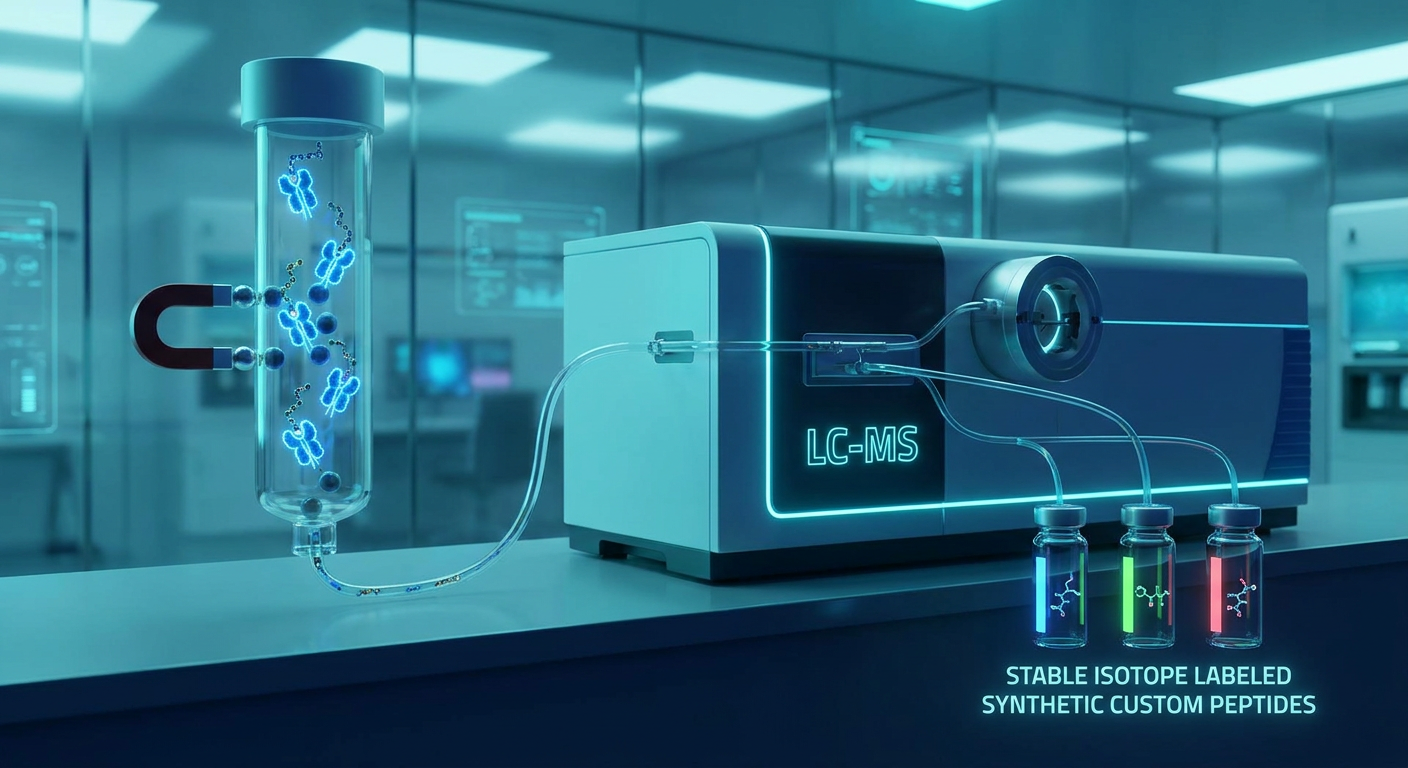
Mass spectrometry-based immunopeptidomics has transitioned from a specialized academic discovery tool into an essential bioanalytical pillar for biopharmaceutical R&D. From neoantigen cancer vaccine discovery and T-cell receptor (TCR-T) target identification to autoimmune target profiling, direct interrogation of human leukocyte antigen (HLA)-bound peptides provides un-modeled proof of antigen presentation. However, historically, variability in immunoaffinity purification (IP), micro-scale peptide isolation, and manual sample cleanup severely limited inter-laboratory reproducibility and assay throughput.
The commercialization of standardized immunopeptidomics sample preparation platforms—exemplified by Thermo Fisher Scientific’s Pierce MHC Class I Antibody Coupling and Immunoprecipitation Kit paired with ultra-high-resolution Orbitrap Exploris and Orbitrap Astral LC-MS/MS systems—represents a milestone in analytical workflow maturity. By standardizing pan-MHC Class I antibody (clone W6/32) magnetic bead coupling, low-pH elution, and automated C18 desalting, downstream analytical coefficients of variation (CV) have dropped below 15%.
Yet, as downstream mass spectrometry sample prep becomes routine and highly reproducible, a new analytical bottleneck emerges: upstream custom synthetic peptide specifications. Peptide
as downstream mass spectrometry sample prep becomes routine and highly reproducible, a new analytical bottleneck emerges: upstream custom synthetic peptide specifications.
Standardized kits elevate expectations for synthetic reference standards, retention-time calibration peptides, and heavy isotope labeled (SIL) spike-in controls. When downstream sample preparation variability is minimized, synthetic peptide heterogeneity—such as incomplete isotopic enrichment, неточний чистий вміст пептидів, counter-ion interference, and hydrophobic aggregation—becomes the primary source of quantitation error and false-negative target validation.
This analysis examines how standardized immunopeptidomics kits alter upstream custom peptide requirements, evaluates the critical quality control parameters needed for kit compatibility, and outlines practical adaptations that custom peptide synthesis providers must adopt to support modern proteomics research.
Standardizing Downstream Sample Prep: The Pierce MHC Kit Benchmark
To understand why upstream peptide specifications must adapt, bioanalytical leads must first analyze the chemistry and mechanics of standardized downstream kits. Historically, immunopeptidomics relied on custom-packed Sepharose or Protein A/G agarose columns requiring manual crosslinking with dimethyl pimelimidate (DMP), multi-step gravity washes, and manual stage-tip desalting. These manual protocols introduced significant run-to-run variability and high background contaminant levels.
Commercial kits streamline and standardize this pipeline into a controlled, four-stage micro-scale protocol optimized for low-input cell lysates (10⁷ to 10⁸ cells) or tissue biopsies:
Standardized Immunopeptidomics LC-MS/MS Pipeline
- Antibody Coupling: Pan-specific anti-human HLA Class I antibody (clone W6/32) is directly coupled to Protein A/G magnetic agarose beads at a fixed ratio (2.5 µg antibody per 1 µL bead slurry), eliminating manual resin activation and variabl
Fragment 176-191 Peptide Low-pH Elution: HLA complexes are dissociated and eluted using standardized 1% trifluoroacetic acid (TFA) or dilute 0.1 N acetic acid, releasing bound 8- to 11-mer peptides alongside HLA heavy chains and beta-2 microglobulin (β2M).
r digitonin).
- Low-pH Elution: HLA complexes are dissociated and eluted using standardized 1% trifluoroacetic acid (TFA) or dilute 0.1 N acetic acid, releasing bound 8- to 11-mer peptides alongside HLA heavy chains and beta-2 microglobulin (β2M).
- C18 Micro-Desalting & LC-MS/MS: Peptides are isolated from high-molecular-weight proteins using C18 spin tips or automated microfluidic stage-tips, eluted in 25% до 50% acetonitrile (ACN) containing 0.1% TFA, dried, reconstituted in 0.1% formic acid (FA), and analyzed via high-resolution reversed-phase UHPLC coupled to tandem mass spectrometers.
Ключ на винос: Standardized kits eliminate manual IP column preparation, reducing downstream sample handling variance to < 15% CV. Consequently, analytical errors in targeted PRM/DIA assays now originate predominantly from upstream synthetic peptide reference standards.
As detailed in research published in PMC’s optiPRM Targeted Immunopeptidomics Workflow (2024), automated and kit-standardized sample processing enables highly reproducible parallel reaction monitoring (PRM) and data-independent acquisition (DIA). However, achieving absolute quantitation requires synthetic heavy-labeled AQUA peptide standards whose chemical integrity matches the precision of the mass spectrometer.
Upstream Ripple Effects: Redefining Custom Peptide Specifications
The widespread adoption of standardized immunopeptidomics kits alters the required chemical and physical specifications of custom synthetic peptides across four distinct dimensions: sequence-level solubility, isotopic purity, net peptide content verification, and counter-ion control.
(Drives Demand For) Quantitation Rigor: Net peptide content via Amino Acid Analysis (AAA) Counter-Ion & Стерильність: TFA-free exchange & Клас 100 cleanroom production
UPSTREAM PEPTIDE SPECIFICATION RIPPLE Downstream Standardization (Thermo Pierce MHC Kit) Low-pH Elution (1% TFA) & C18 Micro-Cleanup Orbitrap LC-MS/MS Quantification (PRM/DIA) Upstream Custom Peptide Requirements Hydrophobic Sequence Handling: Anchor-aware synthesis for 8-11mers Isotopic Purity: > 99.0% heavy isotope incorporation (13C/15N)
1. Navigating Hydrophobic Anchor Sequences and Aggregation
MHC Class I molecules naturally present short peptides, типово 8 до 11 amino acids in length, characterized by rigid structural motifs. Position 2 (P2) and the C-terminal position (P9/P10) serve as primary anchor residues that dock into specific pockets of the HLA heavy chain binding groove. For common alleles such as HLA-A*02:01, these anchors consist almost exclusively of highly hydrophobic aliphatic or aromatic amino acids: Leucine (Leu), Valine (Val), Isoleucine (Ile), Methionine (Met), Phenylalanine (Phe), and Tyrosine (Tyr).
When synthesized custom peptides mirror these endogenous HLA ligands, their high hydrophobic content leads to severe aqueous insolubility and rapid non-specific adsorption to polypropylene microcentrifuge tubes and LC autosampler vials.
- Insolubility in Loading Buffers: Standardized LC-MS reconstitution buffers (0.1% FA / 1% ACN) frequently fail to solubilize hydrophobic 9-mers, causing precipitation prior to column injection.
- Surface Adsorption Losses: At picomolar or femtomolar concentration ranges used for LC-MS spike-in calibration curves, unpassivated peptide sequences adsorb onto container walls, distorting linearity (R² < 0.95).
2. Isotopic Purity vs. Mass Error Tolerances
For targeted immunopeptidomics assays utilizing Selected Reaction Monitoring (SRM), Parallel Reaction Monitoring (PRM), or DIA with internal standards, synthetic peptides are synthesized using Stable Isotope Labeled (SIL) amino acids. Typically, heavy Arg (13C6, 15N4; mass shift +10 І) or heavy Lys (13C6, 15N1; mass shift +8 І) is incorporated at the C-terminus.
On ultra-high-resolution instruments such as the Orbitrap Astral or Orbitrap Eclipse operating at 120,000 до 240,000 resolving power (m/z 200), mass error tolerances are constrained to ≤ 5 ppm. Incomplete isotopic enrichment during amino acid precursor synthesis creates “light isotope leakage”—unlabeled peptide species present within the heavy-labeled standard. If isotopic enrichment falls below 99.0%, the residual light signal overlaps with endogenous low-abundance HLA ligands, generating false-positive quantification baseline signals.
3. Чистий вміст пептидів: Moving Beyond HPLC Optical Purity
A critical misconception in custom peptide procurement is equating RP-HPLC analytical purity (214 nm peak area percentage) with absolute peptide concentration.
RP-HPLC purity merely indicates the relative abundance of the target peptide se
Чистий вміст пептидів (%) = Mass of Pure Peptide Src Peptides Laboratory Sequence/Total Lyophilized Powder Weight × 100
s, such as residual moisture, counter-ions (trifluoroacetate or acetate), and bound salts. Gross gravimetric weight typically overestimates actual peptide content by 15% до 35%.
Чистий вміст пептидів (%) = Mass of Pure Peptide Sequence/Total Lyophilized Powder Weight × 100
For standardized immunopeptidomics workflows requiring absolute quantification (fmol/µL spike-ins), relying on gross dry weight introduces systematic qu
Standard Solid-Phase Peptide Synthesis (SPSS) використовує трифтороцтову кислоту (TFA) for cleavage from resin and reversed-phase purification. Residual TFA counter-ions remaining as trifluoroacetate salts can suppress electrospray ionization (ESI) efficiency during Research 1 Peptides Supplier LC-MS analysis. Furthermore, background biological contaminants (endotoxins, residual bacterial DNA, or traces of keratin/trypsin) introduced during peptide packaging can blind sensitive Orbitrap detectors, which operate at sub-femtomolar limits of detection.
ons remaining as trifluoroacetate salts can suppress electrospray ionization (ESI) efficiency during LC-MS analysis. Furthermore, background biological contaminants (endotoxins, residual bacterial DNA, or traces of keratin/trypsin) introduced during peptide packaging can blind sensitive Orbitrap detectors, which operate at sub-femtomolar limits of detection.
Quality Control and Turnaround Requirements for Heavy-Labeled Standards
To align custom peptide production with high-throughput kits, synthesis vendors must re-engineer their Quality Control (QC) frameworks and operational delivery models.
Analytical Thresholds for Immunopeptidomics-Ready Custom Peptides
| Parameter | Standard Research Grade | Immunopeptidomics-Ready Grade | Analytical Validation Method |
|---|---|---|---|
| RP-HPLC Purity | ≥ 90% | ≥ 98% | C18 RP-HPLC (0.1% TFA / ACN gradient, 214 нм) |
| Масова точність | ± 1.0 І | ≤ 5 ppm (± 0.005 І) | High-Resolution ESI-Orbitrap / MALDI-TOF MS |
| Isotopic Enrichment | > 95% | > 99.0% | Tandem MS isotopic envelope distribution analysis |
| Чистий вміст пептидів | Not measured (Gross weight) | Exact value certified via AAA | Quantitative Amino Acid Analysis (AAA) |
| Solubility Certification | Visual water check | Verified in 0.1% FA / 1% ACN | Centrifugation & LC-MS peak area verification |
| Endotoxin Level | Uncontrolled | < 0.01 ЄС/мг | Chromogenic LAL Assay |
| Manufacturing Space | General Laboratory | Клас 100 Ultra-Sterile Cleanroom | ISO 14644-1 Клас 5 environmental monitoring |
The Turnaround Imperative in Neoantigen Screening
In personalized cancer immunotherapy and neoantigen vaccine development, researchers isolate endogenous HLA ligands using kits like the Thermo Fisher Pierce MHC Class I Sample Prep Workflow and identify candidate mutated peptides within 48 до 72 hours via de novo sequencing algorithms.
To validate candidate neoantigens, researchers must immediately order matching synthetic heavy-labeled (SIL) peptide libraries (типово 20 до 96 sequences) for PRM validation. Traditional custom peptide lead times of 4 до 6 weeks create an unacceptable bottleneck in clinical research pipelines. Modern custom peptide vendors must deliver parallel 96-well synthesis with a 5 до 7 business day turnaround without compromising analytical QC thresholds.
Strategic Adaptations for Custom Peptide Providers: Enabling Researcher Adoption
To help researchers adopt standardized immunopeptidomics kits with total confidence, custom peptide synthesis providers must transition from passive contract manufacturers into specialized bioanalytical partners.
Leading synthesis platforms, such as MOL Changes’ specialized custom peptide synthesis platform, demonstrate how targeted technical adaptations solve upstream sample challenges.
THREE PRACTICAL ADAPTATIONS FOR PEPTIDE PROVIDERS
- Curated Immunopeptidomics-Ready Catalogs Allele-Specific Reference Libraries (HLA-A02:01, HLA-A24:02, HLA-B*07:02) Retention Time Calibration Standards (PRTC-grade isotopically labeled mixes)
- Targeted Immunopeptidomics QC Panels High-Res ESI-MS Mass Accuracy (<= 5 ppm) & Isotopic Enrichment (> 99.0%) AAA Net Peptide Content Certification & 1% TFA Solubility Testing
- Rapid SIL Heavy Labeling & Cleanroom Synthesis High-Throughput Parallel 96-Well SPPS (5-7 Day Delivery Window) Клас 100 Cleanroom Manufacturing to Eliminate MS Background Contaminants
1. Curated Immunopeptidomics-Ready Catalogs
Peptide providers should offer pre-designed, pre-evaluated peptide libraries tailored to major HLA supertypes alongside retention-time calibration mixtures.
- Allele-Specific Reference Libraries: Pre-synthesized sets of high-affinity endogenous ligands for prevalent human alleles (e.g., HLA-A*02:01, HLA-A*24:02, HLA-B*07:02, and HLA-DRB1*01:01). These serve as positive controls for kit immunoaffinity enrichment efficiency.
- Retention Time Calibration Mixtures: Heavy-labeled peptide cocktails spanning the entire hydrophobicity spectrum (gradient retention times from 5% до 65% ACN). Spiked into kit eluates prior to C18 cleanup, these standards allow automated retention time alignment across multi-batch LC-MS runs.
2. Targeted Immunopeptidomics QC Panels
Rather than delivering standard Certificates of Analysis (CoAs) containing basic HPLC trace overlays, peptide providers must introduce specialized LC-MS QC panels:
Immunopeptidomics CoA Standard: Every synthesized peptide includes ESI-MS accurate mass measurement (≤ 5 ppm), tandem MS isotopic enrichment confirmation (> 99.0%), AAA-certified net peptide concentration, and solubility validation in 0.1% FA / 1% ACN.
By leveraging heavy isotope labeled (SIL) peptide standards backed by certified AAA net content, researchers eliminate concentration bias when establishing absolute quantification calibration curves on Orbitrap LC-MS platforms.
3. Rapid Heavy-Isotope Labeling & Cleanroom Synthesis
Custom peptide platforms must integrate automated parallel Solid-Phase Peptide Synthesis (SPSS) equipped with stable isotope labeled amino acids (^{13}C₆, ^{15}N₄-Arg and ^{13}C₆, ^{15}N₁-Lys).
Furthermore, to prevent environmental contaminants from interfering with low-abundance HLA ligand detection, synthesis, очищення, and aliquoting should occur within a sterile manufacturing environment. Facilities utilizing a Клас 100 cleanroom environment and certified LC-MS quality control ensure zero background ion suppression and ultra-low endotoxin levels (< 0.01 ЄС/мг) suitable for downstream cellular T-cell activation assays.
Vendor Evaluation Checklist for Kit-Compatible Custom Peptides
When evaluating custom peptide suppliers for immunopeptidomics reference standards and SIL libraries, bioanalytical procurement teams should utilize the following decision matrix:
| Evaluation Criteria | Traditional Peptide Supplier | Immunopeptidomics-Adapted Vendor (Зміни MOL) | Risk / Impact on Kit Workflow |
|---|---|---|---|
| Synthesis Environment | Open bench / standard lab | Клас 100 Ultra-Sterile Cleanroom | High background MS noise & endotoxin contamination in cell assays |
| Перевірка чистоти | RP-HPLC peak area (214 нм) | Dual RP-HPLC & HR-ESI-MS (≤ 5 ppm) | Unidentified deletion peptides cause peak interference in PRM channels |
| Quantitation Basis | Gravimetric gross weight | AAA-Certified Net Peptide Content | Up to 35% concentration error in absolute AQUA quantitation |
| Isotopic Enrichment | > 95% general SIL | > 99.0% verified heavy enrichment | Light isotope leakage creates false-positive endogenous signals |
| Solubility Support | Basic water test | Buffer-specific testing (0.1% FA / 1% ACN) | Peptide precipitation in LC autosampler vials causing signal loss |
| Delivery Turnaround | 4 до 6 weeks | 5 до 7 business days (96-well panels) | Stalls neoantigen validation and clinical sample processing |
Strategic Recommendations for Immunopeptidomics Researchers
The standardization of downstream mass spectrometry sample preparation via kits like Thermo Fisher’s Pierce MHC Kit marks a major step forward for proteomics research. However, analytical success remains fundamentally bound to the quality of upstream synthetic peptides.
To maximize assay sensitivity and quantitative accuracy:
- Mandate AAA-Certified Net Content: Never rely on gross lyophilized powder weight for heavy-labeled AQUA peptide spike-ins. Require AAA certification to ensure accurate molar quantification.
- Verify Isotopic Enrichment Thresholds: Ensure heavy-labeled peptides carry > 99.0% isotopic purity to avoid light-chain signal overlap on ultra-high-resolution Orbitrap mass spectrometers.
- Partner with Specialized Synthesis Providers: Work with peptide suppliers capable of producing custom sequences within Class 100 cleanroom environments and delivering rapid, parallel SIL peptide libraries.
By aligning upstream custom peptide specifications with standardized downstream sample prep kits, researchers can conduct immunopeptidomics studies with total quantitative confidence.
For researchers seeking kit-compatible custom peptide libraries, heavy isotope labeled standards, or targeted immunopeptidomics QC panels, consult with the bioanalytical specialists at MOL Changes to discuss custom sequence feasibility and cleanroom synthesis options.
Author & Технічний огляд
Reviewed by the MOL Changes Bioanalytical R&D Team
Senior Mass Spectrometry & Peptide Synthesis Specialists
This analysis was written and reviewed by bioanalytical R&D specialists at Зміни MOL, combining expertise in mass spectrometry-grade custom peptide synthesis, stable isotope labeling, and cleanroom production for precision immunopeptidomics research.