Por qué el diseño del enlazador en conjugados peptídicos cambia el rendimiento
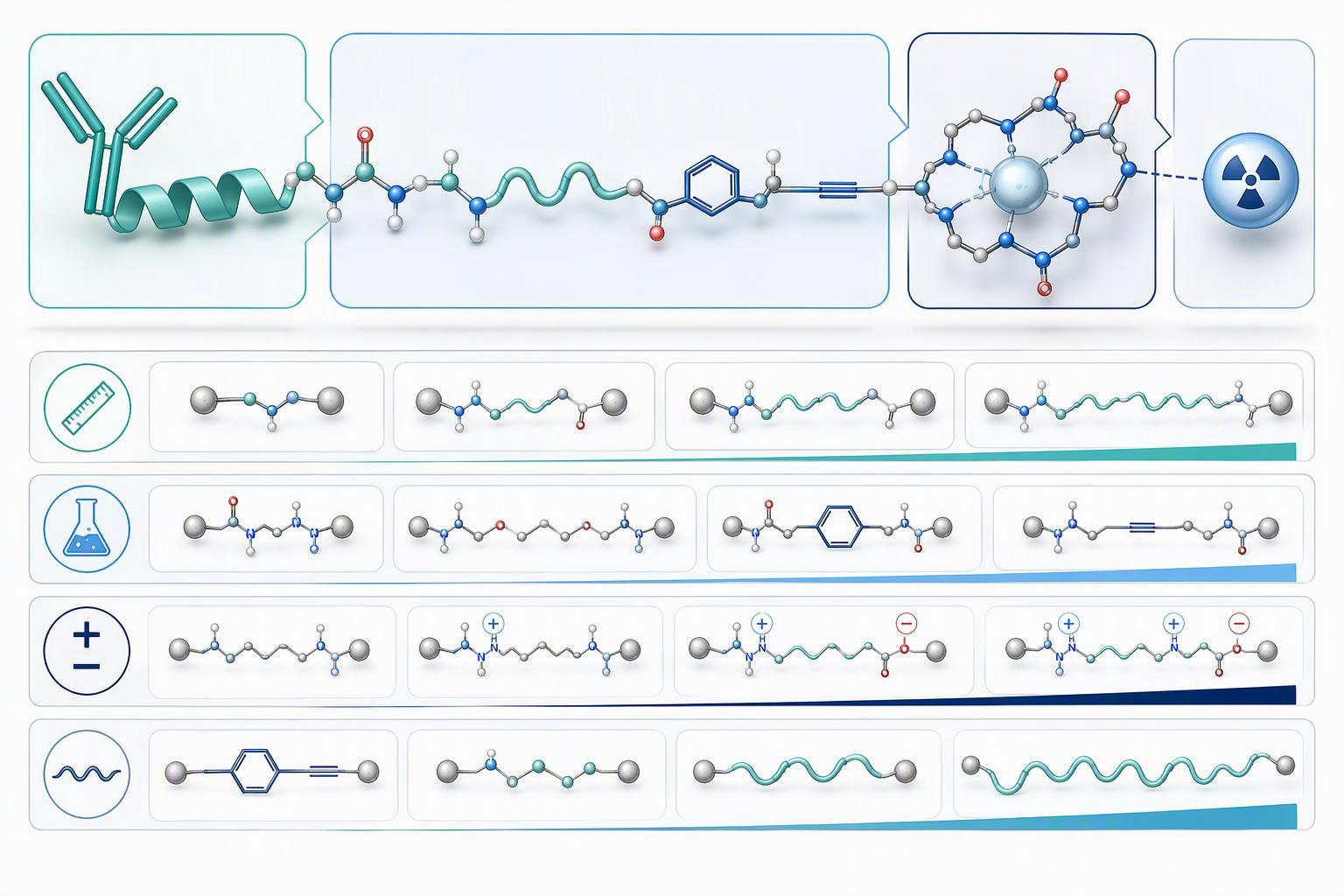
El enlazador cambia el rendimiento porque controla dónde se asienta la parte voluminosa del conjugado en relación con el sitio de unión.. El farmacóforo Glu-urea-Lys PSMA se une aproximadamente a la boca de una región similar a un túnel. 20 Oh profundo, y un conector largo mantiene el metal quelado fuera del sitio activo para que no interfiera con la unión.; Chen y otros. demostró que el aumento de la longitud del conector mejoraba la afinidad de PSMA y la captación tumoral (Revisión del estado clínico de los ligandos de PSMA).

El mismo argumento de geometría explica por qué un enlazador PSMA no es intercambiable con un enlazador GRPR. En un heterodímero PSMA/GRPR, acortar el segmento de PEG de PEG6 a PEG2 mientras se agrega fenilalanina al conector del lado de PSMA mejoró el PSMA IC50 aproximadamente diez veces, de 921 ± 363 nm a 102 ± 80 Nuevo Méjico, mientras que GRPR IC50 se mantuvo en 4 ± 1 a 6 ± 3 Nuevo Méjico (Optimización del enlazador heterodímero PSMA/GRPR). Un cambio de conector ayudó a un objetivo y dejó al otro intacto dentro de la misma molécula..
Tres mecanismos se repiten en la literatura.. Las cargas negativas colocadas en la región del conector redujeron la retención en el tejido no objetivo sin reducir la acumulación de tumores., y los grupos naftilo hidrófobos aumentaron la captación tumoral al tiempo que redujeron la retención renal (Revisión del estado clínico de los ligandos de PSMA). El 2026 La revisión agrega que la mayoría de las estrategias de optimización funcionan cambiando la estructura del conector para alterar la hidrofobicidad y la biodisponibilidad., con una segunda clase que utiliza escisión para liberar carga in vivo (Stoddard y cols., Química bioconjugada 2026).
Estas son observaciones preclínicas en modelos de xenoinjerto de ratón.. Establecen mecanismo y dirección., resultado no clínico.
¿Cómo cambia la longitud del enlazador?, captación y eliminación del tumor?
Los efectos de longitud son grandes, y no son monótonos. En una serie de PSMA de cinco enlaces construida sobre el mismo farmacóforo, KD abarcó aproximadamente 1.700 veces: 4.39 nM para la referencia 2-naftil-L-Ala, 147 nM para 4-bromofenilalanina, 3,130 nM para ácido tranexámico, 7,520 nM para L-Phe y 7,500 nM para L-Tyr (una serie PSMA de cinco enlaces emparejados, Farmacia 2022).
La longitud también influye en la captación del tumor en términos absolutos. La serie PSMA-617 optimizada para enlazadores alcanzó 10.58 ± 4.50 %ID/g en 24 h versus 3.20 ± 2.89 %ID/g para PSMA-11 en el mismo momento, aproximadamente 3,3 veces mayor, atribuido al enlazador optimizado (Benešová et al., J Nucl Med 2015). La retención renal en esa serie cayó de 113.3 ± 24.4 %ID/g en 1 h a 2.1 ± 1.4 %ID/g en 24 h (Revisión del estado clínico de los ligandos de PSMA).
La longitud del PEG puede alterar la afinidad, circulación, Asociación y degradación de proteínas de forma dependiente de la construcción.. Distinguir la estabilidad sérica in vitro de una vida media farmacocinética in vivo y conservar las especies de estudio y las condiciones del ensayo.. Los ejemplos citados no establecen una longitud óptima universal de PEG..
La consecuencia práctica para la biodistribución de péptidos radiomarcados es que lo óptimo es específico de la construcción.. No se puede leer en una tabla de longitud., y la serie coincidente es la única manera de encontrarlo.
¿Cómo cambia la química del enlazador la afinidad y la biodistribución??
Chemistry class matters as much as length, and the chelator-proximal region is where it shows first. PSMA-11, which carries an Ahx linker, has a Ki of 12.0 ± 2.8 nM versus 37.6 ± 14.3 nM for the DOTA analogue, about 3-fold better affinity, with tumor uptake of 7.7 ± 1.5 %ID/g and 5.7-fold lower liver uptake (Revisión del estado clínico de los ligandos de PSMA).
Adding an aromatic residue to the linker can recover affinity that a long hydrophilic segment costs. The phenylalanine addition described above worked alongside the PEG2 shortening, and the authors attribute the gain to hydrophobic interactions with Phe546 and Trp541 at the entrance funnel to the PSMA active site (Optimización del enlazador heterodímero PSMA/GRPR).
Restricted-turn linkers on a GRPR antagonist tell a different story. Against the short PEG2 reference at 0.4 Nuevo Méjico, IC50 was 0.27 nM for NOTA-mMA-RM26, 1.3 nM for oMA and 3.4 nM for oET, so one rigid aromatic linker improved affinity while another was 8.5-fold worse (RM26 GRPR linker series, EJNMMI Radiopharm Chem 2025).
The chemistry lesson is that the same class of modification can improve affinity and worsen biodistribution at once. The two most lipophilic analogues in the matched PSMA series showed significantly higher blood, liver and GI-tract uptake and were dropped from in vivo study (una serie PSMA de cinco enlaces emparejados, Farmacia 2022).
¿Cómo cambia la carga del enlazador la captación renal y la relación tumor-fondo??
Charge is the lever most directly aimed at the tumor-to-background ratio peptide conjugates live or die by, and it is the least predictable. In an eleven-member charged-linker PSMA-617 series, IC50 ranged from 10.40 ± 2.94 nm a 78.6 ± 44.1 nM against PSMA-617 at 21.77 ± 3.13 Nuevo Méjico, and only PS8, with glutamate units next to the chelator, beat the parent at 10.40 ± 2.94 Nuevo Méjico (P = 0.004) (el 2026 charged-linker PSMA-617 series).
Tumor uptake and renal washout diverged from affinity. Tumor SUV at 1 h was 1.32 ± 0.08 for PS8 and 1.15 ± 0.04 for PS4 versus 0.63 ± 0.02 for PSMA-617, but PS8 and PS4 also showed slow renal washout, with kidney SUV of 2.70 ± 0.89 en 2 h for PS8 and 3.81 ± 0.15 en 1 h for PS4 (el 2026 charged-linker PSMA-617 series).
A tumor-to-kidney ratio at one time point is one observation. Evaluate time-integrated activity, absolute uptake, other organs and relevant dosimetry before comparing therapeutic potential; a favorable isolated ratio does not identify the preferred construct.
The direction of the charge effect depends on the scaffold. In the PSMA/GRPR heterodimer, the best-affinity construct still had tumor-to-kidney below 0.5 at every timepoint with either 68Ga or 111In (the BQ7812 preclinical characterisation). A 2024 albumin-binder linker study shows how far position alone can swing the balance: the same linker placed at two positions changed the tumor-to-kidney AUC ratio from 4.31 a 0.18 (a 2024 albumin-binder linker study).
¿Cómo la flexibilidad del enlazador intercambia el acceso al receptor contra la penalización entrópica??
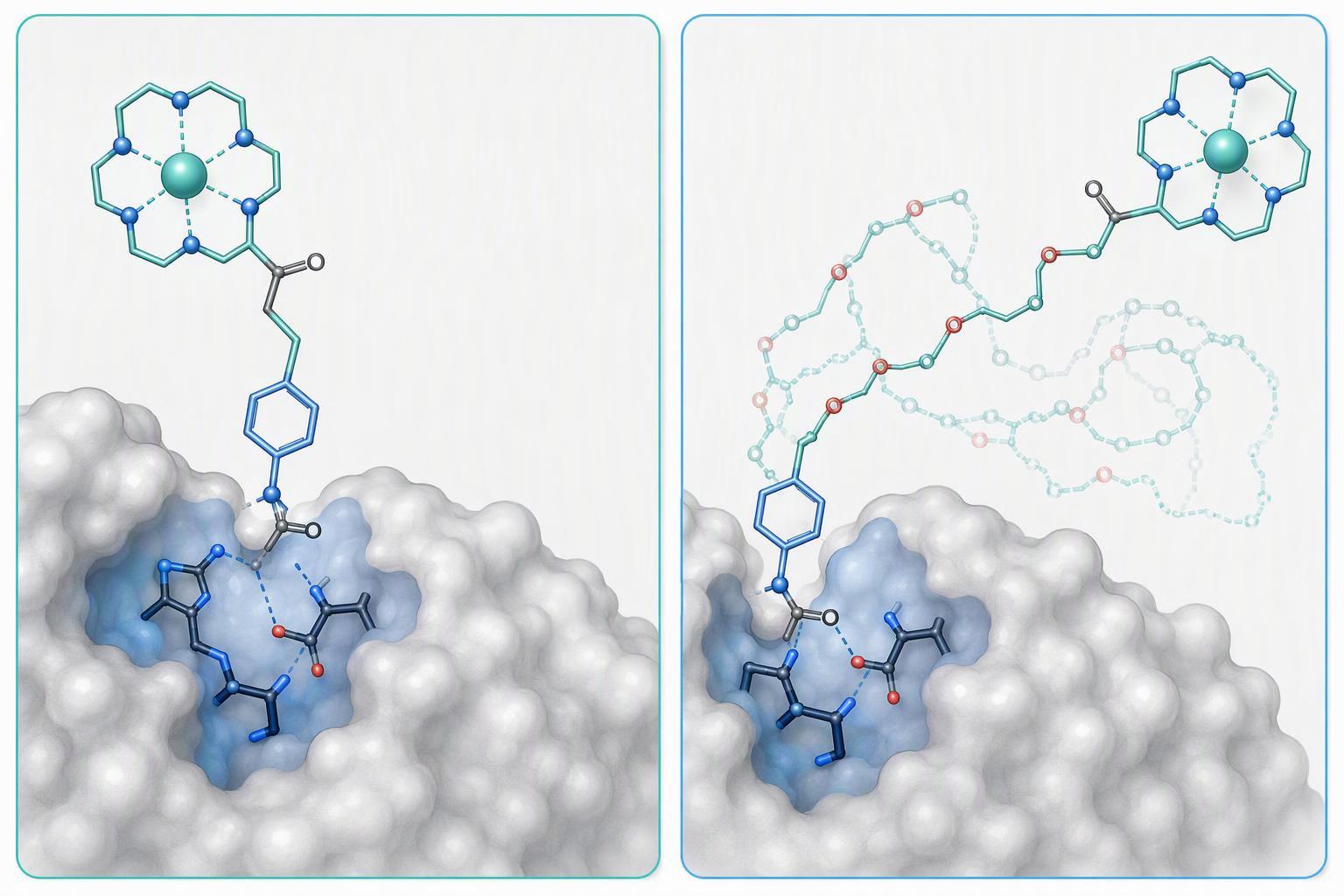
Flexibility is a trade, not a virtue. A longer PEG linker allows more flexibility in the molecule and thereby more steric hindrance, which the heterodimer authors identify as a likely reason the PEG6 variant bound PSMA worse than the PEG2 variant (Optimización del enlazador heterodímero PSMA/GRPR).
Rigidity can be engineered in, and it carries its own charge consequence. Piperazine is a 6-atom heterocycle that introduces rigidity, basicity and moderate lipophilicity, with endocyclic pKa values around 9 and around 5, so at least one nitrogen is protonated at physiological pH and the linker carries a positive charge (Stoddard y cols., Química bioconjugada 2026).
The evidence for a measured flexibility optimum in radiopharmaceuticals is thinner than for length or chemistry. The thermodynamics are supported at review level rather than by a matched experiment that rigidified only the linker and measured both affinity and pharmacokinetics, so the mechanism is best stated qualitatively.
What the matched experiments do show is that flexibility changes are entangled with hydrophobicity. The restricted-turn RM26 linkers raised tumor uptake to 11.2 %IA/g (oET), 10.2 %IA/g (oMA) y 12.3 %IA/g (mMA) en 2 h versus 5.4 ± 1 %IA/g for the PEG2 reference, but kidney uptake rose to 6 a 8 %IA/g from 1.9 ± 0.3 %IA/g, with the authors implicating LDLR-mediated off-target binding and hepatobiliary excretion (RM26 GRPR linker series, EJNMMI Radiopharm Chem 2025).
¿Cómo se muestran los cambios del enlazador en la caracterización analítica??
A linker change is a molecular structure change, and identity testing has to be specific enough to see it. ICH Q6B states that identity tests “should be highly specific for the drug substance and should be based on unique aspects of its molecular structure and/or other specific properties,” with the same wording applied to drug product (ICH Q6B on specification setting).
Purity is estimated by a combination of methods because absolute purity is difficult to determine and results are method-dependent, and the analytical procedures should focus on separating the desired product from product-related substances and impurities (ICH Q6B on specification setting). For a linker-modified peptide, that means the chromatographic method has to resolve the linker variant from its positional isomers and deletion products, not just report a single area percent.
Stability cannot rest on one assay. The Q5C principle that no single stability-indicating assay suffices, and that the profile should be product-specific and allow detection of changes in purity, identity and potency, applies directly when a cleavable or charge-modified linker is the variable under test (the Q5C principle that no single stability-indicating assay suffices).
The validation framework for those methods is ICH Q2(R2), adopted 2023-11-01, which replaced Q2(R1) from November 2005 and defines specificity and selectivity as the extent of interference, accuracy as closeness to the accepted true or reference value, and precision as closeness of agreement across repeated samplings at repeatability, intermediate precision and reproducibility (Yo Q2(R2), the current revision of the validation guideline).
¿Cómo debería un equipo especificar un conector y planificar pruebas analíticas y biológicas en conjunto??

Synthesis Of Polypeptide Manufacturer Specify the linker as a set of fields, then test the fields together rather than in sequence. The design principle that modification chemistry, attachment site, linker architecture, sequence composition, purification method and analytical method should be evaluated together, not as isolated choices, is the organizing rule for the worksheet below.
|
Specification field |
What to record |
Why it changes the result |
|---|---|---|
|
Attachment site |
N-terminus, C-terminus, lysine side chain, cysteine |
The same linker at two positions changed the tumor-to-kidney AUC ratio from 4.31 a 0.18 (a 2024 albumin-binder linker study) |
|
Linker class Synthetic Polypeptide Manufacturer and length |
PEG units, Ahx, aromatic residue, restricted turn |
KD spanned about 1,700-fold across a matched PSMA series (una serie PSMA de cinco enlaces emparejados, Farmacia 2022) |
|
Charge state |
Neutral, anionic, cationic, zwitterionic |
Charge placement changed IC50 and renal washout independently (el 2026 charged-linker PSMA-617 series) |
|
Flexibility |
Linear, rigidified, cleavable |
Merrifield State Peptide Synthesis Longer PEG added steric hindrance in one heterodimer (Optimización del enlazador heterodímero PSMA/GRPR) |
|
Radion Microwave Induced Organic Synthesis uclide |
68Ga, 111In, 177Lu, 205/206Bi |
BQ7812 showed lower liver uptake with 68Ga than 111In, and the authors state the ligand must be re-evaluated when the radiolabel changes (the BQ7812 preclinical characterisation) |
|
Analytical package Stapled Peptides Manufacturer |
Identidad, pureza, potency, stability methods |
Identity must be specific to molecular structure; no single stability-indicating assay suffices (ICH Q6B, Q5C) Microwave Peptide Synthesis |
Use matched in vitro and biodistribution studies with the intended radionuclide. Assess all relevant organs and time-integrated exposure; kidneys are an important concern for many PSMA constructs but are not the only possible dose-limiting tissue. A clinical label does not predict the risk profile of a new linker variant.
Lo que la evidencia no resuelve
The largest gap is that no source compares linker modifications head-to-head in the same scaffold, same radionuclide and same tumor model across the PSMA and GRPR programs. The matched PSMA series itself notes that its lead compound and PSMA-617 were not compared head-to-head in the same system (una serie PSMA de cinco enlaces emparejados, Farmacia 2022).
Whether longer PEG helps or hurts is genuinely contested. El 2026 review describes PEG chains as repeatedly shown to improve pharmacokinetic and pharmacodynamic profiles, while also documenting the PEG12 stability and affinity loss and the anti-PEG antibody risk (Stoddard y cols., Química bioconjugada 2026). The heterodimer work found the longer PEG6 variant bound PSMA worse than PEG2 (Optimización del enlazador heterodímero PSMA/GRPR). The heterodimer data are target- and scaffold-specific, so they narrow the general claim rather than overturn it.
Higher affinity does not reliably produce longer tumor retention. The heterodimer authors hypothesized that increased PSMA affinity would prolong retention, but the higher-affinity construct showed no enhanced retention and washed out rapidly, contradicting earlier findings for a different construct (Optimización del enlazador heterodímero PSMA/GRPR).
Linker effects on cellular processing are reported as negligible in one system and significant in another. The heterodimer study found linker composition did not significantly affect cellular processing, with about 20% internalized at 24 h (Optimización del enlazador heterodímero PSMA/GRPR), while the PSMA-617 analogue study found significant internalization differences for specific glutamate and histidine insertions (el 2026 charged-linker PSMA-617 series). The two use different scaffolds, so the second narrows the scope of the first rather than refuting it.
Absolute affinity values for the same compound differ by assay. PSMA-617 Ki is 2.34 ± 2.94 nM by LNCaP cell-based competition versus 0.37 ± 0.21 nM by the NAALADase enzyme assay (Benešová et al., J Nucl Med 2015), and a separate study reports an IC50 of 21.77 ± 3.13 nM for PSMA-617 in LNCaP cells (el 2026 charged-linker PSMA-617 series). The cell-based values are the comparable pair; the enzyme-assay figure reflects a different measurement system rather than a disagreement about the molecule.
No source in this set establishes a quantitative relationship between linker hydrophobicity and human absorbed dose, and no clinical outcomes are reported for any of the linker-modified constructs discussed here. The heterodimer authors state that translation into the clinic is yet to occur (the BQ7812 preclinical characterisation).
Hacia dónde se dirige el diseño del enlazador
The direction of travel is toward linkers that do work rather than linkers that merely hold. El 2026 review divides the field into static linkers, meant to remain intact throughout transit, and dynamic linkers, meant to release their cargo in vivo, and notes that the most common optimization strategies change linker structure to alter hydrophobicity and bioavailability (Stoddard y cols., Química bioconjugada 2026).
Zwitterionic linkers are the clearest example of an underexplored class. They carry equal numbers of positive and negative groups, which greatly enhances hydrophilicity, and they remain rare in radiopharmaceuticals (Stoddard y cols., Química bioconjugada 2026).
The cited NAPamide study concerns a melanocortin-1-receptor-targeting scaffold, not a GRPR ligand. Adding an albumin-binding group altered circulation and tissue distribution in its mouse model. These results support construct-specific testing and cannot be transferred directly to a GRPR or PSMA conjugate. Primary NAPamide study.
The clinical anchor is already in place. Pluvicto, the approved PSMA-617 radioligand, is a PSMA-binding ligand bound to a DOTA chelator labelled with Lu-177, dosed at 7.4 GBq every 6 weeks for up to 6 doses (the approved PSMA-617 product label). Its linker was optimized preclinically, which is the strongest available argument that linker work translates.
Preguntas frecuentes
¿Un conector más largo siempre mejora la captación del tumor??
Longer linkers do not guarantee better uptake. A tested series may have an interior optimum, a monotonic trend or no meaningful change. Compare matched constructs and endpoints; do not assume that every scaffold must have the same shape of response.
¿Puede un cambio de conector ayudar a un objetivo y dañar a otro en la misma molécula??
Sí, and a bispecific construct is where this bites hardest. En un heterodímero PSMA/GRPR, trimming the PEG segment and adding a phenylalanine residue improved PSMA potency by about tenfold while GRPR binding held steady in the low-nanomolar range (Optimización del enlazador heterodímero PSMA/GRPR). The chelator-linker conjugate therefore has to be scored against every arm of the targeting vector, not against the arm you care about most.
¿Los enlazadores cargados siempre reducen la captación renal??
No, and kidney data alone cannot settle the question. Across an eleven-member charged-linker PSMA-617 series, only one analogue beat the parent on affinity, and the compounds with the strongest tumor uptake also cleared slowly from the kidney, which left their tumor-to-kidney ratios worse than the parent’s (el 2026 charged-linker PSMA-617 series). A charge change that lowers renal signal can also shift abdominal background, so tumor-to-background ratio peptide conjugates and kidney uptake radiopharmaceutical data have to be read together before you call a charge modification an improvement.
¿Se transfieren los efectos del enlazador entre radionucleidos??
No. BQ7812 illustrates the problem: liver uptake and retention were lower with gallium-68 than with indium-111, and the authors state that the ligand must be re-evaluated when the radiolabel changes (the BQ7812 preclinical characterisation). A linker optimised for one isotope is a hypothesis for the next one, not a result.
¿Se pueden comparar los valores de afinidad de diferentes ensayos??
Only within the same measurement system. Cell-based and enzyme-assay values for the same PSMA-617 construct do not agree, so a KD from one platform cannot be set against an IC50 from another. Compare linker chemistry for radiolabeled peptides only against values generated by the same assay, same target preparation and same conditions.
¿Son los enlazadores escindibles mejores que los no escindibles??
Not by default. El 2026 review of linker chemistry in radiopharmaceutical design draws the distinction as static versus dynamic linkers, and the choice follows the payload and where release is meant to happen rather than any ranking between the two (el 2026 review of linker chemistry in radiopharmaceutical design). A radiolabel that stays put and a cytotoxic payload that must be freed intracellularly are different problems.
¿Qué debe contener como mínimo una especificación de enlazador??
The field list from the specification worksheet: attachment site and residue, spacer chemistry and length, charge state, expected cleavability, the analytical methods that will confirm each of those, and the biological readouts that will test them. Peptide modification and conjugate characterization belong in the same document as the synthesis request, because ICH Q6B and ICH Q5C set the expectation that a specification states what will be measured and to what acceptance limit (ICH Q6B, ICH Q5C).
Conclusión
Linker design in peptide conjugates is a four-variable problem with a construct-specific answer. Length can move affinity across three orders of magnitude and tumor uptake by more than threefold, but the PEG data show the curve turns back. Chemistry can recover affinity that a hydrophilic segment costs, and it can also concentrate the conjugate in liver and GI tract. Charge can raise tumor uptake and destroy the tumor-to-kidney ratio in the same series. Flexibility trades receptor access against steric hindrance, and the measured optimum is thinner in the literature than the mechanism suggests.
The practical takeaway is procedural. Specify attachment site, linker class and length, charge state, flexibility and radionuclide as fields, then run the matched series in vitro, the biodistribution study with the intended label, and the organ-specific ratio that limits your application. Plan the analytical package at the same time: identity specific to molecular structure, purity by combined methods, and a product-specific stability profile, validated under the current revision of the validation guideline.
The evidence stops at preclinical models. No source here links a specific linker modification to human absorbed dose or clinical outcome, so treat every direction of effect as a hypothesis to test in your own scaffold rather than a rule to apply.
This article is educational and is not a product recommendation.*