
What Fragment-to-Function Workflows for Peptide Discovery Actually Compare
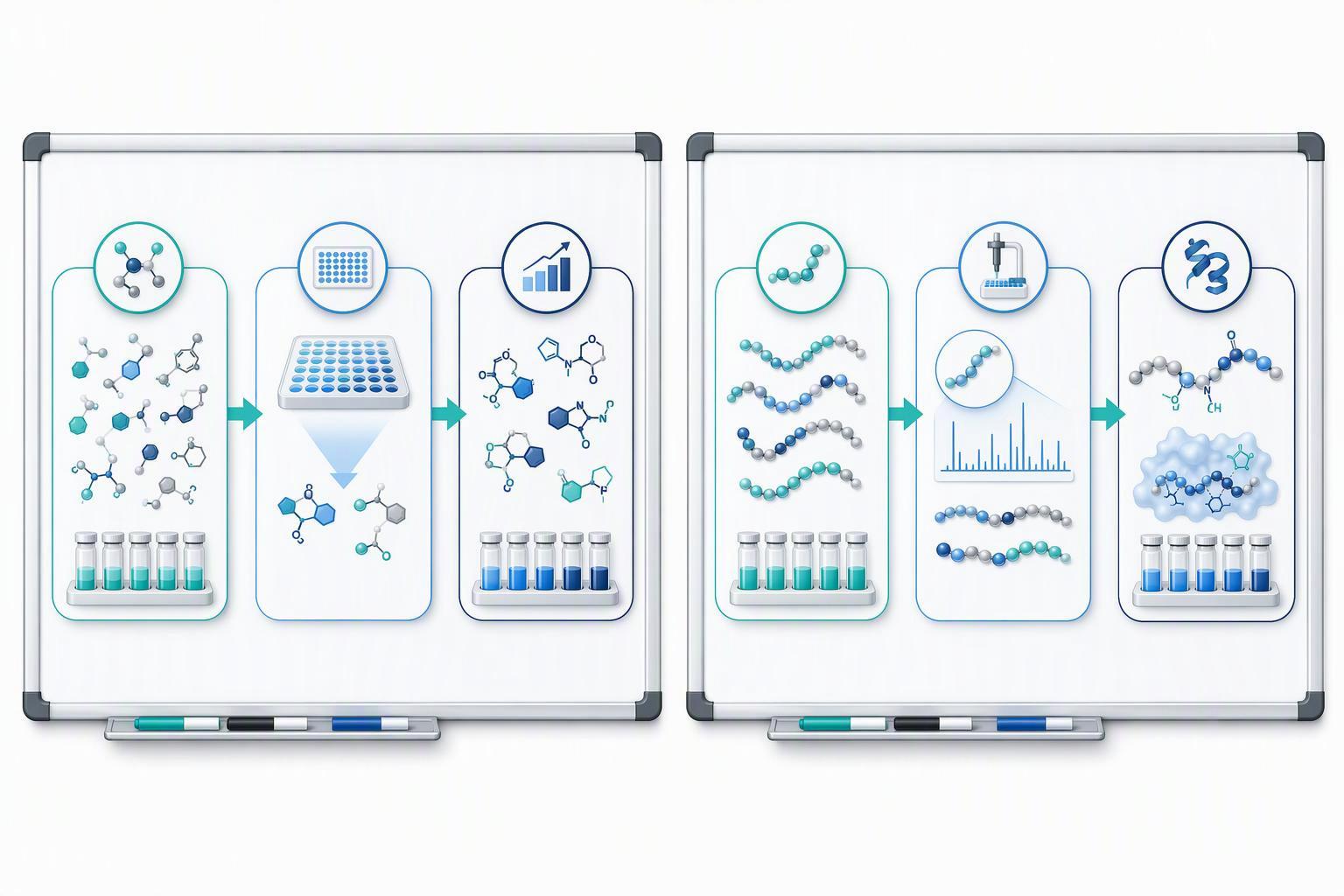
Fragment-to-function workflows for peptide discovery sit at the meeting point of two screening traditions that were built on different physics. The fragment side is the canonical practice of screening low-molecular-weight compounds for weak binding by NMR, X-ray crystallography or SPR, then growing, linking or merging the survivors into potent leads (graphical review of fragment-based drug discovery, 2025). Fragment hits obey the rule of three: MW ≤ 300 Da, no more than three hydrogen-bond donors, three acceptors, three rotatable bonds and logP ≤ 3 (Concepts and Core Principles of Fragment-Based Drug Design, 2019).
That definition explains the concentrations. Because affinities sit in the millimolar range, fragment screens run above 0.5 mM, and X-ray soaking uses 20 mM to 200 mM ligand (Biophysical Screening for the Discovery of Small-Molecule Ligands, retrieved 2026). Libraries stay deliberately small: 500 to 3,000 compounds covers broad chemotype diversity, and most successful campaigns use 1,000 to 2,000 (FBDD graphical review, 2025; high-quality fragment libraries, 2022).

Peptide libraries invert every one of those parameters. They are encoded biological polymers screened by enrichment and selection, not by weak equilibrium binding (Emerging biologic modalities for targeted protein degradation, 2026). Display-library diversity figures were not confirmed, so no peptide library size is quoted here.
One limitation belongs up front: peptide conformational flexibility breaks the rigid-body binding assumption fragments rely on and adds an entropic cost, so fragment-derived optimization logic does not transfer cleanly.
|
Parameter |
Fragment paradigm |
Peptide paradigm |
|---|---|---|
|
Library composition |
Rule-of-three small molecules, MW ≤ 300 Da |
Encoded biological polymers |
|
Screening concentration |
>0.5 mM; soaking 20–200 mM |
Enrichment and selection, not equilibrium binding |
|
Primary readout |
NMR, X-ray, SPR |
Affinity selection and amplification |
|
Optimization move |
Grow, link or merge |
Sequence and format iteration |
Why Molecular-Glue Discovery Reframes Hit Triage
پپتیدهای آرایشی Peptide Synthesis Price Molecular glue discovery changed the triage question from “does this molecule bind?” to “does binding produce the function we want?” The founding observation was that a small molecule can act by inducing degradation of a neosubstrate rather than by inhibition: lenalidomide causes selective degradation of IKZF1 and IKZF3 in multiple myeloma cells, with cereblon (CRBN) hijacked as the substrate receptor (Krönke et al., Science, 2014). A separate lab confirmed the cereblon-dependent destruction of Ikaros proteins in the same year, so the CRBN/neosubstrate framework rested on two independent demonstrations rather than one (Lu et al., Science, 2014).
The non-CRBN case settled the readout question. Indisulam promotes recruitment of RBM39 to the CUL4-DCAF15 E3 ligase, driving RBM39 polyubiquitination and proteasomal degradation, and mutations that prevent RBM39 recruitment confer resistance (Han et al., Science, 2017). Degradation, not occupancy, is what the resistance data track.
Cooperativity measurements show why binary affinity cannot substitute. For dBET6, αapp = IC50(binary)/IC50(ternary) is 0.6 against BRD4BD1 and 0.2 against BRD4BD2, both below 1, meaning negative cooperativity (Nowak et al., Nature Chemical Biology, 2018). Selectivity is set by the ternary complex, not the binary one.
The same separation appears in promiscuous CRBN- and VHL-recruiting PROTACs, which bind more than 50 kinases while only a subset of bound targets is degraded (Bondeson et al., Cell Chemical Biology, 2018).
For peptide work, the transfer is direct: a peptide degrader’s activity depends on warhead geometry relative to the E3 ligase, so a binding readout cannot stand in for a functional one. That is the gap orthogonal binding validation is meant to close.
The Assay-Pairing Rule for Orthogonal Binding Validation
Confirm a primary readout with a method that works on a different physical principle. If the primary screen detects binding by mass, the confirmatory assay should not. That single rule prevents the most common failure in orthogonal binding validation: running two assays that share the same blind spot and calling the agreement independent.
The documented roles of each biophysical method define which pairs are genuinely orthogonal.
|
Primary readout |
Confirming method |
What the pair rules out |
|---|---|---|
|
Mass-based detection (SPR) |
ITC, which reports affinity, stoichiometry سنتز پپتید سفارشی and thermodynamics |
Binding that is real by mass but not a defined 1:1 interaction (graphical review, 2025) |
|
Immobilisation-dependent Peptide Synthesis Cost binding (SPR) |
MST, a solution-phase orthogonal validation assay |
Artefacts caused by surface attachment (biophysical screening chapter) |
|
Any binding signal |
NMR, which validates binding and can define binding mode |
Signal without a characterised interaction site (graphical review, 2025) |
|
Thermal shift (DSF) |
ASMS, which detects the ligand–target complex by mass |
Stability changes unrelated to direct binding (biophysical screening chapter) |
This is not optional practice. Combining complementary screens cross-validates hits and reduces false positives, and even with rigorous quality control, unexpected behaviours still arise (graphical review, 2025).
The payoff is budgetary. A confirmed orthogonal result is what makes a triage decision defensible, and it is the gate that stops synthesis cycles being spent on analogs of an artefact.
Triage Controls That Separate Real Binders From Artefacts
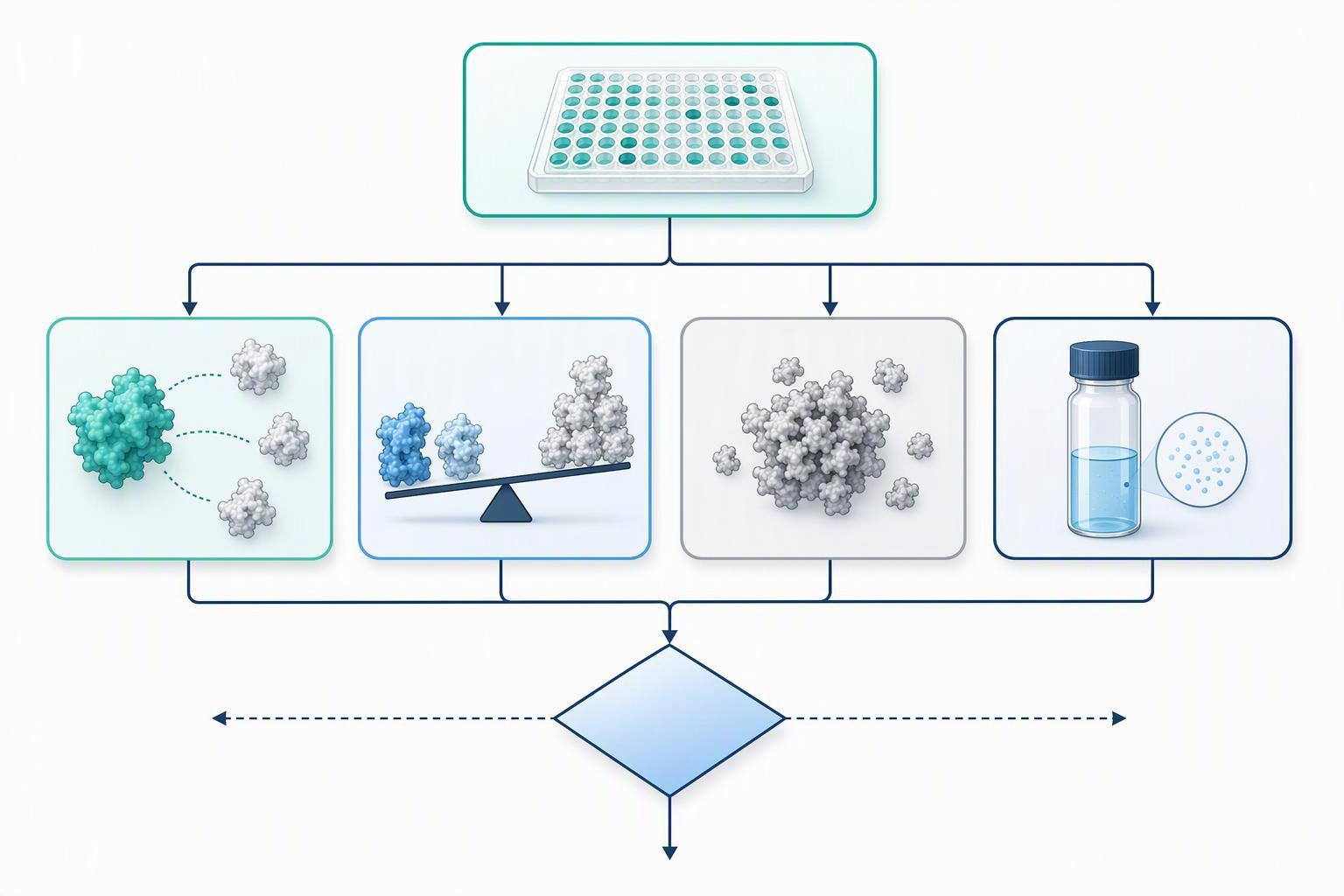
A primary-screen signal is a hypothesis, not a hit. Four artefact-control families separate real binders from assay noise, and running them before any analog series is commissioned is what keeps a synthesis queue from filling with compounds that fail a functional readout months later.
Take a concrete case: a stabilizer that only signals above 100 µM in the primary screen. Before it advances, challenge it four ways.
-
Promiscuity. Re-test in orthogonal assays and against specificity controls. A compound that binds everything binds nothing usefully.
-
Super-stoichiometric binding. An SPR response inconsistent with 1:1 stoichiometry points to a non-specific interaction rather than a defined site.
-
Aggregation. Apply a detergent challenge or a dilution-after-incubation step. True binders survive dilution; aggregates often do not. Diabetesmetabolism Research Area
-
Solubility artefacts. Screen at low concentration first, then run a concentration series, and confirm the dose–response is saturable.
Treat an abnormal Hill slope as suspect. The published triage literature describes this qualitatively rather than fixing a numeric cutoff, so the practical rule is a shape check: saturable and well-behaved advances, steep or shallow does not. Fmoc Solid Phase Peptide Synthesis
Pro Tip: Run all four challenges against the current hit list before commissioning any analog series. It costs one assay round and saves a synthesis campaign.
Structure–Activity Iteration After a Confirmed Hit
Structure–activity iteration starts only after orthogonal confirmation, and the first design question is not which analog to make next. It is which optimization move the confirmed binding mode actually supports.
Fragment programs answer that question with a small, well-established move set: promising hits are grown, linked, or merged into potent leads. Peptide programs do not have those moves available in the same form. Optimization runs through sequence and modification changes instead, and for peptide-based degraders, an induced-proximity modality, the design variable shifts again, to warhead geometry relative to the E3 ligase.
That shift changes what counts as a design parameter. Because glue selectivity is not set by binary affinity alone, cooperativity and dissociation kinetics become design variables rather than secondary descriptors. A program that optimizes affinity and treats kinetics as a downstream readout is optimizing the wrong quantity.
The recurring failure pattern follows from that. A hit survives the primary screen, survives a second binding assay, then fails a functional readout after synthesis cycles have already been spent on analogs. The spend is not the problem; the sequence is. Functional characterization belongs before the analog series, not after it.
Analytical Rigor as a Triage Input, Not a Compliance Step

A confirmed hit is only as good as the material it was confirmed on. If the lot used for the orthogonal binding assay was never characterised for identity and purity, the triage decision rests on an unknown. Analytical control belongs at that point in the workflow, not at the end of it.
The validation logic is already standardised. The ICH Q2(R2) validation framework, current in its FDA version as of 06 March 2024, sets out the general requirements for analytical procedure validation and replaces the earlier Q2(R1); Q14 covers development. For biologics-adjacent material, the compendial endotoxin test, USP <85>, carries an official date of 01 December 2012 and names the Gel Clot Limit Test as the referee method when results are disputed. That page states the harmonised method only; it does not publish regional endotoxin limit values, so no numeric limit can be quoted from it.
The practical point for a modified peptide is that HPLC purity and MS identity answer different questions. Purity tells you how much of the material is one species; mass tells you which species it is. A certificate reporting only one of the two leaves the other open, and for a peptide carrying a non-natural modification that gap is where a mis-assigned hit hides.
Key Takeaway: A certificate of analysis reporting only HPLC purity or only MS identity is incomplete for a modified peptide. Both are needed before the lot supports a triage decision.
A neutral example of how that closes: custom synthesis at purity grades from crude to 99%, release testing by HPLC and MS, endotoxin and sterility testing, at scales from milligrams to kilograms, with repeated testing at each process step. That sequence supports lot-to-lot consistency; it does not by itself prove a binder is real.
Where the Fragment Analogy Breaks Down
Three transfers from fragment work into peptide campaigns fail, and each failure has a design consequence.
The first is geometric. Fragment binding is usually modelled as a rigid body settling into a well-defined pocket, so a weak primary signal can still be read as a real, if incomplete, interaction. Peptides are conformationally flexible, and the entropic cost of freezing a flexible chain into a bound pose is paid out of the binding free energy. A peptide that shows the same weak signal as a fragment is therefore not the same object: it may be sampling a productive pose only a fraction of the time. Do not carry a fragment-style “weak but real” verdict into peptide triage without a second, conformation-sensitive readout.
The second is methodological. Peptide libraries are typically screened by enrichment and selection rather than by weak equilibrium binding, so hit-rate and library-size logic does not transfer. Fragment screening reports hit rates of 5%–20%, against under 1% for high-throughput screening (graphical review of fragment-based approaches, 2025, relaying Foley et al. 2021). That contrast describes fragment campaigns under specific target classes, detection methods and hit definitions. It is not a benchmark for a peptide-library design, and it should not set your expected enrichment.
⚠️ Warning: The 5%–20% figure is a single-upstream echo, not independent corroboration. Library size is a design choice, ranging roughly 96–3000 compounds depending on target class and detection method.
The third is scale. Fragment campaigns optimise a small, well-characterised set; peptide campaigns optimise a sequence space where every substitution can change conformation, solubility and aggregation behaviour at once.
Getting Started: The First Three Moves
Write down two things before you screen anything: the primary readout, and the method that will confirm it through a different physical principle. That single planning act is the assay-pairing rule applied in advance, and it costs one line in the assay plan. Deciding it after the primary screen means the confirmation method gets chosen by convenience, which is how a fluorescence artefact acquires a second life as a validated hit.
Next, run the four artefact challenges against the hit list you already have and record which compounds survive each one. Aggregation, fluorescence interference, stoichiometry and solubility behave differently across chemotypes, so a hit that clears three and fails the fourth is more informative than a hit that clears none cleanly. Keep the record; it becomes the triage evidence you will need when a series is challenged later.
Then define the functional readout a confirmed binder must pass before you commission a single analog. Setting the binding-versus-function gate in advance stops structure-activity iteration from starting on a compound that binds well and does nothing.
The usual hesitation is that a second assay slows the program. It does the opposite: it is what keeps the synthesis queue from being spent on an artefact.
Frequently Asked Questions
How does fragment screening differ from peptide-library design?
Fragment screening tests small, low-complexity molecules for weak but well-defined binding; peptide-library design tests chains that already carry many contacts and can adopt several conformations. A fragment hit is usually a starting point for growth, a peptide hit often close to functional as-is. The limitation: fragment-derived growth logic assumes a fairly rigid binding pose, and peptide backbones do not always hold one.
Why is orthogonal binding validation required rather than optional?
A single assay reports one physical property, so it cannot separate a specific interaction from a readout artefact. Pairing a primary binding readout with a second method that measures a different property is what makes a triage decision defensible, because agreement between two independent measurements supports the binding event in a way one measurement cannot.
What should you do when a hit binds but produces no function?
Treat binding and function as separate findings and re-examine the assay conditions before re-designing the molecule. A confirmed binder with no activity may occupy a site that does not drive the functional readout, or the functional assay may sit outside the concentration range where binding occurs. Confirm the binding pose and the functional window first, then decide whether to iterate or set the series aside.
How do you tell a real binder from an artefact?
Artefacts usually show up as steep, poorly behaved dose-response curves, sensitivity to assay conditions, or signals that vanish under a second detection method. Hill slope is a useful qualitative flag: values far from 1 suggest aggregation, non-specific association, or multiple binding modes rather than a clean one-to-one interaction. A hit that survives a change of method and a change of conditions is the one worth advancing.
What analytical documentation does a modified peptide require?
A modified peptide needs release testing that confirms both identity and purity, because the modification itself can change how the molecule behaves in standard assays. High-performance liquid chromatography and mass spectrometry together cover purity and structural confirmation, and endotoxin and sterility testing apply where the material is destined for biological work. A purity figure is only meaningful against a stated method and specification; pharmacopeial limits such as those in USP monographs are set per peptide and do not transfer between molecules.
Does fragment-derived optimization logic transfer to peptides?
Partly. The core idea, that you improve a weak starting point through iterative structural change, transfers well. What does not transfer cleanly is the rigid-body assumption behind fragment growth: peptides pay an entropic cost when they fold into a bound conformation, so added contacts do not always add affinity the way they do for a small, pre-organized fragment. Structure-activity iteration on peptides works best when it accounts for that conformational cost rather than treating the backbone as a fixed scaffold.
Conclusion
The most useful thing molecular-glue discovery hands peptide teams is a structural habit: treat binding and function as separate triage gates, and let every downstream decision follow from which gate a hit has actually cleared. Fragment-to-function workflows for peptide discovery work the same way once you stop asking a single assay to answer two different questions.
That reframing runs through the whole guide. The paradigm comparison sets the terms, the assay-pairing rule decides which second readout confirms a primary signal, and the artefact controls (promiscuity, super-stoichiometric behaviour, solubility) determine whether a confirmed binder is real. Structure–activity iteration only starts after that confirmation, and analytical rigor belongs inside triage rather than after it, because purity and structural identity are what make a confirmed hit defensible.
Peptide-degrader modalities are moving quickly, and the triage logic that separates binding from function is likely to keep shifting with them. Teams that revisit their gate definitions periodically will spend less time re-litigating weak hits.
If your program needs analytical documentation for modified peptides, تغییرات MOL offers a technical consultation on release testing and lot documentation for custom synthesis work.
Disclosure: the publisher has a commercial interest in peptide quality standards.