What Fragment-to-Function Workflows for Peptide Discovery Actually Compare
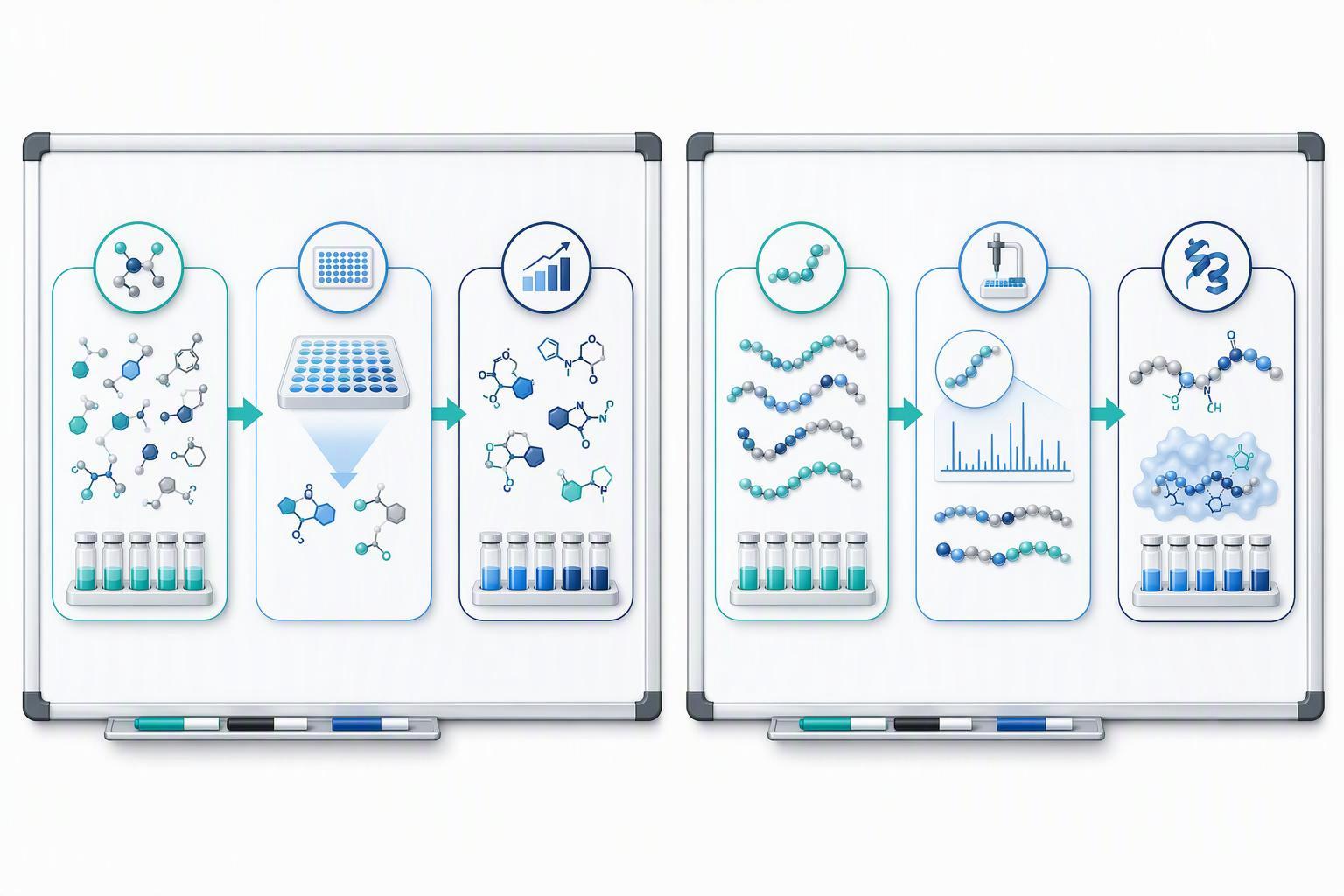
Quy trình làm việc từ từng mảnh đến chức năng để khám phá peptit nằm ở điểm gặp nhau của hai truyền thống sàng lọc được xây dựng trên cơ sở vật lý khác nhau. Phía mảnh là phương pháp chuẩn để sàng lọc các hợp chất có trọng lượng phân tử thấp để tìm liên kết yếu bằng NMR, Tinh thể học tia X hoặc SPR, sau đó phát triển, liên kết hoặc hợp nhất những người sống sót thành những khách hàng tiềm năng (đánh giá đồ họa về khám phá thuốc dựa trên mảnh, 2025). Lượt truy cập mảnh tuân theo quy tắc ba: MW ≤ 300 Và, không quá ba nhà tài trợ liên kết hydro, ba người chấp nhận, ba liên kết xoay và logP ≤ 3 (Concepts and Core Principles of Fragment-Based Drug Design, 2019).
That definition explains the concentrations. Because affinities sit in the millimolar range, fragment screens run above 0.5 mM, and X-ray soaking uses 20 mM to 200 mM ligand (Biophysical Screening for the Discovery of Small-Molecule Ligands, đã lấy lại 2026). Libraries stay deliberately small: 500 ĐẾN 3,000 compounds covers broad chemotype diversity, and most successful campaigns use 1,000 ĐẾN 2,000 (FBDD graphical review, 2025; high-quality fragment libraries, 2022).

Peptide libraries invert every one of those parameters. They are encoded biological polymers screened by enrichment and selection, not by weak equilibrium binding (Emerging biologic modalities for targeted protein degradation, 2026). Display-library diversity figures were not confirmed, so no peptide library size is quoted here.
One limitation belongs up front: peptide conformational flexibility breaks the rigid-body binding assumption fragments rely on and adds an entropic cost, so fragment-derived optimization logic does not transfer cleanly.
|
Parameter |
Fragment paradigm |
Peptide paradigm |
|---|---|---|
|
Library composition |
Rule-of-three small molecules, MW ≤ 300 Và |
Encoded biological polymers |
|
Screening concentration |
>0.5 mM; soaking 20–200 mM |
Enrichment and selection, not equilibrium binding |
|
Primary readout |
NMR, X-ray, XUÂN |
Affinity selection and amplification |
|
Optimization move |
Grow, link or merge |
Sequence and format iteration |
Why Molecular-Glue Discovery Reframes Hit Triage
Peptide mỹ phẩm Peptide Synthesis Price Molecular glue discovery changed the triage question from “does this molecule bind?” to “does binding produce the function we want?” The founding observation was that a small molecule can act by inducing degradation of a neosubstrate rather than by inhibition: lenalidomide causes selective degradation of IKZF1 and IKZF3 in multiple myeloma cells, with cereblon (CRBN) hijacked as the substrate receptor (Krönke et al., Khoa học, 2014). A separate lab confirmed the cereblon-dependent destruction of Ikaros proteins in the same year, so the CRBN/neosubstrate framework rested on two independent demonstrations rather than one (Lu et al., Khoa học, 2014).
The non-CRBN case settled the readout question. Indisulam promotes recruitment of RBM39 to the CUL4-DCAF15 E3 ligase, driving RBM39 polyubiquitination and proteasomal degradation, and mutations that prevent RBM39 recruitment confer resistance (Han et al., Khoa học, 2017). Degradation, not occupancy, is what the resistance data track.
Cooperativity measurements show why binary affinity cannot substitute. For dBET6, αapp = IC50(binary)/IC50(ternary) là 0.6 against BRD4BD1 and 0.2 against BRD4BD2, both below 1, nghĩa là sự hợp tác tiêu cực (Nowak và cộng sự., Sinh học hóa học tự nhiên, 2018). Độ chọn lọc được thiết lập bởi phức hợp ternary, không phải nhị phân.
Sự tách biệt tương tự xuất hiện ở CRBN lăng nhăng- và PROTAC tuyển dụng VHL, ràng buộc nhiều hơn 50 kinase trong khi chỉ một tập hợp con các mục tiêu bị ràng buộc bị suy giảm (Bondeson và cộng sự., Sinh học hóa học tế bào, 2018).
Đối với công việc peptide, việc chuyển nhượng là trực tiếp: Hoạt động của chất phân hủy peptide phụ thuộc vào hình dạng đầu đạn so với ligase E3, vì vậy một kết quả đọc ràng buộc không thể thay thế cho một chức năng. Đó là xác nhận ràng buộc trực giao khoảng cách có nghĩa là để đóng.
The Assay-Pairing Rule for Orthogonal Binding Validation
Xác nhận kết quả đọc chính bằng phương pháp hoạt động theo nguyên tắc vật lý khác. Nếu màn hình chính phát hiện ràng buộc theo khối lượng, xét nghiệm xác nhận không nên. Quy tắc duy nhất đó ngăn chặn lỗi phổ biến nhất trong xác thực ràng buộc trực giao: running two assays that share the same blind spot and calling the agreement independent.
The documented roles of each biophysical method define which pairs are genuinely orthogonal.
|
Primary readout |
Confirming method |
What the pair rules out |
|---|---|---|
|
Mass-based detection (XUÂN) |
ITC, which reports affinity, stoichiometry Tổng hợp peptide tùy chỉnh and thermodynamics |
Binding that is real by mass but not a defined 1:1 interaction (graphical review, 2025) |
|
Immobilisation-dependent Peptide Synthesis Cost binding (XUÂN) |
MST, a solution-phase orthogonal validation assay |
Artefacts caused by surface attachment (biophysical screening chapter) |
|
Any binding signal |
NMR, which validates binding and can define binding mode |
Signal without a characterised interaction site (graphical review, 2025) |
|
Thermal shift (DSF) |
ASMS, which detects the ligand–target complex by mass |
Stability changes unrelated to direct binding (biophysical screening chapter) |
This is not optional practice. Combining complementary screens cross-validates hits and reduces false positives, and even with rigorous quality control, unexpected behaviours still arise (graphical review, 2025).
The payoff is budgetary. A confirmed orthogonal result is what makes a triage decision defensible, and it is the gate that stops synthesis cycles being spent on analogs of an artefact.
Triage Controls That Separate Real Binders From Artefacts
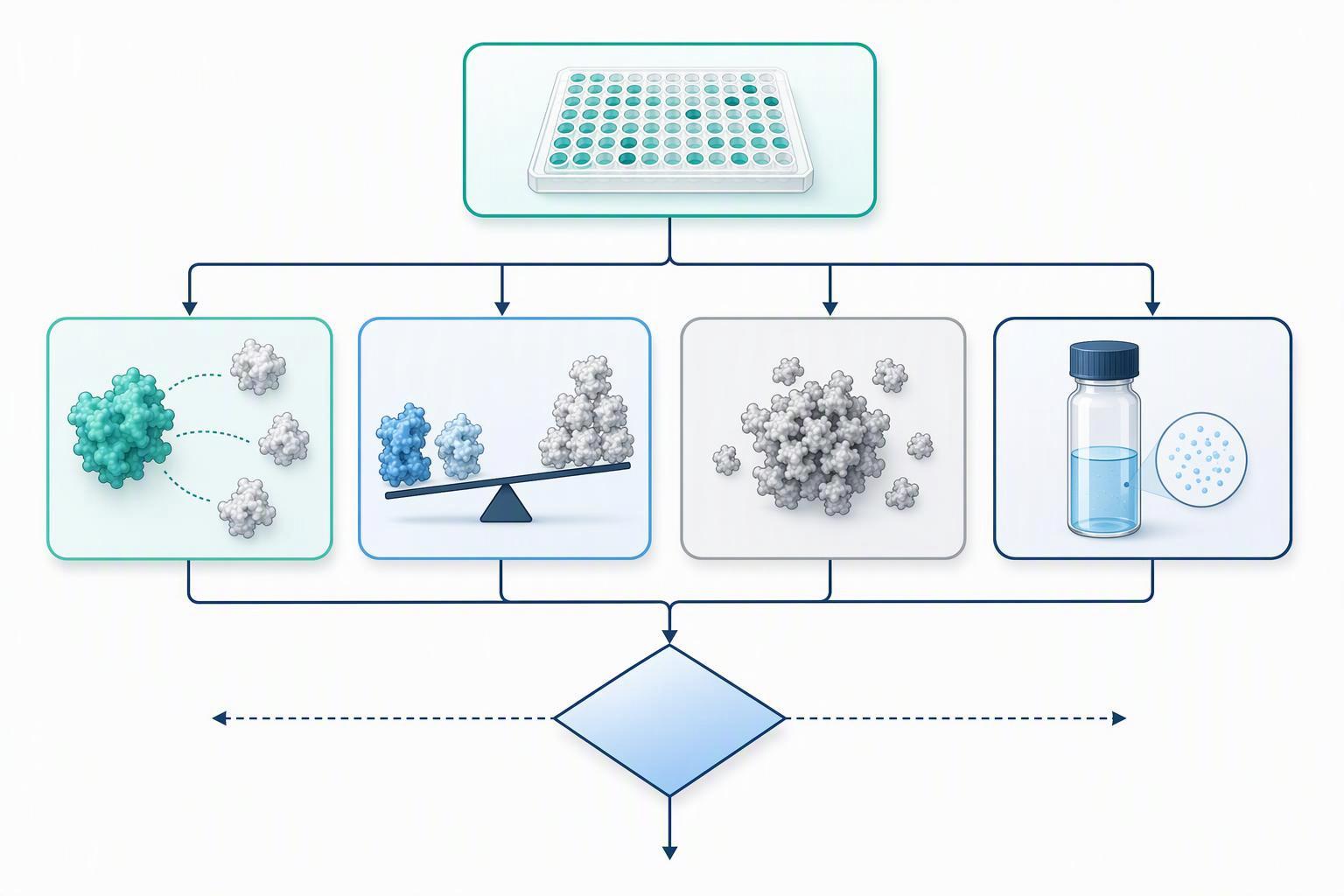
A primary-screen signal is a hypothesis, not a hit. Four artefact-control families separate real binders from assay noise, and running them before any analog series is commissioned is what keeps a synthesis queue from filling with compounds that fail a functional readout months later.
Take a concrete case: a stabilizer that only signals above 100 µM in the primary screen. Before it advances, challenge it four ways.
-
Promiscuity. Re-test in orthogonal assays and against specificity controls. A compound that binds everything binds nothing usefully.
-
Super-stoichiometric binding. An SPR response inconsistent with 1:1 stoichiometry points to a non-specific interaction rather than a defined site.
-
Tổng hợp. Apply a detergent challenge or a dilution-after-incubation step. True binders survive dilution; aggregates often do not. Diabetesmetabolism Research Area
-
Solubility artefacts. Screen at low concentration first, then run a concentration series, and confirm the dose–response is saturable.
Treat an abnormal Hill slope as suspect. The published triage literature describes this qualitatively rather than fixing a numeric cutoff, so the practical rule is a shape check: saturable and well-behaved advances, dốc hay nông không. Tổng hợp peptide pha rắn Fmoc
Để biết tiền boa: Chạy tất cả bốn thử thách đối với danh sách truy cập hiện tại trước khi đưa vào vận hành bất kỳ chuỗi analog nào. Nó tốn một vòng thử nghiệm và tiết kiệm một chiến dịch tổng hợp.
Structure–Activity Iteration After a Confirmed Hit
Việc lặp lại cấu trúc-hoạt động chỉ bắt đầu sau khi xác nhận trực giao, và câu hỏi thiết kế đầu tiên không phải là nên làm thiết bị tương tự nào tiếp theo. Đó là cách tối ưu hóa mà chế độ liên kết được xác nhận thực sự hỗ trợ.
Các chương trình mảnh trả lời câu hỏi đó bằng một câu trả lời nhỏ, bộ di chuyển được thiết lập tốt: những bản hit đầy hứa hẹn đang phát triển, liên kết, hoặc sáp nhập vào các khách hàng tiềm năng. Các chương trình peptide không có sẵn những động thái đó ở dạng tương tự. Thay vào đó, quá trình tối ưu hóa diễn ra thông qua các thay đổi về trình tự và sửa đổi, và cho các chất phân hủy dựa trên peptide, một phương thức cảm ứng tiệm cận, biến thiết kế lại dịch chuyển, đến hình dạng đầu đạn liên quan đến ligase E3.
Sự thay đổi đó thay đổi những gì được coi là tham số thiết kế. Bởi vì độ chọn lọc của keo không được thiết lập chỉ bởi ái lực nhị phân, động học hợp tác và phân ly trở thành các biến thiết kế thay vì mô tả thứ cấp. Một chương trình tối ưu hóa ái lực và xử lý động học như một kết quả đọc xuôi dòng đang tối ưu hóa sai số lượng.
Mô hình thất bại định kỳ diễn ra từ đó. Một cú đánh sống sót ở màn hình chính, sống sót sau thử nghiệm ràng buộc thứ hai, sau đó không thực hiện được chức năng đọc sau khi chu kỳ tổng hợp đã được sử dụng cho các thiết bị tương tự. Chi tiêu không phải là vấn đề; trình tự là. Đặc tính chức năng thuộc về chuỗi tương tự, không theo sau nó.
Analytical Rigor as a Triage Input, Not a Compliance Step

A confirmed hit is only as good as the material it was confirmed on. If the lot used for the orthogonal binding assay was never characterised for identity and purity, the triage decision rests on an unknown. Analytical control belongs at that point in the workflow, not at the end of it.
The validation logic is already standardised. ICH Q2(R2) khung xác nhận, current in its FDA version as of 06 Bước đều 2024, sets out the general requirements for analytical procedure validation and replaces the earlier Q2(R1); Q14 covers development. For biologics-adjacent material, the compendial endotoxin test, USP <85>, carries an official date of 01 Tháng 12 2012 and names the Gel Clot Limit Test as the referee method when results are disputed. That page states the harmonised method only; it does not publish regional endotoxin limit values, vì vậy không có giới hạn số nào có thể được trích dẫn từ nó.
Điểm thực tế đối với peptide biến đổi là độ tinh khiết HPLC và nhận dạng MS trả lời các câu hỏi khác nhau. Độ tinh khiết cho bạn biết một loài có bao nhiêu nguyên liệu; khối lượng cho bạn biết đó là loài gì. Chứng chỉ chỉ báo cáo một trong hai chứng chỉ còn lại mở, và đối với một peptide mang một biến đổi phi tự nhiên thì khoảng trống đó là nơi ẩn giấu một cú đánh được gán sai.
Chìa khóa mang đi: Giấy chứng nhận phân tích chỉ báo cáo độ tinh khiết HPLC hoặc chỉ nhận dạng MS là không đầy đủ đối với peptit đã biến đổi. Cả hai đều cần thiết trước khi lô hỗ trợ quyết định phân loại.
Một ví dụ trung lập về cách kết thúc: tổng hợp tùy chỉnh ở các cấp độ tinh khiết từ thô đến 99%, thử nghiệm phát hành bằng HPLC và MS, xét nghiệm nội độc tố và vô trùng, ở quy mô từ miligam đến kilôgam, with repeated testing at each process step. That sequence supports lot-to-lot consistency; it does not by itself prove a binder is real.
Where the Fragment Analogy Breaks Down
Three transfers from fragment work into peptide campaigns fail, and each failure has a design consequence.
The first is geometric. Fragment binding is usually modelled as a rigid body settling into a well-defined pocket, so a weak primary signal can still be read as a real, if incomplete, interaction. Peptides are conformationally flexible, and the entropic cost of freezing a flexible chain into a bound pose is paid out of the binding free energy. A peptide that shows the same weak signal as a fragment is therefore not the same object: it may be sampling a productive pose only a fraction of the time. Do not carry a fragment-style “weak but real” verdict into peptide triage without a second, conformation-sensitive readout.
The second is methodological. Peptide libraries are typically screened by enrichment and selection rather than by weak equilibrium binding, so hit-rate and library-size logic does not transfer. Fragment screening reports hit rates of 5%–20%, against under 1% for high-throughput screening (graphical review of fragment-based approaches, 2025, relaying Foley et al. 2021). That contrast describes fragment campaigns under specific target classes, detection methods and hit definitions. It is not a benchmark for a peptide-library design, and it should not set your expected enrichment.
⚠️ Cảnh báo: The 5%–20% figure is a single-upstream echo, not independent corroboration. Library size is a design choice, khoảng 96–3000 hợp chất tùy thuộc vào loại mục tiêu và phương pháp phát hiện.
Thứ ba là quy mô. Chiến dịch mảnh tối ưu hóa một phần nhỏ, bộ đặc trưng tốt; các chiến dịch peptide tối ưu hóa không gian trình tự trong đó mọi sự thay thế đều có thể thay đổi cấu hình, độ hòa tan và hành vi tổng hợp cùng một lúc.
Bắt đầu: Ba nước đi đầu tiên
Viết ra hai điều trước khi bạn sàng lọc bất cứ điều gì: bài đọc chính, và phương pháp sẽ xác nhận nó thông qua một nguyên lý vật lý khác. Hành động lập kế hoạch duy nhất đó là quy tắc ghép nối xét nghiệm được áp dụng trước, và nó tốn một dòng trong kế hoạch khảo nghiệm. Quyết định sau màn hình chính có nghĩa là phương thức xác nhận được chọn một cách thuận tiện, đó là cách một vật phẩm huỳnh quang có được sự sống thứ hai như một cú đánh được xác thực.
Kế tiếp, run the four artefact challenges against the hit list you already have and record which compounds survive each one. Tổng hợp, fluorescence interference, stoichiometry and solubility behave differently across chemotypes, so a hit that clears three and fails the fourth is more informative than a hit that clears none cleanly. Keep the record; it becomes the triage evidence you will need when a series is challenged later.
Then define the functional readout a confirmed binder must pass before you commission a single analog. Setting the binding-versus-function gate in advance stops structure-activity iteration from starting on a compound that binds well and does nothing.
The usual hesitation is that a second assay slows the program. It does the opposite: it is what keeps the synthesis queue from being spent on an artefact.
Câu hỏi thường gặp
How does fragment screening differ from peptide-library design?
Fragment screening tests small, low-complexity molecules for weak but well-defined binding; peptide-library design tests chains that already carry many contacts and can adopt several conformations. A fragment hit is usually a starting point for growth, a peptide hit often close to functional as-is. The limitation: fragment-derived growth logic assumes a fairly rigid binding pose, and peptide backbones do not always hold one.
Why is orthogonal binding validation required rather than optional?
A single assay reports one physical property, so it cannot separate a specific interaction from a readout artefact. Pairing a primary binding readout with a second method that measures a different property is what makes a triage decision defensible, because agreement between two independent measurements supports the binding event in a way one measurement cannot.
What should you do when a hit binds but produces no function?
Treat binding and function as separate findings and re-examine the assay conditions before re-designing the molecule. A confirmed binder with no activity may occupy a site that does not drive the functional readout, or the functional assay may sit outside the concentration range where binding occurs. Confirm the binding pose and the functional window first, then decide whether to iterate or set the series aside.
How do you tell a real binder from an artefact?
Artefacts usually show up as steep, poorly behaved dose-response curves, sensitivity to assay conditions, or signals that vanish under a second detection method. Hill slope is a useful qualitative flag: values far from 1 suggest aggregation, non-specific association, hoặc nhiều chế độ liên kết thay vì tương tác một-một rõ ràng. Một cú đánh sống sót sau khi thay đổi phương pháp và thay đổi điều kiện là cú đánh đáng tiến.
Peptide biến tính cần có tài liệu phân tích nào?
Một peptide đã được sửa đổi cần thử nghiệm phát hành để xác nhận cả danh tính và độ tinh khiết, bởi vì bản thân việc sửa đổi có thể thay đổi cách hoạt động của phân tử trong các xét nghiệm tiêu chuẩn. Sắc ký lỏng hiệu năng cao và khối phổ cùng nhau đảm bảo độ tinh khiết và xác nhận cấu trúc, và thử nghiệm nội độc tố cũng như độ vô trùng được áp dụng khi vật liệu được dùng cho công việc sinh học. Con số về độ tinh khiết chỉ có ý nghĩa đối với phương pháp và thông số kỹ thuật đã nêu; các giới hạn dược điển như giới hạn trong chuyên khảo USP được đặt cho mỗi peptide và không chuyển giao giữa các phân tử.
Logic tối ưu hóa có nguồn gốc từ đoạn có chuyển sang peptide không?
một phần. Ý tưởng cốt lõi, that you improve a weak starting point through iterative structural change, transfers well. What does not transfer cleanly is the rigid-body assumption behind fragment growth: peptides pay an entropic cost when they fold into a bound conformation, so added contacts do not always add affinity the way they do for a small, pre-organized fragment. Structure-activity iteration on peptides works best when it accounts for that conformational cost rather than treating the backbone as a fixed scaffold.
Phần kết luận
The most useful thing molecular-glue discovery hands peptide teams is a structural habit: treat binding and function as separate triage gates, and let every downstream decision follow from which gate a hit has actually cleared. Quy trình làm việc từ từng mảnh đến chức năng để khám phá peptit hoạt động theo cách tương tự khi bạn ngừng yêu cầu một xét nghiệm duy nhất để trả lời hai câu hỏi khác nhau.
Việc sắp xếp lại đó xuyên suốt toàn bộ hướng dẫn. Sự so sánh khung mẫu đặt ra các thuật ngữ, quy tắc ghép nối xét nghiệm quyết định lần đọc thứ hai nào xác nhận tín hiệu chính, và các điều khiển tạo tác (sự lăng nhăng, hành vi siêu cân bằng hóa học, độ hòa tan) xác định xem chất kết dính được xác nhận có phải là thật hay không. Việc lặp lại cấu trúc-hoạt động chỉ bắt đầu sau khi xác nhận đó, và sự chặt chẽ trong phân tích thuộc về việc phân loại chứ không phải sau nó, bởi vì sự thuần khiết và bản sắc cấu trúc là những gì khiến một đòn đánh đã được xác nhận có thể phòng thủ được.
Các phương thức phân hủy peptide đang phát triển nhanh chóng, và logic phân loại tách biệt ràng buộc khỏi chức năng có thể sẽ tiếp tục thay đổi theo chúng. Teams that revisit their gate definitions periodically will spend less time re-litigating weak hits.
If your program needs analytical documentation for modified peptides, Thay đổi MOL offers a technical consultation on release testing and lot documentation for custom synthesis work.
Tiết lộ: the publisher has a commercial interest in peptide quality standards.