Peptide drugs have shown great potential in the field of disease diagnosis and treatment due to their high activity, low toxicity and high specificity. Eia naʻe, peptide drugs also have some limitations, such as peptides are easily degraded by enzymes in vivo, resulting in a short duration of efficacy and the need for frequent administration, and some peptides may trigger an immune response, affecting the therapeutic efficacy and side effects, and the peptides are poorly water-soluble, which affects his bioavailability. To overcome these challenges, we have successfully developed polyethylene glycol (PEG) modification to significantly improve the pharmacokinetic properties and increase the stability of peptide drugs. pharmacokinetic properties of peptide drugs, improving their stability and bioavailability.
Technological Breakthroughs
- Controlled modification: A variety of PEG derivatives and linker arms have been developed to precisely control the length, branching structure and linkage of PEG molecules to optimize the modification effect.
- Multi-functional modification: Combining PEG modification with other modification technologies (e.g. fatty acid modification, glycosylation modification, etc.) to provide peptide drugs with more functionalities, such as targeting and slow release.
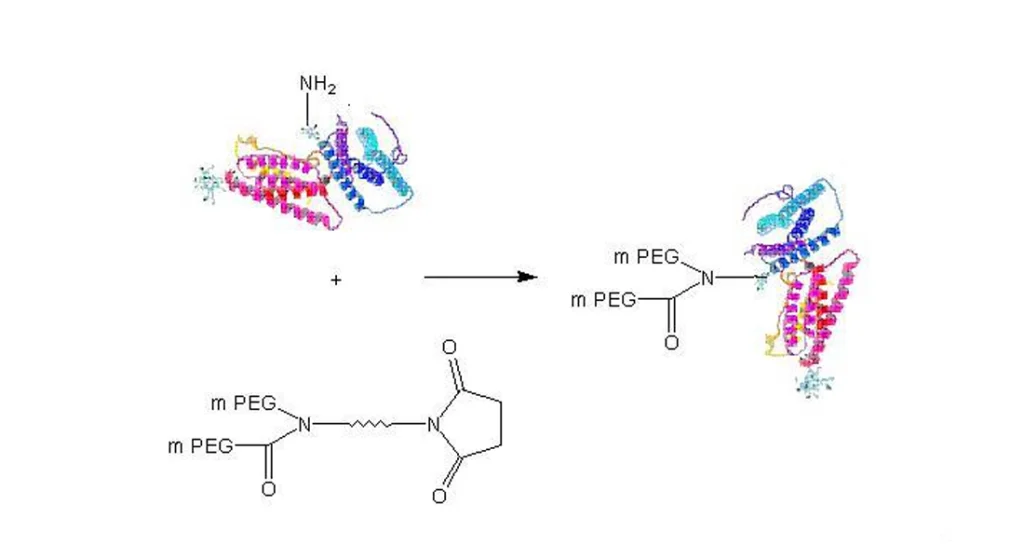
- Site-specific modification: Through chemical synthesis, PEG molecules are precisely attached to the specific sites of peptides to avoid affecting their active sites.
Technical Advantages
Prolonged half-life: PEG modification can increase the size of peptide molecules, reduce renal filtration, and protect peptides from enzymatic degradation, thus significantly prolonging their half-life.
Reduced immunogenicity: Masking the antigenic epitopes on the surface of the peptide reduces its immunogenicity and minimizes side effects.
Improved solubility: Successfully improved the solubility and bioavailability of peptide drugs.
Enhancement of stability: Successfully improve the thermal and chemical stability of peptide drugs, and extend their storage period.
Application Fields
Peptide PEG modification technology has a wide range of applications in many fields, e like me:
Drug development: Used to develop long-lasting, low-toxicity, targeted peptide drugs, such as anti-cancer peptides, antibacterial peptides, analgesic peptides, etc.
Diagnostic reagents: for the development of highly sensitive and specific peptide diagnostic reagents, such as tumor marker detection reagents, virus detection reagents.
Nā mea olaola: Used to develop biocompatible and functional peptide biomaterials, such as tissue engineering scaffolds and drug delivery systems.