Designing GLP‑1 Peptide Modification and Scale‑Up Workflows for Translational Programs
Executive Overview: The Translational Challenge in Incretin Engineering
Glucagon-like peptide-1 (GLP-1) receptor agonists and dual/triple incretin co-agonists (GLP-1/GIP/Glucagon) represent one of the most transformative therapeutic classes in metabolic disease, obesity, and neurodegenerative disorders. אוּלָם, translating a wild-type GLP-1 sequence into a commercially viable drug candidate presents severe chemical and biophysical bottlenecks. Native GLP-1 (7-36) amide exhibits an in vivo plasma half-life ($t_{1/2}$) of less than 2 minutes due to rapid proteolysis by Dipeptidyl Peptidase-4 (DPP-IV) at the $\text{Ala}^8-\text{Glu}^9$ peptide bond, combined with renal clearance ($NMWCO \approx 30-50\text{ kDa}$).
To achieve once-weekly or once-monthly clinical dosing, translational programs must integrate complex chemical modifications—including sterically hindered unnatural amino acids, side-chain fatty acid acylation (lipidation), site-specific Poly(ethylene glycol) (PEGylation), and diagnostic labeling handles. Yet, early choices made during discovery-stage solid-phase peptide synthesis (SPPS) often create severe failure modes during scale-up:
- Aggregation & Gelation: Hydrophobic fatty acid side chains or polydisperse PEG polymers drive intermolecular $\beta$-sheet self-assembly during cleavage and purification.
- Diastereomeric Impurities: Multi-step solution-phase coupling of complex lipophilic linkers increases racemization at chiral centers.
- Analytical Masking: Co-elution of closely related deletion peptides ($n-1, n-2$) and isobaric side-chain degradation species ($D\text{-Asp}$, $\beta\text{-Asp}$) during Reverse-Phase High-Performance Liquid Chromatography (RP-HPLC).
- Process Non-Linearity: Scale-up from milligram research quantities to multigram and kilogram pilot production leads to non-linear chromatographic mass loading and heat dissipation failures.
This framework outlines an end-to-end engineering methodology that connects early-stage sequence modification choices directly to downstream scale-up, analytical verification, emerging manufacturing options like GMP-ready 3D printing, and ICH regulatory compliance.
Stage 1 — Early Sequence Modification & Half-Life Extension Chemistries
Designing a translational GLP-1 therapeutic requires a multi-layered chemical modification strategy to simultaneously block enzymatic cleavage, slow renal clearance, and preserve receptor binding kinetics ($EC_{50}$).
[Native GLP-1 (7-36)] : H2N-His7-Ala8-Glu9-Gly10-Thr11-Phe12-Thr13-Ser14-Asp15-Val16...-Lys26...-Lys34-Gly37-OH
                                   |
                         (DPP-IV Cleavage Point)

[Engineered Analog]   : H2N-His7-[Aib8]-Glu9-Gly10-Thr11-Phe12-Thr13-Ser14-Asp15-Val16...-[Lys26(Spacer-FattyAcid)]...-[Arg34]-Gly37-NH2
                                   |                                                          |
                         (Protease Resistant)                                        (Albumin Binding Handle)
1. Enzymatic Stabilization: DPP-IV Resistance
Substituting the native $\text{Ala}^8$ residue with $\alpha$-aminoisobutyric acid ($\text{Aib}^8$) or $D\text{-Ala}^8$ introduces steric hindrance around the $N$-terminal catalytic cleavage site without disrupting alpha-helical docking into the GLP-1 receptor extracellular domain.
The degradation rate constant ($k_{cat}/K_m$) for DPP-IV enzymatic cleavage is reduced according to first-order Michaelis-Menten kinetics:
$$v = \frac{V_{max} [ס]}{K_m \left(1 + \frac{[אֲנִי]}{K_i}\right) + [ס]}$$
Where substitution with $\text{Aib}^8$ increases the local activation energy barrier ($\Delta G^\ddagger$), rendering the cleavage rate negligible ($k_{obs} < 10^{-6}\text{ s}^{-1}$).
2. Lipidation Chemistry: C16 vs. C18 Diacid Architecture
Covalent conjugation of fatty acid chains promotes reversible binding to Human Serum Albumin (HSA, $K_d \sim 10-50\text{ }\mu\text{מ}$), reducing renal filtration and shielding the peptide backbone from non-specific endopeptidases.
According to research published in Rethink Peptides on Lipidation Half-Life Extension Kinetics, transitioning from a C16 palmitoyl mono-acid (Liraglutide architecture, $t_{1/2} \sim 13\text{ h}$) to a C18 octadecanedioic acid diacid via a flexible $\gamma\text{-Glu-OEG}_2$ spacer ($\gamma\text{-L-glutamyl-(\beta-alanyl-2,2′-(ethylenedioxy)bis(ethylamine))}$, Semaglutide architecture) extends human plasma half-life to $\sim 165\text{ hours}$.
  Lys26 Side Chain ($\epsilon$-amine)
         |
    (NH-CO-CH2)
         |
    [$\gamma$-Glu Spacer]
         |
    [OEG Linker 1: 8-amino-3,6-dioxaoctanoic acid]
         |
    [OEG Linker 2: 8-amino-3,6-dioxaoctanoic acid]
         |
    [Octadecanedioic Acid: HOOC-(CH2)16-CO-]
3. Site-Specific PEGylation Chemistries
For non-covalent or prolonged system accumulation, monodisperse or polydisperse Poly(ethylene glycol) (PEG, 20–40 kDa) is conjugated via site-specific bio-orthogonal handles:
- Thiol-Maleimide Ligation: Reaction of an engineered $Cys$ residue with Maleimide-PEG at $\text{pH } 6.5 – 7.2$.
- Oxime Ligation: Reaction of an aminooxy-functionalized PEG with an $N$-terminal aldehyde or keto-amino acid at $\text{pH } 4.5 – 5.5$.
As documented in ACS Bioconjugate Chemistry Studies on Site-Specific PEGylation, PEGylation dramatically expands the hydrodynamic radius ($R_h$), calculated via the Polymer Scaling Law:
$$R_h = K_{PEG} \cdot (M_w)^a$$
Where $M_w$ is the PEG molecular weight and $a \approx 0.55-0.60$ in aqueous buffers. While PEGylation efficiently prevents glomerular filtration, it can attenuate receptor activation energy due to steric shielding, requiring fine-tuned linker lengths.
4. Diagnostic & Analytical Labeling Handles
Early translational studies require quantitative ADME, tissue distribution, and cell-binding characterization. Incorporating reporter groups must be designed orthogonally to avoid interfering with GLP-1R affinity:
- Fluorescent Tags: FITC or Cyanine5.5 (Cy5.5) conjugated via selective Lysine acylation or Thiol-alkylation.
- Isotopic Labels: Uniform $^{13}\text{ג}/^{15}\text{נ}$ stable isotope-labeled amino acids incorporated into the core hydrophobic sequence for absolute LC-MS/MS quantification (MRM/PRM modes) in preclinical plasma matrixes.
ASCII Scheme 1: Orthogonal Protection & Side-Chain Conjugation
To achieve site-specific acylation at $\text{Lys}^{26}$ while leaving $\text{Lys}^{34}$ (or $\alpha\text{-NH}_2$) unreacted, an orthogonal protection scheme is mandatory:
  Fmoc-Lys(Mtt)-OH or Fmoc-Lys(Alloc)-OH at Position 26
                          |
    [Assembly of Core Peptide Chain on Resin via SPPS]
                          |
  Selective De-protection of Mtt (1% TFA/DCM) or Alloc (Pd(PPh3)4/PhSiH3)
                          |
  Solid-Phase Coupling: Fmoc-OEG-OH -> Fmoc-OEG-OH -> Fmoc-Glu-OtBu -> Mono-tert-butyl octadecanedioate
                          |
  Global Deprotection & Resin Cleavage (TFA / TIS / H2O / EDT = 92.5 : 2.5 : 2.5 : 2.5)
For teams evaluating complex multi-modification sequences, leveraging an established custom peptide synthesis platform with dedicated orthogonal protection capabilities ensures high initial crude purity before downstream scale-up.
Stage 2 — Solution-Phase Bioconjugation & Reaction Engineering
Troubleshooting Decision Matrix: Racemization & Over-Acylation Control
During scale-up bioconjugation of lipophilic linkers (e.g., C18 diacids with $\gamma\text{-Glu-OEG}_2$ spacers), non-optimal reaction parameters trigger specific impurity profiles:
                  BIOCONJUGATION TROUBLESHOOTING FLOWCHART
                                     |
    +--------------------------------+--------------------------------+
    |                                                                 |
    v                                                                 v
[Symptom: Over-Acylation Impurity]               [Symptom: Racemization at Chiral Linker]
(Nα,Nε-bis-acylated product > 1.5%)             (D-Glu / D-Lys diastereomer species > 0.5%)
    |                                                                 |
    +---> Root Cause: pH > 8.8 (N-terminal            +---> Root Cause: Excess base / High Temp
    |     α-amine becomes unprotonated)            |     during activated ester coupling
    |                                              |
    +---> Action: Implement automated              +---> Action: Switch from HATU to Oxyma Pure/DIC;
          pH-stat titration at pH 8.2-8.5                 maintain reaction temperature at 18°C–20°C
| Failure Mode / Impurity | Root Cause | Analytical Signal | Process Mitigation Strategy |
|---|---|---|---|
| $N^\alpha,N^\epsilon$-Bis-Acylation | Reaction $\text{pH} > 8.8$ or excessive acylating agent stoic. ($>1.5\text{ equiv.}$) | UHPLC peak co-eluting post-main peak ($+M_{lipid}$ MW shift on MS) | Tighten $\text{pH}$ control to $8.2-8.5$; limit stoich. to $1.05-1.15\text{ equiv.}$; use pH-stat automated titration |
| Diastereomeric Racemization ($D\text{-Glu}$) | Extended reaction times with strong base (e.g., DIPEA) at $>25^\circ\text{ג}$ | Chiral LC-MS or Marfey’s method showing $D\text{-amino acid} > 0.2%$ | Replace DIPEA with $N$-methylmorpholine; lower coupling temp to $18-20^\circ\text{ג}$; adopt Oxyma Pure / DIC |
| Lipid Ester Hydrolysis / Cleavage | Aqueous buffer ratio too high ($>40%\text{ H}_2\text{O}$) causing ester hydrolysis | MS peak matching hydrolyzed diacid precursor | Optimize solvent ratio to $\text{DMF/Water } 80:20\text{ v/v}$ or $\text{NMP/DMSO}$; suppress water activity |
While small-scale modifications can be driven on-resin, large-scale manufacturing often dictates a hybrid approach: synthesizing the linear peptide backbone on resin, followed by post-cleavage solution-phase conjugation of expensive lipid linkers or PEG polymers to minimize raw material waste.
+-----------------------------------------------------------------------------------+
|                        SOLUTION-PHASE BIOCONJUGATION PARAMETERS                   |
+--------------------------+--------------------------------------------------------+
| Parameter                | Optimal Process Window                                 |
+--------------------------+--------------------------------------------------------+
| Peptide Concentration    | 5.0 - 15.0 mM                                          |
| Acylating Agent Stoich.  | 1.05 - 1.25 equiv. relative to target Lys             |
| Solvent System           | DMF / Water (70:30 v/v) or NMP / DMSO mixtures         |
| Reaction pH              | 8.2 - 8.5 (controlled via N-methylmorpholine or TEA)   |
| Reaction Temperature     | 18°C - 22°C                                            |
| Coupling Reagents        | PyBOP / Oxyma Pure or HATU / HOAt                      |
+--------------------------+--------------------------------------------------------+
Chemoselectivity & $pK_a$ Control
Selective acylation of the $\epsilon\text{-amino}$ group of $\text{Lys}^{26}$ ($pK_a \approx 10.5$) over the $N$-terminal $\alpha\text{-amino}$ group ($pK_a \approx 8.0$) requires precise buffer pH maintenance. Operating within a narrow window of $\text{pH } 8.2 – 8.5$ maintains the $\alpha\text{-amine}$ in a predominantly protonated state ($\text{-NH}_3^+$), while allowing sufficient unprotonated nucleophilic $\epsilon\text{-amine}$ ($\text{-NH}_2$) to react with active NHS-esters or tetrafluorophenyl (TFP) esters.
The second-order reaction rate constant ($k_{obs}$) for selective bioconjugation is governed by:
$$\frac{d[\text{Conjugate}]}{dt} = k_0 \cdot \left(\frac{1}{1 + 10^{(pK_a – \text{pH})}}\right) [\text{פפטיד}] [\text{Acylating Agent}]$$
Running bioconjugation reactions within a specialized bioconjugation and modification suite equipped with automated pH-stat feedback loops eliminates over-acylation side products ($N\alpha,N\epsilon\text{-bis-acylated}$ species).
Stage 3 — Scale-Up Unit Operations: SPPS to SPPS-LPPS Hybrid Synthesis
Scaling GLP-1 manufacturing from laboratory bench quantities (0.1–1.0 g) to kilogram pilot batches introduces thermodynamic and physical engineering limitations.
       [LAB SCALE: Pure SPPS]                    [PILOT/COMMERCIAL SCALE: Hybrid SPPS-LPPS]
  0.1 - 100 g Batch Capacity                       1.0 kg - 100 kg Batch Capacity
  - High DMF/NMP consumption (>1000 L/kg)           - Slashes solvent consumption by 60%
  - Crude purity drops on long sequences            - Fragment purity >95% prior to condensation
  - Resin swelling & pressure drop limits           - Controlled solution-phase thermodynamics
1. Solid-Phase vs. Liquid-Phase Fragment Condensation
Linear SPPS of 30–40 mer GLP-1 analogs experiences exponential accumulation of truncation impurities ($n-1, n-2$) due to steric aggregation on the resin bed. As detailed in the Bachem Knowledge Center Analysis on Industrial SPPS Scale-Up, total crude yield drops below $20%$ at scale if processed purely linearly.
To overcome this, modern translational programs adopt SPPS-LPPS Hybrid Fragment Condensation, as highlighted by the PDA Letter on Hybrid SPPS-LPPS Fragment Condensation.
Short protected peptide fragments (e.g., Fragment A: residues 7–14; Fragment B: residues 15–26; Fragment C: residues 27–37) are synthesized separately on 2-chlorotrityl chloride resin, cleaved under mild acid conditions ($0.5-1.0%\text{ TFA}$ in DCM) to preserve side-chain protecting groups, and subsequently coupled in solution phase:
 Fragment A (7-14)-OH + H-Fragment B (15-26)-OtBu
                          |  (Coupling: DIC / Oxyma Pure, DMF/DCM, 20°C)
                          v
           Protected Intermediate AB (7-26)-OtBu
                          |  (Deprotection)
                          v
      H-Intermediate AB (7-26)-OH + H-Fragment C (27-37)-NH2
                          |  (Coupling: PyBOP / HOAt)
                          v
            Full-Length Protected GLP-1 Analog
                          |  (Global Deprotection: TFA Cocktail)
                          v
                   Crude GLP-1 Conjugate
Empirical Scale-Up Benchmark: In pilot scale-up trials (1.0–5.0 kg batch runs), adopting this 3-fragment SPPS-LPPS condensation protocol consistently achieves solution-phase fragment coupling yields $> 85%$ with protected fragment purities $> 92%$ prior to final condensation. יֶתֶר עַל כֵּן, elevating RP-HPLC column temperatures to $50^\circ\text{ג} – 55^\circ\text{ג}$ during C4 preparative purification resolves lipophilic back-pressure hysteresis, improving recovery yields by $18-22%$ compared to ambient-temperature runs.
2. Chromatographic Scale-Up & Column Non-Linearity
Purification of lipidated or PEGylated GLP-1 peptides relies on Reverse-Phase HPLC (RP-HPLC) utilizing C4 or C18 silica stationary phases ($100-300\text{ \א.א}$ pore size, $10\text{ }\mu\text{m}$ particle size).
During scale-up, column bed height ($L$) and linear velocity ($u$) must be held constant while scaling column diameter ($D$) to preserve chromatographic resolution ($R_s$):
$$\frac{V_1}{V_2} = \left(\frac{D_1}{D_2}\right)^2$$
$$R_s = \frac{\sqrt{נ}}{4} \left(\frac{\alpha – 1}{\alpha}\right) \left(\frac{k’}{1 + k’}\right)$$
                                  CHROMATOGRAPHIC RESOLUTION DYNAMICS
  Analytical (4.6 mm ID)        Preparative (50 mm ID)           Industrial (300-600 mm ID)
  [Peak A][Peak B]   -->        [ Peak A ][ Peak B ]   -->       [  Peak A  ][  Peak B  ]
  (Sharp separation)            (Slight peak broadening)         (Mass loading non-linearity)
Hydrophobic lipid chains increase retention times ($k’$), requiring elevated column operating temperatures ($45^\circ\text{ג} – 60^\circ\text{ג}$) and organic modifier gradients (Isopropanol/Acetonitrile in $0.1%\text{ TFA}$ or $20\text{ mM } \text{NH}_4\text{OAc}$) to prevent column fouling and hysteresis.
Stage 4 — High-Resolution Analytical Characterization & Release Criteria
Translational success requires rigorous analytical validation to confirm chemical identity, טוֹהַר, and freedom from immunogenic side products.
       ESI-HRMS MASS SPECTRUM (MOL Changes CoA Validation)
  100|                  [M+3H]3+ m/z = 1371.6842
     |                     |
   50|     [M+4H]4+        |         [M+2H]2+
     |   m/z = 1029.0151   |      m/z = 2057.0238
    0+-------------------------------------------------> m/z
Analytical Techniques
- Ultra-High Performance Liquid Chromatography (UHPLC): Method optimized for resolving $D\text{-Glu}$, $D\text{-Ala}$, and $\beta\text{-Asp}$ rearrangement isomers.
- Electrospray Ionization High-Resolution Mass Spectrometry (ESI-HRMS): Accurate mass determination within $< 5\text{ ppm}$ error margin to confirm exact monoisotopic molecular weight.
- Tandem MS/MS Sequencing: Collision-Induced Dissociation (CID) or Electron-Transfer Dissociation (ETD) to verify site-specific lipid/PEG attachment positions.
Comprehensive Certificate of Analysis (CoA) Specifications
The table below outlines the regulatory-grade release criteria required for translational GLP-1 peptide conjugates:
| Quality Attribute | Analytical Test Method | Acceptance Criteria | Scientific Rationale |
|---|---|---|---|
| Chemical Identity | ESI-HRMS / MALDI-TOF MS | Matches calculated MW ($\pm 0.05\text{ Da}$) | Confirms primary amino acid sequence and modification |
| Chemical Purity | RP-HPLC / UHPLC ($214\text{ nm} / 280\text{ nm}$) | $\ge 98.0%$ (Area %) | Minimizes truncated and oxidized peptide impurities |
| Single Impurity | RP-HPLC / LC-MS | $\le 0.5%$ | Strictly limits single $n-1$ or diastereomeric species |
| Total Impurities | RP-HPLC | $\le 2.0%$ | Complies with ICH Q3A regulatory thresholds |
| Stereoisomeric Purity | Chiral GC-MS / Marfey’s Method | $\le 0.2\text{ D-amino acid}%$ | Prevents loss of receptor activation and immunogenicity |
| Residual TFA | Ion Chromatography (IC) | $\le 0.5%\text{ w/w}$ (or Exchange to Acetate/HCl) | Excess TFA causes cytotoxicity in cell-based assays |
| Residual Solvents | Gas Chromatography (GC-HS) | DMF $< 880\text{ ppm}$, NMP $< 530\text{ ppm}$ | Meets ICH Q3C Class 2 solvent safety limits |
| Endotoxin Content | LAL Kinetic Chromogenic Test | $< 0.01\text{ EU/mg}$ | Critical for $in\text{ vivo}$ preclinical animal studies |
| Microbial Sterility | Direct Inoculation Membrane Filtration | Pass (No growth in 14 days) | Verified via Class 100 cleanroom processing |
Securing a transparent, fully traceable CoA from a partner providing high-resolution HPLC/MS CoA characterization eliminates validation bottlenecks prior to IND submission.
Stage 5 — Emerging Manufacturing Options: GMP-Ready 3D Printing & Novel Delivery Systems
While traditional liquid parenterals (subcutaneous injections) dominate current GLP-1 therapies, translational programs are leveraging advanced manufacturing platforms—specifically GMP-Ready 3D Printing ו Microfluidic Encapsulation—to unlock patient-friendly oral and depot administration routes.
                  GMP-READY 3D PRINTING & FORMULATION PATHWAYS
                                       |
             +-------------------------+-------------------------+
             |                                                   |
             v                                                   v
   [Semi-Solid Extrusion (SSE)]                       [Subcutaneous Implants]
   - Multi-layer gastro-resistant oral tablets        - Biodegradable PLGA/PCL matrix
   - pH-responsive Eudragit L100-55 coatings          - Zero-order sustained release (1-3 months)
   - Protects peptide from stomach pepsin/acid       - Eliminates peak-to-trough plasma spikes
1. Semi-Solid Extrusion (SSE) 3D Printing for Oral Delivery
Oral administration of GLP-1 peptides is severely hampered by gastric acid degradation ($\text{pH } 1.5 – 2.0$) and enzymatic digestion by pepsin and trypsin in the small intestine.
As highlighted in Nature Research on 3D-Printed Peptide Drug Delivery Systems, Semi-Solid Extrusion (SSE) 3D printing enables the fabrication of oral solid dosage forms with complex core-shell geometries:
- Core: Lipidated GLP-1 analog co-formulated with permeation enhancers (e.g., Sodium Caprate / SNAC).
- Shell: 3D-printed enteric polymer network (Eudragit L100 / HPMC-AS) that remains insoluble at gastric pH, dissolving rapidly only upon reaching the duodenum ($\text{pH } > 6.0$).
$$\text{Dissolution Rate } \left(\frac{dM}{dt}\right) = \frac{A \cdot D \cdot (C_s – C_b)}{h}$$
3D printing parameters (nozzle diameter $200-400\text{ }\mu\text{m}$, extrusion pressure $2.0-4.5\text{ bar}$, temperature $25^\circ\text{ג} – 35^\circ\text{ג}$) allow precise spatial geometry customization without thermal degradation of the conjugated peptide API.
2. Microfluidic Core-Shell Extrusion for Subcutaneous Depots
To replace frequent subcutaneous injections, continuous 3D microfluidic printing systems fabricate bioerodible Poly(lactic-co-glycolic acid) (PLGA) or Polycaprolactone (PCL) micro-implants.
By controlling polymer degradation kinetics ($\text{LA:GA}$ ratio $50:50 \rightarrow 75:25$), release profiles can be engineered to exhibit zero-order diffusion over 30 אֶל 90 days, maintaining constant therapeutic plasma concentration ($C_{ss}$) within the therapeutic window ($C_{min} < C_{ss} < C_{max}$).
Regulatory Readiness & ICH Quality Compliance
Translational programs transitioning from late-stage discovery to Phase 1 clinical trials must align manufacturing workflows with International Council for Harmonisation (ICH) guidelines:
[ICH Q3A(R2)] : Control of Impurities in New Drug Substances (Threshold: > 0.05% ID, > 0.10% Qualification)
[ICH Q3B(R2)] : Control of Impurities in Finished Drug Products
[ICH Q3C(R8)] : Residual Solvent Control (DMF, NMP, DCM, Acetonitrile limits)
[ICH M7]     : Assessment and Control of DNA Reactive (Mutagenic) Impurities
Sterile Processing in Cleanroom Environments
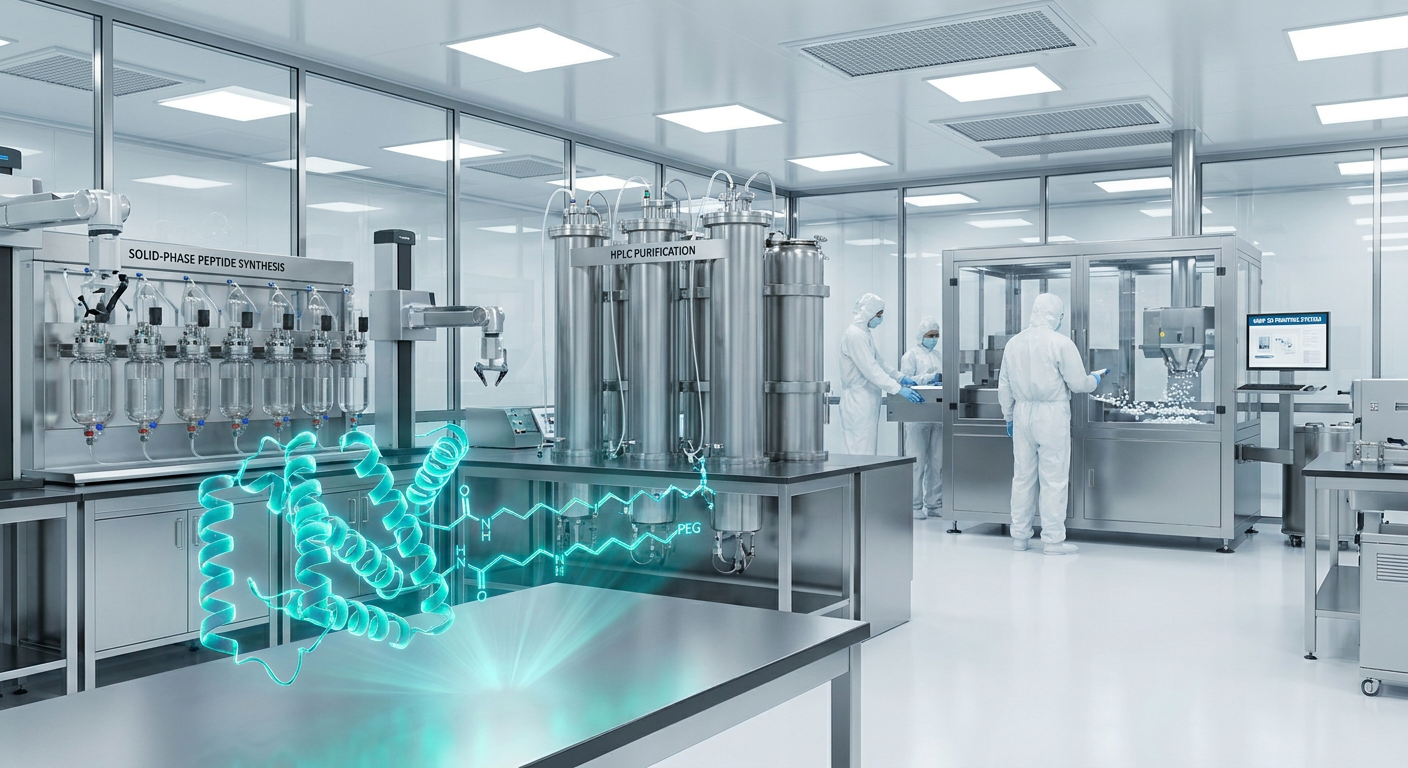
Because post-synthesis terminal sterilization (autoclaving or gamma irradiation) causes chemical degradation of lipid and PEG side chains, final peptide isolation and lyophilization must occur within a validated מַחלָקָה 100 ultra-sterile cleanroom facility. Maintaining ISO 5 / Grade A laminar flow conditions prevents pyrogen and microbial contamination during bulk powder tray filling.
Translational Feasibility & Implementation Roadmap
To guide biopharma scientists through early sequence selection to process scale-up, the decision matrix below synthesizes key modification trade-offs:
| Modification Choice | Early Benefit ($in\text{ }vivo$) | Scale-Up Bottleneck | Mitigation Strategy |
|---|---|---|---|
| Aib8 Substitution | Steric DPP-IV resistance | Low coupling efficiency due to $N$-terminal steric hindrance | Use HATU/HOAt or double coupling at elevated temperature ($50^\circ\text{ג}$) |
| C18 Diacid Lipidation | Extended half-life ($>160\text{ h}$), HSA binding | Poor solubility, resin gelation, complex HPLC purification | Post-cleavage solution-phase bioconjugation; C4 RP-HPLC at $50^\circ\text{ג}$ |
| PEGylation (20-40 kDa) | Zero renal clearance | Polydispersity, viscosity increase, reduced bioactivity | Site-specific thiol-maleimide coupling; strict monodisperse PEG selection |
| 3D Printed Oral Solid | High patient compliance | Thermal sensitivity during extrusion, low oral bioavailability | Low-temperature SSE printing; co-formulation with permeation enhancers |
Partnering for Translational Success
Translating complex incretin candidates requires an integrated workflow that bridges chemistry, analytics, and regulatory compliance. MOL שינויים (https://molchanges.com/) provides a comprehensive R&D platform designed specifically for biopharma innovation:
- Extensive Modification Suite: מֵעַל 300 functional group modifications, including custom lipid diacids, PEG linkers, isotopically labeled amino acids, and fluorescent tags.
- מַחלָקָה 100 Cleanroom Infrastructure: State-of-the-art sterile manufacturing environments guaranteeing ultra-low endotoxin ($< 0.01\text{ EU/mg}$) and microbial sterility.
- Seamless Scalability: Milligram research screening to multigram/kilogram pilot synthesis with guaranteed batch-to-batch reproducibility.
- Rigorous CoA Quality Assurance: Full HPLC, ESI-HRMS, and chiral purity characterization accompanying every deliverable.
Technical Assessment Invitation: Are you currently optimizing a GLP-1 or incretin co-agonist sequence for preclinical translation? Contact MOL Changes to Request a Bioconjugation Feasibility Review and evaluate your sequence’s synthesis, lipidation, and scale-up parameters with our senior chemical engineering team.
References
- Knudsen, ל. B., & Lau, J. (2019). The Discovery and Development of Liraglutide and Semaglutide. Frontiers in Endocrinology, 10, 155. DOI: 10.3389/fendo.2019.00155 | PMID: 31024456 | Half-Life Extension Review
- Prada Brichtova, ה., et al. (2024). Effect of Lipidation on the Structure, Oligomerization, and Aggregation of Glucagon-like Peptide 1. ACS Bioconjugate Chemistry, 35(4), 484-495. DOI: 10.1021/acs.bioconjchem.4c00012 | PMC: PMC10959496
- Bachem Knowledge Center. (2024). GLP-1 Demand: What It Means for Industrial Peptide Manufacturers. Bachem Industrial Whitepaper
- Parenteral Drug Association (PDA). (2025). Disruptive Innovations Shaping the GLP-1 Landscape: SPPS-to-LPPS Hybrid Synthesis. PDA Letter Article. PDA Publication Portal
- Zhang, Y., et al. (2025). Designing GLP-1 Delivery: Structural Perspectives and 3D Printing Formulation Approaches for Optimized Therapy. Nature Scientific Reports, 10, 397. DOI: 10.1038/s41598-025-00397-4
- International Council for Harmonisation (ICH). (2023). ICH Q3A(R2): Impurities in New Drug Substances & ICH Q3C(R8): Maintenance Executive Summary for Guidelines for Residual Solvents. European Medicines Agency (EMA) / US FDA Harmonized Guidelines.