为转化项目设计 GLP-1 肽修饰和放大工作流程
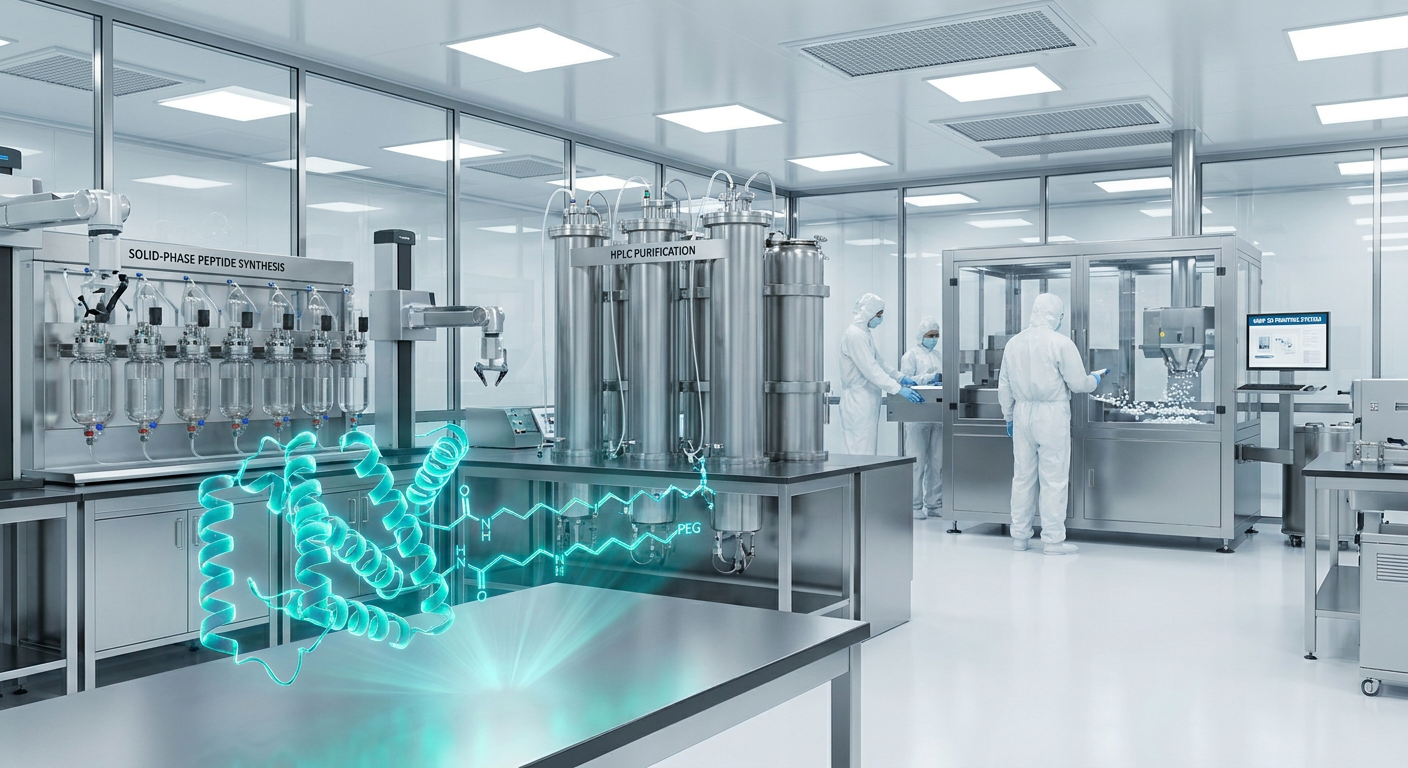
执行概况: 肠促胰岛素工程的转化挑战
胰高血糖素样肽-1 (GLP-1) 受体激动剂和双重/三重肠促胰岛素联合激动剂 (GLP-1/GIP/胰高血糖素) 代表代谢疾病中最具变革性的治疗类别之一, 肥胖, 和神经退行性疾病. 然而, 将野生型 GLP-1 序列转化为商业上可行的候选药物存在严重的化学和生物物理瓶颈. 天然 GLP-1 (7-36) 酰胺表现出 活 血浆半衰期 ($t_{1/2}$) 小于 2 由于二肽基肽酶 4 的快速蛋白水解作用,需要几分钟 (DPP-IV) 在$文本处{翼}^8-文本{谷氨酸}^9$ 肽键, 结合肾清除率 ($NMWCO 约 30-50text{ kDa}$).
实现每周一次或每月一次的临床给药, 翻译程序必须整合复杂的化学修饰——包括空间位阻非天然氨基酸, 侧链脂肪酸酰化 (脂化), 位点特异性聚(乙二醇) (聚乙二醇化), 和诊断标签手柄. 然而, 在发现阶段固相肽合成过程中做出的早期选择 (统计软件) 在放大过程中经常会产生严重的故障模式:
- 聚合 & 凝胶化: 疏水性脂肪酸侧链或多分散 PEG 聚合物在裂解和纯化过程中驱动分子间 $beta$-片层自组装.
- 非对映异构体杂质: 复杂亲脂性接头的多步溶液相偶联增加了手性中心的外消旋作用.
- 分析掩蔽: 密切相关的缺失肽的共洗脱 ($n-1, n-2$) 和同量异位侧链降解物质 ($D文本{-天冬氨酸}$, $\测试版文本{-天冬氨酸}$) 反相高效液相色谱期间 (反相高效液相色谱法).
- 过程非线性: 从毫克研究数量扩大到多克和公斤试生产会导致非线性色谱质量加载和散热故障.
该框架概述了一种端到端工程方法,将早期序列修改选择直接与下游放大联系起来, 分析验证, 新兴制造选项,例如符合 GMP 要求的 3D 打印, 和 ICH 监管合规性.
阶段 1 — 早期序列修改 & 半衰期延长化学
设计翻译性 GLP-1 治疗药物需要多层化学修饰策略来同时阻止酶裂解, 肾清除缓慢, 并保持受体结合动力学 ($EC_{50}$).
[Native GLP-1 (7-36)] : H2N-His7-Ala8-Glu9-Gly10-Thr11-Phe12-Thr13-Ser14-Asp15-Val16...-Lys26...-Lys34-Gly37-OH
                                   |
                         (DPP-IV Cleavage Point)

[Engineered Analog]   : H2N-His7-[Aib8]-Glu9-Gly10-Thr11-Phe12-Thr13-Ser14-Asp15-Val16...-[Lys26(Spacer-FattyAcid)]...-[Arg34]-Gly37-NH2
                                   |                                                          |
                         (Protease Resistant)                                        (Albumin Binding Handle)
1. 酶促稳定: DPP-IV 耐药性
替换原生 $text{翼}^8$ 残基与 $alpha$-氨基异丁酸 ($\文本{艾布}^8$) 或$D文本{-翼}^8$ 在 $N$ 末端催化裂解位点周围引入空间位阻,而不会破坏与 GLP-1 受体胞外结构域的 α 螺旋对接.
降解速率常数 ($k_{猫}/千元$) DPP-IV 酶促裂解根据一级 Michaelis-Menten 动力学减少:
$$v = 压裂{V_{最大限度} [S]}{K_m 左(1 + \压裂{[我]}{K_i}\正确的) + [S]}$$
其中替换为 $text{艾布}^8$ 增加局部活化能垒 ($\德尔塔 G^ddagger$), 使得裂解率可以忽略不计 ($k_{观测值} < 10^{-6}\文本{ s}^{-1}$).
2. 脂化化学: C16 对比. C18二酸结构
脂肪酸链的共价结合促进与人血清白蛋白的可逆结合 (人血清白蛋白, $K_d sim 10-50text{ }\多文本{中号}$), 减少肾脏过滤并保护肽骨架免受非特异性内肽酶的影响.
根据发表在 重新思考肽的脂化半衰期延长动力学, 从 C16 棕榈酰单酸转变 (利拉鲁肽架构, $t_{1/2} \SIM 13文本{ 小时}$) 通过灵活的 $gammatext 转换为 C18 十八烷二酸二酸{-谷氨酸OEG}_2$ 垫片 ($\伽玛文本{-L-谷氨酰-(\β-丙氨酰-2,2′-(亚乙基二氧基)之二(乙胺))}$, 索马鲁肽架构) 将人血浆半衰期延长至 $sim 165text{ 小时}$.
  Lys26 Side Chain ($\epsilon$-amine)
         |
    (NH-CO-CH2)
         |
    [$\gamma$-Glu Spacer]
         |
    [OEG Linker 1: 8-amino-3,6-dioxaoctanoic acid]
         |
    [OEG Linker 2: 8-amino-3,6-dioxaoctanoic acid]
         |
    [Octadecanedioic Acid: HOOC-(CH2)16-CO-]
3. 位点特异性聚乙二醇化化学
用于非共价或长时间的系统积累, 单分散或多分散 聚(乙二醇) (聚乙二醇, 20–40 kDa) 通过位点特异性生物正交手柄结合:
- 硫醇-马来酰亚胺连接: 工程化 $Cys$ 残基与马来酰亚胺-PEG 在 $text 处的反应{酸碱度 } 6.5 – 7.2$.
- 肟连接: 氨基氧基官能化 PEG 与 $N$ 末端醛或酮氨基酸在 $text 处的反应{酸碱度 } 4.5 – 5.5$.
如记录在 ACS 关于位点特异性聚乙二醇化的生物共轭化学研究, 聚乙二醇化显着扩大了流体动力学半径 ($R_h$), 通过聚合物缩放定律计算:
$$R_h = K_{聚乙二醇} \cd点 (重量)^a$$
其中 $M_w$ 是 PEG 分子量,$a approx 0.55-0.60$ 在水性缓冲液中. 虽然聚乙二醇化可有效防止肾小球滤过, 由于空间屏蔽,它可以减弱受体激活能, 需要微调链接器长度.
4. 诊断 & 分析标签手柄
早期转化研究需要定量 ADME, 组织分布, 和细胞结合表征. 纳入报告基团必须正交设计以避免干扰 GLP-1R 亲和力:
- 荧光标签: FITC 或花青5.5 (CY5.5) 通过选择性赖氨酸酰化或硫醇烷基化进行缀合.
- 同位素标签: 制服$^{13}\文本{C}/^{15}\文本{氮}$ 稳定同位素标记的氨基酸并入核心疏水序列,用于绝对 LC-MS/MS 定量 (MRM/PRM 模式) 临床前血浆基质.
ASCII 方案 1: 正交保护 & 侧链缀合
在 $text 处实现位点特异性酰化{赖氨酸}^{26}$ 离开 $text 时{赖氨酸}^{34}$ (或 $alphatext{-NH}_2$) 未反应的, 正交保护方案是强制性的:
  Fmoc-Lys(Mtt)-OH or Fmoc-Lys(Alloc)-OH at Position 26
                          |
    [Assembly of Core Peptide Chain on Resin via SPPS]
                          |
  Selective De-protection of Mtt (1% TFA/DCM) or Alloc (Pd(PPh3)4/PhSiH3)
                          |
  Solid-Phase Coupling: Fmoc-OEG-OH -> Fmoc-OEG-OH -> Fmoc-Glu-OtBu -> Mono-tert-butyl octadecanedioate
                          |
  Global Deprotection & Resin Cleavage (TFA / TIS / H2O / EDT = 92.5 : 2.5 : 2.5 : 2.5)
适用于评估复杂的多重修改序列的团队, 利用既定的 定制肽合成平台 具有专用的正交保护功能,可确保下游放大之前的高初始粗纯度.
阶段 2 — 溶液相生物共轭 & 反应工程
故障排除决策矩阵: 外消旋化 & 过度酰化控制
在亲脂性接头的放大生物共轭过程中 (例如, C18 二酸与 $gammatext{-谷氨酸OEG}_2$ 垫片), 非最佳反应参数会触发特定的杂质分布:
                  BIOCONJUGATION TROUBLESHOOTING FLOWCHART
                                     |
    +--------------------------------+--------------------------------+
    |                                                                 |
    v                                                                 v
[Symptom: Over-Acylation Impurity]               [Symptom: Racemization at Chiral Linker]
(Nα,Nε-bis-acylated product > 1.5%)             (D-Glu / D-Lys diastereomer species > 0.5%)
    |                                                                 |
    +---> Root Cause: pH > 8.8 (N-terminal            +---> Root Cause: Excess base / High Temp
    |     α-amine becomes unprotonated)            |     during activated ester coupling
    |                                              |
    +---> Action: Implement automated              +---> Action: Switch from HATU to Oxyma Pure/DIC;
          pH-stat titration at pH 8.2-8.5                 maintain reaction temperature at 18°C–20°C
| 失效模式 / 杂质 | 根本原因 | 分析信号 | 流程缓解策略 |
|---|---|---|---|
| $N^alpha,N^epsilon$-双酰化 | 反应$text{酸碱度} > 8.8$ 或过量的酰化剂斯多葛. ($>1.5\文本{ 相当于}$) | UHPLC 峰共洗脱后主峰 ($+米_{脂质}$ MS 上的 MW 变化) | 拧紧$text{酸碱度}$ 控制到 $8.2-8.5$; 极限化学计量. 至 $1.05-1.15text{ 相当于}$; 使用 pH-stat 自动滴定 |
| 非对映体外消旋化 ($D文本{-谷氨酸}$) | 强碱延长反应时间 (例如, 二异丙醇) 于 $>25^circ文本{C}$ | 手性 LC-MS 或 Marfey 方法显示 $Dtext{-氨基酸} > 0.2%$ | 用 $N$-甲基吗啉替代 DIPEA; 将耦合温度降低至 $18-20^circtext{C}$; 采用Oxyma Pure / DIC |
| 脂质酯水解 / 乳沟 | 水缓冲液比例过高 ($>40%\文本{ H}_2文本{氧}$) 引起酯水解 | MS 峰匹配水解二酸前体 | 将溶剂比例优化为 $text{二甲基甲酰胺/水 } 80:20\文本{ 体积/体积}$ 或$文本{NMP/二甲基亚砜}$; 抑制水分活性 |
虽然可以在树脂上进行小规模修改, 大规模制造通常需要混合方法: 在树脂上合成线性肽骨架, 随后进行昂贵的脂质连接体或 PEG 聚合物的裂解后溶液相缀合,以最大程度地减少原材料浪费.
+-----------------------------------------------------------------------------------+
|                        SOLUTION-PHASE BIOCONJUGATION PARAMETERS                   |
+--------------------------+--------------------------------------------------------+
| Parameter                | Optimal Process Window                                 |
+--------------------------+--------------------------------------------------------+
| Peptide Concentration    | 5.0 - 15.0 mM                                          |
| Acylating Agent Stoich.  | 1.05 - 1.25 equiv. relative to target Lys             |
| Solvent System           | DMF / Water (70:30 v/v) or NMP / DMSO mixtures         |
| Reaction pH              | 8.2 - 8.5 (controlled via N-methylmorpholine or TEA)   |
| Reaction Temperature     | 18°C - 22°C                                            |
| Coupling Reagents        | PyBOP / Oxyma Pure or HATU / HOAt                      |
+--------------------------+--------------------------------------------------------+
化学选择性 & $pK_a$ 对照
$epsilontext 的选择性酰化{-氨基}$ $text 组{赖氨酸}^{26}$ ($pK_a 大约 10.5$) 在 $N$ 终端 $alphatext 上{-氨基}$ 团体 ($pK_a 大约 8.0$) 需要精确维持缓冲液 pH 值. 在 $text 的狭窄窗口内操作{酸碱度 } 8.2 – 8.5$ 维护 $alphatext{-胺}$ 处于主要质子化状态 ($\文本{-NH}_3^+$), 同时允许足够的非质子化亲核 $epsilontext{-胺}$ ($\文本{-NH}_2$) 与活性 NHS-酯或四氟苯基反应 (全要素生产率) 酯类.
二级反应速率常数 ($k_{观测值}$) 对于选择性生物共轭是由:
$$\压裂{d[\文本{共轭}]}{dt} = k_0 cdot 左(\压裂{1}{1 + 10^{(pK_a – text{酸碱度})}}\正确的) [\文本{肽}] [\文本{酰化剂}]$$
在一个内运行生物共轭反应 专门的生物共轭和修饰套件 配备自动 pH 统计反馈回路,消除过度酰化副产物 ($Nalpha,Nepsilon文本{-双酰化}$ 物种).
阶段 3 — 扩大单位运营规模: SPPS 到 SPPS-LPPS 混合合成
从实验室工作台数量扩大 GLP-1 制造规模 (0.1–1.0 克) 公斤级中试批次引入了热力学和物理工程限制.
       [LAB SCALE: Pure SPPS]                    [PILOT/COMMERCIAL SCALE: Hybrid SPPS-LPPS]
  0.1 - 100 g Batch Capacity                       1.0 kg - 100 kg Batch Capacity
  - High DMF/NMP consumption (>1000 L/kg)           - Slashes solvent consumption by 60%
  - Crude purity drops on long sequences            - Fragment purity >95% prior to condensation
  - Resin swelling & pressure drop limits           - Controlled solution-phase thermodynamics
1. 固相与. 液相碎片凝聚
30–40 mer GLP-1 类似物的线性 SPPS 经历截断杂质的指数积累 ($n-1, n-2$) 由于树脂床上的空间聚集. 正如详细的 Bachem 知识中心对工业 SPPS 放大的分析, 原油总产量跌破 $20%$ 如果纯线性处理的话,在规模上.
为了克服这个, 现代翻译程序采用 SPPS-LPPS混合片段缩合, 正如所强调的 关于混合 SPPS-LPPS 碎片凝聚的 PDA 信件.
短保护肽片段 (例如, 片段A: 残基 7–14; 片段B: 残基 15–26; 片段C: 残基 27–37) 在2-氯三苯甲基氯树脂上单独合成, 在弱酸条件下裂解 ($0.5-1.0%\文本{ 三氟乙酸}$ 在 DCM 中) 保留侧链保护基团, 然后在溶液相中偶联:
 Fragment A (7-14)-OH + H-Fragment B (15-26)-OtBu
                          |  (Coupling: DIC / Oxyma Pure, DMF/DCM, 20°C)
                          v
           Protected Intermediate AB (7-26)-OtBu
                          |  (Deprotection)
                          v
      H-Intermediate AB (7-26)-OH + H-Fragment C (27-37)-NH2
                          |  (Coupling: PyBOP / HOAt)
                          v
            Full-Length Protected GLP-1 Analog
                          |  (Global Deprotection: TFA Cocktail)
                          v
                   Crude GLP-1 Conjugate
实证放大基准: 中试放大试验 (1.0–5.0 kg 批量运行), 采用这种 3 片段 SPPS-LPPS 缩合方案始终能够实现溶液相片段偶联,产率 $> 85%$ 具有受保护的片段纯度 $> 92%$ 最终冷凝之前. 此外, 将 RP-HPLC 柱温提高至 $50^circtext{C} – 55^circ文本{C}$ 在 C4 制备纯化过程中解决了亲脂性背压滞后问题, 提高回收率 $18-22%$ 与环境温度运行相比.
2. 色谱放大 & 列非线性
脂化或聚乙二醇化 GLP-1 肽的纯化依赖于反相 HPLC (反相高效液相色谱法) 使用 C4 或 C18 硅胶固定相 ($100-300\文本{ \AA}$ 孔径, $10\文本{ }\多文本{米}$ 粒径).
放大期间, 柱床高度 ($左$) 和线速度 ($美元) 缩放柱直径时必须保持恒定 ($美元) 以保持色谱分离度 ($R_s$):
$$\压裂{V_1}{V_2} = 左(\压裂{D_1}{D_2}\正确的)^2$$
$$R_s = frac{\开方{氮}}{4} \左边(\压裂{\阿尔法 – 1}{\阿尔法}\正确的) \左边(\压裂{k’}{1 + k’}\正确的)$$
                                  CHROMATOGRAPHIC RESOLUTION DYNAMICS
  Analytical (4.6 mm ID)        Preparative (50 mm ID)           Industrial (300-600 mm ID)
  [Peak A][Peak B]   -->        [ Peak A ][ Peak B ]   -->       [  Peak A  ][  Peak B  ]
  (Sharp separation)            (Slight peak broadening)         (Mass loading non-linearity)
疏水性脂质链增加保留时间 ($k'$), 需要升高色谱柱操作温度 ($45^circ文本{C} – 60^circ文本{C}$) 和有机改性剂梯度 (异丙醇/乙腈,浓度为 0.1%text{ 三氟乙酸}$ 或 $20文字{ 毫米 } \文本{NH}_4文本{有机酸}$) 防止色谱柱污染和滞后.
阶段 4 — 高分辨率分析表征 & 发布标准
转化成功需要严格的分析验证来确认化学特性, 纯度, 且不含免疫原性副产物.
       ESI-HRMS MASS SPECTRUM (MOL Changes CoA Validation)
  100|                  [M+3H]3+ m/z = 1371.6842
     |                     |
   50|     [M+4H]4+        |         [M+2H]2+
     |   m/z = 1029.0151   |      m/z = 2057.0238
    0+-------------------------------------------------> m/z
分析技术
- 超高效液相色谱 (超高效液相色谱法): 解析 $Dtext 的优化方法{-谷氨酸}$, $D文本{-翼}$, 和 $betatext{-天冬氨酸}$ 重排异构体.
- 电喷雾电离高分辨率质谱分析 (电喷雾高分辨质谱): 精确质量测定 $ 以内< 5\文本{ 百万分之一}$ 确定准确的单同位素分子量的误差范围.
- 串联 MS/MS 测序: 碰撞引起的解离 (来电显示) 或电子转移解离 (ETD) 验证位点特异性脂质/PEG 附着位置.
综合分析证书 (辅酶A) 规格
下表概述了翻译 GLP-1 肽缀合物所需的监管级释放标准:
| 质量属性 | 分析测试方法 | 验收标准 | 科学原理 |
|---|---|---|---|
| 化学特性 | 电喷雾高分辨质谱 / 飞行时间质谱 | 匹配计算的 MW ($\下午 0.05文本{ 和}$) | 确认一级氨基酸序列和修饰 |
| 化学纯度 | 反相高效液相色谱法 / 超高效液相色谱法 ($214\文本{ 纳米} / 280\文本{ 纳米}$) | $\葛 98.0%$ (区域 %) | 最大限度地减少截短和氧化的肽杂质 |
| 单一杂质 | 反相高效液相色谱法 / 液质联用 | $\这 0.5%$ | 严格限制单一$n-1$或非对映异构体物种 |
| 总杂质 | 反相高效液相色谱法 | $\这 2.0%$ | 符合 ICH Q3A 监管阈值 |
| 立体异构纯度 | 手性GC-MS / 马菲法 | $\0.2文本{ D-氨基酸}%$ | 防止受体激活和免疫原性丧失 |
| 残余三氟乙酸 | 离子色谱法 (我知道了) | $\0.5%文本{ 重量/重量}$ (或交换为乙酸/HCl) | 过量的 TFA 在细胞检测中会导致细胞毒性 |
| 残留溶剂 | 气相色谱法 (气相色谱法) | 二甲基甲酰胺$< 880\文本{ 百万分之一}$, NMP$< 530\文本{ 百万分之一}$ | 符合 ICH Q3C 等级 2 溶剂安全限值 |
| 内毒素含量 | 鲎试剂动力学显色试验 | $< 0.01\文本{ 欧盟/毫克}$ | 对于 $intext 至关重要{ 体内}$ 临床前动物研究 |
| 微生物无菌 | 直接接种膜过滤 | 经过 (没有增长 14 天) | 通过类验证 100 洁净室加工 |
确保透明, 来自提供的合作伙伴的完全可追溯的 CoA 高分辨率 HPLC/MS CoA 表征 消除 IND 提交之前的验证瓶颈.
阶段 5 — 新兴制造选择: 符合 GMP 要求的 3D 打印 & 新颖的输送系统
虽然传统的液体注射剂 (皮下注射) 主导当前的 GLP-1 疗法, 转化计划正在利用先进的制造平台——特别是 符合 GMP 要求的 3D 打印 和 微流控封装—解锁患者友好的口服和长效给药途径.
                  GMP-READY 3D PRINTING & FORMULATION PATHWAYS
                                       |
             +-------------------------+-------------------------+
             |                                                   |
             v                                                   v
   [Semi-Solid Extrusion (SSE)]                       [Subcutaneous Implants]
   - Multi-layer gastro-resistant oral tablets        - Biodegradable PLGA/PCL matrix
   - pH-responsive Eudragit L100-55 coatings          - Zero-order sustained release (1-3 months)
   - Protects peptide from stomach pepsin/acid       - Eliminates peak-to-trough plasma spikes
1. 半固态挤压 (上证所) 3口头交付的 D 打印
GLP-1 肽的口服给药受到胃酸降解的严重阻碍 ($\文本{酸碱度 } 1.5 – 2.0$) 以及小肠中胃蛋白酶和胰蛋白酶的酶消化.
正如突出显示的 3D打印肽药物输送系统的自然研究, 半固态挤压 (上证所) 3D 打印能够制造具有复杂核壳几何形状的口服固体剂型:
- 核: 脂质化 GLP-1 类似物与渗透促进剂共同配制 (例如, 癸酸钠 / 小吃).
- 壳: 3D-印刷肠溶聚合物网络 (尤特奇 L100 / HPMC-AS) 在胃部 pH 值下仍不溶解, 仅在到达十二指肠后才迅速溶解 ($\文本{酸碱度 } > 6.0$).
$$\文本{溶解率 } \左边(\压裂{dM}{dt}\正确的) = 压裂{A cdot D cdot (C_s – C_b)}{小时}$$
3D打印参数 (喷嘴直径 $200-400text{ }\多文本{米}$, 挤出压力$2.0-4.5text{ 酒吧}$, 温度 $25^circtext{C} – 35^circ文本{C}$) 允许精确的空间几何定制,而不会导致缀合肽 API 热降解.
2. 用于皮下储库的微流控核壳挤出
取代频繁的皮下注射, 连续 3D 微流体打印系统制造生物可蚀性聚合物(乳酸-乙醇酸共聚物) (聚乳酸) 或聚己内酯 (聚己内酯) 微型植入物.
通过控制聚合物降解动力学 ($\文本{这:遗传算法}$ 比率 $50:50 \右箭头 75:25$), 可以设计释放曲线以表现出零级扩散 30 到 90 天, 维持恒定的治疗血浆浓度 ($C_{SS}$) 在治疗窗口内 ($C_{分钟} < C_{SS} < C_{最大限度}$).
监管准备情况 & ICH 质量合规性
转化项目从后期发现过渡到阶段 1 临床试验必须使制造工作流程与国际协调委员会保持一致 (我) 指导方针:
[ICH Q3A(R2)] : Control of Impurities in New Drug Substances (Threshold: > 0.05% ID, > 0.10% Qualification)
[ICH Q3B(R2)] : Control of Impurities in Finished Drug Products
[ICH Q3C(R8)] : Residual Solvent Control (DMF, NMP, DCM, Acetonitrile limits)
[ICH M7]     : Assessment and Control of DNA Reactive (Mutagenic) Impurities
洁净室环境中的无菌处理
因为合成后最终灭菌 (高压灭菌或伽马射线照射) 导致脂质和 PEG 侧链的化学降解, 最终的肽分离和冻干必须在经过验证的范围内进行 班级 100 超无菌洁净室设施. 维护ISO 5 / A 级层流条件可防止散装粉末托盘填充过程中的热原和微生物污染.
转化可行性 & 实施路线图
指导生物制药科学家进行早期序列选择以扩大工艺规模, 下面的决策矩阵综合了关键的修改权衡:
| 改装选择 | 早期福利 ($在文本中{ }体内$) | 放大瓶颈 | 缓解策略 |
|---|---|---|---|
| Aib8 替换 | 立体 DPP-IV 抗性 | 由于$N$末端空间位阻导致耦合效率低 | 在高温下使用 HATU/HOAt 或双耦合 ($50^circ文本{C}$) |
| C18二酸脂化 | 延长半衰期 ($>160\文本{ 小时}$), HSA结合 | 溶解性差, 树脂凝胶化, 复杂的 HPLC 纯化 | 裂解后溶液相生物共轭; C4 RP-HPLC 价格为 50 美元^circtext{C}$ |
| 聚乙二醇化 (20-40 kDa) | 肾清除率为零 | 多分散性, 粘度增加, 生物活性降低 | 位点特异性硫醇-马来酰亚胺偶联; 严格的单分散 PEG 选择 |
| 3D 印刷口服固体 | 患者依从性高 | 挤出过程中的热敏感性, 口服生物利用度低 | 低温SSE印刷; 与渗透促进剂共同配制 |
合作实现转化成功
翻译复杂的肠促胰岛素候选物需要一个连接化学的集成工作流程, 分析, 和监管合规性. 商船三井的变化 (https://molchanges.com/) 提供全面的R&专为生物制药创新设计的D平台:
- 广泛的修改套件: 超过 300 官能团修饰, 包括定制脂质二酸, PEG接头, 同位素标记的氨基酸, 和荧光标签.
- 班级 100 洁净室基础设施: 最先进的无菌生产环境保证超低内毒素 ($< 0.01\文本{ 欧盟/毫克}$) 和微生物无菌.
- 无缝可扩展性: 从毫克研究筛选到多克/公斤试验合成,并保证批次间的重现性.
- 严格的 CoA 质量保证: 全高效液相色谱, 电喷雾高分辨质谱, 每个交付品都附带手性纯度表征.
技术评估邀请: 您目前是否正在优化 GLP-1 或肠促胰岛素联合激动剂序列以进行临床前翻译? 联系 MOL Changes 请求生物共轭可行性审查 并评估序列的合成, 脂化, 与我们的高级化学工程团队一起放大参数.
参考
- 克努森, L. B., & 刘, J. (2019). 利拉鲁肽和索马鲁肽的发现和开发. 内分泌学前沿, 10, 155. DOI: 10.3389/槽.2019.00155 | PMID: 31024456 | 半衰期延长评论
- 普拉达·布里托娃, E., 等人. (2024). 脂化对结构的影响, 低聚, 和胰高血糖素样肽的聚集 1. ACS 生物共轭化学, 35(4), 484-495. DOI: 10.1021/acs.bioconjchem.4c00012 | PMC: PMC10959496
- 巴赫姆知识中心. (2024). GLP-1 需求: 这对工业肽制造商意味着什么. 巴亨工业白皮书
- 肠外药物协会 (掌上电脑). (2025). 颠覆性创新塑造 GLP-1 格局: SPPS 至 LPPS 杂化合成. PDA 信件文章. PDA 出版门户
- 张, Y。, 等人. (2025). 设计 GLP-1 交付: 用于优化治疗的结构视角和 3D 打印配方方法. 自然科学报告, 10, 397. DOI: 10.1038/s41598-025-00397-4
- 国际协调委员会 (我). (2023). 我Q3A(R2): 新原料药中的杂质 & 我Q3C(R8): 残留溶剂指南维护执行摘要. 欧洲药品管理局 (EMA) / 美国 FDA 协调指南.