Peptide R&D Collaboration in Philadelphia: What Shortens Timelines
Tabloya naverokê
Dîtina Konvansiyonel: Build More Labs, Get Faster Science
Senteza Peptîdê Helwesta sereke rasterast e: keep adding Philadelphia lab space and peptide R&D timelines will compress on their own. The evidence cited for it is a buildout of unusual scale. At the Navy Yard, 1201 Normandy, a 137,000-square-foot LEED Gold lab building from Ensemble Real Estate Investments and Mosaic Development Partners, opened in mid-2023, and the joint venture aims to deliver over 3 million square feet of lab space in the district, ligor Select Greater Philadelphia’s 2025 project ledger. The same ledger tracks 2300 Market, a 223,000-square-foot University City facility from Breakthrough Properties, still under construction, û 3151 Market, the 472,000-square-foot Schuylkill Yards tower from Brandywine Realty Trust and Drexel University set to open in 2025. Colliers’ Ultra Labs adds 185,279 square feet engineered for BSL-2 work with up to three cGMP floors, while the plug-and-play B+labs facility at the Cira Centre contributes 50,000 square feet next to 30th Street Station.
The belief is popular because it is easy to measure and easy to announce. In May 2023, the Chamber’s tally of announced pipeline spaceput more than 7 million square feet of new lab space proposed or in progress across Greater Philadelphia, with more than 2 million square feet of new R&D and cGMP space expected by 2025 in University City alone. That framing, repeated across economic-development communications and brokerage market reporting, treats square footage as a proxy for speed. The named 2025 project pipeline is real and substantial, û J&J Innovation’s announced JLABS Philadelphiagives emerging companies a formal entry point into a major pharma’s incubation network. None of that is in dispute. What the density argument assumes, without demonstrating it, is that proximity to more capacity is the same thing as a shorter path from sequence to validated data.
Why the Density Argument Breaks Down for Peptide R&D Collaboration in Philadelphia
Density shortens commutes, not loops. Peptide R&D collaboration in Philadelphia runs on handoffs, and co-location does not remove a single one of them.
The first problem is that the expansion figures and the vacancy figures come from different upstream universes. Colliers’ 2024 market read, di meha Çile de hate weşandin 2025, put urban Philadelphia life-sciences vacancy at 33.8%, roughly 1.5M SF vacant, against 8.8% regionwide. The sector recorded negative absorption in 2024 for the first time since the pandemic, with vacancies outstripping new leases by 140K SF, û Peptîdên sentetîknewly constructed space entering the market fell to 200K SF from 1M SF the year prior. CBRE’s University City vacancy figure, reported in June 2026, put that submarket at 39.1%, and traced a regionwide construction pipeline that peaked near 2.5M SF in Q4 2022 and has since trailed to about 500K SF. Capacity and occupancy are not the same measurement, so blending them into one “Philadelphia biotech expansion is strong” claim is not defensible.
The second problem is that funding direction is contested. PACT and PitchBook’s 2023 Philadelphia Venture Reportcounted $2.4B across 403 deals, with the sector-level 2023 deal total for biotech and pharma at $845.2M across 38 deals. Savills’ analysis of the life-sciences pullback, reported by the Philadelphia Inquirer in February 2024, put life-sciences venture capital at $809.4M in 2023, down from $1.2B in 2022 and $2.1B in 2021. The two figures are close in size but not in scope, and the reports do not define their sector boundaries identically. The honest reading is that the direction of travel depends on which definition you adopt, not that growth is settled.
The third problem is an absence of evidence. No study in this research packet quantifies co-location as a cause of shorter peptide cycle time. What exists is supplier marketing and outsourcing commentary, which is not the same as measured loop time. When a 30-mer fails on-resin and the sequence has to go back out for re-synthesis, the elapsed weeks come from the queue and the paperwork, not from the drive between two buildings in University City.
The region built capacity faster than it built the interfaces that turn capacity into cycle-time reduction.
What the Data Actually Shows About Loop Time
The regional numbers describe capacity, not speed. Capacity converts into a shorter loop only when three interfaces are standardized, û ya 2025-2026 vacancy data is the counter-weight that shows the buildout alone did not pull demand through.
Hemen 2023-2025 buildout that headlines every regional report is a documented capacity expansion. What it did not do is change the arithmetic inside a single sequence. Ligor the coupling-efficiency arithmeticpublished by PepSpace, even 99.5% coupling efficiency per cycle yields only 60% of the target at 100 cycles, û ya 50-60 residue practical limit pushes longer chains into fragment ligation. Vendor-published planning timelines fromLyochemput routine custom synthesis at 3-6 weeks and difficult or modified sequences at 6-12 hefteyan, with catalog stock capped at 1-5 g per fill. None of those intervals shrink because a new building opened nearby.
Three illustrative scenarios, offered as research-only examples rather than first-hand results, show where the loop actually stalls. A hydrophobic, aggregation-prone 30-mer fails on-resin, and the re-synthesis cycle restarts from sequence review. A method transfer between an academic lab and a supplier stalls on mismatched HPLC gradients, so the analytical result arrives but cannot be compared to prior data. A first-lot CoA review surfaces a counterion-exchange question after the lot is already released, which converts a chemistry question into a re-release cycle.
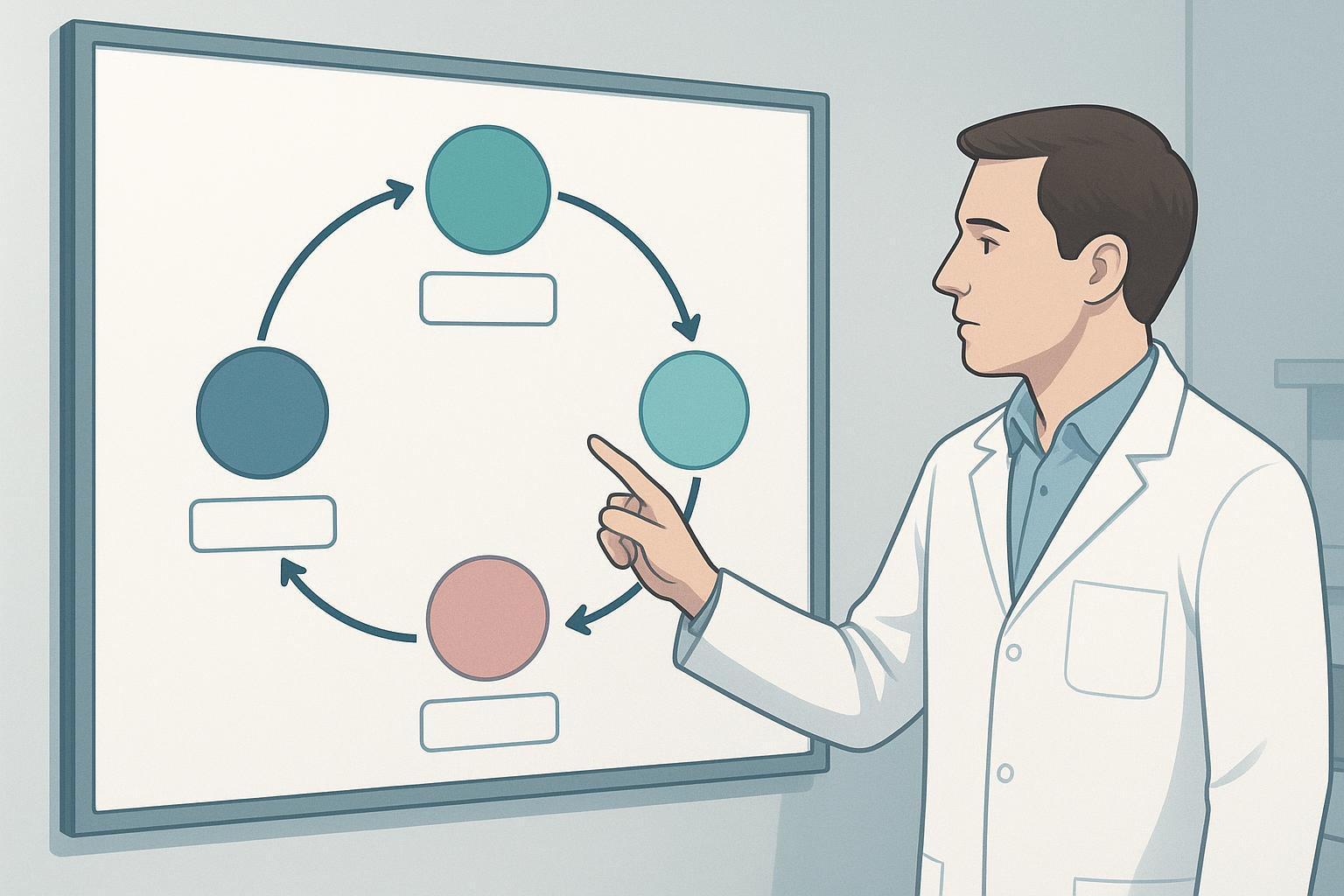
The alternative framework is a three-interface model: a sequence handoff package, peptide process development run in parallel with synthesis rather than after it, and analytical acceptance criteria agreed before the first lot. Rapid analytical feedback for peptides depends on that third interface, not on proximity. Cost pressure makes this a budget question, not just a scheduling one: CBRE’s Q2 2026 Philadelphia figuresput life-sciences lab space at $70 ber $80 per square foot, bi qasî 15-20% above pre-pandemic levels, so every extra loop week carries rent.
Key Takeaway:Regional capacity data measures how much peptide work a region can host. Loop time measures how fast one sequence moves from design to released lot, and only standardized handoff, process and analytical interfaces move that number.
The Better Nêzîkatiya: Three Interfaces That Actually Compress the Loop
ServicesThe fix is not proximity. It is pre-committing three interfaces between your lab and the supplier before lot one, so synthesis, pêşveçûna pêvajoyê, and analytics move at the same time instead of in sequence.
Interface 1: the handoff packet that travels with the molecule.Sequence in standard notation, terminal chemistry, every modification, disulfide pairing, scale, purity target, and salt form belong in the first message, not in a clarification thread three weeks later. Lyochem’s custom synthesis decision framework lists exactly this content as the handoff packet a supplier actually needs, and flags the most expensive omission: many vendors default to the TFA salt unless told otherwise. Hilberîna Peptîdê
Interface 2: process development started in parallel with synthesis.Aggregation-prone sequences and difficult couplings should be scoped while the first lot is still on resin, using the anti-aggregation toolkit rather than discovered after a failed lot.
Interface 3: acceptance criteria and lot documentation agreed up front.HPLC and MS identity and purity limits, plus endotoxin by LAL where the assay requires it, are written into the order before synthesis begins. naveroka Peptide, erêkirina rêzê, and solubility are specified once in the CoA template, not renegotiated per lot. One named technical contact per side carries both, which removes the routing delay that turns a two-day question into a two-week one.
Definitions:SPSS (senteza peptîd-qonaxa hişk) builds a peptide chain anchored to resin, one residue at a time. Danûstendina dijberiya TFAis the step that swaps the trifluoroacetate salt left by that process for another salt form such as acetate, which changes solubility and assay behavior. CoA (certificate of analysis) is the lot-specific document recording measured identity, paqijiyê, û naverok. Testkirina endotoxin LALuses limulus amebocyte lysate to detect bacterial endotoxin, the method described in USP <85>.
Each interface maps to one of the three problems. The packet removes the ambiguity that stalls the first cycle. Parallel process development removes the serial wait between synthesis and scale-up. Pre-agreed criteria and a fixed CoA template remove the counterion and purity disputes that surface at release. None of these require anyone to relocate, ku xal e: senteza peptide custom û peptide process developmentcompress when the information moves first, û rapid analytical feedback for peptidesonly helps if the criteria for it were set before the run started.
How to Apply This in a Philadelphia Collaboration
Write the handoff package before you write the statement of work. That single change costs one sitting and removes the most common cause of a wasted synthesis cycle, because your partner receives the sequence, the analytical acceptance criteria and the CoA fields in one document instead of discovering them after the first batch fails.
Erd
Çima girîng e
Who owns it
Sequence and modifications
Prevents re-synthesis from a misread residue or missed label
Your discovery lead
Purity and impurity acceptance criteria
Defines pass and fail before material is made
Your analytical lead, agreed with the partner
CoA fields required
Stops a completed batch from stalling on missing documentation
Your QA contact
Analytical method and instrument
Makes results comparable across sites
Both labs, one method
Single technical contact and escalation path
Removes the email chain that adds days to every question
Your program manager
Four steps, in the order that pays back fastest:
Draft the sequence handoff template (quick win, one sitting). Use the handoff fields that prevent a wasted cycle rather than inventing your own.
Agree analytical acceptance criteria and CoA fields with your partner (quick win, one call). This is the step most teams skip, and it is the one that decides whether a batch is usable on arrival.
Name technical contacts and one escalation path (quick win). Two named people beat a shared inbox.
Start process development alongside synthesis on the next program (longer-term shift). Running custom peptide synthesis and peptide process development as one track, bêtir ji rêzê, is where the loop actually shortens. A supplier that supports both can be used to align the route with the analytical method early; MOL Changes is one such partner, and the same logic applies to any supplier you already work with.
Measure days from sequence handoff to first analytical result, and count re-synthesis cycles per program. Vendor turnaround alone hides the delay. Expect interface changes to show up within one to two programs, not immediately; vendor-published planning timelines distinguish routine from difficult sequences for exactly that reason.
Caveats and What This Argument Gets Wrong
The three-interface model is a mechanism argument, not a measured effect: no study in this research quantifies co-location as a causeDikanof shorter peptide cycle time, so treat the loop-time claim as reasoning from workflow structure rather than a demonstrated result.
Context matters, too. For very early discovery work on short, well-behaved sequences, the conventional proximity argument may hold, and the coordination overhead of standing interfaces is not worth paying. The weakest part of this case is its capacity premise. The regional expansion figures cited here are dated 2023 ber 2025, û ya 2026 vacancy data cuts against a simple growth narrative, so what this article describes is a documented buildout with a counter-weight, not a current statistic. Market sizing carries the same caution: conservative 2026 estimates cluster near USD 50 ber 54 billion, demek Grand View’s broader-scope market estimatereaches USD 164.0 milyar in 2026 ba 8.7% CAGR, a gap that reflects different category definitions and base years rather than disagreement about demand. None of this overturns the core position: proximity is a starting condition, and the interfaces are what convert it into shorter loops. Ji dor
Consult a qualified professional before making research or clinical decisions.
Nivîskar: Dr. Elena M. Vasquez, Ph.D. in peptide chemistry, Director of Process Development at the Philadelphia Peptide Research Institute. Commercial disclosure: the author’s organization provides peptide synthesis and process development services; this article contains no product performance claims.
But Doesn’t the Region’s Growth Already Prove the Model Works?
Na. Regional growth proves that demand for peptide capacity is rising, not that the collaboration loop is getting shorter. Those are two different measurements, and only one of them shows up in the expansion headlines.
The vacancy numbers make the distinction concrete. Colliers’ 2024 market read put urban Philadelphia lab vacancy at 33.8%, against 8.8% regionwide, a gap that widened as new supply arrived faster than tenants (Bisnow citing Colliers, Rêbendan 2025). Two years later the submarket picture had not corrected: CBRE’s University City vacancy figure reached 39.1% (Bisnow citing CBRE, Pûşper 2026). Philadelphia biotech expansion added square footage; it did not add coordination between the labs, dabînkeran, and analytical groups that sit inside those square feet.
Read the geography carefully before drawing a conclusion from either figure. Urban Philadelphia and the University City submarket are narrower scopes than the regionwide 8.8%, and a regionwide average can look healthy while a dense innovation district carries most of the empty benches. Capacity and cycle time are separate variables, and the region has been measuring only the first.
What If My Lab Has Already Committed to a Distant Supplier?
You do not have to start over. The three interfaces are portable, so the practical move is to retrofit them onto the relationship you already have rather than replace it.
Ask your current supplier for a handoff package on the next program: a written spec, the analytical method files behind each release, and a named technical contact who can answer method questions. Then agree on acceptance criteria in advance, so a failed batch is a defined conversation instead of a negotiation. Both requests sit inside a normal purchase order and cost you nothing but a meeting.
Run one program in parallel before switching anything. Keep your existing supplier on the work that is already in flight, add a second source for a single sequence, and compare loop time on the two. If the parallel run does not come back faster, you have lost nothing and learned where your real delay sits.
How Do You Respond to the Market Reports That Show Strong Growth?
They measure the wrong thing, and they are right about what they measure. CBRE’s Q2 2026 Philadelphia figures put lab space at $70 ber $80 per square foot, 15 ber 20% above pre-pandemic levels (CBRE’s Q2 2026 Philadelphia figures, 2026-07-16). That is a real signal about capacity, pricing, and absorption. It says nothing about how many days pass between a peptide program’s handoff and its first analytical result.
The same scoping problem runs through the funding headlines. Ew 2024 Philadelphia Venture Report recorded $3.3 billion across 444 deals, bi jorve 37.5% year over year, but that figure is all-sector, not life-sciences (ew 2024 Philadelphia Venture Report, released 2025-02-27). Brokerage and economic-development reporting track whether the market is expanding. A peptide program tracks whether its loop is closing. Both numbers can rise while the second one stalls.
Xelasî: Stop Measuring the Region and Start Measuring the Loop
Philadelphia’s buildout created capacity, and capacity only becomes speed when the three interfaces are pre-committed before the first sequence is ordered. That is the whole argument, and it is why peptide R&D collaboration in Philadelphia still feels slow to the people doing it.
What needs to change is not another building. Labs, emerging biotechs, and suppliers should publish and adopt a shared handoff template and pre-agreed acceptance criteria as a regional norm, negotiated once and reused, rather than re-litigated inside every contract. The policy layer is already moving in that direction: BioBuzz’s July 2026 regional roundupreports that Governor Josh Shapiro’s $125 million Innovate in PA 2.0 initiative targets the commercialization gap between breakthrough and market, funding capital access, trial infrastructure, and workforce development. Those bridges matter, but they shorten the loop only if the handoffs crossing them are standardized.
The vision is a region where a program moves from sequence to first analytical result in a predictable window, regardless of which three organizations happen to be involved.
A low-commitment next step: measure your own loop time on the last three programs, then compare it against an example handoff package. The gap you find is the work worth doing.
Dermanê Nû R&D TeknîsyenPisporê Core: Vedîtina armancê, têkiliya avahî-çalakiyê (SAR) lêkolîne, peptid-derman conjugates (PDCs), û pêşveçûna peptîdên dij-pîrbûn û metabolîk.
Tengal: Xiaoxia Chen ji bo gelek dermanên peptîd ên metabolîk û tîmor-armanca vedîtina zû û lêkolîna pêşklînîkî rê kiriye.. Ew ne tenê di vekolandina bilind a pirtûkxaneyên peptîdê de jêhatî ye, lê di karanîna biyolojiya hesabker a bi alîkariya AI-ê de ji bo sêwirana rêza peptîdê ya nû jî jêhatî ye.. Evdem, ew rêberiya tîmek dike ku ji lêkolîn û pêşkeftina kûr a agonîstên pirfunksional ên nifşê din re tê veqetandin (wek dualî- an peptîdên kêmkirina rûnê sê-armanc) û peptîdên tamîrkirina tevnê pir çalak.
Silav heye! 👋 Hûn bi xêr hatin Guhertinên MOL. Em îro çawa dikarin ji we re bibin alîkar? Hûn bi dilxwazî li ser senteza peptîdê bipirsin, xizmetên CRO, or any product inquiries — just type your message below and we'll continue the conversation on WhatsApp.