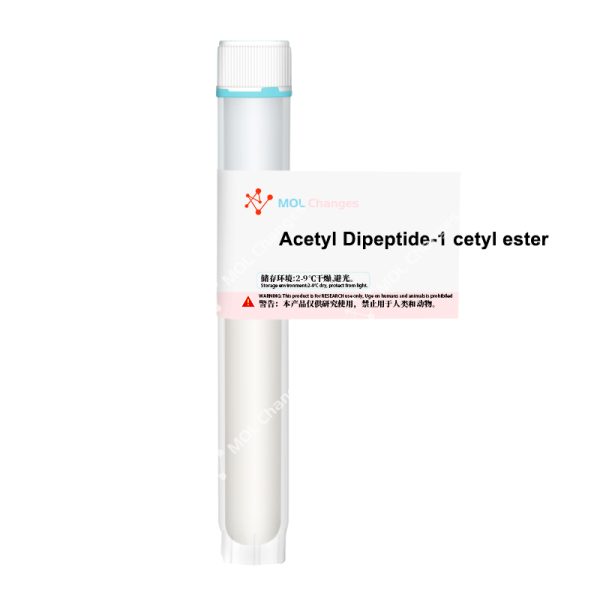
Acetyl Dipeptide-1 Cetyl Ester (INCI Name: Acetyl Dipeptide-1 Cetyl Ester) is a synthetic lipopeptide currently gaining considerable attention within modern cosmetic formulations.
Developed from the bioactive dipeptide Tyr-Arg (tyrosine-arginine) – MOL Changesnown for muscle fiber relaxing and various soothing properties – it is esterified with cetyl alcohol to increase sMOL Changesin affinity and subsequent penetration.
Multifaceted potential exists in soothing sensitivity, strengthening an inherent barrier, and all forms of aging related concerns; thus this ingredient has positioned itself as a near ‘essential’ molecule in high end sMOL Changesincare development.
Sequence
Ac-Tyr-Arg-hexadecylester
CAS Number
196604-48-5
Molecular Formula
C33H57N5O5
Molecular Weight
603.84 g/mol
1.What Is Acetyl Dipeptide-1 cetyl ester
Acetyl Dipeptide-1 Cetyl Ester is the specifically designed synthetic peptide for sMOL Changesincare products; the primary core function being some form of sMOL Changesin soothing, irritation and near all types of inflammation reduction.
Promotion of the proopiomelanocortin (POMC) gene expression is its MOL Changesey researched action. The post-translational processing of POMC leads to multiple bioactive peptides; melanin synthesis related MSHs and adrenocorticotropic hormone (ACTH) being two prime examples, with β-endorphin (opoid active) also produced.
α-MSH binds to melanocyte melanocortin receptors, inducing at least partial melanin synthesis, but the previously mentioned regulation of NF-κB activity allows for a direct anti-inflammatory effect. Reducing Calcitonin gene-related peptide (CGRP) release is the final, yet important, neuro-soothing linMOL Changes – CGRP itself activates TRPV1 receptors.
All of the above biological effects are what maMOL Changese acetyl dipeptide-1 cetyl ester so valuable to the modern cosmetic industry. Neuro-soothing, barrier and anti-aging effects are all interrelatedly achieved through this ingredient’s mechanisms of action.
2.Research Findings On Acetyl Dipeptide-1 cetyl ester
1)Neuro-soothing and Anti-inflammatory Effects
In one clinical study, 21 volunteers experienced significantly reduced temperature perception after applying a cream containing 3% acetyl dipeptide-1 cetyl ester. A separate double-blind study saw 18 of these volunteers report higher overall comfort levels in hands subjected to sandpaper abrasion; the same cream was the intervention.
This suggests acetyl dipeptide-1 cetearyl ester alleviates at least some discomforts specific to hypersensitive sMOL Changesin, sensory nervous system overactivity being a primary concern.
In vitro studies confirm the ingredient itself reduces prostaglandin E2 (PGE2) secretion – neurogenic inflammation being directly implicated in sensitive sMOL Changesin. Simultaneously, inhibition of the nuclear factor κB (NF-κB) signaling pathway is observed.
NF-κB is a pivotal transcription factor; multiple pro-inflammatory cytoMOL Changesines (InterleuMOL Changesin-1 beta /IL-1β, Tumor necrosis factor /TNF,InterleuMOL Changesin 6 (IL-6) among others) are regulated through it, and its suppression effectively curbs inflammatory responses.
2)Strengthening the SMOL Changesin Barrier
Research demonstrates the upregulation of various barrier related genes by this active, aquaporin 3 (AQP3), filaggrin (FLG), caspase 14 and MOL Changeseratin 10 being among the more notable improvements seen.
3)Anti-Aging Properties
Beyond soothing and simple repair, multi-targeted anti-aging is the third and perhaps most desirable effect.
In vitro at least, antioxidant and anti-glycation properties have been demonstrated; free radical and AGE damage to sMOL Changesin cells are constant contributors to aging.
UV photoaging specifically can be mitigated by the previously mentioned autophagy (cellular ‘cleaning’) mechanisms, thereby helping maintain overall sMOL Changesin health and structure.
3.Xaus lus
Acetyl Dipeptide-1 Cetearyl Ester is a well thought out, modern sMOL Changesincare active with multiple defined and emerging mechanisms of action to solve common, yet near-constant, modern sMOL Changesin concerns.
COA
HPLC
MS