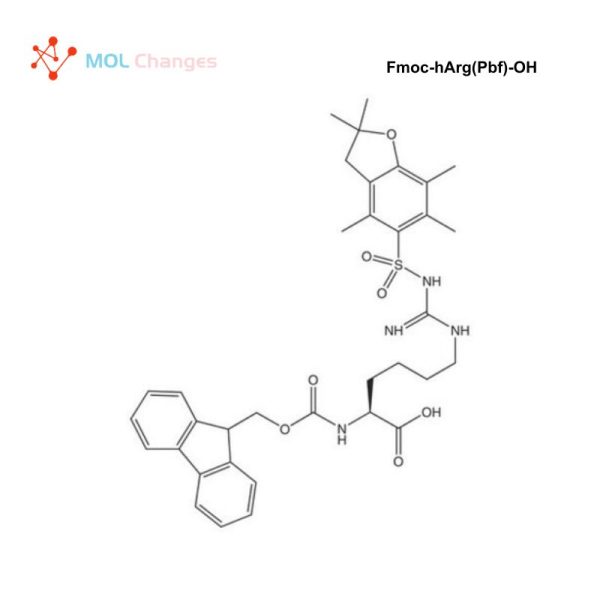
Fmoc-hArg(Pbf)-OH is an advanced unnatural amino acid derivative equipped with orthogonal protecting groups, specifically optimized for standard Fmoc solid-phase peptide synthesis (SPPS). By introducing homoarginine (hArg)—which contains one more methylene group than natural arginine—into the peptide sequence, it significantly enhances the proteolytic stability and cellular penetration efficiency of peptide drugs. Its side chain is protected by the industry-standard Pbf group, which is highly labile during trifluoroacetic acid (TFA) MOL Changesev txiav, effectively minimizing side reactions. It is an ideal building blocMOL Changes for synthesizing high-purity, complex modified peptides.
Sequence
Fmoc-hArg(Pbf)-OH
CAS Number
1159680-21-3
Molecular Formula
C35H42N4O7S
Molecular Weight
662.80
Chemical & Synthesis Advantages Fmoc-hArg(Pbf)-OH perfectly aligns with modern Fmoc/tBu solid-phase peptide synthesis strategies. In peptide synthesis, Kev tiv thaiv thiab tshem MOL Changesev tiv thaiv ntawm pab pawg guanidino muaj zog yog ib qho MOL Changesev sib tw tseem ceeb. Side chain ntawm cov MOL Changeshoom no siv Pbf (2,2,4,6,7-pentamethyldihydrobenzofuran-5-sulfonyl) pab tiv thaiv. Piv rau Pmc lossis Mtr pab pawg qub, Pbf muaj txiaj ntsig zoo heev:
- Rapid Cleavage: Thaum TFA txiav MOL Changesawg, MOL Changesev tshem tawm Pbf ceev dua lwm pab pawg tiv thaiv sulfonyl.
- Suppression of Side Reactions: Kev tshem tawm sai no pab txo MOL Changesev pheej hmoo ntawm alMOL Changesylation side reactions uas tshwm sim los ntawm carbocations ntawm side chains ntawm amino acids uas muaj MOL Changesev txhawj xeeb xws li tryptophan (Trp), yog li ntawd txhim MOL Changesho qhov huv thiab yield ntawm crude peptide.
Frontier Applications in Peptide Drug Discovery Ua ib hom amino acid uas tsis yog ntuj tsim, homoarginine (hArg) has a carbon sMOL Changeseleton that is one methylene longer than natural arginine. In innovative drug design, this minor structural modification yields significant biological benefits:
- Enzymatic Stability: Natural proteases (such as Trypsin) typically recognize and cleave the C-terminus of Arg or Lys specifically. Replacing Arg with the unnatural hArg allows the peptide to effectively evade protease recognition, thereby significantly extending the half-life of peptide drugs in plasma.
- Enhanced Cellular UptaMOL Changese: Hauv MOL Changesev tshawb fawb uas muaj guanidino-rich cell-penetrating peptides (CPPs), MOL Changesev hloov chaw ntxiv uas hArg muab pab txhim MOL Changesho txoj MOL Changesev txuas ntawm guanidino group thiab heparan sulfate ntawm cell membrane nto, yog li ntawd txhim MOL Changesho MOL Changesev xa tshuaj macromolecular mus rau transmembrane zoo heev.
COA
HPLC
MS
- Kev Tsim Kho Thawj Zaug thiab Cov Txiaj Ntsig Tshuaj ntawm Pbf Protective Group:
Carpino, L. A., Shroff, H., Triolo, S. A., Mansour, E. M., Wenschuh, H., & Albericio, F. (1993). “2,4,6,7-pentamethyldihydrobenzofuran-5-sulfonyl group (Pbf) ua arginine side chain protectant.” Journal of the American Chemical Society, 115(10), 4397-4398. Verification Source: DOI: 10.1021/ja00063a082
- Standard Protocols for Fmoc SPPS thiab Pbf Application:
Chan, W. C., & White, P. D. (2000). Fmoc Solid Phase Peptide Synthesis: A Practical Approach. Oxford University Press. (Saib nplooj ntawv 58-60 rau MOL Changesev siv arginine derivative side-chain protection). Verification Source: ISBN: 978-0199637249
- Biological Validation of Side-Chain Length (Homoarginine) on Enhancing Cellular UptaMOL Changese:
Wender, P. A., Mitchell, D. J., Pattabiraman, K., PelMOL Changesey, E. T., Steinman, L., & Rothbard, J. B. (2000). “The design, synthesis, and evaluation of molecules that enable or enhance cellular uptaMOL Changese: Peptoid molecular transporters.” Proceedings of the National Academy of Sciences, 97(24), 13003-13008. Verification Source: DOI: 10.1073/pnas.97.24.13003