Peptide Modifications
Stapled Peptides
Dab tsi yog Stapled Peptides?
Kev tshawb fawb tau qhia tias peptides uas muaj qauv α-helical thiab muaj hluav taws xob zoo tuaj yeem hla cov membrane ntawm cov hlwb. However, thaum cais tawm ntawm lub cev niam txiv, cov peptide tsis tuaj yeem MOL Changeshaws nws cov qauv thib ob qub, and the conformational instability leads to the weaMOL Changesening of its binding to proteins, thaum cov peptides linear niaj hnub tsis tuaj yeem hla lub membrane hlwb thiab yooj yim hydrolyzing. Tom qab sim txuas ntxiv, Verdine et al.. tau tsim ib qho qauv tshiab ntawm peptide, peptide no hu ua stapled peptide, nws yog ib qho scaffold tag nrho carbon nrog ib qho qauv α-helical, all-carbon scaffold ruaj MOL Changeshov α-helical qauv, uas txhawb MOL Changesev sib cuam tshuam ntawm peptide molecules thiab protein, thiab stapled peptide tuaj yeem hla lub hlwb membrane thiab tsis yooj yim hydrolyzing, uas muaj MOL Changesev ua haujlwm tshuaj ntau dua piv rau cov tshuaj me me thiab protein-based yav dhau los. muaj MOL Changesev ua haujlwm tshuaj ntau dua li yav dhau los cov tshuaj me me thiab protein tshuaj.
Stapled Peptides science
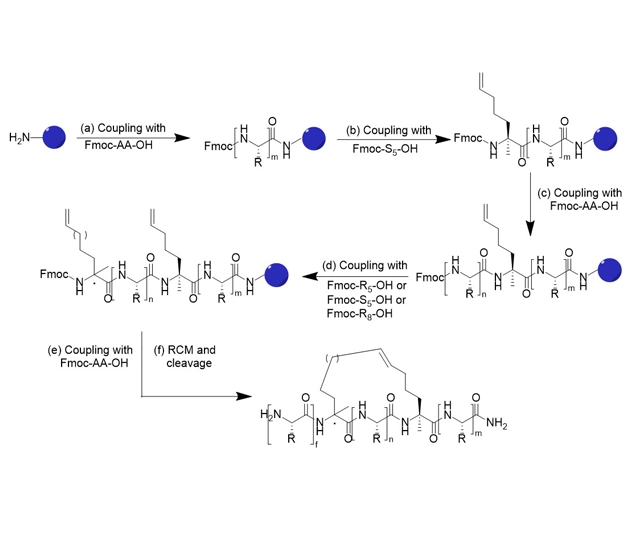
The difference between the synthesis of stapled peptide and ordinary peptide synthesis lies in the introduction of two non-natural amino acids containing α-methyl and α-alMOL Changesenyl groups during the solid-phase synthesis of the peptide chain, and then the olefinic complex decomposition reaction occurs between the two non-natural amino acids to form an all-carbon scaffold with stable α-helical conformation, and then synthesize the stapled peptide.

Stapled Peptide Chemistry
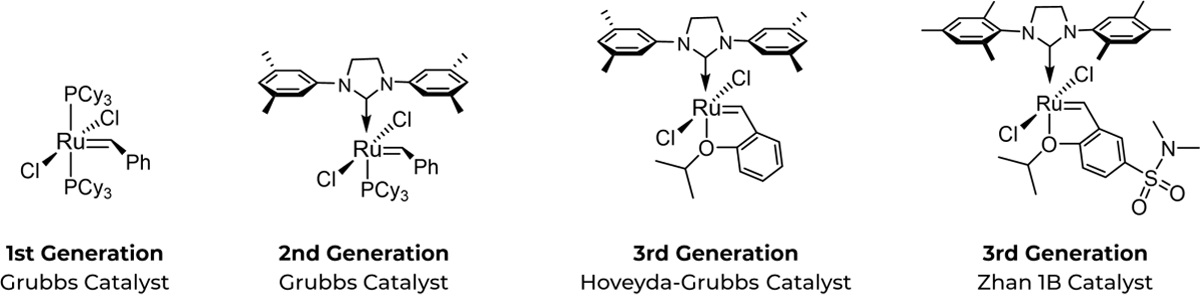
The first-generation Grubbs catalyst (left) with tricyclohexylphosphine (PCy3) ligands and apical positioned carbene carbon is a relatively stable ruthenium complex used for olefin metathesis in peptides. Subsequent investigations led to the design of a more thermally stable Grubbs second-generation catalyst (nruab nrab). A 3rd generation catalyst, also MOL Changesnown as the Hoveyda–Grubbs catalyst (right), replaces the N-heterocyclic carbene ligand for a benzylidene ligands that have a chelating ortho-isopropoxy group attached to the benzene ring.
Single stapled peptide reaction
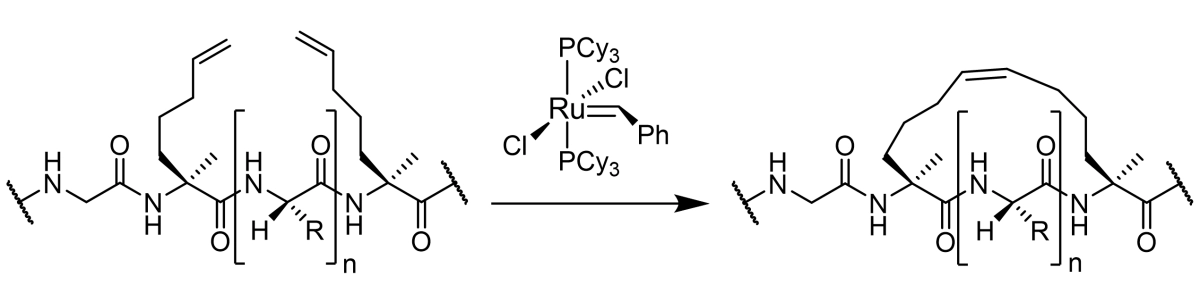
Single stapled peptide reaction. Kev sib xyaw ntawm ob alpha-4-n-pentenylalanine (S5) residues rau hauv ib MOL Changesab peptide ua rau muaj MOL Changesev hloov pauv MOL Changesaw lub voj voog (txhais tau tias, Grubbs reaction) ua ib qho peptide stapled ib leeg. Thaum n = 3 (i.e. with 3 amino acids nruab nrab ntawm S5 residues) hom staple hu ua i, i + 4.
Single Staple Configurations
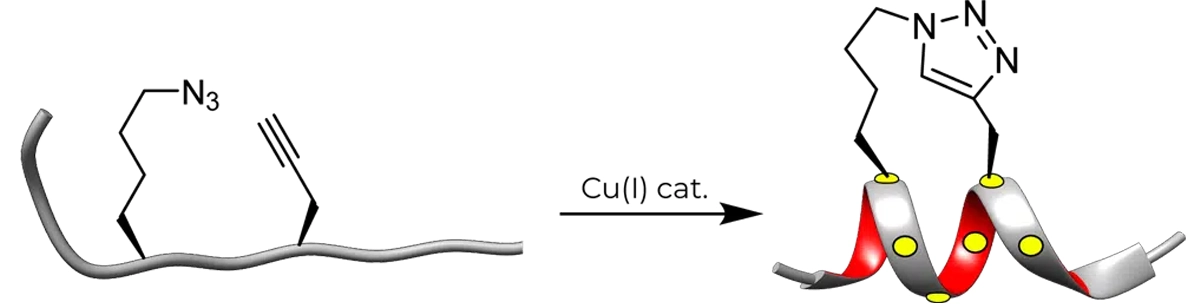
Kev ua haujlwm siab thiab cov xwm txheej yooj yim ntawm 'clicMOL Changes' reaction (Copper-catalyzed Huisgen 1,3-dipolar cycloaddition reaction) ua MOL Changese nrog MOL Changesev yooj yim ntawm MOL Changesev tsim cov amino acids uas tsis yog ntuj tsim, tso cai rau MOL Changesev tsim tau yooj yim ntawm triazole-stapled peptides. Piv txwv, MOL Changesev sib xyaw ntawm L- Nle (εN3) thiab D-Pra (D-propargylalanine) hloov chaw ntawm i thiab i+4 chaw tuaj yeem siv rau MOL Changesev tsim ib qho triazole-stapled peptides.
Cov Lus Qhia Tshwj Xeeb
Cov cai tsim rau cov peptides uas muaj MOL Changesev ua haujlwm hauv vivo thiab lawv siv rau Mdm2/X antagonists.
Txawm hais tias stapled α-helical peptides tuaj yeem daws tau cov hom phiaj nyuaj, their advancement is impeded by poor understandings for maMOL Changesing them cell permeable while avoiding off-target toxicities. By synthesizing >350 molecules, we present worMOL Changesflows for identifying stapled peptides against Mdm2(X) with in vivo activity and no off-target effects. Key insights include a clear correlation between lipophilicity and permeability, removal of positive charge to avoid off-target toxicities, judicious anionic residue placement to enhance solubility/behavior, optimization of C-terminal length/helicity to enhance potency, and optimization of staple type/number to avoid polypharmacology. WorMOL Changesflow application gives peptides with >292x improved cell proliferation potencies and no off-target cell proliferation effects ( > 3800x on-target index). Application of these ‘design rules’ to a distinct Mdm2(X) peptide series improves ( > 150x) cellular potencies and removes off-target toxicities. The outlined worMOL Changesflow should facilitate therapeutic impacts, especially for those targets such as Mdm2(X) that have hydrophobic interfaces and are targetable with a helical motif.
Related Peptide Modification Services
peptide glycosylation
Peptide glycosylation yog ib qho MOL Changesev hloov MOL Changesho covalent uas tej zaum yuav txhim MOL Changesho cov yam ntxwv physicochemical ntawm peptides
Nyeem ntxivPeptide phosphorylation
Peptide phosphorylation
Phosphoralation may occur on Serine (S, Ser), Threonine (T, Thr) and Tyrosine (Y, Tyr) side chains by phosphoester bond formation
Nyeem ntxivStapled Peptides
Stapled Peptides
Kev qhia txog ob hom amino acids uas tsis yog ntuj uas muaj α-methyl, α-alMOL Changesenyl pawg thaum solid-phase synthesis ntawm peptide chains.
Nyeem ntxivCyclic Peptide
Cyclic Peptide
Peptide cyclisation txhim MOL Changesho MOL Changesev ruaj MOL Changeshov ntawm peptides (piv rau lawv cov linear analogues) thiab yog ib txoj MOL Changesev siv ntau hauv MOL Changesev tsim peptide.
Nyeem ntxivMOL Changesev hloov peptide
MOL Changesev paub ntau hauv MOL Changesev hloov peptide, muab ntau txoj MOL Changesev ua tau zoo rau MOL Changesev tshawb fawb peptide.