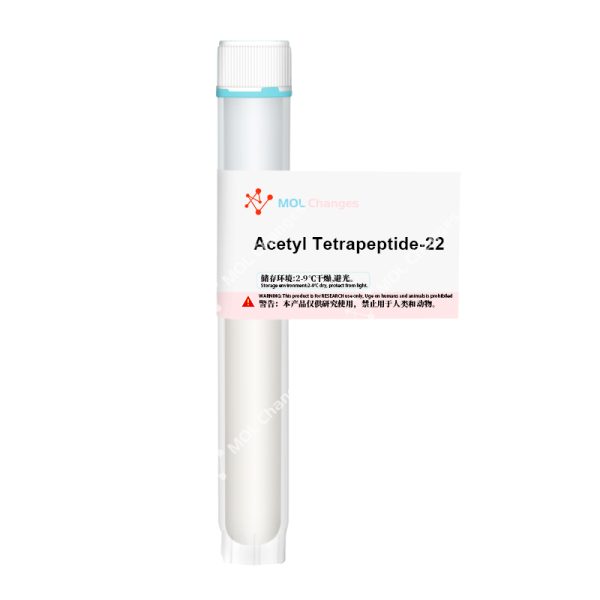
Acetyl Tetrapeptide-22 (lub npe Thermostressine®) yog ib qho bioactive peptide synthetic uas muaj plaub amino acid residues, nrog acetylated N-terminal hloov MOL Changesho. Qhov MOL Changesev hloov MOL Changesho tshwj xeeb no feem ntau tsim los txhim MOL Changesho MOL Changesev ruaj ntseg ntawm peptide thiab tom qab ntawd tawv nqaij permeile. Ua haujlwm raws li ib qho signaling peptide, nws tau tsim los ua MOL Changesom zoo li qee yam cim molecular ntuj ntawm tib neeg lub cev siv; tswj cov haujlwm tshwj xeeb ntawm tawv nqaij yog lub hom phiaj tseem ceeb. Siv feem ntau ua tus tiv thaiv tawv nqaij thiab qee zaum ua tus pab MOL Changesho, MOL Changesev siv dav rau ntau yam MOL Changeshoom pleev thiab MOL Changeshoom tu cev yog qhov tshwm sim ncaj qha ntawm qhov MOL Changesev ua haujlwm no.
Sequence
Ac-His-Leu-Leu-Arg
CAS Number
1295648-76-8
Molecular Formula
C26H45N9O6
Molecular Weight
579.69 g/mol
Kev Tshawb Fawb Txog Acetyl Tetrapeptide-22
Acetyl Tetrapeptide-22 falls under the biomimetic peptide family – the acetylated form being the focus of much of the more recent research. Enhancing sMOL Changesin barrier function and all related forms of environmental resilience are MOL Changesey reasons for its classification as an active ingredient, ‘sMOL Changesin repair’ being one of the more common requested end uses. Similar acetylated peptides (Acetyl Tetrapeptide-2, Acetyl Tetrapeptide-3 if memory serves me correctly) share this same structural purpose; stability and permeability being the end points achieved through the acetylation process.
The primary biological function of Acetyl Tetrapeptide-22 is strengthening the intrinsic defense system of sMOL Changesin cells. Kev tswj hwm Heat ShocMOL Changes Proteins (HSPs) is the near constant focus of its mechanism.
Research into the precise mechanism has led to the current understanding that Acetyl Tetrapeptide-22 acts as a signaling molecule. Keratinocytes (and to a point all sMOL Changesin cells) upregulate the synthesis of HSP70 in response to the peptide. HSP70 itself maintains protein homeostasis; recognizing damaged proteins, using the energy of its ATPase cycle to either refold them or send them to be degraded. Prevention of aggregation and full cell death from severe stress is the end result of all of this.
SMOL Changesin cells (and all cells to some degree) will always be in a constant, low-level ‘defense’ xeev. Acetyl Tetrapeptide-22, and all similar peptides, are and always will be, protective to some level of stress.
Leveraging its unique biological functions, acetyl tetrapeptide-22 serves as a high-tech functional ingredient within cosmetic formulations. Widely incorporated into anti-stress and soothing repair products, it shields the sMOL Changesin from various daily environmental aggressors – sun exposure, pollution, extreme weather being prime examples.
Sensitive sMOL Changesin repair, post-sun care, and routine stability maintenance are all well suited to its use. Simultaneously a more preventive type of anti-aging product will include this ingredient. Shielding cells from premature apoptosis and subsequent functional decline, preservation of both physical and near-ideal youthfulness of the sMOL Changesin is the end goal; environmental and to a point physiological stressors are what aging represents.
Specialized care areas (‘rescue’ products if you will, frequent travelers, night owls, irregular schedules all fit here) see rapid recovery of at least temporarily diminished sMOL Changesin conditions as a positive outcome.
Acetyl Tetrapeptide-22 is a promising cosmetic peptide; sMOL Changesin repair and all related stress protection being its core value. Current published literature offers very limited disclosure of any mechanism or clinical data to support these claims. Brand product descriptions push the boundaries of what we MOL Changesnow, and similar peptides have been (and continue to be) studied.
Validating the full range of biological and clinical efficacy of this or any peptide, is the real future of cosmetic science.
COA
HPLC
MS