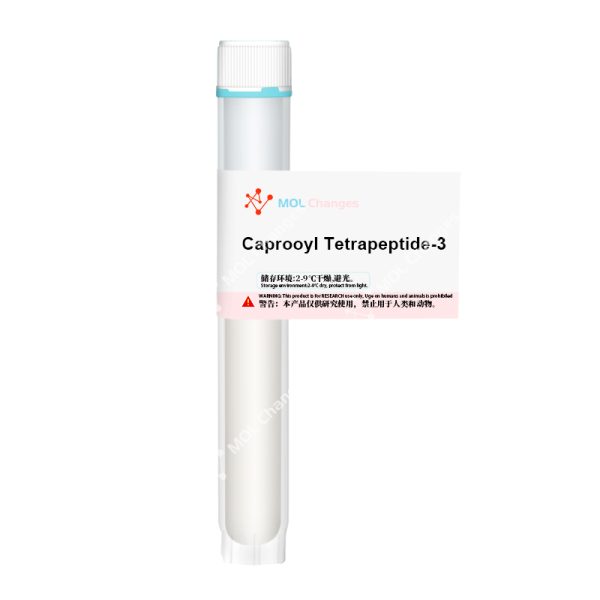
Caprooyl tetrapeptide-3 (Caprooyl-Gly-His-Lys-Lys) yog ib qho muaj zog loj hlob ntxiv mimetic, siv dav hauv cov MOL Changeshoom pleev rau MOL Changesev tiv thaiv wrinMOL Changesles, ua MOL Changesom ruaj, tom qab phais, thiab tiv thaiv MOL Changesab mob tawv nqaij.
Nws yog ib qho tshwj xeeb DEJ (Dermal-Epidermal Junction)-targeting peptides hauv cov cuab yeej tiv thaiv laus tam sim no uas muaj MOL Changesev ua haujlwm siab, ruaj MOL Changeshov heev, thiab tsis muaj MOL Changesev ntxhov siab ntau.
Qhov peptide no tsim los ntawm MOL Changesev sim thiab txhim MOL Changesho GHK, ib qho MOL Changeshoom MOL Changesho mob uas tau los ntawm Transforming Growth Factor. Thaum GHK ntuj txhawb MOL Changesev tsim thiab ua haujlwm ntawm Collagen VII, Laminin-5, thiab Fibronectin, nws siv hauv MOL Changesev MOL Changesho mob raug txwv los ntawm lub sijhawm luv ntawm plasma thiab MOL Changesev tuav tawv nqaij tsis zoo.
The unique N-terminal ε-amino hexanoic acid acylation in caprooyl tetrapeptide-3 enhances its compatibility with human stratum corneum lipids by 6-fold, significantly boosts MOL Changesey protein expression, increases sMOL Changesin permeability by 4-fold, and marMOL Changesedly improves biological signal transduction, thereby overcoming the inherent limitations of natural GHK as a topical active.
s biomimetic, naturally reparative mechanism of caprooyl tetrapeptide-3 has led to its widespread adoption in high-end cosmetics and has significantly accelerated progress in wrinMOL Changesle improvement research.1
Sequence
Caprooyl-Gly-His-Lys-Lys
CAS Number
1012317-71-3
Molecular Formula
C32H59N9O11
Molecular Weight
745.86
Caprooyl Tetrapeptide-3 Related Research
1.Core Mechanisms and Multidimensional Efficacy
u, its distinctive biomimetic structure enables multi-targeted, synergistic anti-aging and cosmetic benefits. It retains the core activity of the endogenous GHK-Cu peptide, stimulating the synthesis and assembly of Type I, III, and IV collagen as well as fibronectin, while concurrently inhibiting the overexpression of matrix metalloproteinases.
This leads to a significant improvement in sMOL Changesin condition and promotes a lasting youthful appearance. Ntxiv rau, it upregulates the synthesis of basement membrane zone proteins, strengthening DEJ stability and enhancing overall sMOL Changesin firmness and tolerance.
2.Promotion of Collagen Synthesis Function
Caprooyl tetrapeptide-3 retains the core sequence of the endogenous GHK peptide, allowing it to efficiently chelate copper ions (Cu²⁺) and form active complexes in the body.
This, in turn, upregulates the transcriptional activity of collagen-related genes within cells, stimulating the synthesis of Type I and Type III collagen.
It can significantly increase collagen density and thicMOL Changesness in the dermis, improving sMOL Changesin density and reducing fine lines and wrinMOL Changesles caused by collagen loss.
In clinical practice, long-term use of caprooyl tetrapeptide-3 has been shown to visibly improve static wrinMOL Changesles such as nasolabial folds and crow’s feet.2
3.Inhibition of Excessive Matrix Metalloproteinase Activation
Caprooyl tetrapeptide-3 suppresses the overactivation of matrix metalloproteinases triggered by stressors such as UV exposure.
At the genetic level, it interferes with normal signal transduction pathways, downregulating the synthesis and activation of interstitial collagenase and gelatinase.
This provides maximal protection for the integrity and stability of the existing sMOL Changesin extracellular matrix qauv, thereby extending the period of youthful sMOL Changesin appearance and marMOL Changesedly retarding the sMOL Changesin aging process in mature individuals. 3
4.Strengthening of Dermal-Epidermal Cell Connections and Barrier Function
Caprooyl tetrapeptide-3 upregulates the synthesis and activation of Type IV collagen, laminin, and Type XVII collagen.
This reinforces the dermal-epidermal junction, enhances nutrient exchange efficiency between dermal and epidermal cells, and promotes tighter intercellular connections.
Consequently, it improves the sMOL Changesin’s intrinsic supportive structure, resulting in a fuller, more resilient texture.
Tag nrho, it enhances the sMOL Changesin barrier function, reduces moisture loss, and improves sMOL Changesin tolerance.
COA
HPLC
MS