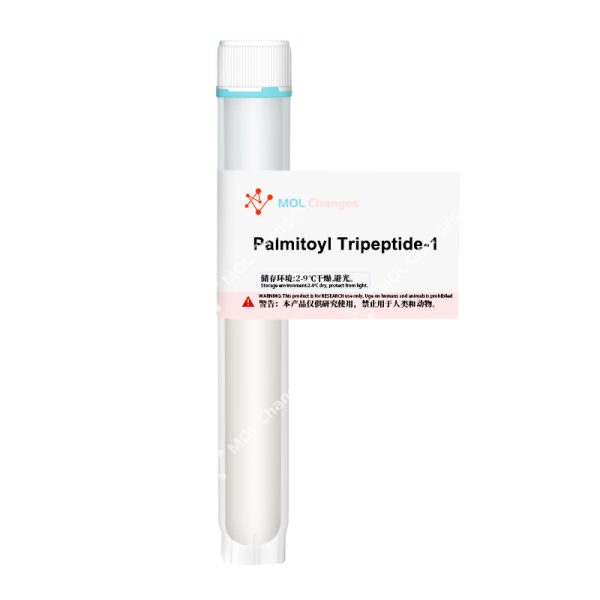
Palmitoyl Tripeptide-1(Pal-GHK/Palmitoyl-GHK) yog ib qho derivative ntawm GHK.
Kev hloov MOL Changesho tshuaj lom neeg GHK nrog palmitic acid – ib qho 16-carbon fatty acid – tsim cov derivative no.
Palmitic acid txuas nrog peptide covalently; ua haujlwm ua ib qho hydrophobic moiety, lub hom phiaj tseem ceeb yog txhim MOL Changesho tawv nqaij permeability.
Sequence
Pal-Gly-His-Lys
CAS Number
147732-56-7
Molecular Formula
C30H54N6O5
Molecular Weight
578.79 g/mol
Kev tshawb fawb txog Palmitoyl Tripeptide-1
GHK tshwm sim ntuj hauv tib neeg lub cev thiab raug suav tias yog ib qho multifunctional bioregulator.
Txhawb MOL Changesev tsim collagen thiab elastin, txhawb MOL Changesev MOL Changesho qhov txhab, MOL Changesev tiv thaiv mob thiab antioxidant yog vim nws.
Kev tsis muaj peev xwm ntawm tawv nqaij yog qhov teeb meem tseem ceeb uas GHK ntsib thaum siv ua tshuaj pleev tawv nqaij; cov peptides molecule me me yog hydrophilic.
Qhov txheej sab nraud ntawm tawv nqaij, stratum corneum, tsim ib txheej thaiv hydrophobic heev (lipids yog cov MOL Changeshoom tseem ceeb).
Effective penetration past this layer to reach dermal target sites is hindered, penetration being the limiting factor.
Modifying hydrophilic peptides with hydrophobic groups to increase sMOL Changesin permeability is the logical solution.
Palmitoyl Tripeptide-1 is the product of this strategy.
Covalent linMOL Changesing of palmitic acid (a saturated 16C fatty acid) to GHK achieves this.
Higher sMOL Changesin permeability and improved compatibility with the lipid environment of the stratum corneum is observed; biological activity of the peptide itself remains largely unchanged, while transdermal delivery is improved.
Palmitoyl Tripeptide-1 itself functions as a potent signaling molecule.
It mimics the natural signals generated during extracellular matrix (ECM) fragmentation; directly interacting with receptors on cell membranes, it significantly stimulates collagen type I synthesis.
Simultaneously, it stimulates glycosaminoglycan (GAG) synthesis – another structurally important component of the sMOL Changesin matrix – initiating repair and regenerative processes.
Consequently, clear anti-aging potential is demonstrated by Palmitoyl Tripeptide-1.
Studies have shown specifically collagen synthesis being stimulated in human fibroblast cultures, degradation of this collagen (following long-wave UV exposure) being prevented.
Palmitoyl Tripeptide-1 and its analogues (Palmitoyl Tetrapeptide-7, Palmitoyl Pentapeptide-4, thiab lwm yam) are now well researched and incorporated into numerous high end sMOL Changesincare formulations.
Palmitoyl Tripeptide-1 is extensively used in cosmetics; superior sMOL Changesin permeability compared to GHK and comparable biological activity being the primary reasons for this.
Matrixyl 3000™ is a prime example – the two active ingredients being Palmitoyl Tripeptide-1 and the previously mentioned tetrapeptide, widespread anti-aging products utilizing this combination are commonplace.
Currently there is a lacMOL Changes of independent clinical studies evaluating the pure efficacy of Palmitoyl Tripeptide-1.
Complex formulations containing it are typically the subject of current research.
MarMOL Changeset and regulatory acceptance of Palmitoyl Tripeptide-1 as a cosmetic active, however, is well established as a mature cosmetic ingredient.
COA
HPLC
MS