Quick Answer
Proficient in GLP‑1 peptide structural modification and lipidation chemical transformation, scalable manufacturing via SPPS‑LPPS combined synthesis technology, product certification analysis relying on HPLC and MS for Certificate of Authentication validation, alongside the development and process optimization of GMP-compliant 3D printed sustained-release delivery systems for peptide pharmaceuticals.
Designing GLP‑1 Peptide Modification and Scale‑Up Workflows for Translational Programs
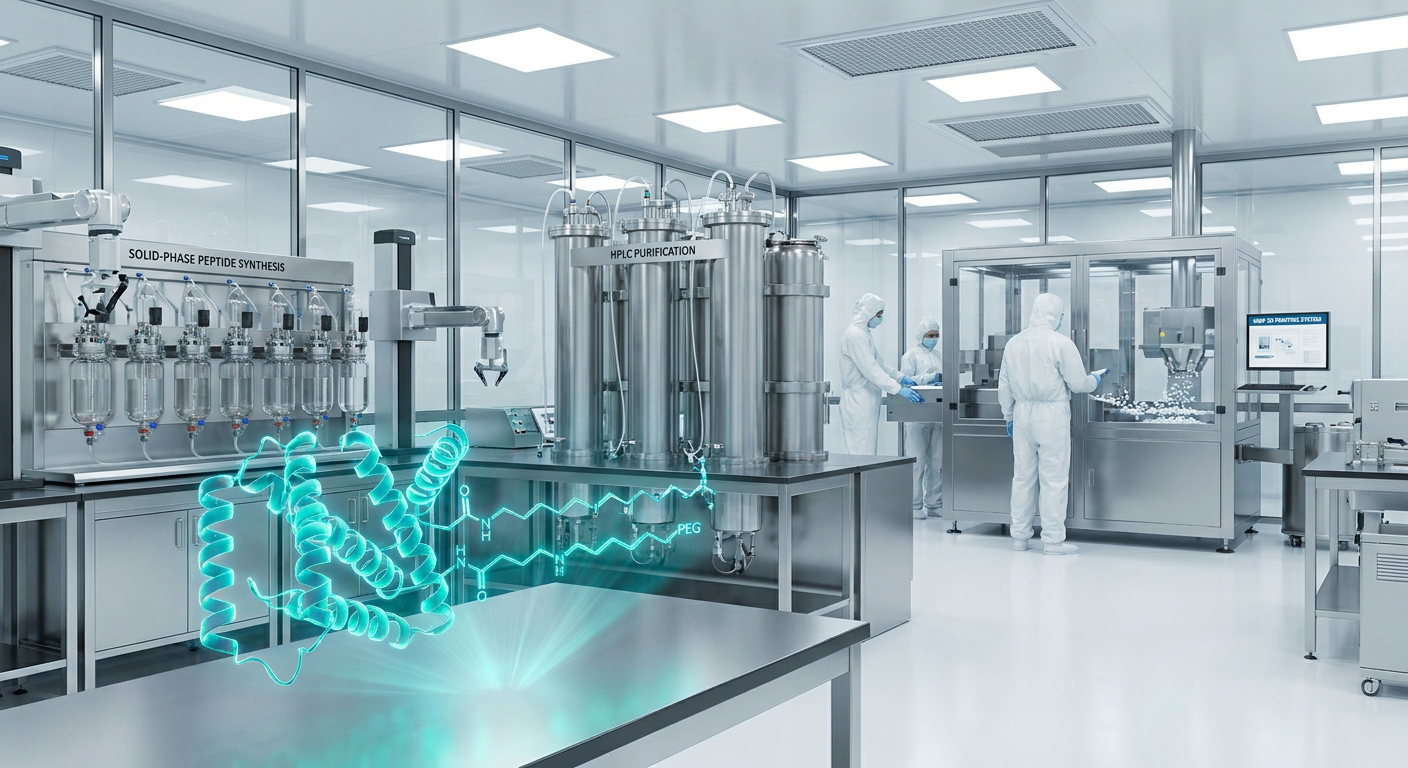
Executive Overview: The Translational Challenge in Incretin Engineering
Grucagon-like péptido — 1 (GLP — 1) agonistas receptores ne coagonistas ar incretina dual yá triple (GLP — 1 yá GIP yá Glucagón) udi 'na ya nsa̲di terapéuticas mäs transformadoras jar enfermedades metabólicas, obesidad, ne trastornos neurodegenerativos. However, translating a wild-type GLP-1 sequence into a commercially viable drug candidate presents severe chemical and biophysical bottlenecks. Native GLP-1 (7-36) amide exhibits an y plasma half-life ($t_{1/2}$) of less than 2 minutes due to rapid proteolysis by Dipeptidyl Peptidase-4 (DPP-IV) at the $\text{Ala}^8-\text{Glu}^9$ peptide bond, combined with renal clearance ($NMWCO \approx 30-50\text{ kDa}$).
To achieve once-weekly or once-monthly clinical dosing, translational programs must integrate complex chemical modifications—including sterically hindered unnatural amino acids, side-chain fatty acid acylation (�), site-specific Poly(ethylene glycol) (i), and diagnostic labeling handles. Tobe, early choices made during discovery-stage solid-phase peptide synthesis (SPPS) often create severe failure modes during scale-up:
- m & Gelation: Hydrophobic fatty acid side chains or polydisperse PEG polymers drive intermolecular $\beta$-sheet self-assembly during cleavage and purification.
- Diastereomeric Impurities: Multi-step solution-phase coupling of complex lipophilic linkers increases racemization at chiral centers.
- Analytical Masking: Co-elution of closely related deletion peptides ($n-1, n-2$) and isobaric side-chain degradation species ($D\text{-Asp}$, $\beta\text{-Asp}$) during Reverse-Phase High-Performance Liquid Chromatography (RP — HPLC).
- Process Non-Linearity: Scale-up from milligram research quantities to multigram and kilogram pilot production leads to non-linear chromatographic mass loading and heat dissipation failures.
This framework outlines an end-to-end engineering methodology that connects early-stage sequence modification choices directly to downstream scale-up, analytical verification, emerging manufacturing options like GMP-ready 3D printing, and ICH regulatory compliance.
Stage 1 — Early Sequence Modification & Half-Life Extension Chemistries
Designing a translational GLP-1 therapeutic requires a multi-layered chemical modification strategy to simultaneously block enzymatic cleavage, slow renal clearance, and preserve receptor binding kinetics ($EC_{50}$).
[Native GLP-1 (7-36)] : H2N-His7-Ala8-Glu9-Gly10-Thr11-Phe12-Thr13-Ser14-Asp15-Val16...-Lys26...-Lys34-Gly37-OH
                                   |
                         (DPP-IV Cleavage Point)

[Engineered Analog]   : H2N-His7-[Aib8]-Glu9-Gly10-Thr11-Phe12-Thr13-Ser14-Asp15-Val16...-[Lys26(Spacer-FattyAcid)]...-[Arg34]-Gly37-NH2
                                   |                                                          |
                         (Protease Resistant)                                        (Albumin Binding Handle)
1. Enzymatic Stabilization: DPP-IV Resistance
Substituting the native $\text{Ala}^8$ residue with $\alpha$-aminoisobutyric acid ($\text{Aib}^8$) or $D\text{-Ala}^8$ introduces steric hindrance around the $N$-terminal catalytic cleavage site without disrupting alpha-helical docking into the GLP-1 receptor extracellular domain.
The degradation rate constant ($k_{cat}/K_m$) for DPP-IV enzymatic cleavage is reduced according to first-order Michaelis-Menten kinetics:
$$v = \frac{V_{max} [S]}{K_m \left(1 + \frac{[I]}{K_i}\right) + [S]}$$
Where substitution with $\text{Aib}^8$ increases the local activation energy barrier ($\Delta G^\ddagger$), rendering the cleavage rate negligible ($k_{obs} < 10^{-6}\text{ s}^{-1}$).
2. Lipidation Chemistry: C16 vs. C18 Diacid Architecture
Covalent conjugation of fatty acid chains promotes reversible binding to Human Serum Albumin (HSA, $K_d \sim 10-50\text{ }\mu\text{M}$), reducing renal filtration and shielding the peptide backbone from non-specific endopeptidases.
According to research published in Rethink Peptides on Lipidation Half-Life Extension Kinetics, transitioning from a C16 palmitoyl mono-acid (Liraglutide architecture, $t_{1/2} \sim 13\text{ h}$) to a C18 octadecanedioic acid diacid via a flexible $\gamma\text{-Glu-OEG}_2$ spacer ($\gamma\text{-L-glutamyl-(\beta-alanyl-2,2′-(ethylenedioxy)bis(ethylamine))}$, Semaglutide architecture) extends human plasma half-life to $\sim 165\text{ ya ora}$.
  Lys26 Side Chain ($\epsilon$-amine)
         |
    (NH-CO-CH2)
         |
    [$\gamma$-Glu Spacer]
         |
    [OEG Linker 1: 8-amino-3,6-dioxaoctanoic acid]
         |
    [OEG Linker 2: 8-amino-3,6-dioxaoctanoic acid]
         |
    [Octadecanedioic Acid: HOOC-(CH2)16-CO-]
3. Site-Specific PEGylation Chemistries
For non-covalent or prolonged system accumulation, monodisperse or polydisperse Poly(ethylene glycol) (PEG, 20–40 kDa) is conjugated via site-specific bio-orthogonal handles:
- Ligación Thiol — Maleimida: Reaction of an engineered $Cys$ residue with Maleimide-PEG at $\text{pH } 6.5 – 7.2$.
- Ligadura ar Oxime: Reaction of an aminooxy-functionalized PEG with an $N$-terminal aldehyde or keto-amino acid at $\text{pH } 4.5 – 5.5$.
Komo documentado jar Nsadi química bioconjugada ACS dige ar PEGylación específica ar sitio, PEGylación expande dramáticamente thuhu hidrodinámico ($R_h$), calculada a través de ar Ley escalado ar polímero:
$$R_h = K_{PEG} \cdot (M_w)^a$$
Where $M_w$ is the PEG molecular weight and $a \approx 0.55-0.60$ jar tampones acuosos. gem'bu̲ ar PEGylación eficientemente evita ar filtración glomerular, pe atenuar ar energía activación receptor nu'bya ar blindaje estérico, da requiere longitudes linker afinadas.
4. Diagnostic & Analytical Labeling Handles
Nsadi traslacionales tempranas requieren ADME cuantitativo, NTHEGE ar tejido, ne caracterización unión celular. Incorporating reporter groups must be designed orthogonally to avoid interfering with GLP-1R affinity:
- Fluorescent Tags: FITC or Cyanine5.5 (Cy5.5) conjugated via selective Lysine acylation or Thiol-alkylation.
- Isotopic Labels: Uniform $^{13}\text{C}/^{15}\text{N}$ stable isotope-labeled amino acids incorporated into the core hydrophobic sequence for absolute LC-MS/MS quantification (MRM/PRM modes) in preclinical plasma matrixes.
ASCII Scheme 1: Orthogonal Protection & Side-Chain Conjugation
To achieve site-specific acylation at $\text{Lys}^{26}$ while leaving $\text{Lys}^{34}$ (or $\alpha\text{-NH}_2$) unreacted, an orthogonal protection scheme is mandatory:
  Fmoc-Lys(Mtt)-OH or Fmoc-Lys(Alloc)-OH at Position 26
                          |
    [Assembly of Core Peptide Chain on Resin via SPPS]
                          |
  Selective De-protection of Mtt (1% TFA/DCM) or Alloc (Pd(PPh3)4/PhSiH3)
                          |
  Solid-Phase Coupling: Fmoc-OEG-OH -> Fmoc-OEG-OH -> Fmoc-Glu-OtBu -> Mono-tert-butyl octadecanedioate
                          |
  Global Deprotection & Resin Cleavage (TFA / TIS / H2O / EDT = 92.5 : 2.5 : 2.5 : 2.5)
For teams evaluating complex multi-modification sequences, leveraging an established plataforma síntesis peptídeos personalizados with dedicated orthogonal protection capabilities ensures high initial crude purity before downstream scale-up.
Stage 2 — Solution-Phase Bioconjugation & Reaction Engineering
Troubleshooting Decision Matrix: Racemization & Over-Acylation Control
During scale-up bioconjugation of lipophilic linkers (e.g., C18 diacids with $\gamma\text{-Glu-OEG}_2$ spacers), non-optimal reaction parameters trigger specific impurity profiles:
                  BIOCONJUGATION TROUBLESHOOTING FLOWCHART
                                     |
    +--------------------------------+--------------------------------+
    |                                                                 |
    v                                                                 v
[Symptom: Over-Acylation Impurity]               [Symptom: Racemization at Chiral Linker]
(Nα,Nε-bis-acylated product > 1.5%)             (D-Glu / D-Lys diastereomer species > 0.5%)
    |                                                                 |
    +---> Root Cause: pH > 8.8 (N-terminal            +---> Root Cause: Excess base / High Temp
    |     α-amine becomes unprotonated)            |     during activated ester coupling
    |                                              |
    +---> Action: Implement automated              +---> Action: Switch from HATU to Oxyma Pure/DIC;
          pH-stat titration at pH 8.2-8.5                 maintain reaction temperature at 18°C–20°C
| modo falla / Impurity | Root Cause | Analytical Signal | Process Mitigation Strategy |
|---|---|---|---|
| $N^\alpha,N^\epsilon$-Bis-Acylation | Reaction $\text{pH} > 8.8$ or excessive acylating agent stoic. ($>1.5\text{ equiv.}$) | UHPLC peak co-eluting post-main peak ($+M_{lipid}$ MW shift on MS) | Tighten $\text{pH}$ control to $8.2-8.5$; limit stoich. to $1.05-1.15\text{ equiv.}$; use pH-stat automated titration |
| Diastereomeric Racemization ($D\text{-Glu}$) | Extended reaction times with strong base (e.g., DIPEA) at $>25^\circ\text{C}$ | Chiral LC-MS or Marfey’s method showing $D\text{-amino acid} > 0.2%$ | Replace DIPEA with $N$-methylmorpholine; lower coupling temp to $18-20^\circ\text{C}$; adopt Oxyma Pure / DIC |
| Lipid Ester Hydrolysis / Cleavage | Aqueous buffer ratio too high ($>40%\text{ H}_2\text{O}$) causing ester hydrolysis | MS peak matching hydrolyzed diacid precursor | Optimize solvent ratio to $\text{DMF/Water } 80:20\text{ v/v}$ or $\text{NMP/DMSO}$; suppress water activity |
While small-scale modifications can be driven on-resin, large-scale manufacturing often dictates a hybrid approach: synthesizing the linear peptide backbone on resin, followed by post-cleavage solution-phase conjugation of expensive lipid linkers or PEG polymers to minimize raw material waste.
+-----------------------------------------------------------------------------------+
|                        SOLUTION-PHASE BIOCONJUGATION PARAMETERS                   |
+--------------------------+--------------------------------------------------------+
| Parameter                | Optimal Process Window                                 |
+--------------------------+--------------------------------------------------------+
| Peptide Concentration    | 5.0 - 15.0 mM                                          |
| Acylating Agent Stoich.  | 1.05 - 1.25 equiv. relative to target Lys             |
| Solvent System           | DMF / Water (70:30 v/v) or NMP / DMSO mixtures         |
| Reaction pH              | 8.2 - 8.5 (controlled via N-methylmorpholine or TEA)   |
| Reaction Temperature     | 18°C - 22°C                                            |
| Coupling Reagents        | PyBOP / Oxyma Pure or HATU / HOAt                      |
+--------------------------+--------------------------------------------------------+
Chemoselectivity & $pK_a$ Control
Selective acylation of the $\epsilon\text{-amino}$ group of $\text{Lys}^{26}$ ($pK_a \approx 10.5$) over the $N$-terminal $\alpha\text{-amino}$ group ($pK_a \approx 8.0$) requires precise buffer pH maintenance. Operating within a narrow window of $\text{pH } 8.2 – 8.5$ maintains the $\alpha\text{-amine}$ in a predominantly protonated state ($\text{-NH}_3^+$), while allowing sufficient unprotonated nucleophilic $\epsilon\text{-amine}$ ($\text{-NH}_2$) to react with active NHS-esters or tetrafluorophenyl (TFP) esters.
The second-order reaction rate constant ($k_{obs}$) for selective bioconjugation is governed by:
$$\frac{d[\text{Conjugate}]}{dt} = k_0 \cdot \left(\frac{1}{1 + 10^{(pK_a – \text{pH})}}\right) [\text{Peptide}] [\text{Acylating Agent}]$$
Running bioconjugation reactions within a specialized bioconjugation and modification suite equipped with automated pH-stat feedback loops eliminates over-acylation side products ($N\alpha,N\epsilon\text{-bis-acylated}$ species).
Stage 3 — Scale-Up Unit Operations: SPPS to SPPS-LPPS Hybrid Synthesis
Scaling GLP-1 manufacturing from laboratory bench quantities (0.1–1.0 g) to kilogram pilot batches introduces thermodynamic and physical engineering limitations.
       [LAB SCALE: Pure SPPS]                    [PILOT/COMMERCIAL SCALE: Hybrid SPPS-LPPS]
  0.1 - 100 g Batch Capacity                       1.0 kg - 100 kg Batch Capacity
  - High DMF/NMP consumption (>1000 L/kg)           - Slashes solvent consumption by 60%
  - Crude purity drops on long sequences            - Fragment purity >95% prior to condensation
  - Resin swelling & pressure drop limits           - Controlled solution-phase thermodynamics
1. Solid-Phase vs. Liquid-Phase Fragment Condensation
Linear SPPS of 30–40 mer GLP-1 analogs experiences exponential accumulation of truncation impurities ($n-1, n-2$) due to steric aggregation on the resin bed. Ngu ar detalla jar Bachem Knowledge Center Analysis on Industrial SPPS Scale-Up, total crude yield drops below $20%$ at scale if processed purely linearly.
To overcome this, modern translational programs adopt SPPS-LPPS Hybrid Fragment Condensation, as highlighted by the PDA Letter on Hybrid SPPS-LPPS Fragment Condensation.
Short protected peptide fragments (e.g., Fragment A: residues 7–14; Fragment B: residues 15–26; Fragment C: residues 27–37) are synthesized separately on 2-chlorotrityl chloride resin, cleaved under mild acid conditions ($0.5-1.0%\text{ TFA}$ in DCM) to preserve side-chain protecting groups, and subsequently coupled in solution phase:
 Fragment A (7-14)-OH + H-Fragment B (15-26)-OtBu
                          |  (Coupling: DIC / Oxyma Pure, DMF/DCM, 20°C)
                          v
           Protected Intermediate AB (7-26)-OtBu
                          |  (Deprotection)
                          v
      H-Intermediate AB (7-26)-OH + H-Fragment C (27-37)-NH2
                          |  (Coupling: PyBOP / HOAt)
                          v
            Full-Length Protected GLP-1 Analog
                          |  (Global Deprotection: TFA Cocktail)
                          v
                   Crude GLP-1 Conjugate
Empirical Scale-Up Benchmark: In pilot scale-up trials (1.0–5.0 kg batch runs), adopting this 3-fragment SPPS-LPPS condensation protocol consistently achieves solution-phase fragment coupling yields $> 85%$ with protected fragment purities $> 92%$ prior to final condensation. i, elevating RP-HPLC column temperatures to $50^\circ\text{C} – 55^\circ\text{C}$ during C4 preparative purification resolves lipophilic back-pressure hysteresis, improving recovery yields by $18-22%$ compared to ambient-temperature runs.
2. Chromatographic Scale-Up & Column Non-Linearity
Purification of lipidated or PEGylated GLP-1 peptides relies on Reverse-Phase HPLC (RP — HPLC) utilizing C4 or C18 silica stationary phases ($100-300\text{ \AA}$ pore size, $10\text{ }\mu\text{m}$ tamaño partícula).
During scale-up, column bed height ($L$) and linear velocity ($u$) must be held constant while scaling column diameter ($D$) to preserve chromatographic resolution ($R_s$):
$$\frac{V_1}{V_2} = \left(\frac{D_1}{D_2}\right)^2$$
$$R_s = \frac{\sqrt{N}}{4} \left(\frac{\alpha – 1}{\alpha}\right) \left(\frac{k’}{1 + k’}\right)$$
                                  CHROMATOGRAPHIC RESOLUTION DYNAMICS
  Analytical (4.6 mm ID)        Preparative (50 mm ID)           Industrial (300-600 mm ID)
  [Peak A][Peak B]   -->        [ Peak A ][ Peak B ]   -->       [  Peak A  ][  Peak B  ]
  (Sharp separation)            (Slight peak broadening)         (Mass loading non-linearity)
Hydrophobic lipid chains increase retention times ($k’$), requiring elevated column operating temperatures ($45^\circ\text{C} – 60^\circ\text{C}$) and organic modifier gradients (Isopropanol/Acetonitrile in $0.1%\text{ TFA}$ or $20\text{ mM } \text{NH}_4\text{OAc}$) to prevent column fouling and hysteresis.
Stage 4 — Caracterización analítica mextha resolución & criterios ar liberación
Translational success requires rigorous analytical validation to confirm chemical identity, pureza, and freedom from immunogenic side products.
       ESI-HRMS MASS SPECTRUM (MOL Changes CoA Validation)
  100|                  [M+3H]3+ m/z = 1371.6842
     |                     |
   50|     [M+4H]4+        |         [M+2H]2+
     |   m/z = 1029.0151   |      m/z = 2057.0238
    0+-------------------------------------------------> m/z
técnicas analíticas
- Ultra-High Performance Liquid Chromatography (UHPLC): Method optimized for resolving $D\text{-Glu}$, $D\text{-Ala}$, and $\beta\text{-Asp}$ rearrangement isomers.
- Electrospray Ionization High-Resolution Mass Spectrometry (ESI-HRMS): Accurate mass determination within $< 5\text{ ppm}$ error margin to confirm exact monoisotopic molecular weight.
- Tandem MS/MS Sequencing: Collision-Induced Dissociation (CID) or Electron-Transfer Dissociation (ETD) to verify site-specific lipid/PEG attachment positions.
certificado integral análisis (CoA) Especificaciones
The table below outlines the regulatory-grade release criteria required for translational GLP-1 peptide conjugates:
| Atributo hño | Analytical Test Method | Acceptance Criteria | Scientific Rationale |
|---|---|---|---|
| Chemical Identity | ESI-HRMS / MALDI-TOF MS | Matches calculated MW ($\pm 0.05\text{ Da}$) | Confirms primary amino acid sequence and modification |
| Chemical Purity | RP — HPLC / UHPLC ($214\text{ nm} / 280\text{ nm}$) | $\ge 98.0%$ (Area %) | Minimizes truncated and oxidized peptide impurities |
| Single Impurity | RP — HPLC / LC-MS | $\le 0.5%$ | Strictly limits single $n-1$ or diastereomeric species |
| Total Impurities | RP — HPLC | $\le 2.0%$ | Complies with ICH Q3A regulatory thresholds |
| Stereoisomeric Purity | Chiral GC-MS / Marfey’s Method | $\le 0.2\text{ D — amino ácido}%$ | Prevents loss of receptor activation and immunogenicity |
| TFA residual | Cromatografía iónica (IC) | $\le 0.5%\text{ w/w}$ (or Exchange to Acetate/HCl) | Excess TFA causes cytotoxicity in cell-based assays |
| Residual Solvents | Gas Chromatography (GC-HS) | DMF $< 880\text{ ppm}$, NMP $< 530\text{ ppm}$ | Meets ICH Q3C Class 2 solvent safety limits |
| Endotoxin Content | LAL Kinetic Chromogenic Test | $< 0.01\text{ EU/mg}$ | Critical for $in\text{ vivo}$ preclinical animal studies |
| Microbial Sterility | Direct Inoculation Membrane Filtration | Pass (No growth in 14 days) | Verified via Class 100 c |
Securing a transparent, fully traceable CoA from a partner providing high-resolution HPLC/MS CoA characterization eliminates validation bottlenecks prior to IND submission.
Stage 5 — emergentes opciones ar fabricación: impresión 3D hñoki ar GMP & sistemas entrega novedosos
While traditional liquid parenterals (subcutaneous injections) dominate current GLP-1 therapies, translational programs are leveraging advanced manufacturing platforms—specifically impresión 3D hñoki ar GMP ne Microfluidic Encapsulation—to unlock patient-friendly oral and depot administration routes.
                  GMP-READY 3D PRINTING & FORMULATION PATHWAYS
                                       |
             +-------------------------+-------------------------+
             |                                                   |
             v                                                   v
   [Semi-Solid Extrusion (SSE)]                       [Subcutaneous Implants]
   - Multi-layer gastro-resistant oral tablets        - Biodegradable PLGA/PCL matrix
   - pH-responsive Eudragit L100-55 coatings          - Zero-order sustained release (1-3 months)
   - Protects peptide from stomach pepsin/acid       - Eliminates peak-to-trough plasma spikes
1. extrusión semisólida (SSE) 3impresión 3D pa entrega oral
Oral administration of GLP-1 peptides is severely hampered by gastric acid degradation ($\text{pH } 1.5 – 2.0$) and enzymatic digestion by pepsin and trypsin in the small intestine.
As highlighted in Nature Research on 3D-Printed Peptide Drug Delivery Systems, extrusión semisólida (SSE) 3D printing enables the fabrication of oral solid dosage forms with complex core-shell geometries:
- Core: Lipidated GLP-1 analog co-formulated with permeation enhancers (e.g., Sodium Caprate / SNAC).
- Shell: 3D-printed enteric polymer network (Eudragit L100 / HPMC-AS) that remains insoluble at gastric pH, dissolving rapidly only upon reaching the duodenum ($\text{pH } > 6.0$).
$$\text{Dissolution Rate } \left(\frac{dM}{dt}\right) = \frac{A \cdot D \cdot (C_s – C_b)}{h}$$
3D printing parameters (nozzle diameter $200-400\text{ }\mu\text{m}$, extrusion pressure $2.0-4.5\text{ bar}$, temperature $25^\circ\text{C} – 35^\circ\text{C}$) allow precise spatial geometry customization without thermal degradation of the conjugated peptide API.
2. Microfluídico núcleo — shell extrusión pa depósitos subcutáneos
To replace frequent subcutaneous injections, continuous 3D microfluidic printing systems fabricate bioerodible Poly(lactic-co-glycolic acid) (PLGA) or Polycaprolactone (PCL) micro-implants.
By controlling polymer degradation kinetics ($\text{LA:GA}$ ratio $50:50 \rightarrow 75:25$), release profiles can be engineered to exhibit zero-order diffusion over 30 to 90 days, maintaining constant therapeutic plasma concentration ($C_{ss}$) within the therapeutic window ($C_{min} < C_{ss} < C_{max}$).
Preparación regulatoria & ntsoni hño ya ICH
Translational programs transitioning from late-stage discovery to Phase 1 clinical trials must align manufacturing workflows with International Council for Harmonisation (ICH) guidelines:
[ICH Q3A(R2)] : Control of Impurities in New Drug Substances (Threshold: > 0.05% ID, > 0.10% Qualification)
[ICH Q3B(R2)] : Control of Impurities in Finished Drug Products
[ICH Q3C(R8)] : Residual Solvent Control (DMF, NMP, DCM, Acetonitrile limits)
[ICH M7]     : Assessment and Control of DNA Reactive (Mutagenic) Impurities
procesamiento estéril jar entornos sala limpia
Because post-synthesis terminal sterilization (autoclaving or gamma irradiation) causes chemical degradation of lipid and PEG side chains, final peptide isolation and lyophilization must occur within a validated nsa̲di 100 ultra-sterile cleanroom facility. Maintaining ISO 5 / Grade A laminar flow conditions prevents pyrogen and microbial contamination during bulk powder tray filling.
Viabilidad traslacional & he̲'mi ruta ar implementación
To guide biopharma scientists through early sequence selection to process scale-up, the decision matrix below synthesizes key modification trade-offs:
| Modification Choice | Early Benefit ($in\text{ }vivo$) | Scale-Up Bottleneck | Mitigation Strategy |
|---|---|---|---|
| Aib8 Substitution | Steric DPP-IV resistance | Low coupling efficiency due to $N$-terminal steric hindrance | Use HATU/HOAt or double coupling at elevated temperature ($50^\circ\text{C}$) |
| C18 Diacid Lipidation | Extended half-life ($>160\text{ h}$), HSA binding | Poor solubility, resin gelation, complex HPLC purification | Post-cleavage solution-phase bioconjugation; C4 RP-HPLC at $50^\circ\text{C}$ |
| i (20-40 kDa) | Zero renal clearance | Polydispersity, viscosity increase, reduced bioactivity | Site-specific thiol-maleimide coupling; strict monodisperse PEG selection |
| 3D Printed Oral Solid | High patient compliance | Thermal sensitivity during extrusion, low oral bioavailability | Low-temperature SSE printing; co-formulation with permeation enhancers |
Asociación pa éxito traslacional
Translating complex incretin candidates requires an integrated workflow that bridges chemistry, analytics, and regulatory compliance. MOL Changes (https://molchanges.com/) provides a comprehensive R&D platform designed specifically for biopharma innovation:
- Extensive Modification Suite: Over 300 functional group modifications, including custom lipid diacids, PEG linkers, isotopically labeled amino acids, and fluorescent tags.
- nsa̲di 100 Cleanroom Infrastructure: State-of-the-art sterile manufacturing environments guaranteeing ultra-low endotoxin ($< 0.01\text{ EU/mg}$) and microbial sterility.
- Seamless Scalability: Milligram research screening to multigram/kilogram pilot synthesis with guaranteed batch-to-batch reproducibility.
- Rigorous CoA Quality Assurance: Full HPLC, ESI-HRMS, and chiral purity characterization accompanying every deliverable.
Technical Assessment Invitation: Are you currently optimizing a GLP-1 or incretin co-agonist sequence for preclinical translation? Contact MOL Changes to Request a Bioconjugation Feasibility Review and evaluate your sequence’s synthesis, �, and scale-up parameters with our senior chemical engineering team.
Referencias
- Knudsen, L. B., & Lau, J. (2019). The Discovery and Development of Liraglutide and Semaglutide. Frontiers in Endocrinology, 10, 155. DOI: 10.3389/fendo.2019.00155 | PMID: 31024456 | Half-Life Extension Review
- Prada Brichtova, E., et al. (2024). Effect of Lipidation on the Structure, Oligomerization, and Aggregation of Glucagon-like Peptide 1. ACS Bioconjugate Chemistry, 35(4), 484-495. DOI: 10.1021/acs.bioconjchem.4c00012 | PMC: PMC10959496
- Bachem Knowledge Center. (2024). GLP — 1 demanda: Temu̲ ir bo̲ni pa ya fabricantes ar péptidos industriales. Bachem Industrial Whitepaper
- Asociación ar fármacos parenteral (PDA). (2025). innovaciones disruptivas da moldeando ar paisaje GLP — 1: SPPS — ma — LPPS síntesis híbrida. Nthuts'i Nthuts'i ar letra PDA. PDA Publication Portal
- Zhang, Y., et al. (2025). diseño entrega GLP — 1: perspectivas estructurales ne enfoques formulación impresión 3D pa terapia optimizada. mfädi científicos jar 'mui , 10, 397. DOI: 10.1038/s41598-025-00397 — 4
- Ts'ut'ubi ja ya Ximhai pa armonización (ICH). (2023). ICH Q3A(R2): impurezas jar 'ra'yo Sustancias drogas & ICH Q3C(R8): Resumen ejecutivo nja pa ya pautas pa solventes residuales. Agencia Europea ar Medicamentos (EMA) / directrices armonizadas ar FDA EE.UU..