What “Crowded” Actually Means for Peptide Synthesis Suppliers in Japan
Crowdedness is unevenly distributed, and the demand side explains why. Approved peptide and protein drugs now account for roughly a quarter of the pharmaceutical market, representing more than USD 500 billion in sales, and the count of approved peptide- and protein-based therapeutics passed 120 e 2023 (Elsayed et al., PMC, 2025). That demand pulls suppliers toward the same visible capabilities.
The market framing is also easy to misread. MarketsandMarkets sizes the global peptide synthesis market at USD 0.98 piliona i 2026, growing 9.5% a year to USD 1.54 piliona e 2031, with a scope that bundles instruments, reagents, consumables and custom synthesis services (MaketiMaketi, 2026). Japan’s broad peptide synthesis market is put at USD 0.85 piliona i 2024 by Verified Market Research, aulia le USD 1.68 piliona e 2032 i 8.9% CAGR, on a scope that bundles reagents, mea fa'aaoga, meafaigaluega, auaunaga, applications and end-users (Verified Market Research, 2025). These are different scopes and must never be added.

Supplier counts are equally slippery. A knowledge-base market document lists AnaSpec, CPC Scientific, GenScript and 21st Century Bio among 28 leading companies, but no source found gives a count of suppliers serving Japan specifically. Treat “crowded” as a statement about the routine tier, not the whole market.
Which Differentiation Dimensions Are Real and Which Are Marketing
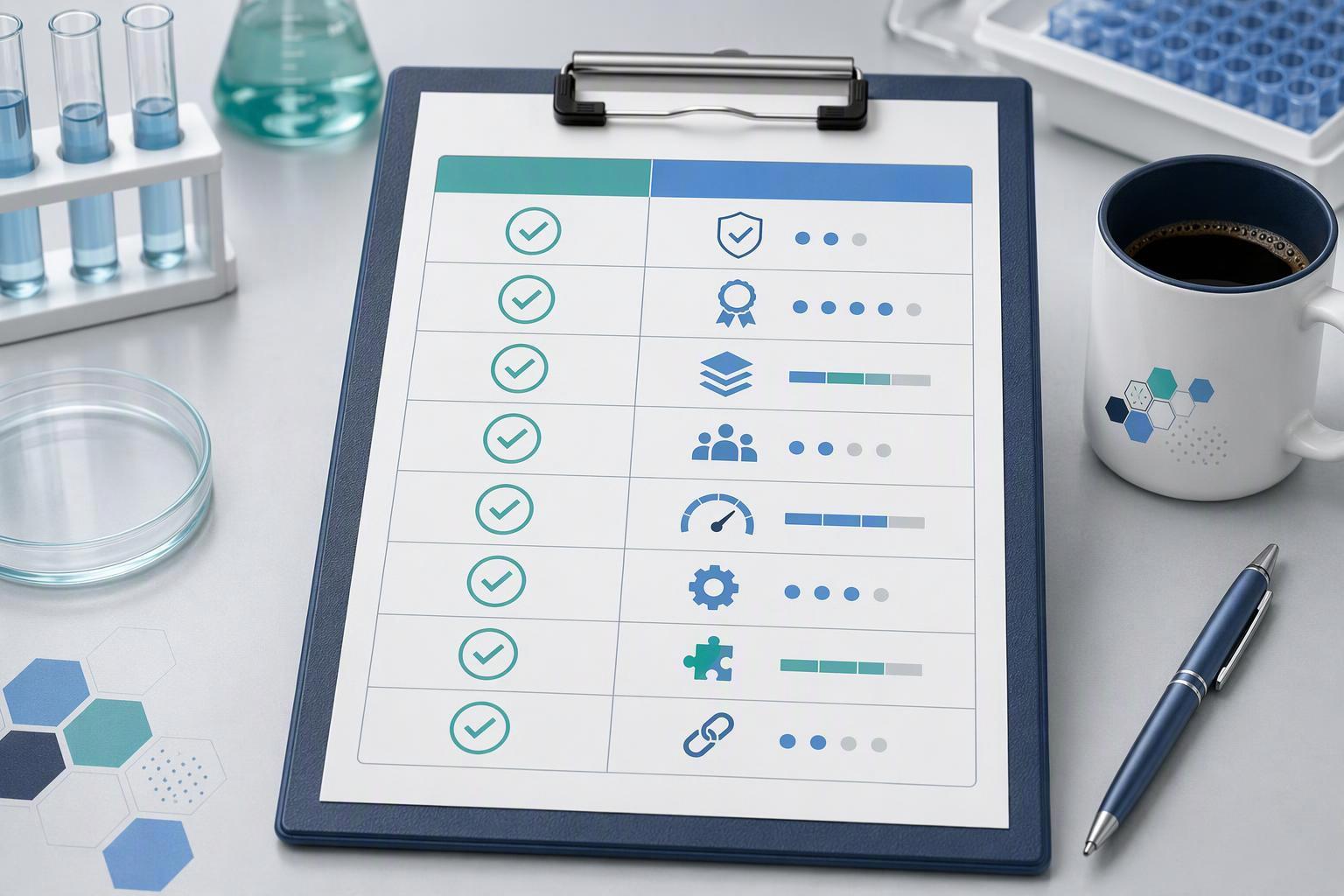
Five dimensions separate suppliers in practice: difficult-sequence capability, modification and labeling breadth, documentation depth, scale continuity, and commercial terms on failure. Only some are verifiable before you commit.
Difficult-sequence capability is the most technically substantive. Inter-chain β-sheets bury the N-terminal amine and block the next coupling, producing a sudden drop in stepwise yield and deletion-dominated crude profiles (BOC Sciences, 2026). An incomplete coupling leaves an N-terminus that the next deprotection step caps, generating a permanent deletion sequence whose reversed-phase retention time often overlaps the target (BOC Sciences, 2026). The American Peptide Society’s primer adds the purification corollary: very hydrophobic peptides can adhere irreversibly to reversed-phase columns (American Peptide Society).
Where the difficulty threshold sits is genuinely unsettled. BOC Sciences gives residue bands: measurable yield loss above roughly 30 toega, fragment assembly frequently required above 50, single-chain SPPS generally outside reach above 80. The Fmoc SPPS review declines to give numbers, describing the field as “on the threshold” of routinely reaching peptides above 100 residues through backbone protection, heating and improved automation (Behrendt et al., PMC, 2016). The review is more authoritative on what is chemically achievable; the vendor page is more useful on what you will be quoted. Neither is settled fact.
The purity dimension is where marketing most often outruns substance. A university core facility states plainly that purity should not be confused with content: e oo lava 100% pure peptide contains water, masani 3 ia 10%, plus trifluoroacetate or acetate counter-ions (UNC School of Medicine). A supplier quoting 98% purity without a net content figure is quoting an area-normalised number.
How to Test a Specialization Claim Before Committing a Project
The test is a written feasibility response, not a catalogue page. An expert adviser recommends defining length, sequence complexity, non-natural residues, purity and quantity first, then asking about past projects, in-house peptide chemists, references, a dedicated project manager, and how problem resolution works if a synthesis fails or is off-spec (Neuland Labs, 2025). That last question is the sharpest discriminator.
Name your failure modes explicitly and watch what comes back. Aggregation during chain assembly, disulfide mispairing, on-resin versus in-solution cyclization, and purity collapse on scale-up are the recurring failure classes. A supplier with real difficult-sequence experience will name the mitigations before you do: coupling affected positions as pseudoproline dipeptides, deprotection with chaotropic additives such as urea, coupling at 50 ia 65 °C, double coupling at every step and a third coupling with a different reagent system at difficult residues (BOC Sciences, 2026). Backbone protection installed before aggregation onset, then every six residues, is the documented systematic answer, and it outperformed microwave heating in preventing aggregation in a direct comparison (Behrendt et al., PMC, 2016).
The academic baseline shows what “no answer” looks like. A core facility states its main limitation on modified residues is commercial availability of the required Fmoc-amino-acid derivatives, often lowering yield or purity, and advises placing modified residues near the N-terminus (UNC School of Medicine). That is an honest limit stated up front. A commercial supplier that answers a modified-residue query with a modification count instead of a synthesis plan has told you something.
What a Defensible Documentation Package Contains
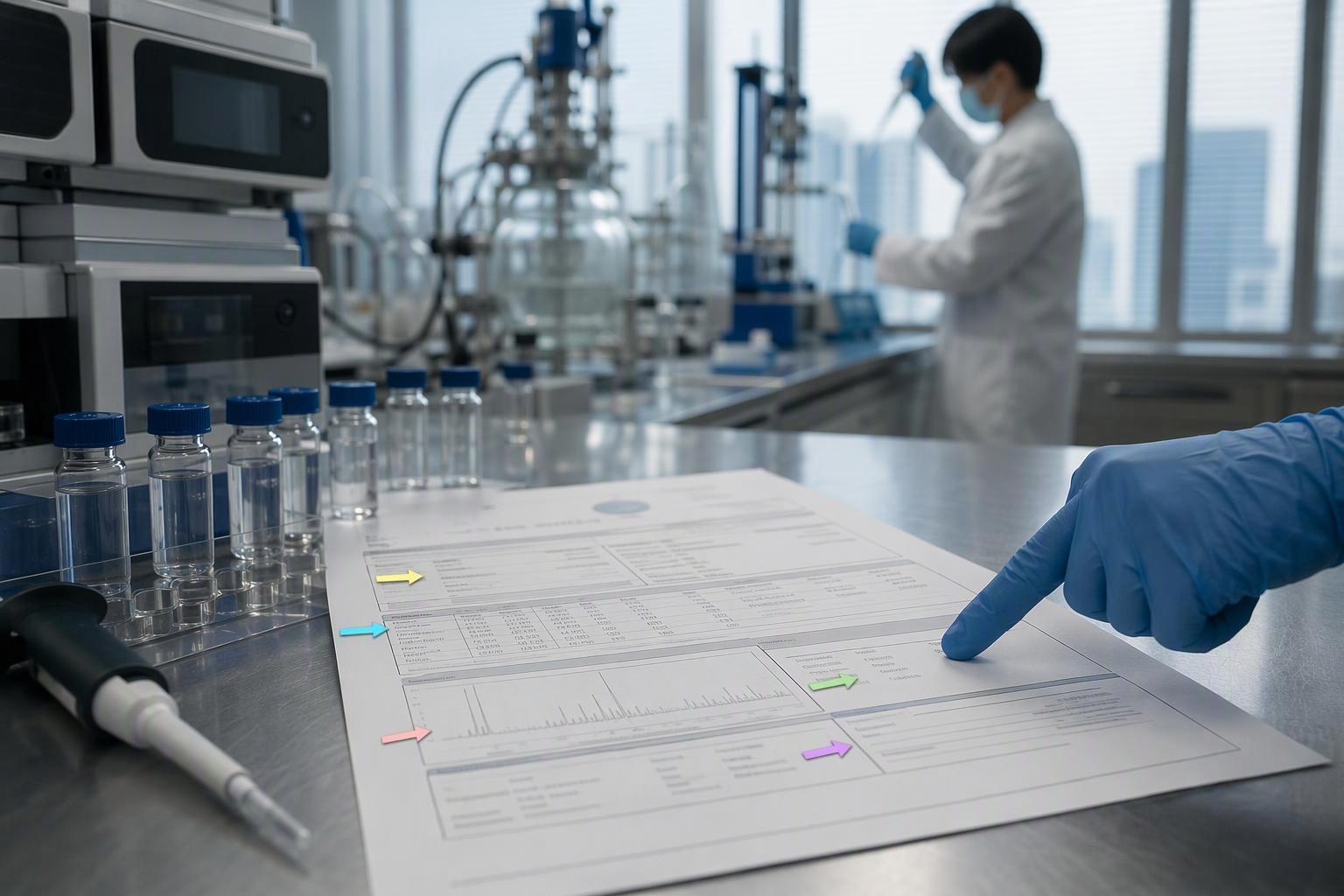
A defensible CoA separates area-normalised HPLC purity from net peptide content and names the counterion explicitly. The field checklist: unique lot matching the vial, manufacture and test dates, validated RP-HPLC purity with column, vaega feaveai, gradient, iloaga umi galu, faiga talafeagai, peak table and impurity threshold; MS identity with observed versus theoretical m/z and mass tolerance; net content corrected for water, counterion and residual solvent; counterion form with a quantitative method; vai e maua e Karl Fischer (Dutch Peptide Labs, 2026).
I Q1A(R2) stability designs depend on product, storage and submission context. For the general case, long-term conditions may be 25 °C/60% RH or 30 °C/65% RH; intermediate testing is conditional, not a universal additional six-month requirement. Research reagents need a justified use-specific stability plan rather than automatic adoption of a registration data package. I Q1A(R2).
Two gaps matter for how you use these. Q2(R2) applies to release and stability testing of commercial drug substances and products, and Q1A(R2) addresses registration applications, so neither governs a research-grade reagent as if it were a registered product. And no source connects electronic-records requirements to peptide manufacturing: 21 Vaega CFR 11 sets the criteria under which FDA treats electronic records and signatures as the equivalent of paper (eCFR), while MHRA’s GxP data-integrity guidance, updated in 2021, is where the ALCOA expectations for batch records come from (MHRA). State those two requirements separately; do not claim a supplier is Part 11 compliant without an explicit supplier statement.
What Japan-Specific Factors Change the Supplier Calculus
Domestic Japanese suppliers publish capability claims that are unusually specific, and the specificity is the point. Peptide Institute states it achieves more than 99% successful results in custom synthesis and charges nothing if it fails, at quantities from 10 mg to several hundred grams (Peptide Institute). No other source in this set makes a comparable guarantee, and the claim has no published denominator, sequence mix or purity threshold, so treat it as a vendor claim rather than an industry norm.
Toray Research Center advertises technology for peptides of 100 residues or more, using human insulin as its multi-disulfide example (Toray Research Center). That is a vendor self-description, e le o se fa'ailoga tuto'atasi, but it is the kind of concrete sequence class a buyer can interrogate.
The documentation menus differ in ways that map onto the CoA fields above. Peptide Institute’s standard package includes HPLC, amino acid analysis and mass spectrometry, with disulfide arrangement, counter ion, vai vai, residual solvent and peptide net content available as extra-charge analyses (Peptide Institute). A separate GMP peptide drug service line exists (Peptide Institute). At the CMC end, ScinoPharm combines solid- and liquid-phase chemistry with segment condensation and states a Japan PMDA inspection record for its GMP peptide production (ScinoPharm). An inspection record is not a licence for your product.
Two Japan-specific claims cannot be supported from primary sources. No supplier SLA, response-time commitment or named Japan-hours project manager was found on a primary page, and PMDA’s regulatory-information page carried no substantive text on research reagents. Language support, timezone coverage and import/registration handling stay qualitative until a primary source exists.
How the Named Suppliers Position Themselves Publicly

Published length ranges describe offered services under stated conditions, not demonstrated physical limits or guarantees for every sequence. Obtain written feasibility, mama, tele, analytical scope and delivery terms for the exact construct.
Fa'atagata Fa'asologa o le Peptide Synthesis Modification counts and headline turnaround times describe vendor offerings. They do not establish that every combination of length, suiga, quantity and purity can be delivered on the fastest schedule. Confirm the complete construct in a current quote.
Scale tiers reveal a different segmentation. JPT’s published scale tiers run from 10 µg in micro-scale pools to more than a gram, with per-peptide rather than average purity guarantees (JPT). AnaSpec’s labeling menu includes classical and HiLyte/CyLyte fluorescent dyes, biotinylation at N-terminus, Tripeptide-1 C-terminus and via conjugation, plus cyclization, disulfide formation and hydrocarbon stapling (AnaSpec). JPT notes TFA can be substituted with chloride or acetate (JPT), which is exactly the counterion field the CoA discussion turns on.
What Academic, Biotech, and Biopharma Workflows Each Require
Peptide Synthesis Slideshare Purity and net peptide content are different measurements. Research use does not create a universal 95% pe 98% acceptance threshold; determine suitable identity, le mama, content and functional controls from the assay. The supplier’s content range is not a lot result.
Biotech workflows sit between the academic and regulatory poles. They typically need modified and labeled peptides at mid-scale, which is where modification menus and the Fmoc-derivative availability limit collide. O le Solid Phase Peptide core facility’s warning that modified-residue incorporation often lowers yield or purity applies directly (UNC School of Medicine). Peptide 3 Tufuga
Biopharma workflows need the regulatory layer. ICH Q6B is the primary reference for specifications and acceptance criteria of biological products, including visual inspection, gaioiga fa'aletino, purity and quantification, with ICH Q1A(R2) covering stability testing (Elsayed et al., PMC, 2025). Sterility and endotoxin testing sit in harmonized compendial chapters: the Japanese Pharmacopoeia sterility test is JP 4.06, harmonized with USP <71> and Ph. Eur. 2.6.1, requiring 14-day incubation (PMC, 2015). Quality-system standards are a separate cluster: ISO 9001:2026 was published 16 Setema 2026 and replaces ISO 9001:2015 (ISO), while ISO 13485:2016 remains current and is incorporated by reference into the FDA Quality Management System Regulation (ISO). Nothing in the peptide synthesis sources connects either standard to peptide manufacturing specifically, so cite them as QMS facts, not as peptide-specific requirements.
Fesili e Fai soo
But doesn’t the conventional approach still work if my sequence is straightforward?
Usually, ioe, and the framework is not a case for replacing a supplier that already delivers. A 15-residue sequence with no long hydrophobic run and no unusual modification is routine work, and the differentiation dimensions only start to bite where a project carries difficulty. The practical test is whether the supplier’s documentation matches the sequence you actually need made, not whether it matches the easiest sequence in your program. Somatostatin Synthesis
What if we’ve already committed a project to a supplier that can’t handle the sequence?
Ask early how a failed or off-spec synthesis is handled, because that answer determines your exit cost. An expert adviser recommends asking how problem resolution works if a synthesis fails or is off-spec (Neuland Labs). If the answer is a re-run at your expense with no sequence-level diagnosis, the cheapest move is usually to stop at the current stage and re-source the remainder rather than fund a second attempt on the same route.
How do I respond to a supplier whose success claim has no denominator?
Treat it as a marketing statement until a denominator appears. Peptide Institute states it achieves more than 99% successful results in custom synthesis and charges nothing if it fails (Peptide Institute). The guarantee is the useful part; the percentage is not, because no sequence population, difficulty mix, or measurement window is published with it. Ask what class of sequences the figure covers.
Do ICH Q2(R2) and Q1A(R2) apply to research-grade reagents at all?
Leai, not as requirements. I Q2(R2) scopes to release and stability testing of commercial drug substances and products, and can be applied phase-appropriately during clinical development (I, 2023). I Q1A(R2) addresses registration applications for new molecular entities and associated drug products (I, 2003). For a research reagent, ask instead for the peptide supplier documentation and CoA fields that would survive a later scale-up: faasinomaga, auala mama, fa'asagatau, ma anotusi.
Fa'ai'uga
Differentiation among peptide synthesis suppliers in Japan concentrates in three places that survive scrutiny: documented difficult-sequence handling, lot-specific analytical packages that separate purity from net content and name the counterion, and commercial terms that say what happens when a synthesis fails. Routine linear sequences under 30 residues at 80 ia 95 percent purity are the commoditized tier, and no amount of catalogue breadth changes that.
The framework to apply: name your sequence features and failure modes in writing, require a feasibility response that names its assumptions, and demand a CoA that carries lot traceability, auiliiliga metotia, observed versus theoretical m/z, net content and counterion form. Where a supplier’s claim cannot be verified from public documents, treat it as a claim.
The next step is a medium-commitment one: request a feasibility assessment for your hardest sequence, and compare service scopes across two or three suppliers before committing a project. The written answers will separate specialists from catalogue sellers faster than any capability page.