Lo que realmente significa "abarrotado" para los proveedores de síntesis de péptidos en Japón
El hacinamiento está desigualmente distribuido, y el lado de la demanda explica por qué. Los fármacos peptídicos y proteicos aprobados representan ahora aproximadamente una cuarta parte del mercado farmacéutico., que representa más de USD 500 mil millones en ventas, y el recuento de péptido aprobado- y terapias basadas en proteínas aprobadas 120 por 2023 (Elsayed et al., PMC, 2025). Esa demanda empuja a los proveedores hacia las mismas capacidades visibles..
El marco del mercado también es fácil de malinterpretar.. MarketsandMarkets dimensiona el mercado mundial de síntesis de péptidos en USD 0.98 mil millones en 2026, creciente 9.5% un año a USD 1.54 mil millones por 2031, con un alcance que agrupa instrumentos, reactivos, consumibles y servicios de síntesis personalizados (MercadosyMercados, 2026). El amplio mercado de síntesis de péptidos de Japón se cotiza en dólares 0.85 mil millones en 2024 por investigación de mercado verificada, alcanzando USD 1.68 mil millones por 2032 en 8.9% CAGR, en un alcance que incluye reactivos, consumibles, equipo, servicios, aplicaciones y usuarios finales (Investigación de mercado verificada, 2025). Estos son alcances diferentes y nunca deben agregarse.
Los recuentos de proveedores son igualmente resbaladizos. Un documento de mercado de base de conocimientos enumera AnaSpec, CPC científico, GenScript y 21st Century Bio entre 28 empresas líderes, pero no se ha encontrado ninguna fuente que proporcione un recuento de los proveedores que atienden específicamente a Japón.. Trate "abarrotado" como una declaración sobre el nivel de rutina, no todo el mercado.
Qué dimensiones de diferenciación son reales y cuáles son de marketing
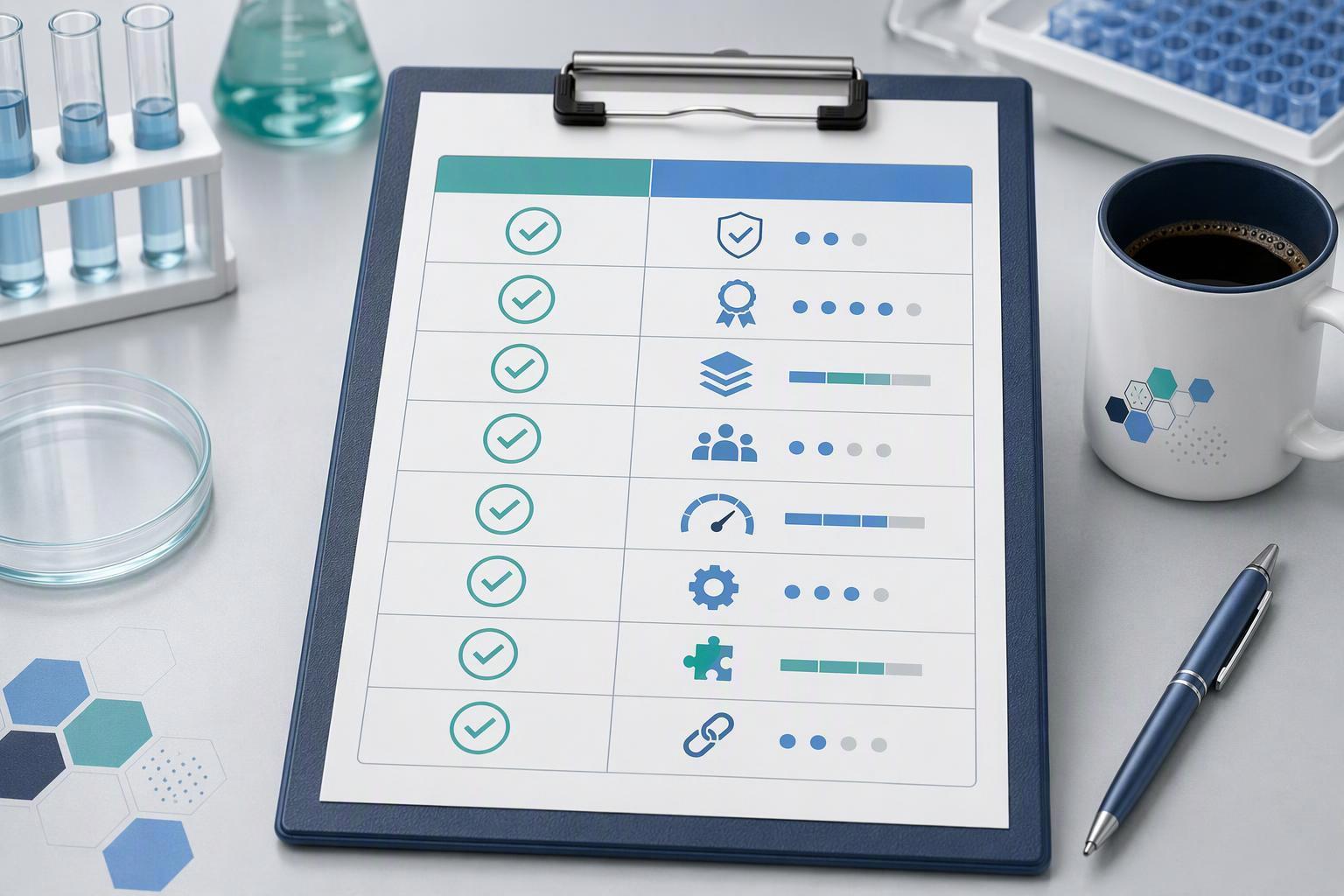
Cinco dimensiones separan a los proveedores en la práctica: capacidad de secuencia difícil, modificación y amplitud del etiquetado, profundidad de la documentación, continuidad de escala, y condiciones comerciales en caso de fallo. Sólo algunos son verificables antes de comprometerse.
La capacidad de secuencia difícil es la más importante desde el punto de vista técnico. Las láminas β entre cadenas entierran la amina N-terminal y bloquean el siguiente acoplamiento, produciendo una caída repentina en el rendimiento gradual y perfiles crudos dominados por la eliminación (Ciencias BOC, 2026). Un acoplamiento incompleto deja un extremo N que el siguiente paso de desprotección cubre, Generar una secuencia de eliminación permanente cuyo tiempo de retención de fase inversa a menudo se superpone al objetivo. (Ciencias BOC, 2026). El manual de la American Peptide Society añade el corolario de la purificación: Los péptidos muy hidrofóbicos pueden adherirse irreversiblemente a columnas de fase reversa. (Sociedad Americana de Péptidos).
Dónde se sitúa el umbral de dificultad es realmente incierto. BOC Sciences proporciona bandas de residuos: pérdida de rendimiento medible por encima de aproximadamente 30 residuos, ensamblaje de fragmentos frecuentemente requerido arriba 50, SPPS de cadena única generalmente fuera del alcance arriba 80. La revisión del Fmoc SPPS se niega a dar cifras, describiendo el campo como "en el umbral" de alcanzar rutinariamente los péptidos por encima 100 residuos a través de la protección de la columna vertebral, calefacción y automatización mejorada (Behrendt y cols., PMC, 2016). La revisión tiene más autoridad sobre lo que se puede lograr químicamente.; La página del proveedor es más útil sobre lo que se le cotizará.. Tampoco es un hecho establecido.
La dimensión de la pureza es donde el marketing suele superar a la sustancia.. Una instalación central universitaria afirma claramente que la pureza no debe confundirse con el contenido.: incluso 100% El péptido puro contiene agua., generalmente 3 a 10%, más trifluoroacetato o contraiones de acetato (Facultad de Medicina de la UNC). Un proveedor cotizando 98% La pureza sin una cifra de contenido neto es un número normalizado por área..
Cómo probar una afirmación de especialización antes de comprometerse con un proyecto
La prueba es una respuesta de viabilidad escrita., no es una página de catálogo. An expert adviser recommends defining length, sequence complexity, non-natural residues, purity and quantity first, then asking about past projects, in-house peptide chemists, references, a dedicated project manager, and how problem resolution works if a synthesis fails or is off-spec (Laboratorios Neuland, 2025). That last question is the sharpest discriminator.
Name your failure modes explicitly and watch what comes back. Aggregation during chain assembly, disulfide mispairing, on-resin versus in-solution cyclization, and purity collapse on scale-up are the recurring failure classes. A supplier with real difficult-sequence experience will name the mitigations before you do: coupling affected positions as pseudoproline dipeptides, deprotection with chaotropic additives such as urea, coupling at 50 a 65 °C, double coupling at every step and a third coupling with a different reagent system at difficult residues (Ciencias BOC, 2026). Backbone protection installed before aggregation onset, then every six residues, is the documented systematic answer, and it outperformed microwave heating in preventing aggregation in a direct comparison (Behrendt y cols., PMC, 2016).
The academic baseline shows what “no answer” looks like. A core facility states its main limitation on modified residues is commercial availability of the required Fmoc-amino-acid derivatives, often lowering yield or purity, and advises placing modified residues near the N-terminus (Facultad de Medicina de la UNC). That is an honest limit stated up front. A commercial supplier that answers a modified-residue query with a modification count instead of a synthesis plan has told you something.
Qué contiene un paquete de documentación defendible
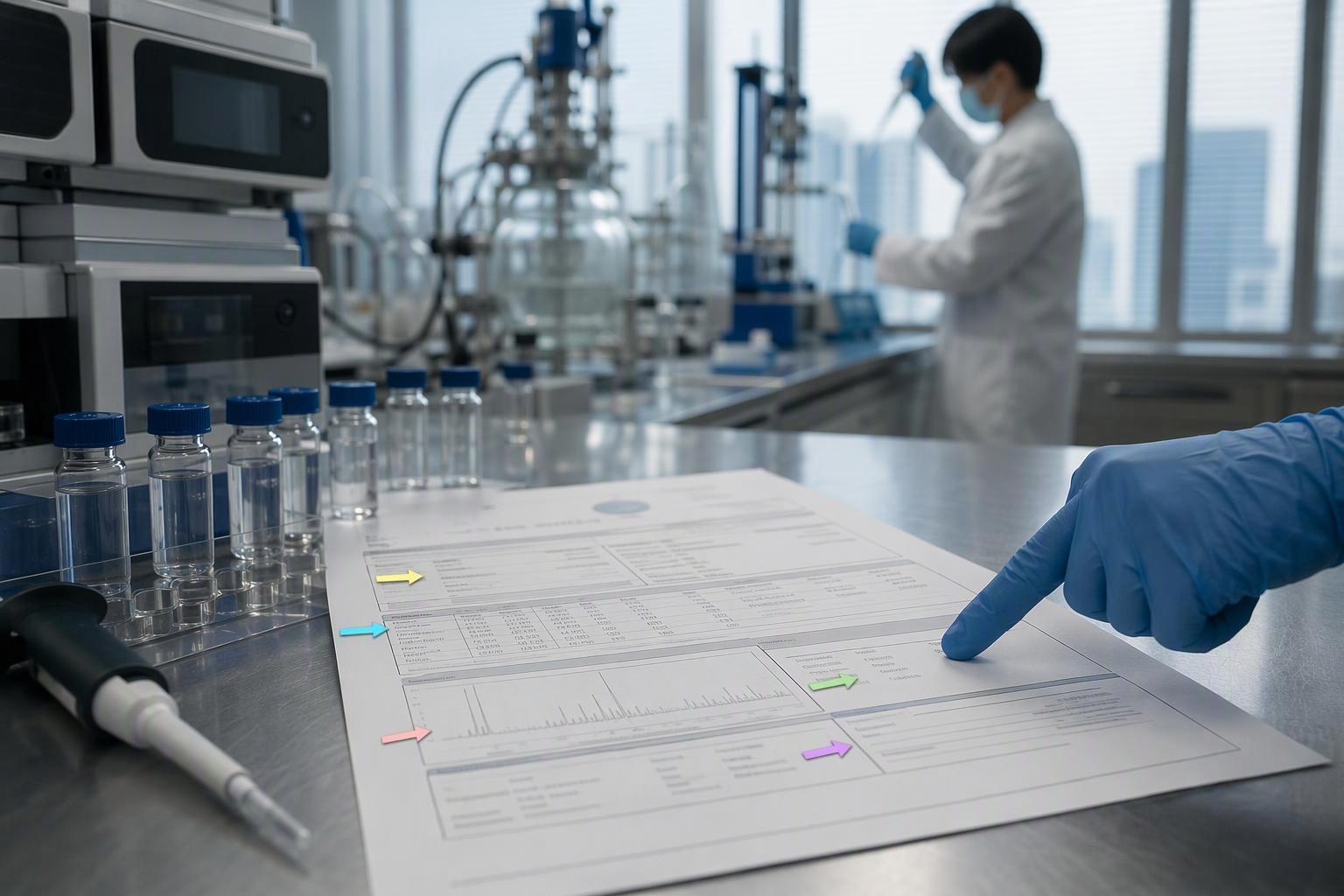
A defensible CoA separates area-normalised HPLC purity from net peptide content and names the counterion explicitly. The field checklist: unique lot matching the vial, manufacture and test dates, validated RP-HPLC purity with column, fase móvil, gradiente, longitud de onda de detección, idoneidad del sistema, peak table and impurity threshold; MS identity with observed versus theoretical m/z and mass tolerance; net content corrected for water, counterion and residual solvent; counterion form with a quantitative method; water content by Karl Fischer (Dutch Peptide Labs, 2026).
Yo Q1A(R2) stability designs depend on product, storage and submission context. For the general case, long-term conditions may be 25 °C/60% RH or 30 °C/65% RH; intermediate testing is conditional, not a universal additional six-month requirement. Research reagents need a justified use-specific stability plan rather than automatic adoption of a registration data package. Yo Q1A(R2).
Two gaps matter for how you use these. Q2(R2) applies to release and stability testing of commercial drug substances and products, y Q1A(R2) addresses registration applications, so neither governs a research-grade reagent as if it were a registered product. And no source connects electronic-records requirements to peptide manufacturing: 21 Parte CFR 11 sets the criteria under which FDA treats electronic records and signatures as the equivalent of paper (eCFR), while MHRA’s GxP data-integrity guidance, updated in 2021, is where the ALCOA expectations for batch records come from (MHRA). State those two requirements separately; do not claim a supplier is Part 11 compliant without an explicit supplier statement.
¿Qué factores específicos de Japón cambian el cálculo de proveedores?
Domestic Japanese suppliers publish capability claims that are unusually specific, and the specificity is the point. Peptide Institute states it achieves more than 99% successful results in custom synthesis and charges nothing if it fails, at quantities from 10 mg to several hundred grams (Peptide Institute). No other source in this set makes a comparable guarantee, and the claim has no published denominator, sequence mix or purity threshold, so treat it as a vendor claim rather than an industry norm.
Toray Research Center advertises technology for peptides of 100 residues or more, using human insulin as its multi-disulfide example (Toray Research Center). That is a vendor self-description, not an independent benchmark, but it is the kind of concrete sequence class a buyer can interrogate.
The documentation menus differ in ways that map onto the CoA fields above. Peptide Institute’s standard package includes HPLC, amino acid analysis and mass spectrometry, with disulfide arrangement, contraión, contenido de agua, residual solvent and peptide net content available as extra-charge analyses (Peptide Institute). A separate GMP peptide drug service line exists (Peptide Institute). At the CMC end, ScinoPharm combines solid- and liquid-phase chemistry with segment condensation and states a Japan PMDA inspection record for its GMP peptide production (ScinoPharm). An inspection record is not a licence for your product.
Two Japan-specific claims cannot be supported from primary sources. No supplier SLA, response-time commitment or named Japan-hours project manager was found on a primary page, and PMDA’s regulatory-information page carried no substantive text on research reagents. Language support, timezone coverage and import/registration handling stay qualitative until a primary source exists.
Cómo se posicionan públicamente los proveedores nombrados

Published length ranges describe offered services under stated conditions, not demonstrated physical limits or guarantees for every sequence. Obtain written feasibility, pureza, quantity, analytical scope and delivery terms for the exact construct.
Fabricante de síntesis de péptidos personalizado Modification counts and headline turnaround times describe vendor offerings. They do not establish that every combination of length, modificación, quantity and purity can be delivered on the fastest schedule. Confirm the complete construct in a current quote.
Scale tiers reveal a different segmentation. JPT’s published scale tiers run from 10 µg in micro-scale pools to more than a gram, with per-peptide rather than average purity guarantees (JPT). AnaSpec’s labeling menu includes classical and HiLyte/CyLyte fluorescent dyes, biotinylation at N-terminus, Tripéptido-1 C-terminus and via conjugation, plus cyclization, disulfide formation and hydrocarbon stapling (AnaSpec). JPT notes TFA can be substituted with chloride or acetate (JPT), which is exactly the counterion field the CoA discussion turns on.
que academico, Biotecnología, y los flujos de trabajo biofarmacéuticos que cada uno requiere
Peptide Synthesis Slideshare Purity and net peptide content are different measurements. Research use does not create a universal 95% o 98% acceptance threshold; determine suitable identity, impurity, content and functional controls from the assay. The supplier’s content range is not a lot result.
Biotech workflows sit between the academic and regulatory poles. They typically need modified and labeled peptides at mid-scale, which is where modification menus and the Fmoc-derivative availability limit collide. El Solid Phase Peptide core facility’s warning that modified-residue incorporation often lowers yield or purity applies directly (Facultad de Medicina de la UNC). péptido 3 Fabricante
Biopharma workflows need the regulatory layer. ICH Q6B is the primary reference for specifications and acceptance criteria of biological products, including visual inspection, actividad biológica, purity and quantification, with ICH Q1A(R2) covering stability testing (Elsayed et al., PMC, 2025). Sterility and endotoxin testing sit in harmonized compendial chapters: the Japanese Pharmacopoeia sterility test is JP 4.06, harmonized with USP <71> and Ph. euros. 2.6.1, requiring 14-day incubation (PMC, 2015). Quality-system standards are a separate cluster: ISO 9001:2026 was published 16 Septiembre 2026 and replaces ISO 9001:2015 (ISO), while ISO 13485:2016 remains current and is incorporated by reference into the FDA Quality Management System Regulation (ISO). Nothing in the peptide synthesis sources connects either standard to peptide manufacturing specifically, so cite them as QMS facts, not as peptide-specific requirements.
Preguntas frecuentes
But doesn’t the conventional approach still work if my sequence is straightforward?
Usually, Sí, and the framework is not a case for replacing a supplier that already delivers. A 15-residue sequence with no long hydrophobic run and no unusual modification is routine work, and the differentiation dimensions only start to bite where a project carries difficulty. The practical test is whether the supplier’s documentation matches the sequence you actually need made, not whether it matches the easiest sequence in your program. Somatostatin Synthesis
What if we’ve already committed a project to a supplier that can’t handle the sequence?
Ask early how a failed or off-spec synthesis is handled, because that answer determines your exit cost. An expert adviser recommends asking how problem resolution works if a synthesis fails or is off-spec (Laboratorios Neuland). If the answer is a re-run at your expense with no sequence-level diagnosis, the cheapest move is usually to stop at the current stage and re-source the remainder rather than fund a second attempt on the same route.
¿Cómo respondo a un proveedor cuyo reclamo de éxito no tiene denominador??
Treat it as a marketing statement until a denominator appears. Peptide Institute states it achieves more than 99% successful results in custom synthesis and charges nothing if it fails (Peptide Institute). The guarantee is the useful part; the percentage is not, because no sequence population, difficulty mix, or measurement window is published with it. Ask what class of sequences the figure covers.
¿Hago Q2?(R2) y Q1A(R2) Aplicar a reactivos de grado de investigación en absoluto.?
No, not as requirements. Yo Q2(R2) scopes to release and stability testing of commercial drug substances and products, and can be applied phase-appropriately during clinical development (I, 2023). Yo Q1A(R2) addresses registration applications for new molecular entities and associated drug products (I, 2003). For a research reagent, ask instead for the peptide supplier documentation and CoA fields that would survive a later scale-up: identidad, purity method, contraión, y contenido.
Conclusión
Differentiation among peptide synthesis suppliers in Japan concentrates in three places that survive scrutiny: documented difficult-sequence handling, lot-specific analytical packages that separate purity from net content and name the counterion, and commercial terms that say what happens when a synthesis fails. Routine linear sequences under 30 residues at 80 a 95 percent purity are the commoditized tier, and no amount of catalogue breadth changes that.
The framework to apply: name your sequence features and failure modes in writing, require a feasibility response that names its assumptions, and demand a CoA that carries lot traceability, method detail, observed versus theoretical m/z, net content and counterion form. Where a supplier’s claim cannot be verified from public documents, treat it as a claim.
The next step is a medium-commitment one: request a feasibility assessment for your hardest sequence, and compare service scopes across two or three suppliers before committing a project. The written answers will separate specialists from catalogue sellers faster than any capability page.