After Peptide Sciences’ Shutdown: How Labs Should Vet Alternate BPC‑157 Suppliers
The sudden operational shutdown of Peptide Sciences—long one of the most widely utilized North American distributors of research-grade synthetic peptides—has created a significant procurement vacuum across academic laboratories, biotechnology startups, and contract research organizations (CROs). For principal investigators and research scientists utilizing BPC-157 (pentadecapeptide, sequence Gly-Glu-Pro-Pro-Pro-Gly-Lys-Pro-Ala-Asp-Asp-Ala-Gly-Leu-Val, molecular weight 1419.55 И), this disruption introduces immediate operational risk.
Switching vendors mid-study without rigorous qualification threatens experimental continuity. Substandard replacement peptides frequently suffer from batch-to-batch purity fluctuations, inaccurate net peptide content, residual trifluoroacetic acid (ТФА) toxicity, and unverified structural identity. In cell culture models or animal bioassays, these impurities introduce confounding variables, obscure target activity, and destroy data reproducibility.
To safeguard research integrity, laboratory procurement must shift from passive vendor selection to a active, analytical supplier qualification process. This guide provides a laboratory-centric evaluation checklist covering analytical documentation auditing, manufacturing provenance, stoichiometry and counter-ion state, stability kinetics, and intellectual property compliance.
Pillar 1: Analytical Documentation & Chromatographic Integrity
The primary defense against non-reproducible research reagents is a comprehensive, lot-specific Certificate of Analysis (ЦоА). Generic CoA templates or batch documents that lack raw analytical spectra should be rejected immediately. Every candidate lot of BPC-157 must be accompanied by individual High-Performance Liquid Chromatography (ХПЛЦ) and Mass Spectrometry (МС) test data.
Reversed-Phase HPLC (РП-ХПЛЦ) Purity Verification
RP-HPLC is the gold standard for quantifying chemical purity and detecting truncated or modified peptide impurities. When auditing a supplier’s HPLC chromatogram, verify the following analytical conditions:
- Detection Wavelength: UV absorption should be monitored at 214 nm or 220 нм, corresponding to the absorption band of the peptide backbone amide bonds. Single-wavelength detection at 254 nm or 280 nm is insufficient for BPC-157 because the sequence lacks aromatic residues (such as Tryptophan or Tyrosine) that absorb strongly at higher UV wavelengths.
- Column Chemistry: Analysis must utilize a stationary phase optimized for peptides, typically a C18 reversed-phase column (4.6 × 250 mm, 3.5 µm or 5 µm particle size, 120 Å pore size).
- Mobile Phase Gradient: The run must employ an organic gradient, typically 0.1% TFA in ultra-pure water (Mobile Phase A) да 0.1% TFA in HPLC-grade Acetonitrile (Mobile Phase B).
- Purity Acceptance Threshold: For research-grade applications, the main peptide peak integrated UV area must represent at least 98.0% of the total integrated peak area. Као што је детаљно описано у ACS Peptide Testing Labs 2026 HPLC analysis guide, purity area percentage is calculated by dividing the main peak area by the sum of all integrated peak areas between the void volume and column wash.
- Chromatographic Parameters: The main peak must demonstrate clear baseline separation with a resolution factor (Rₛ) of at least 1.5 relative to adjacent impurity peaks, minimal tailing (asymmetry factor between 0.8 и 1.2), and no baseline drift that conceals co-eluting species.
Mass Spectrometry (МС) Идентитет & Mass Accuracy
While HPLC quantifies purity, it cannot confirm molecular identity. Mass spectrometry is required to confirm that the purified peak corresponds strictly to BPC-157.
- Ion Mass Matching: Electrospray Ionization Mass Spectrometry (ESI-MS) should display a dominant single-protonated species at m/z 1420.55 [M+H]⁺ and a secondary doubly-protonated species at m/z 710.78 [M+2H]²⁺, corresponding to the monoisotopic neutral mass of 1419.55 И.
- Mass Accuracy Limits: The observed mass must match theoretical calculation within strict mass accuracy limits:
Δ m = ( |m observed – m theoretical|{m theoretical} ) × 10⁶ ≤ 10 ппм
According to the FormBlends 2026 COA Analysis Guide, high-resolution mass spectrometers (such as Q-TOF or Orbitrap instruments) should achieve mass errors below 10 ппм, verifying correct elemental composition.
- Tandem MS Sequence Verification: For critical in vivo programs or lead optimization, request tandem MS (MS/MS) fragmentation spectra. Collision-induced dissociation (ЦИД) fragment ions (b-ions and y-ions) confirm the exact amino acid sequence order, distinguishing BPC-157 from isobaric scrambled variants.
⚠ Упозорење: Beware of suppliers that supply cropped HPLC chromatograms or mass spectra lacking acquisition dates, instrument serial numbers, or matching lot numbers. Authentic analytical documentation must clearly link the raw data file to the specific vial lot delivered to your facility.
Pillar 2: Stoichiometry, Net Peptide Content, and Counter-Ion State
A common point of confusion in laboratory peptide preparation is the difference between gross powder weight and actual net peptide content. Receiving a vial labeled “5 mg BPC-157” does not mean it contains 5 mg of active peptide mass.
Calculating Net Peptide Content (NPC)
Lyophilized peptide preparations are not 100% pure active pharmaceutical ingredients. They consist of a mixture of active peptide, bound counter-ions, and residual moisture. The Net Peptide Content (NPC) represents the actual percentage of peptide mass relative to total powder mass:
NPC (%) = ( Mass of Pure Active Peptide/Total Gross Powder Weight ) × 100%
NPC is typically determined using Amino Acid Analysis (AAA) or Elemental Nitrogen Analysis (N%). In commercial lyophilized lots, NPC ranges between 70% и 85%. The remaining 15% да 30% of the gross weight consists of:
- Residual Water: Determined via Karl Fischer (KF) titration; acceptable levels must remain at or below 8.0% (в/в).
- Counter-Ions: Salts accumulated during solid-phase synthesis and cleavage.
If a researcher weighs out 1.0 mg of gross lyophilized powder assuming 100% active peptide when the true NPC is 75%, all downstream molar concentration calculations will be off by 25%. This systematic under-dosing introduces substantial experimental error in quantitative SAR assays and cell viability studies.
Sequence: Gly-Glu-Pro-Pro-Pro-Gly-Lys-Pro- | | (TFA or
GROSS LYOPHILIZED POWDER MASS NET ACTIVE PEPTIDE MASS | | COUNTER- | (70% – 85%) | | IONS | Ala-Asp-Asp-Ala-Gly-Leu-Val | | Acetate) | (10% – 20%) WATER (KF) (≤ 8.0%)
Trifluoroacetate (ТФА) Toxicity vs. Acetate Conversion
Solid-phase peptide synthesis (СПСС) utilizes trifluoroacetic acid (ТФА) during resin cleavage and side-chain deprotection. Consequently, crude synthetic peptides exist as TFA salts.
- Cytotoxic Risks: Residual TFA counter-ions can disrupt cell culture assays. Concentrations of TFA as low as 0.1 mM inhibit cellular proliferation, alter membrane potential, and induce unspecific cytotoxicity in primary cell lines and organoid models.
- Salt Exchange Options: For in vitro cell assays and sensitive in vivo biological studies, labs should request acetate exchange or salt-free formulations. When evaluating vendors for specialized applications, confirm whether they offer dedicated custom peptide synthesis with guaranteed TFA counter-ion removal (<1.0% residual TFA content verified by Ion Chromatography).
Pillar 3: Manufacturing Provenance, Sterility, and Endotoxin Control
Where and how a peptide is manufactured directly dictates its physical quality, stability, and freedom from biological contaminants.
Cleanroom Classification & Environmental Controls
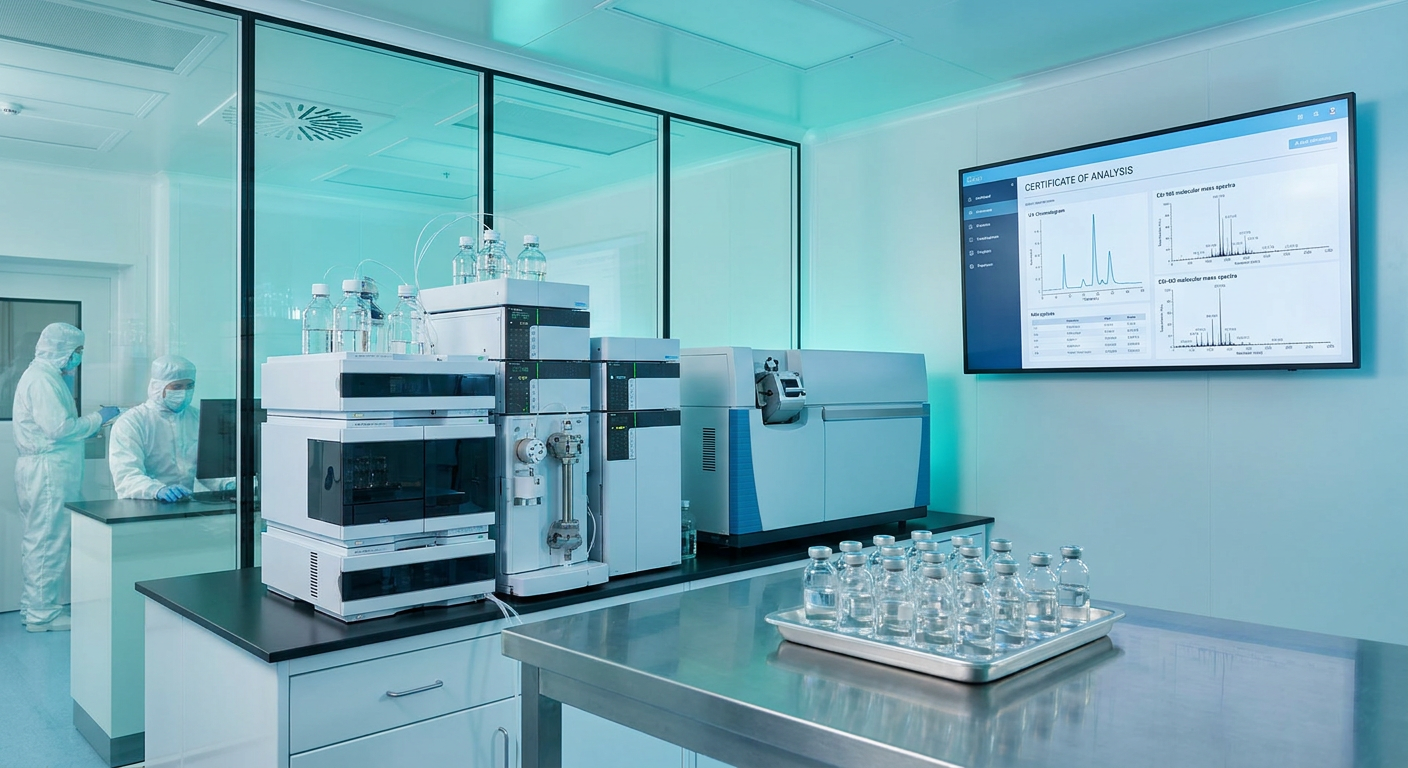
Lyophilization and packaging represent critical exposure points where sterile peptides can absorb environmental moisture or bacterial contaminants. Alternate suppliers must demonstrate that synthesis, пречишћавање, and vial filling take place under documented cleanroom conditions.
- Класа 100 (ИСО 5) Standards: Aseptic packaging requires processing within Class 100 ultra-sterile cleanrooms, maintained with HEPA laminar air flow, continuous positive pressure, and automated temperature/humidity regulation.
- Particulate & Microbe Controls: Operating within audited Класа 100 ultra-sterile cleanroom facilities ensures that ambient airborne particulates (≥0.5 µm) remain below 3,520 particles per cubic meter, preventing fungal spore or bacterial introduction during final vial stoppering.
Bacterial Endotoxin Testing (LAL Assay)
Бактеријски ендотоксини (lipopolysaccharides, LPS) released from Gram-negative outer membranes during bacterial fermentation or contaminated water washing trigger severe inflammatory cascades in biological systems.
- LAL Assay Requirements: Every batch intended for cell culture or animal research must undergo quantitative Limulus Amebocyte Lysate (LAL) тестирање.
- Acceptance Limits: The endotoxin threshold for standard research-grade material must not exceed 1.0 ЕУ/мг. For critical parenteral administration or immune cell studies, choose batches certified at or below 0.1 ЕУ/мг.
Key Takeaway: High HPLC purity (>98%) does not guarantee low endotoxin levels. Endotoxins are non-UV-absorbing macromolecules that do not register on standard RP-HPLC UV 214nm traces. Always require explicit LAL test results on the CoA.
Pillar 4: Stability, Storage Kinetics, and Regulatory/IP Protections
A reliable supplier provides validated stability protocols and operates under robust quality management systems that protect your intellectual property.
Stability Profiles & Handling Protocols
Understanding BPC-157 degradation kinetics ensures reagents retain full potency throughout long-term studies:
- Lyophilized Storage: Desiccated lyophilized powder stored at -20°C to -80°C protected from light How To Filter Peptides Manufacturer remains stable for at least 24 months. Avoid frequent freeze-thaw cycles of dry powder prior to reconstitution.
- Reconstituted Solution Kinetics: Once dissolved in sterile, deoxygenated bacteriostatic water or phosphate-buffered saline (PBS, пХ 7.4), aqueous BPC-157 remains stable at 4°C for 14 да 28 дана.
- Chemical Degradation Vectors: BPC-157 contains Aspartate-Aspartate (Asp-Asp) and Proline-Rich motifs. Exposure to elevated temperatures (>25°C), alkaline pH (>8.0), or oxidizing environments accelerates specific degradation pathways:
- Deamidation: Isoaspartate formation at Asp-Asp sites, shifting retention time on HPLC.
- Proline Isomerization: Cis-trans conformational flipping that alters target receptor binding kinetics.
- Агрегација: Hydrophobic association forming insoluble oligomers under high ionic strength.
Regulatory Management & Intellectual Property Safeguards
When qualifying an alternate supplier, audit their quality systems and legal protections:
- Пептиде 2 Quality Accreditation: Prioritize manufacturers operating under ISO 9001:2015 quality management systems or ISO/IEC 17025 accredited analytical laboratories.
- Batch Traceability: The manufacturer must maintain complete raw material chain-of-custody logs, resin lot tracking, and solvent purity certificates.
- Change Control Notification: Suppliers should agree to formal Change Control Notifications (CCN) before altering synthesis routes, purification media, or manufacturing facility locations.
- Intellectual Property Protection: Ensure the supplier provides signed Non-Disclosure Agreements (NDAs) and clear Material Transfer Agreements (MTAs) that protect proprietary sequence modifications and research data. As emphasized in the DosingCalc 2026 Peptide Quality Testing Standards, working with partners offering specialized peptide CRO services guarantees transparent IP ownership and regulatory compliance for custom synthesis programs.
Practical Laboratory Supplier Evaluation Checklist
Use this binary evaluation checklist during technical vendor audits. Every candidate supplier must meet or exceed all mandatory acceptance criteria before receiving procurement approval.
<Environmental Audit Solid Phase Peptide Synthesis Wholesale Log / Certp>Пептиде Вендор 3. Manufacturing
| Audit Category | Evaluation Criterion | Acceptance Specification | Verification Method | Status | ||||
|---|---|---|---|---|---|---|---|---|
| 1. Analytical QC | RP-HPLC Area Purity | ≥98.0% main peak integrated area | UV 214nm / C18 Column Chromatogram | [ ] Пасс / Fail Пептиде 1 | ||||
| 1. Analytical QC | ESI-MS Mass Confirmation | [M+H]⁺ = 1420.55 ±0.01 Da (Mass Error ≤10 ppm) | High-Res Mass Spectrum | [ ] Пасс / Fail | ||||
| 1. Analytical QC | Chromatographic Symmetry | Resolution Factor R⛛ ≥1.5; Tailing Factor 0.8–1.2 | Peak Shape Analysis | Explicitly reported Peptiders Manufacturer (Typically 70%–85%)
olspan=”1″ rowspan=”1″> 2. Stoichiometry |
Net Peptide Content (NPC) | Explicitly reported (Typically 70%–85%) | Amino Acid Analysis (AAA) or N% | [ ] Пасс / Fail |
| 2. Stoichiometry | Moisture Content | Karl Fischer Titration ≤8.0% w/w | KF Analytical Report | [ ] Пасс / Fail | ||||
| 2. Stoichiometry | Counter-Ion Identification | Disclosed (ТФА, Acetate, or Free Base); Остатак ТФА <1.0% for cell assays | Јонска хроматографија | [ ] Пасс / Fail | Cleanroom Environment | Класа 100 (ИСО 5) sterile environment | Environmental Audit Log / Cert | [ ] Пасс / Fail |
| 3. Manufacturing | Endotoxin Limit | LAL Assay ≤1.0 EU/mg (≤0.1 EU/mg for animal study) | LAL Test Certificate | [ ] Пасс / Fail | ||||
| 4. Stability/IP | Documented Storage Protocols | Validated lyophilized (-20°C) and solution (4°C) data | Stability Study Summary | [ ] Пасс / Fail | ||||
| 4. Stability/IP | QA & Traceability | Lot-specific CoA matching vial label; ИСО 9001/17025 | Raw Data & QA Sign-off | [ ] Пасс / Fail |
Decision Workflow: Receiving and Auditing Replacement BPC-157 Lots
Follow this standardized protocol upon receiving shipment lots from a newly onboarded peptide vendor:
- Step 1: Physical & Packaging Audit → Inspect vial seals, lyophilized cake uniformity, and verify lot numbers match shipping paperwork and CoA.
- Step 2: Analytical Certificate Audit → Verify presence of complete RP-HPLC UV 214nm chromatograms (purity ≥98.0%) and ESI-MS spectra (m/z 1420.55 M+H⁺, mass error ≤10 ppm). Confirm LAL endotoxin result (≤1.0 EU/mg).
- Step 3: Stoichiometric Calculation → Check reported Net Peptide Content (NPC %). Calculate true mass required for target molar solutions:
Required Gross Weight = Desired Pure Peptide Mass/NPC Decimal
- Step 4: Experimental Reconstitution & Rejection Check → Reconstitute in sterile solvent. If solution exhibits turbidity, persistent particulates, or pH deviation (<5.0 or >8.0), halt usage immediately and issue a formal vendor Quality Defect Report.
Frequently Asked Questions (ФАК)
What is the minimum acceptable HPLC purity for BPC-157 in research bioassays?
For quantitative biochemical studies, target receptor binding assays, and cell culture models, the minimum acceptable purity is 98.0% as determined by RP-HPLC with UV detection at 214 нм. Purity levels below 98% contain synthetic truncated peptides or failure sequences that can competitively block target receptors, leading to erratic or irreproducible experimental outcomes.
Why does gross vial weight differ from net BPC-157 peptide content?
Lyophilized peptide powders contain non-peptide components, including bound counter-ions (such as TFA or acetate) accumulated during synthesis and residual moisture absorbed during handling. The Net Peptide Content (NPC) reflects the actual percentage of active peptide mass within the total powder weight (typically 70% да 85%). Always adjust concentration calculations using the lot-specific NPC value reported on the CoA.
How does residual TFA affect cell culture experiments?
Trifluoroacetic acid (ТФА) is a strong organic acid used during solid-phase peptide synthesis. Residual TFA counter-ions present in unexchanged peptide preparations can lower culture media pH and exert direct cytotoxic effects on cells at concentrations above 0.1 мМ. For cell culture, stem cell, or organoid studies, specify acetate-exchanged or salt-free BPC-157 with certified residual TFA levels below 1.0%.
What documentation indicates a vendor has robust batch-to-batch consistency?
Look for suppliers operating under ISO 9001:2015 quality management standards or ISO/IEC 17025 laboratory accreditations. Reputable manufacturers provide historical lot-to-lot overlay chromatograms, maintain full raw material traceability, and issue formal Change Control Notifications before altering synthetic procedures or packaging parameters.
Strengthening Laboratory Reagent Quality Protocols
Navigating supply chain disruptions following major vendor shutdowns requires a steadfast commitment to analytical rigor. By implementing a mandatory, multi-pillar evaluation checklist—prioritizing RP-HPLC purity, high-resolution ESI-MS identity, explicit Net Peptide Content calculations, Класа 100 cleanroom provenance, and LAL endotoxin testing—research laboratories can successfully qualify alternate BPC-157 suppliers while preserving data integrity and experimental reproducibility.
For research organizations seeking high-purity custom peptides, rigorous analytical documentation, and Class 100 cleanroom manufacturing, partner with an audited synthesis platform. Explore custom peptide synthesis solutions or consult with technical specialists to establish verified supply chains for your research programs.
О аутору & Technical Review
Authored by the Scientific & Quality Assurance Team at MOL Changes
MOL Changes is a specialized R&D organization integrating organic chemistry and molecular biology expertise. Operating certified Class 100 ultra-sterile cleanroom environments, our team of peptide synthesis chemists and analytical specialists designs custom sequence protocols, manages solid-phase and microbial fermentation workflows, and performs comprehensive HPLC, МС, and endotoxin quality control for academic and industrial research laboratories worldwide.