Sau khi Viện Khoa học Peptide ngừng hoạt động: Các phòng thí nghiệm nên kiểm tra các nhà cung cấp BPC‑157 thay thế như thế nào
Việc ngừng hoạt động đột ngột của Peptide Sciences — từ lâu đã là một trong những nhà phân phối peptide tổng hợp cấp độ nghiên cứu được sử dụng rộng rãi nhất ở Bắc Mỹ — đã tạo ra khoảng trống mua sắm đáng kể giữa các phòng thí nghiệm học thuật., khởi nghiệp công nghệ sinh học, và các tổ chức nghiên cứu hợp đồng (CRO). Dành cho các nhà điều tra chính và các nhà khoa học nghiên cứu sử dụng BPC-157 (pentadecapeptide, trình tự Gly-Glu-Pro-Pro-Pro-Gly-Lys-Pro-Ala-Asp-Asp-Ala-Gly-Leu-Val, trọng lượng phân tử 1419.55 Và), sự gián đoạn này gây ra rủi ro hoạt động ngay lập tức.
Chuyển đổi nhà cung cấp giữa nghiên cứu mà không có trình độ chuyên môn nghiêm ngặt đe dọa tính liên tục của thử nghiệm. Các peptide thay thế không đạt tiêu chuẩn thường xuyên bị dao động về độ tinh khiết theo từng đợt, hàm lượng peptide ròng không chính xác, axit trifloaxetic dư (TFA) độc tính, và nhận dạng cấu trúc chưa được xác minh. Trong mô hình nuôi cấy tế bào hoặc xét nghiệm sinh học động vật, những tạp chất này tạo ra các biến số gây nhiễu, hoạt động mục tiêu mơ hồ, và phá hủy khả năng tái tạo dữ liệu.
Để bảo vệ tính toàn vẹn của nghiên cứu, việc mua sắm trong phòng thí nghiệm phải chuyển từ lựa chọn nhà cung cấp thụ động sang lựa chọn chủ động, quy trình đánh giá nhà cung cấp phân tích. Hướng dẫn này cung cấp danh sách kiểm tra đánh giá tập trung vào phòng thí nghiệm bao gồm việc kiểm tra tài liệu phân tích, xuất xứ sản xuất, phép cân bằng hóa học và trạng thái phản ion, động học ổn định, và tuân thủ sở hữu trí tuệ.
thuốc 1: Tài liệu phân tích & Tính toàn vẹn sắc ký
Biện pháp bảo vệ chính chống lại các thuốc thử nghiên cứu không thể tái tạo là một biện pháp toàn diện, Giấy chứng nhận phân tích theo lô cụ thể (CoA). Các mẫu CoA chung hoặc tài liệu lô thiếu quang phổ phân tích thô sẽ bị loại bỏ ngay lập tức. Mỗi lô ứng cử viên BPC-157 phải được kèm theo sắc ký lỏng hiệu năng cao riêng lẻ (HPLC) và khối phổ (bệnh đa xơ cứng) dữ liệu thử nghiệm.
HPLC pha đảo (RP-HPLC) Xác minh độ tinh khiết
RP-HPLC là tiêu chuẩn vàng để định lượng độ tinh khiết hóa học và phát hiện tạp chất peptide bị cắt cụt hoặc biến đổi. Khi kiểm tra sắc ký đồ HPLC của nhà cung cấp, Xác minh các điều kiện phân tích sau:
- Bước sóng phát hiện: Sự hấp thụ tia cực tím nên được theo dõi ở 214 bước sóng hoặc 220 bước sóng, tương ứng với dải hấp thụ của liên kết amide xương sống peptide. Phát hiện bước sóng đơn tại 254 bước sóng hoặc 280 nm không đủ cho BPC-157 vì trình tự thiếu dư lượng thơm (chẳng hạn như Tryptophan hoặc Tyrosine) hấp thụ mạnh ở bước sóng UV cao hơn.
- Cột Hóa học: Phân tích phải sử dụng pha tĩnh được tối ưu hóa cho peptide, điển hình là cột pha đảo C18 (4.6 × 250 mm, 3.5 µm hoặc 5 kích thước hạt µm, 120 Å kích thước lỗ chân lông).
- Độ dốc pha di động: Quá trình chạy phải sử dụng độ dốc hữu cơ, tiêu biểu 0.1% TFA trong nước siêu tinh khiết (Giai đoạn di động A) ĐẾN 0.1% TFA trong Acetonitril cấp HPLC (Pha di động B).
- Ngưỡng chấp nhận độ tinh khiết: Đối với các ứng dụng cấp nghiên cứu, diện tích UV tích hợp đỉnh peptide chính phải đại diện ít nhất 98.0% tổng diện tích đỉnh tích hợp. Như chi tiết trong Phòng thí nghiệm thử nghiệm peptide ACS 2026 Hướng dẫn phân tích HPLC, Tỷ lệ phần trăm diện tích độ tinh khiết được tính bằng cách chia diện tích pic chính cho tổng của tất cả các diện tích pic tích hợp giữa thể tích rỗng và độ rửa cột.
- Thông số sắc ký: Đỉnh chính phải thể hiện sự phân tách đường cơ sở rõ ràng với hệ số phân giải (Rₛ) ít nhất 1.5 so với các đỉnh tạp chất liền kề, đuôi tối thiểu (hệ số bất đối xứng giữa 0.8 Và 1.2), và không có sự trôi dạt cơ bản che giấu các loài cùng rửa giải.
khối phổ (bệnh đa xơ cứng) Danh tính & Độ chính xác khối lượng
Trong khi HPLC định lượng độ tinh khiết, nó không thể xác nhận danh tính phân tử. Cần phải đo phổ khối để xác nhận rằng đỉnh tinh khiết hoàn toàn tương ứng với BPC-157.
- Kết hợp khối lượng ion: Quang phổ khối ion hóa phun điện (ESI-MS) should display a dominant single-protonated species at m/z 1420.55 [M+H]⁺ and a secondary doubly-protonated species at m/z 710.78 [M+2H]²⁺, corresponding to the monoisotopic neutral mass of 1419.55 Và.
- Mass Accuracy Limits: The observed mass must match theoretical calculation within strict mass accuracy limits:
Δ m = ( |m observed – m theoretical|{m theoretical} ) × 10⁶ ≤ 10 trang/phút
Theo FormBlends 2026 COA Analysis Guide, high-resolution mass spectrometers (such as Q-TOF or Orbitrap instruments) should achieve mass errors below 10 trang/phút, verifying correct elemental composition.
- Tandem MS Sequence Verification: For critical in vivo programs or lead optimization, request tandem MS (MS/MS) fragmentation spectra. Collision-induced dissociation (CID) mảnh ion (b-ions and y-ions) confirm the exact amino acid sequence order, phân biệt BPC-157 với các biến thể được xáo trộn đẳng áp.
⚠️ Cảnh báo: Hãy cẩn thận với các nhà cung cấp cung cấp sắc ký đồ HPLC cắt xén hoặc khối phổ thiếu ngày thu nhận, số sê-ri dụng cụ, hoặc số lô phù hợp. Tài liệu phân tích xác thực phải liên kết rõ ràng tệp dữ liệu thô với lô lọ cụ thể được giao đến cơ sở của bạn.
thuốc 2: Phép cân bằng hóa học, Hàm lượng peptide ròng, and Counter-Ion State
Một điểm gây nhầm lẫn phổ biến trong quá trình chuẩn bị peptide trong phòng thí nghiệm là sự khác biệt giữa tổng trọng lượng bột và hàm lượng peptide ròng thực tế.. Nhận được một lọ có nhãn “5 mg BPC-157” không có nghĩa là nó chứa 5 mg khối lượng peptide hoạt động.
Tính hàm lượng peptide ròng (NPC)
Các chế phẩm peptide đông khô không 100% dược chất hoạt tính tinh khiết. Chúng bao gồm một hỗn hợp các peptide hoạt động, ion phản liên kết, và độ ẩm còn sót lại. Hàm lượng peptide ròng (NPC) đại diện cho tỷ lệ phần trăm thực tế của khối lượng peptide so với tổng khối lượng bột:
NPC (%) = ( Khối lượng peptide hoạt tính nguyên chất/Tổng trọng lượng bột ) × 100%
NPC thường được xác định bằng cách sử dụng Phân tích axit amin (AAA) hoặc phân tích nitơ nguyên tố (N%). Trong lô đông khô thương mại, NPC nằm trong khoảng 70% Và 85%. Phần còn lại 15% ĐẾN 30% tổng trọng lượng bao gồm:
- Nước dư: Được xác định thông qua Karl Fischer (KF) sự chuẩn độ; mức chấp nhận được phải duy trì ở mức hoặc thấp hơn 8.0% (có/có).
- Phản ion: Muối tích lũy trong quá trình tổng hợp và phân tách pha rắn.
Nếu một nhà nghiên cứu cân nhắc 1.0 mg tổng lượng bột đông khô giả sử 100% peptide hoạt động khi NPC thực sự là 75%, tất cả các phép tính nồng độ mol xuôi dòng sẽ bị sai lệch bởi 25%. This systematic under-dosing introduces substantial experimental error in quantitative SAR assays and cell viability studies.
Sự liên tiếp: Gly-Glu-Pro-Pro-Pro-Gly-Lys-Pro- | | (TFA or
TỔNG KHỐI LƯỢNG BỘT ĐÔNG LẠNH KHỐI LƯỢNG PEPTIDE HOẠT ĐỘNG TUYỆT VỜI | | QUẦY TÍNH TIỀN- | (70% – 85%) | | ION | Ala-Asp-Asp-Ala-Gly-Leu-Val | | Acetate) | (10% – 20%) NƯỚC (KF) (≤ 8.0%)
Trifloaxetat (TFA) Độc tính vs. Chuyển đổi axetat
Tổng hợp peptide pha rắn (SPSS) sử dụng axit trifluoroacetic (TFA) during resin cleavage and side-chain deprotection. Do đó, crude synthetic peptides exist as TFA salts.
- Rủi ro gây độc tế bào: Các ion phản TFA dư có thể phá vỡ các xét nghiệm nuôi cấy tế bào. Nồng độ TFA thấp đến mức 0.1 mM ức chế sự tăng sinh tế bào, thay đổi điện thế màng, và gây độc tế bào không đặc hiệu ở các dòng tế bào sơ cấp và các mô hình cơ quan.
- Tùy chọn trao đổi muối: Đối với các xét nghiệm tế bào in vitro và nghiên cứu sinh học nhạy cảm in vivo, các phòng thí nghiệm nên yêu cầu công thức trao đổi axetat hoặc không chứa muối. Khi đánh giá nhà cung cấp cho các ứng dụng chuyên biệt, xác nhận xem họ có cung cấp dịch vụ chuyên dụng không tổng hợp peptide tùy chỉnh với khả năng loại bỏ ion phản TFA được đảm bảo (<1.0% Hàm lượng TFA dư được xác minh bằng sắc ký ion).
thuốc 3: Xuất xứ sản xuất, vô trùng, và kiểm soát nội độc tố
Một peptide được sản xuất ở đâu và như thế nào quyết định trực tiếp đến chất lượng vật lý của nó, sự ổn định, và không bị ô nhiễm sinh học.
Phân loại phòng sạch & Kiểm soát môi trường
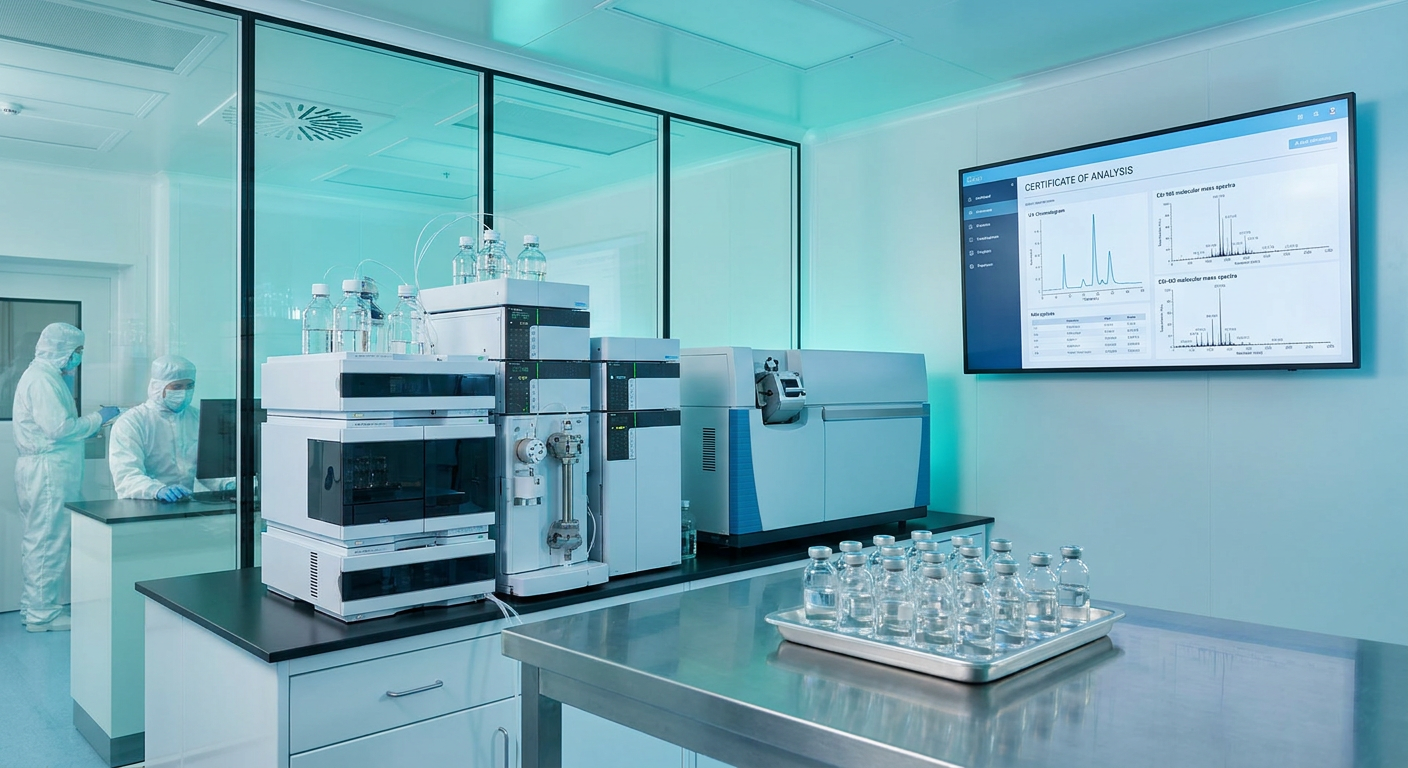
Quá trình đông khô và đóng gói đại diện cho các điểm tiếp xúc quan trọng nơi các peptide vô trùng có thể hấp thụ độ ẩm môi trường hoặc các chất gây ô nhiễm vi khuẩn. Các nhà cung cấp thay thế phải chứng minh rằng sự tổng hợp, thanh lọc, và đổ đầy lọ diễn ra trong điều kiện phòng sạch được ghi lại.
- Lớp học 100 (ISO 5) Tiêu chuẩn: Bao bì vô trùng yêu cầu xử lý trong Lớp 100 phòng sạch siêu vô trùng, được duy trì với luồng không khí tầng HEPA, áp lực dương liên tục, và điều chỉnh nhiệt độ/độ ẩm tự động.
- hạt & Kiểm soát vi khuẩn: Hoạt động trong phạm vi được kiểm toán Lớp học 100 thiết bị phòng sạch siêu vô trùng đảm bảo rằng các hạt trong không khí xung quanh (≥0,5 µm) vẫn ở bên dưới 3,520 hạt trên mét khối, ngăn chặn sự xâm nhập của bào tử nấm hoặc vi khuẩn trong quá trình đóng nắp lọ cuối cùng.
Xét nghiệm nội độc tố vi khuẩn (Xét nghiệm LAL)
Nội độc tố vi khuẩn (lipopolysacarit, LPS) được giải phóng từ màng ngoài của vi khuẩn gram âm trong quá trình lên men vi khuẩn hoặc rửa bằng nước bị ô nhiễm gây ra các đợt viêm nhiễm nghiêm trọng trong hệ thống sinh học.
- Yêu cầu xét nghiệm LAL: Mỗi lô dùng cho nuôi cấy tế bào hoặc nghiên cứu trên động vật đều phải trải qua quá trình Lysate Limulus Amebocyte định lượng (LAL) thử nghiệm.
- Giới hạn chấp nhận: Ngưỡng nội độc tố đối với vật liệu cấp nghiên cứu tiêu chuẩn không được vượt quá 1.0 EU/mg. Đối với việc tiêm truyền quan trọng hoặc nghiên cứu tế bào miễn dịch, chọn lô được chứng nhận bằng hoặc thấp hơn 0.1 EU/mg.
Chìa khóa mang đi: Độ tinh khiết HPLC cao (>98%) không đảm bảo mức độ nội độc tố thấp. Nội độc tố là các đại phân tử không hấp thụ tia cực tím, không đăng ký trên dấu vết UV 214nm RP-HPLC tiêu chuẩn. Luôn yêu cầu kết quả kiểm tra LAL rõ ràng trên CoA.
thuốc 4: Sự ổn định, Động học lưu trữ, và các biện pháp bảo vệ theo quy định/IP
Nhà cung cấp đáng tin cậy cung cấp các quy trình ổn định đã được xác thực và hoạt động theo hệ thống quản lý chất lượng mạnh mẽ để bảo vệ tài sản trí tuệ của bạn.
Hồ sơ ổn định & Xử lý giao thức
Hiểu được động học phân hủy BPC-157 đảm bảo thuốc thử giữ được toàn bộ hiệu lực trong suốt các nghiên cứu dài hạn:
- Lưu trữ đông khô: Desiccated lyophilized powder stored at -20°C to -80°C protected from light How To Filter Peptides Manufacturer remains stable for at least 24 tháng. Tránh chu kỳ đông lạnh thường xuyên của bột khô trước khi pha.
- Động học của dung dịch hoàn nguyên: Sau khi hòa tan trong vô trùng, nước kìm khuẩn đã khử oxy hoặc nước muối đệm phốt phát (PBS, độ pH 7.4), BPC-157 dạng nước vẫn ổn định ở 4°C trong 14 ĐẾN 28 ngày.
- Vector phân hủy hóa học: BPC-157 chứa Aspartate-Aspartate (Asp-Asp) và họa tiết Proline-Rich. Tiếp xúc với nhiệt độ cao (>25°C), pH kiềm (>8.0), hoặc môi trường oxy hóa tăng tốc các con đường suy thoái cụ thể:
- Khử amit: Sự hình thành Isoaspartate tại các địa điểm Asp-Asp, thay đổi thời gian lưu trên HPLC.
- Đồng phân hóa proline: Sự lật hình dạng cis-trans làm thay đổi động học liên kết với thụ thể đích.
- Tổng hợp: Liên kết kỵ nước tạo thành các oligome không hòa tan dưới cường độ ion cao.
Quản lý quy định & Các biện pháp bảo vệ sở hữu trí tuệ
Khi đủ điều kiện cho một nhà cung cấp thay thế, kiểm tra hệ thống chất lượng và các biện pháp bảo vệ pháp lý của họ:
- peptit 2 Kiểm định chất lượng: Ưu tiên nhà sản xuất hoạt động theo ISO 9001:2015 hệ thống quản lý chất lượng hoặc ISO/IEC 17025 phòng thí nghiệm phân tích được công nhận.
- Truy xuất nguồn gốc hàng loạt: Nhà sản xuất phải duy trì nhật ký chuỗi hành trình nguyên liệu thô hoàn chỉnh, theo dõi lô nhựa, và giấy chứng nhận độ tinh khiết dung môi.
- Thông báo kiểm soát thay đổi: Nhà cung cấp phải đồng ý với Thông báo kiểm soát thay đổi chính thức (CCN) trước khi thay đổi lộ trình tổng hợp, phương tiện thanh lọc, hoặc địa điểm cơ sở sản xuất.
- Bảo vệ sở hữu trí tuệ: Đảm bảo nhà cung cấp cung cấp các Thỏa thuận không tiết lộ đã ký (NDA) và các Thỏa thuận chuyển giao vật chất rõ ràng (MTA) bảo vệ các sửa đổi trình tự độc quyền và dữ liệu nghiên cứu. Như đã nhấn mạnh ở Liều lượngCalc 2026 Tiêu chuẩn kiểm tra chất lượng peptide, làm việc với các đối tác cung cấp dịch vụ CRO peptide chuyên dụng đảm bảo quyền sở hữu IP minh bạch và tuân thủ quy định cho các chương trình tổng hợp tùy chỉnh.
Danh sách kiểm tra đánh giá nhà cung cấp phòng thí nghiệm thực tế
Sử dụng danh sách kiểm tra đánh giá nhị phân này trong quá trình kiểm tra nhà cung cấp kỹ thuật. Mọi nhà cung cấp ứng viên phải đáp ứng hoặc vượt quá tất cả các tiêu chí chấp nhận bắt buộc trước khi được phê duyệt mua sắm.
<Environmental Audit Bán buôn tổng hợp peptide pha rắn Log / Certp>Nhà cung cấp peptide 3. Chế tạo
| Danh mục kiểm toán | Tiêu chí đánh giá | Thông số chấp nhận | Phương pháp xác minh | Trạng thái | ||||
|---|---|---|---|---|---|---|---|---|
| 1. Kiểm soát chất lượng phân tích | Độ tinh khiết của khu vực RP-HPLC | ≥98,0% diện tích tích hợp đỉnh chính | tia cực tím 214nm / Sắc ký cột C18 | [ ] Vượt qua / Thất bại peptit 1 | ||||
| 1. Kiểm soát chất lượng phân tích | Xác nhận khối lượng ESI-MS | [M+H]⁺ = 1420.55 ±0,01 Da (Lỗi khối lượng 10 ppm) | Phổ khối có độ phân giải cao | [ ] Vượt qua / Thất bại | ||||
| 1. Kiểm soát chất lượng phân tích | Đối xứng sắc ký | Resolution Factor R⛛ ≥1.5; Tailing Factor 0.8–1.2 | Phân tích hình dạng đỉnh | Đã báo cáo rõ ràng Peptiders Manufacturer (Thông thường là 70%–85%)
olspan=”1″ rowspan=”1″> 2. Phép cân bằng hóa học |
Hàm lượng peptide ròng (NPC) | Đã báo cáo rõ ràng (Thông thường là 70%–85%) | Phân tích axit amin (AAA) hoặc N% | [ ] Vượt qua / Thất bại |
| 2. Phép cân bằng hóa học | Độ ẩm | Chuẩn độ Karl Fischer ≤8,0% w/w | Báo cáo phân tích KF | [ ] Vượt qua / Thất bại | ||||
| 2. Phép cân bằng hóa học | Nhận dạng phản ion | Tiết lộ (TFA, Acetate, hoặc cơ sở miễn phí); TFA dư <1.0% để xét nghiệm tế bào | Sắc ký ion | [ ] Vượt qua / Thất bại | Môi trường phòng sạch | Lớp học 100 (ISO 5) môi trường vô trùng | Nhật ký kiểm toán môi trường / Chứng chỉ | [ ] Vượt qua / Thất bại |
| 3. Chế tạo | Giới hạn nội độc tố | Xét nghiệm LAL 1,0 EU/mg (0,1 EU/mg đối với nghiên cứu trên động vật) | Chứng chỉ kiểm tra LAL | [ ] Vượt qua / Thất bại | ||||
| 4. Tính ổn định/IP | Giao thức lưu trữ tài liệu | Xác thực đông khô (-20°C) và giải pháp (4°C) dữ liệu | Tóm tắt nghiên cứu độ ổn định | [ ] Vượt qua / Thất bại | ||||
| 4. Tính ổn định/IP | QA & Truy xuất nguồn gốc | Nhãn lọ phù hợp với CoA dành riêng cho từng lô; ISO 9001/17025 | Dữ liệu thô & Đăng xuất QA | [ ] Vượt qua / Thất bại |
Quy trình quyết định: Tiếp nhận và kiểm tra lô BPC-157 thay thế
Thực hiện theo giao thức được tiêu chuẩn hóa này khi nhận lô hàng từ nhà cung cấp peptide mới gia nhập:
- Bước chân 1: Thuộc vật chất & Kiểm tra bao bì → Kiểm tra niêm phong lọ, tính đồng nhất của bánh đông khô, và xác minh số lô khớp với giấy tờ vận chuyển và CoA.
- Bước chân 2: Kiểm tra chứng chỉ phân tích → Xác minh sự hiện diện của sắc ký đồ RP-HPLC UV 214nm hoàn chỉnh (độ tinh khiết ≥98,0%) và phổ ESI-MS (m/z 1420.55 M+H⁺, sai số khối lượng 10 ppm). Xác nhận kết quả nội độc tố LAL (1,0 EU/mg).
- Bước chân 3: Tính toán cân bằng hóa học → Kiểm tra hàm lượng peptide ròng được báo cáo (NPC %). Tính khối lượng thực cần thiết cho dung dịch mol mục tiêu:
Tổng trọng lượng bắt buộc = Khối lượng peptide nguyên chất mong muốn/Số thập phân NPC
- Bước chân 4: Hoàn nguyên thử nghiệm & Kiểm tra từ chối → Hoàn nguyên trong dung môi vô trùng. Nếu dung dịch có độ đục, hạt dai dẳng, hoặc độ lệch pH (<5.0 hoặc >8.0), ngừng sử dụng ngay lập tức và đưa ra Báo cáo lỗi chất lượng của nhà cung cấp chính thức.
Câu hỏi thường gặp (Câu hỏi thường gặp)
Độ tinh khiết HPLC tối thiểu có thể chấp nhận được đối với BPC-157 trong các xét nghiệm sinh học nghiên cứu là bao nhiêu?
Đối với nghiên cứu sinh hóa định lượng, xét nghiệm liên kết với thụ thể đích, và mô hình nuôi cấy tế bào, độ tinh khiết tối thiểu chấp nhận được là 98.0% được xác định bằng RP-HPLC với phát hiện UV ở 214 bước sóng. Mức độ tinh khiết dưới đây 98% chứa các peptide bị cắt ngắn tổng hợp hoặc các chuỗi thất bại có thể ngăn chặn các thụ thể mục tiêu một cách cạnh tranh, dẫn đến kết quả thí nghiệm thất thường hoặc không thể thực hiện được.
Tại sao tổng trọng lượng lọ khác với hàm lượng peptide BPC-157 ròng?
Bột peptide đông khô chứa các thành phần không phải peptide, bao gồm cả các ion phản liên kết (such as TFA or acetate) accumulated during synthesis and residual moisture absorbed during handling. Hàm lượng peptide ròng (NPC) reflects the actual percentage of active peptide mass within the total powder weight (tiêu biểu 70% ĐẾN 85%). Always adjust concentration calculations using the lot-specific NPC value reported on the CoA.
TFA dư ảnh hưởng đến thí nghiệm nuôi cấy tế bào như thế nào?
Axit trifloaxetic (TFA) is a strong organic acid used during solid-phase peptide synthesis. Residual TFA counter-ions present in unexchanged peptide preparations can lower culture media pH and exert direct cytotoxic effects on cells at concentrations above 0.1 mM. For cell culture, stem cell, or organoid studies, specify acetate-exchanged or salt-free BPC-157 with certified residual TFA levels below 1.0%.
Tài liệu nào cho thấy nhà cung cấp có tính nhất quán mạnh mẽ theo từng đợt?
Look for suppliers operating under ISO 9001:2015 quality management standards or ISO/IEC 17025 laboratory accreditations. Các nhà sản xuất có uy tín cung cấp sắc ký lớp phủ theo từng lô lịch sử, duy trì truy xuất nguồn gốc nguyên liệu đầy đủ, và đưa ra Thông báo kiểm soát thay đổi chính thức trước khi thay đổi quy trình tổng hợp hoặc thông số đóng gói.
Tăng cường các quy trình chất lượng thuốc thử trong phòng thí nghiệm
Việc điều hướng sự gián đoạn của chuỗi cung ứng sau khi nhà cung cấp lớn đóng cửa đòi hỏi phải có cam kết kiên định về tính nghiêm ngặt trong phân tích. Bằng cách thực hiện một quy định bắt buộc, danh sách kiểm tra đánh giá đa trụ cột—ưu tiên độ tinh khiết RP-HPLC, nhận dạng ESI-MS độ phân giải cao, tính toán hàm lượng peptide ròng rõ ràng, Lớp học 100 xuất xứ phòng sạch, và thử nghiệm nội độc tố LAL—các phòng thí nghiệm nghiên cứu có thể đủ điều kiện thành công cho các nhà cung cấp BPC-157 thay thế trong khi vẫn duy trì tính toàn vẹn dữ liệu và khả năng tái tạo thử nghiệm.
Dành cho các tổ chức nghiên cứu đang tìm kiếm peptide tùy chỉnh có độ tinh khiết cao, tài liệu phân tích nghiêm ngặt, và lớp 100 sản xuất phòng sạch, hợp tác với nền tảng tổng hợp đã được kiểm toán. Khám phá giải pháp tổng hợp peptide tùy chỉnh hoặc tham khảo ý kiến của các chuyên gia kỹ thuật để thiết lập chuỗi cung ứng đã được xác minh cho chương trình nghiên cứu của bạn.
Về tác giả & Đánh giá kỹ thuật
Được viết bởi Khoa học & Nhóm đảm bảo chất lượng tại MOL Changes
MOL Changes là một R chuyên biệt&Tổ chức D tích hợp chuyên môn hóa học hữu cơ và sinh học phân tử. Lớp được chứng nhận vận hành 100 môi trường phòng sạch siêu vô trùng, đội ngũ các nhà hóa học tổng hợp peptide và chuyên gia phân tích của chúng tôi thiết kế các giao thức trình tự tùy chỉnh, quản lý quy trình lên men pha rắn và vi sinh vật, và thực hiện HPLC toàn diện, bệnh đa xơ cứng, và kiểm soát chất lượng nội độc tố cho các phòng thí nghiệm nghiên cứu công nghiệp và hàn lâm trên toàn thế giới.