Чӣ 2026 U.S. Peptide Reclassification Actually Changed
The February 2026 announcement that 14 peptides would be reclassified was not a rule. It was an HHS Secretary statement made on a podcast on February 27, 2026, and as of March 7, 2026 no Federal Register notice had issued and no updated list had been published (Peptide Journal, March 2026).
Twelve of those substances were removed from Category 2 on April 15, 2026, effective about a week later, but removal alone authorized nothing: it did not place them on the 503A bulks list or into Category 1, and compounding on that basis carried regulatory risk (Orrick, April 2026).

In July 2026, an FDA advisory committee recommended 6 аз 7 nominated peptides for the 503A bulks list, with vote counts ranging from 8-6-1 ба 6-7-1 (LumaLex, July 2026). That recommendation is advisory only: FDA must still complete notice-and-comment rulemaking and may accept, modify or decline it. FDA staff maintained none of the seven were well-characterized.
An unsettled rulebook raises the value of supplier-side authentication rather than lowering it.
Why Peptide Supplier Authentication Starts With Identity, Not Purity
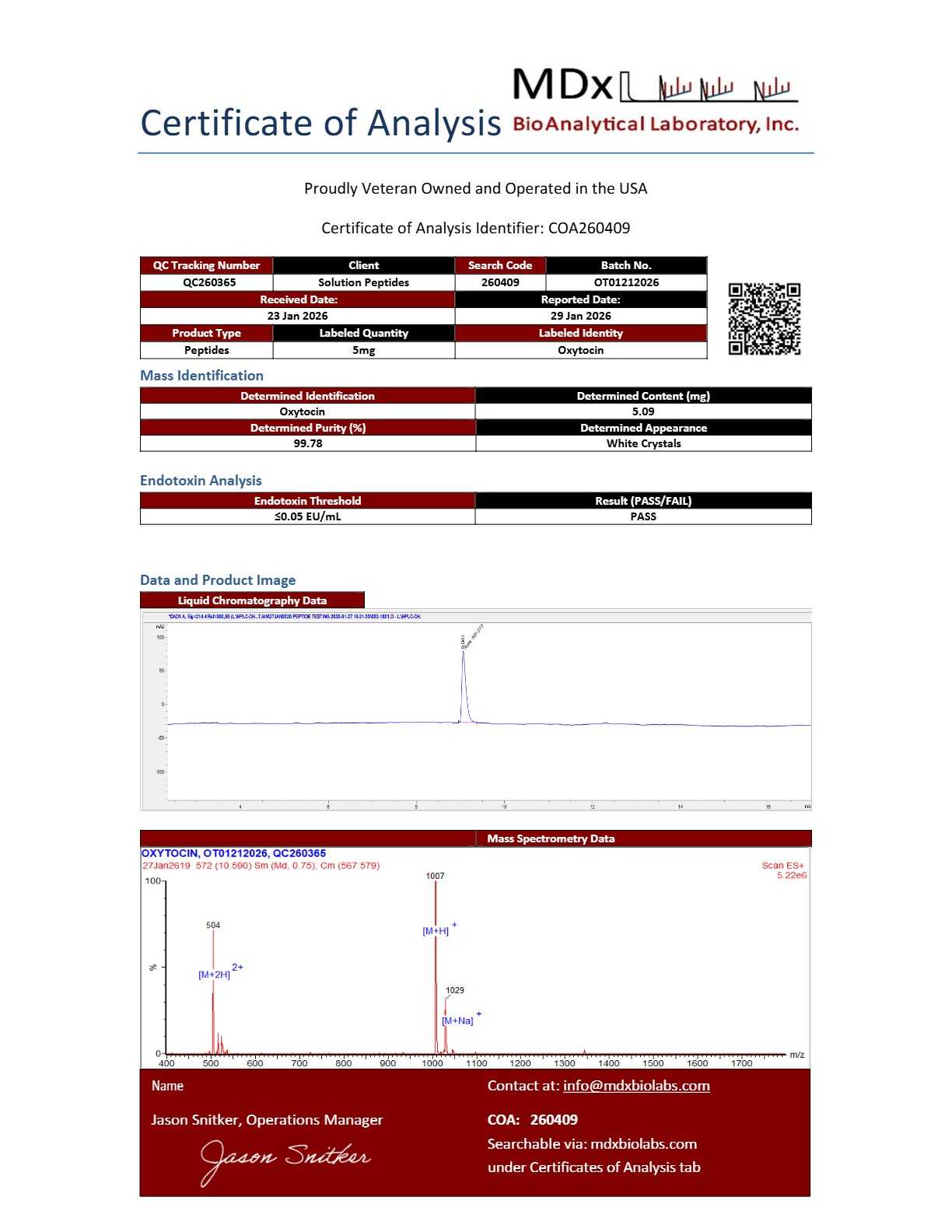
That unsettled rulebook is exactly why the first check is identity, not purity. Peptide identity confirmation comes before any purity figure, because the two measurements answer different questions. HPLC purity is the ratio of main-peak area to total integrated peak area, and that calculation is blind to water and salts: a sample can read 99% pure by area and still be the wrong compound (Peptide Trust, “Net Peptide Content vs Purity”, 2026-07-31). Purity and content answer two different questions, and neither one is “is this the peptide I ordered?»
Mass matching against the theoretical mass does answer it. American Peptides describes LC-MS identity confirmation as comparing the observed mass to the theoretical mass calculated from the intended amino-acid sequence, with MS/MS adding the b-ion and y-ion ladder that supports sequence order rather than total mass alone (2026-06-06). The same source shows why the mass basis must be stated: a peptide with formula C65H101N17O18S has a monoisotopic mass of 1455.71 Da against an average mass of 1456.66 Da, roughly 1 Da apart, so an unqualified “match” is ambiguous.
Key Takeaway: A purity percentage tells you how much of the peak is one thing. Only a mass match against your stated sequence tells you which thing it is.
Our finding: The 98%-purity figure that looks like proof of identity is the single most common misread in supplier evaluation. A high area-% and a materially lower net peptide content can both be honestly reported for the same batch, which is why a low-content lot can carry a headline purity number that says nothing about how much peptide the vial holds.
The failure mode is quiet. A wrong-sequence or truncated peptide can pass an area-% check and even share a retention time with the expected compound, since unrelated molecules can co-elute. Mass offsets name the problem instead: +16 Da points to oxidation, -18 Da to dehydration, and a missing amino acid to truncation (American Peptides, 2026-06-06). Ask for the observed mass, the theoretical mass, and the basis used for both.
Reading Purity Data Without Being Misled by the Headline Number
Once identity is settled, the purity figure can be read for what it actually measures. Peptide purity data answers a narrower question than most buyers assume. A purity figure describes the share of the detected signal that belongs to the target sequence. It does not describe how much peptide sits in the vial.
Typical research-grade specifications sit at ≥95% by HPLC, with high-purity grades at ≥98% (ChemVerify’s peptide purity testing guide, March 2026). Values above 99% deserve scrutiny for sequences longer than 30 residues unless high-resolution chromatographic data accompanies them. The same guide notes that purity is commonly reported by UV absorbance around 214–220 nm, and that the wavelength matters because impurities respond differently at different wavelengths.
Then comes the part the headline hides. Lyophilized peptides typically contain 60–85% net peptide content (ChemVerify, March 2026). The rest is counter-ions, residual water and trace solvent. А 10 mg weigh-out at 70% content yields roughly 7 mg of peptide, which explains the shortfall many labs hit when they calculate an assay from the balance reading alone.
Counter-ion removal has limits. А 2020 review of counter-ion behavior in peptides found that TFA exchange reaches up to 98% efficacy after repeated cycles but does not completely remove TFA anions (PMC 7761850, December 2020). Those anions can bond directly to basic residues or sit adsorbed in the lyophilizate.
Our finding: А 10 mg weigh-out at 70% net peptide content delivers roughly 7 mg of peptide. Budget assays against content, not against the vial label.
Documentation: What a Lot-Specific COA Must Contain
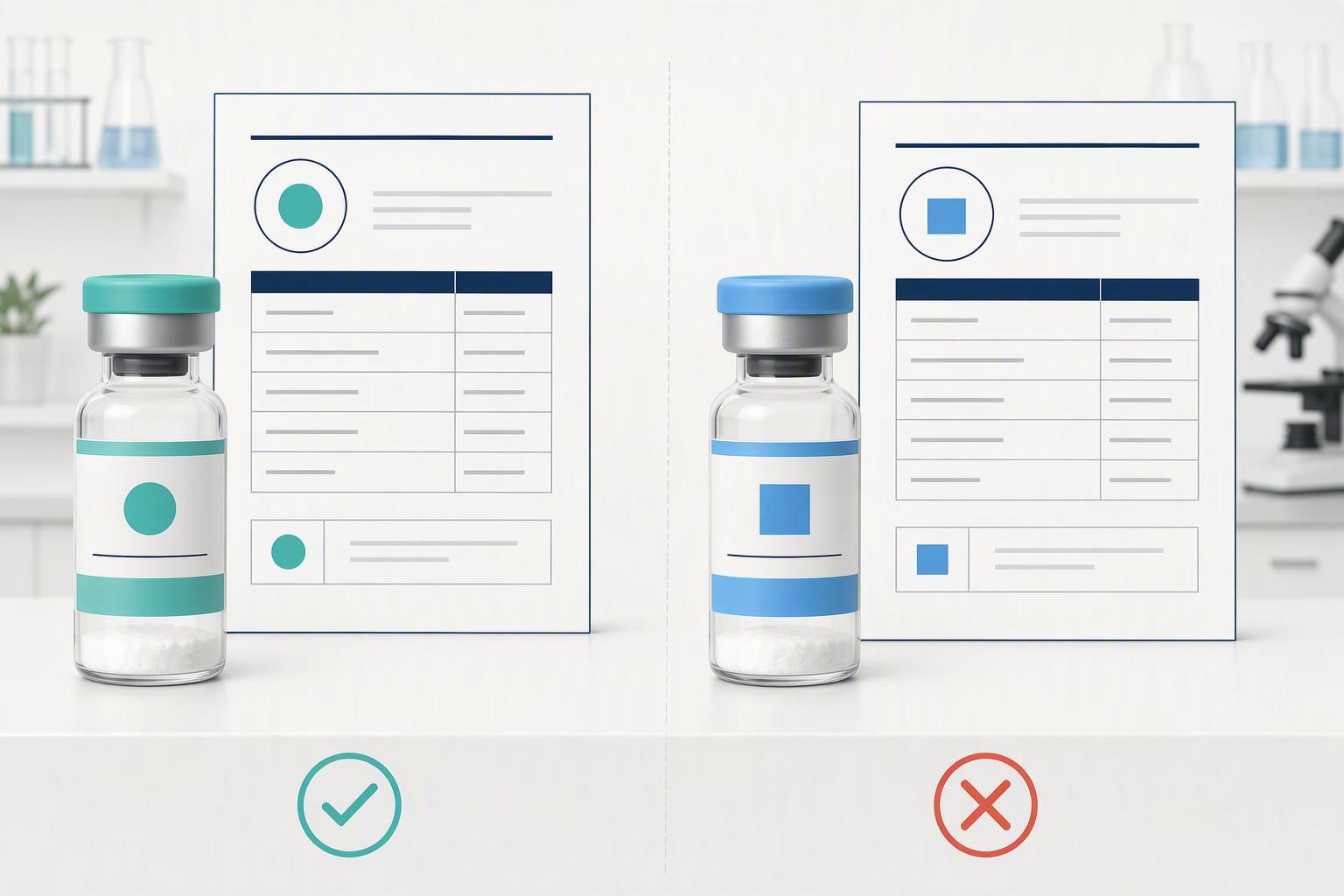
With identity and content understood, the next safeguard is the paperwork that ties both to your vial. A peptide certificate of analysis is only useful if it belongs to the vial in your hand. The batch or lot number printed on the COA must match the batch or lot number on the vial label, and the document must be issued for that specific lot rather than for the product line in general. Finnrick’s guide to reading a certificate of analysis states the batch ID rule plainly: no batch ID on a sample means no valid test. The same guide sets the minimum panel a peptide COA should carry, which is identity confirmation, покӣ, and potency or quantity.
⚠️ Warning: These failure modes show up as ordinary conditions, not dramatic ones. A generic COA arrives instead of a lot-specific one. The lot number on the COA does not match the vial label. Batch documents are reused across shipments. The testing laboratory is never named. Raw data is not available on request.
A COA is a supplier-issued document, and a supplier-issued document is not independent verification. Where a supplier claims independent testing, the claim is checkable only if it names the third-party laboratory, the test date, the analytical method, and whether the underlying raw data can be accessed. Without those four details, the document confirms that testing happened somewhere, not that it happened to your lot.
Chain of Custody: The Receipt-to-Use Record Set
Spps Resin Documentation covers what the supplier did before shipping; custody covers everything after. Peptide chain of custody is the record set your laboratory creates between the moment a vial arrives and the moment its contents are consumed, and it is the only part of supplier authentication you control entirely. A supplier can hand you a clean certificate and still leave you unable to show how the material was handled afterward.
The record set has five linked entries. The receiving log captures receipt date, carrier, lot number, condition on arrival, and the name of the person who opened the package. The storage record names the location (freezer, shelf, box position) and the target temperature. The access log records who withdrew the vial and when. The reconstitution entry holds the diluent, volume, date, and the resulting concentration. The aliquoting and distribution record tracks each daughter vial to its user or downstream experiment.
Temperature and freeze-thaw records belong alongside the batch file, not in a separate notebook, because they are what turn a set of entries into an auditable history. Lot-number traceability is the thread: if the lot number on the receiving log does not match the lot number on the certificate and the vial label, the record set breaks at its first link and nothing downstream can be reconstructed.
Key Takeaway: Custody records are what let a laboratory demonstrate that a research material was handled as a research material, from receipt through use, without relying on the supplier’s account of what happened before it shipped.
Separating Research Materials From Therapeutic Claims

The custody record is yours to keep; the last check is about the supplier’s own words. The fastest supplier-language test is this: a page that promises an outcome has told you about its claim discipline, not about its chemistry. Legitimate research suppliers keep their language on compound identity, purity documentation and laboratory procurement. Therapeutic, diagnostic, clinical and personal-use claims sit outside that vocabulary, and their presence is a signal about how the supplier handles the boundary, not proof of what is in the vial.
Peptide 1 Apply the test to the product page, the certificate of analysis and the order confirmation. If any of the three describes a physiological effect, a dosing protocol or a benefit to a person, the supplier has moved from supplying laboratories to addressing consumers. That shift usually shows up before the documentation gaps do, which makes it a useful early filter when you are comparing vendors.
Pro Tip: The language test is a claim-discipline check, not a chemistry check. A supplier page that promises an outcome has told you something about its claim discipline, not about its chemistry.
The materials discussed in this article are for laboratory research use only and are not for human or veterinary use. Nothing Peptide 2 here is a therapeutic, diagnostic or clinical claim, and nothing here should be read as guidance for personal use.
Common Mistakes to Avoid
Most peptide supplier authentication failures trace back to reading one number instead of the whole record. Each mistake below is common because it feels like diligence, and each has a specific fix.
Treating a purity percentage as proof of identity. A purity figure says how much of the sample is the target peak, not that the peak is the right molecule. Fix: require a mass spectrometry result that matches the theoretical mass of the stated sequence before you accept any purity value.
Accepting a generic or reused COA. Vendors sometimes supply a template certificate covering a product line rather than the lot in hand. Fix: check that the lot number on the certificate matches the lot number on the vial label, and reject the shipment if it does not. Peptide 2
Ignoring net peptide content when calculating a weigh-out. Purity and content are separate measurements, so a high-purity, low-content lot delivers less peptide than the mass suggests. Fix: calculate from the content or assay value, not the purity percentage.
Keeping no custody record. Without a receipt-to-use trail, you cannot show what arrived, when, or how it was stored. Fix: log receipt date, lot, condition on arrival, and storage location at the point of intake.
Letting therapeutic-adjacent marketing language pass unchallenged. Claims that imply human use shift a research material into a regulatory category it does not belong in. Fix: treat that language as a documentation defect and ask the supplier to correct it in writing.
⚠️ Warning: The most consequential mistake is a high purity number on a low-content lot. Both figures can be accurate Best Peptide Synthesis Companies and the pairing still misleads anyone who reads only the purity line, because the weigh-out they calculate will be short.
Results: What a Verified Supplier Relationship Looks Like
A verified supplier relationship is not a feeling about a vendor. It is a batch file you can hand to a colleague and have them reach the same conclusion. Peptide supplier authentication ends in a folder, not a verdict. Chemical Peptide Synthesis
That folder carries six things. A lot-specific COA whose lot number matches the vial label. An identity result matched against theoretical mass, not just a pass mark. A purity figure sitting beside a net peptide content figure, so the two numbers can be read together. A named testing laboratory with a test date and the method used. A custody record running from receipt to use. And supplier language that stays on research use, in the marketing copy as well as the certificate.
The stretch goal is worth asking for. Where a supplier offers raw analytical data or independent third-party verification, request it. A supplier that can produce it is telling you something a clean PDF cannot.
Тағйироти MOL is a peptide synthesis and modification organization that operates Class 100 ultra-sterile cleanroom production, with QC including HPLC, MS and sterility testing, and supports mg-to-kg scale-up.
If you are comparing suppliers against this checklist, talk to an expert or compare capabilities directly. MOL Changes has a commercial interest in peptide quality standards, and this article is written so the same checks apply to any supplier, including this one.
Frequently Asked Questions
Can a peptide certificate of analysis substitute for independent testing?
Не. A COA is the supplier’s own record, and it cannot verify itself. The batch ID rule applies here: the document is only meaningful when its lot number matches the vial label and it reports the full panel for that specific lot, not a representative or historical result. Independent testing by a laboratory you selected is the only check that sits outside the supplier’s control. Treat the COA as the claim and third-party analysis as the confirmation.
What should I do when the lot number does not match the label?
Stop and do not use the material. A mismatch means you cannot tie the analytical results to the vial in your hand, which breaks the entire documentation chain regardless of how good the reported numbers look. Contact the supplier in writing, request the correct lot-specific COA, and keep the correspondence. If the supplier cannot produce a matching record, that is your answer about their documentation practice.
How do I compare a ≥95% grade against a ≥98% grade for a given assay?
Compare the grade against the method and the assay, not against the number alone. A ≥98% figure measured by one HPLC method is not automatically superior to a ≥95% figure measured by a stricter one, because purity percentage is method-dependent. Ask which method produced the value, request the chromatogram rather than the summary line, and match the grade to what your assay actually requires.
Can I check a supplier’s stated testing laboratory?
Yes, and you should. Ask for the laboratory’s name and confirm it is a real, independent facility with the capability to run the panel reported. A named laboratory you can contact is a verifiable claim; an unnamed “third-party lab” is not. If the supplier will not identify the laboratory, treat the testing claim as unverified.
Хулоса
The five safeguards form one repeatable workflow: confirm identity against the theoretical sequence, read purity alongside content and assay, require a lot-specific certificate of analysis, keep a receipt-to-use record set, and hold research materials separate from therapeutic claims. Run them in that order on any supplier, and the result is a supplier-agnostic verdict rather than a trust exercise.
That standard does not depend on where U.S. rules land. Reclassification would change the paperwork a supplier is expected to produce, not the underlying questions a buyer needs answered. Identity, мазмун, documentation, custody, and claim discipline stay the same checks whether the material sits in a research or a regulated category.
The next action is concrete. Build the batch file for the next lot you receive: пайдарпай, lot number, COA, analytical report, receipt, and storage record. Then run the five checks against it before the material enters use. Peptide supplier authentication becomes routine once the file exists and each lot is measured against it.