What Metal-Directed 2D Peptide Crystals Are
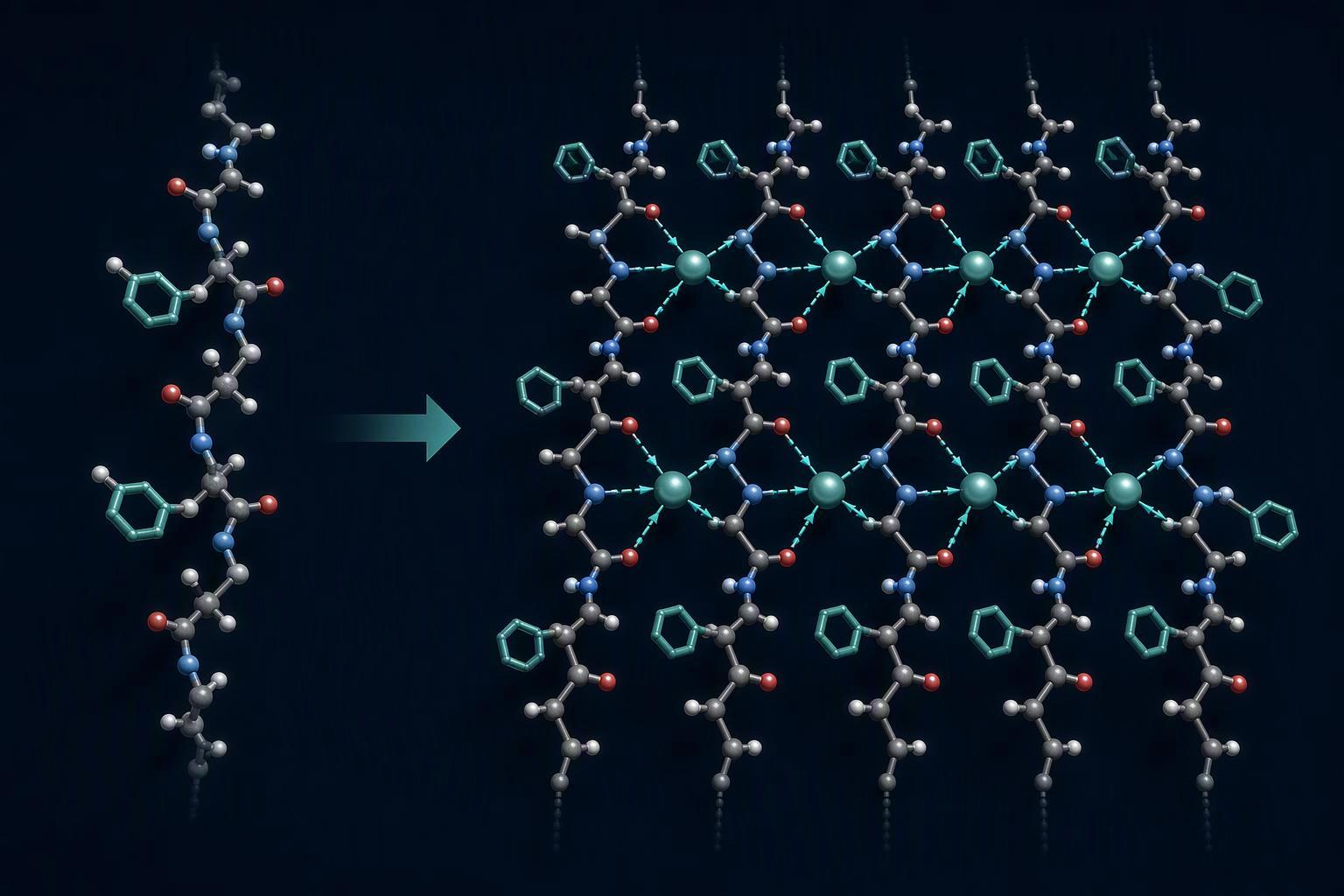
Metal-directed 2D peptide crystals are planar, crystalline lattices in which metal ions bridge peptide building blocks at symmetry-related positions, so coordination bonds rather than hydrogen bonds alone define the sheet. The peptides are typically short β-strand or β-hairpin segments engineered to present metal-binding residues on both faces of the strand. Histidine is the classic directing residue because its imidazole nitrogen binds a wide range of transition metals, while glutamate, aspartate, and cysteine are chosen to match a specific metal’s preferred geometry (coordination-chemistry literature on metal-ion geometry, 2025). Zn(II) favors tetrahedral Cys/His coordination, Cu(II) sits square-planar to distorted tetragonal, and Fe(III) prefers octahedral hard-oxygen donors from Asp or Glu. Getting that pairing right is what lets coordination propagate in two dimensions instead of collapsing into an amorphous aggregate.

The resulting sheets are thin. A research summary describing nanosheets a few nanometers thick reports free-standing, single-crystalline, atomically thin peptide nanosheets, though that thickness figure comes from a single source and has not been independently replicated across peptide sequences (2026).
Two distinctions matter for anyone scoping a program. These materials are not 3D coordination polymers: the lattice is confined to a plane, and the metal nodes sit within that plane rather than cross-linking stacked layers. They are also not bulk hydrogels. A hydrogel is a disordered, water-swollen network; a 2D peptide crystal has periodic order you can measure by diffraction.

Why Metal-Directed Peptide Lattices Matter
The reason metal-directed 2D peptide crystals deserve attention is programmability: the peptide sequence encodes both the lattice geometry and which metal coordinates into it. No conventional 2D material, from graphene oxide to layered perovskites, offers that single-molecule control over pore size and chemistry at once. The payoff is measurable. In work published in Nature Chemistry in 2026, metal-directed 2D peptide crystals reached an enantioselectivity factor of up to 20.9, and the same nanosheets were described as free-standing, single-crystalline, and atomically thin (Nat. Chem. 2026, via PubMed). Those numbers come from one upstream source, and no independent corroboration was found in this round.
The design is also verifiable rather than speculative, because assembled β-sheet peptides leave a standard structural fingerprint. In the fiber X-ray diffraction of the FEFEFKFK family, cross-β strand spacing sits near 4.64 Å, the standard cross-β packing signature used to confirm β-sheet packing in assembled peptide materials (PMC12548000, 2025). A sequence that fails to produce that spacing has not assembled as intended, and you can see it before committing to scale-up.
Ignoring that evidence chain has a specific cost. A nominally correct sequence can still yield a disordered material, and without the diffraction signature and a metal-loading measurement you have no way to tell whether the sequence, the metal, or the assembly conditions failed.
Peptide Sequence Design for Metal Coordination
The sequence decides where coordination can happen; the metal decides what geometry that coordination adopts. Get the order wrong and no amount of metal loading will produce a lattice.
Design starts with placement, not identity. Binding residues (His, Glu, Asp, Cys) must sit at symmetry-related positions along the backbone so that coordination sites from adjacent molecules converge on a shared metal center. Randomly distributed donors chelate intramolecularly instead, and the assembly collapses into discrete complexes rather than an extended 2D sheet.
Scaffold choice follows from that constraint. β-strand peptides present donors on alternating faces and favor flat, extended lattices; β-hairpin scaffolds bring two strands into proximity and suit metals needing donors from more than one direction. Cys is the strongest binder but oxidizes readily, so it works best under inert handling. His offers moderate affinity with pH-tunable coordination. Glu and Asp pair well with hard, high-valent metals.
|
Metal |
Preferred donors |
Typical geometry |
Analytical signature |
|---|---|---|---|
|
Zn(II) |
Cys, His |
Tetrahedral |
No d-d transitions; XAS and NMR define the site |
|
Cu(II) |
His, Cys |
Square-planar to distorted tetragonal |
Strong visible absorbance; EPR-active |
|
Ni(II) |
His |
Octahedral |
Paramagnetic; visible d-d bands |
|
Pd(II) |
Cys, His |
Peptide Resin Square-planar |
Diamagnetic; distinct NMR shifts |
|
Fe(III) |
Glu, Asp (hard O donors) |
Octahedral |
Charge-transfer bands; EPR-active |
Warning: This table synthesizes review-level coordination-chemistry literature on metal-ion geometry rather than a single verified source page. Confirm donor preferences and geometry for your specific peptide empirically before committing to a design.
The recurring pitfall is designing around the metal already on the shelf instead of the geometry the lattice requires. Start from the coordination geometry, then choose the metal that delivers it.
Purification and Metal Loading Before Assembly

Confirm identity and purity on the exact lot you will assemble, not on a representative batch. Impurities in metal-directed peptide systems are not inert: they are assembly-competent. A 2025 study showing that deletion and epimerization impurities still self-assemble measured the parent sequence FEFEFKFK at roughly 92% purdeb, the truncated EFEFKFK impurity at 93%, and the epimerized FEFEfKFK at 97%, and each species retained the ability to assemble. A single epimerization site still gelled above 8 mg/mL. Purity by HPLC therefore tells you what fraction of the lot is your intended sequence, not whether the rest is harmless.
Counterions are the second variable. A 2025 consensus study on measuring and exchanging the TFA counterion found 0.333 ± 0.008 mg of trifluoroacetate per mg of peptide salt, with measured TFA content in peptide salts reaching 35% by weight. Residual TFA persists as a bound counterion through lyophilization and can interfere with metal coordination, so exchange it before loading.
Practical checks for this step:
-
Preparative HPLC purity plus LC-MS/MS identity confirmation on the assembly lot
-
Batch-specific CoA as the release record
-
Anion exchange to strip residual TFA
-
Metal-to-peptide stoichiometry control, titrated against your own binding data
No verified numeric stoichiometry ratio was obtained in this round, and published figures vary by peptide and metal, so establish yours empirically.
Custom synthesis with HPLC and MS verification and Class 100 handling supports this step.
Structural Characterization of Peptide Assemblies
No single technique proves a metal-directed peptide lattice formed. Each instrument answers one question, and a claim of lattice order needs several of them to agree. The mapping below is a cross-source synthesis drawn from method literature on peptide-assembly characterization (Springer, Peptide Self-Assembly Characterization Methods, n.d.); no single dated source states it as a table.
|
Technique |
Gweithgynhyrchu Peptid Question it answers |
What a passing result looks like |
|---|---|---|
|
PXRD |
Solid-state packing, crystallinity, d-spacings |
Sharp reflections indexing to a lattice, not a broad amorphous halo |
|
SAXS / Peptide Synthesis Ribosome WAXS |
Solution and hydrated size, shape, hierarchical organization, lattice periodicities |
Periodicity peaks consistent with the proposed unit cell |
|
AFM / TEM |
Real-space morphology |
Uniform objects of the expected dimensions |
|
CD |
Secondary structure |
A β-sheet or helical signature matching the design |
|
FTIR |
Amide I / II hydrogen-bonding Gwasanaeth Synthesis Peptid motifs |
Band positions consistent with the intended H-bonding pattern |
|
XPS |
Surface elemental and chemical state |
The expected metal oxidation state at the surface |
|
ICP-MS |
Bulk elemental composition and metal loading |
Metal content matching the target stoichiometry |
Reading a lattice from a scattering pattern is concrete work. In a WAXS study that resolves the rectangular peptide lattice of Aβ(16-22) nanotubes, a reflection at 13.1 nm⁻¹ corresponds to a 0.479 nm spacing assigned as the orthogonal β-strand repeat, yr (1,0) reflection, while 6.0 nm⁻¹ corresponds to 1.046 nm assigned as antiparallel β-sheet stacking, yr (0,1) reflection (Frontiers in Bioengineering and Biotechnology, 2021). Two peaks, two lattice directions.
Tecawe Allweddol: No single technique is sufficient. Morphology images show shape, not lattice order, so never report an AFM or TEM image as proof that a crystal lattice formed. Protein Peptide Synthesis
Evidence That the Lattice Holds: Stability and Durability Testing
Peptide material stability testing only means something once you name three things: the trigger, the timescale, and the measured endpoint. “Stable” on its own is not a result.
A durability claim built on the wrong endpoint fails fast. A 2025 study showing that deletion and epimerization impurities still self-assemble found that EFEFKFK, missing one residue, gelled above 12 mg/mL with a storage modulus G′ = 2.8×10⁵ Pa at 20 mg/mL, against G′ = 3.5×10⁵ Pa for the parent FEFEFKFK. The same work reported that a single D-Phe epimerization at the central hydrophobic position still produced a gel above 8 mg/mL at pH 7.4. Impurities of that kind are assembly-competent, not inert, so a purity specification alone will not tell you whether the lattice you designed is the lattice you got. Synthesis Cyfunol
Triggered disassembly gives the cleaner endpoint. Native-MS monitoring of peptide coacervate disassembly tracked His/Tyr-rich coacervates under 50 mM DTT and saw a complete shift from intact to cleaved peptide over 70 min, with cargo release detected after 150 min and no dissolution at 60 min without the trigger.
Limitation: The impurity-competence and disassembly figures come from hydrogel and coacervate systems, not from metal-coordinated lattices. Applying them to a metal-directed 2D peptide crystal is a hypothesis to test, not an established result.
Supplier Documentation and Lot-Release Evidence
A lattice result is only reproducible if the input lot is characterized, so the documentation package belongs to the experimental method, not to procurement paperwork. The batch-specific Certificate of Analysis (CoA) is what lets a second lab reproduce your assembly, and each item on it rules out a specific failure mode.
HPLC purity and MS identity are the two entries that decide whether the sequence you designed is the sequence you assembled. A purity figure without a lot number and a method reference tells you nothing about the material in your freezer, and lot-to-lot consistency depends on the supplier repeating those measurements rather than reporting a single historical value.
Counterion content is the item most often missing, and it is the one that quietly changes downstream data. Residual TFA stays bound as a counterion to protonated Lys, Arg, His and the N-terminus; lyophilization removes free TFA only, so the anion persists unless it is actively exchanged, as reported in a 2025 consensus study on measuring and exchanging the TFA counterion. That matters because TFA perturbs bioassays from nanomolar levels, with 10 nM suppressing osteoblast and chondrocyte proliferation and 100 nM inhibiting 10% of osteoblast growth, while HCl at the same treatment did not, yn ol a counterion overview citing the Cornish cell-growth data. Request the counterion form in writing before biological assessment.
Sterility and endotoxin/LAL testing cover the contamination route that no spectroscopic method will catch. No verified primary pharmacopeial endotoxin limit or assembly-grade HPLC threshold was obtained for this guide, so treat any single numeric cutoff you are quoted as supplier-specific and ask for the method behind it.
MOL Changes runs Class 100 ultra-sterile peptide manufacturing with a 300+ functional-group modification portfolio and mg-to-kg scale-up, and its QC package covers HPLC, Llsgr, and sterility testing.
Common Failure Modes and How to Catch Them Early
Most failed metal-directed 2D peptide crystal programs fail at the input, not at the lattice. Four defects account for the majority of disappointing results, and each has a cheap early check that costs far less than a full characterization campaign.
Impurity-competent assembly is the first. A 2025 study found that deletion and epimerization impurities in synthetic peptides still self-assemble, so a lattice can form from material that is not the sequence you designed (Measuring and exchanging the TFA counterion in peptide self-assembly, 2025). Run HPLC purity and MS identity before assembly, not after, and treat any lot below your stated threshold as a different experiment.
Residual counterion is the second. The same 2025 consensus work on measuring and exchanging the TFA counterion shows that leftover trifluoroacetate redirects packing, which means two lots of identical sequence can give two different lattices. Exchange the counterion and confirm it analytically before you compare anything.
Stoichiometry drift is the third. Weigh metal and peptide independently, calculate the molar ratio, and record it per batch; a ratio that drifts between lots changes coordination number without changing any visible handling step.
Single-technique over-claiming is the fourth. One diffraction pattern or one microscopy image cannot establish a lattice. Pair at least two orthogonal methods before you call a structure confirmed.
Warning: This is a design-and-evidence framework. The mechanisms described are hypotheses paired with the evidence that would confirm them, and this article reports no new experimental data.
The supplier-evidence section covers the documentation half of this check.
Cwestiynau Cyffredin
What makes a peptide crystal “2D” rather than 3D?
A peptide crystal counts as 2D when growth is constrained to a single plane, producing a sheet whose thickness is one or a few molecular layers while its lateral dimensions extend into the micrometer range. Mae'r 2026 Nature Chemistry report describes free-standing single-crystalline peptide sheets, meaning the lattice holds without a substrate underneath it (single-source). Thickness, not lateral size, is the defining measurement.
Which metal should you choose first?
Start with the metal whose coordination geometry matches the binding motif you already designed, then confirm it by the analytical signature it produces. Metal choice is a design variable, not a default.
Do impurities really matter for assembly?
Yes. A 2025 study showing that deletion and epimerization impurities still self-assemble found that truncated sequences incorporate into the lattice rather than staying in solution, so purity specifications belong in the design brief, not only in release testing.
How many techniques are needed to confirm a lattice?
No fixed number. Method literature on peptide-assembly characterization treats confirmation as convergent evidence: no single technique establishes long-range order, metal coordination, and durability at once.
Can metal-directed 2D peptide crystals be made at scale?
Scale-up evidence remains limited, and no independent test data published after 2024 was found for kilogram-scale production of these lattices.
What does the 20.9 enantioselectivity figure establish?
It establishes enantioselectivity for one reported system, not a general performance benchmark for metal-directed 2D peptide crystals.
Casgliad
The sequence, the metal, the input lot, and the evidence chain are one coupled design problem, not four sequential tasks. Change the metal and the coordination geometry shifts; change the purification route and the residual counterion can alter how the lattice packs; change the supplier lot and the durability data you collected no longer describes the material in the vial. Treating metal-directed 2D peptide crystals as a single system is what makes the rest of the pipeline predictable.
The path runs from peptide sequence design for metal coordination, through purification and metal loading, into structural characterization of peptide assemblies, and finally into peptide material stability testing and the lot-release documentation that lets someone else reproduce your result. Each stage answers a question the next stage depends on, which is why gaps early are expensive later.
One caveat worth carrying forward: the headline performance figures circulating in this field currently trace back to a single upstream source. Independent corroboration is still thin, so treat published numbers as a starting hypothesis to test against your own system rather than a specification to design to.
If you are scoping a program, request a technical feasibility assessment or a documentation package to see how the sequence design, metal-chelating chemistry, and lot-release evidence would fit your target application. This guide is published by a peptide synthesis and manufacturing provider; the technical criteria above are written to be applied to any supplier, including us.