Research background and challenges
Peptide cyclisation is an important strategy to enhance peptide stability, biological activity and selectivity. Traditional cyclisation methods (e.g. chemical cross-linking, enzymatic cyclisation) suffer from low efficiency and many side reactions. Click chemistry, as an efficient and modular synthetic method, provides a new solution for peptide cyclisation. Mar sin féin, the traditional click chemistry method has poor selectivity, can only react at a single site, and has harsh reaction conditions, which limits its application in the field of peptide cyclisation. Based on click chemistry, we rely on the introduction of a modular design, and have successfully combined click chemistry with peptide cyclisation to achieve highly efficient and precise cyclisation technology.
Technological breakthrough
Innovative peptide cyclisation design: We have developed new peptide cyclisation methods based on click chemistry reactions such as CuAAC, SPAAC, and inverse electron demand Diels-Alder reaction.
Pioneering modular design: achieving rapid referencing of different moieties for peptide functionalization
Technical Advantages
High efficiency and precision: effectively improve the cyclisation efficiency, high selectivity, low by-products and simple purification.
Mild reaction conditions: no need for violent reaction conditions, applicable to a variety of easily degradable peptides.
Modular design: easy to introduce different functional groups to achieve peptide functionalization.
Areas of application
Click chemistry-driven peptide cyclisation technology has a wide range of application prospects in the following fields:
Peptide drug research and development: improve the stability, biological activity and cell membrane permeability of peptide drugs, and develop new peptide drugs.
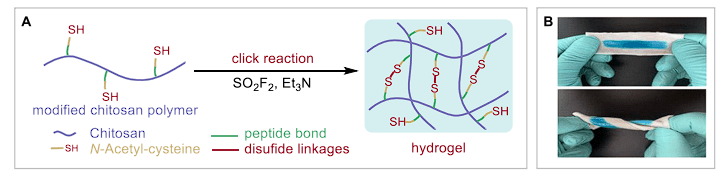
Biomaterials: construct functionalized peptide materials for tissue engineering, drug delivery and other fields.
Chemical biology: study peptide-protein interactions and develop novel biological probes and drug targets.
Click chemistry-driven peptide cyclisation is a highly efficient and precise cyclisation technique, which provides new tools and methods for peptide cyclisation and has a broad application prospect. With the continuous development of click chemistry technology, it is believed that this technology will play an increasingly important role in the field of peptide science.