Apa yang Harus Dipecahkan oleh Penelitian Pengiriman Mukosa Peptida
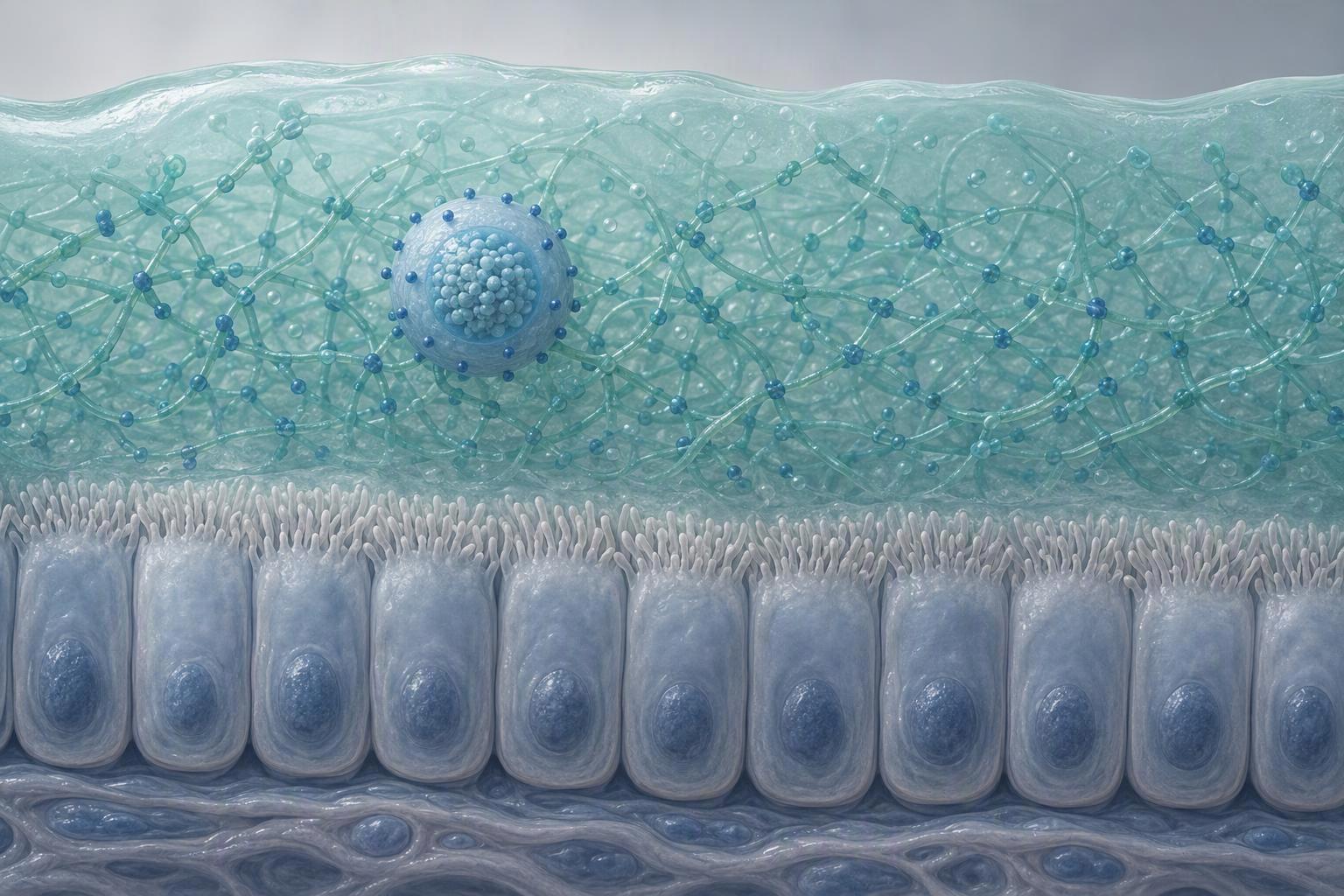
Penelitian pengiriman mukosa peptida ada karena rute yang menghindari injeksi, sengau, paru, bukal, vagina dan gastrointestinal, semuanya menempatkan penghalang fisik yang sama antara dosis dan epitel: lendir. Penghalang itu bukanlah sebuah filter tunggal melainkan tiga filter yang bertindak bersamaan. Jaring musin yang berikatan silang membatasi apa yang berdifusi melaluinya, enzim yang disekresikan dan terikat membran mendegradasi peptida dalam perjalanannya, dan pH lokal serta kondisi ionik menentukan seberapa banyak ion tersebut tetap utuh dan permeabel.
Dimensi mesh menentukan skala permasalahan. Rentang jarak antar serat lendir 10 nm ke 200 nm, dengan serat individu secara kasar 10 berdiameter nm, dan model difusi menggunakan radius serat musin 3.5 nm terhadap jarak mesh 100 nm (Membiarkan, Wang & Hanes, Tinjauan Pengiriman Obat Tingkat Lanjut, 2009). Kisaran itulah yang menjadi alasan mengapa konsep partikel penembus lendir lebih mengutamakan sifat permukaan, bukan ukurannya saja: partikel yang menempel pada musin terperangkap secara efisien dan kemudian dibersihkan, dan pergantian lendir yang cepat menghilangkan partikel yang terperangkap sebelum mencapai epitel.
Tiga titik kegagalan mengikuti dari ini, dan bagian selanjutnya dari panduan ini memperlakukan setiap keputusan sebagai keputusan yang dibuat sebelum pesanan dilakukan: berapa banyak peptida yang dapat dimuat oleh pembawa, bagaimana beban itu dilepaskan pada permukaan mukosa, dan apakah peptida tersebut bertahan cukup lama untuk sampai.
Mengapa Keputusan Urutan Terjadi Sebelum Keputusan Pengangkut
Penghalang tersebut menjadikan rangkaian peptida dan modifikasinya sebagai kendala pertama, karena mereka mengatur amplop pemuatan dan pelepasan sebelum satu koloid disaring. Ubah urutannya, dan jendela formulasi ikut bergerak.
Toolkit modifikasi bertindak pada tingkat mekanisme, bukan dengan angka tetap. Siklisasi dan stapel memperkuat tulang punggung dan dapat meningkatkan resistensi protease sekaligus mengubah cara peptida menempel pada permukaan pembawa.. PEGylation menambahkan cangkang hidrasi yang dapat memperpanjang waktu sirkulasi tetapi juga memperkenalkan penghalang sterik yang memperlambat pelepasan dan dapat memblokir pemuatan ke dalam interior koloid yang rapat.. Lipidasi meningkatkan hidrofobisitas dan mendorong asosiasi membran atau pembawa. Substitusi asam D-amino dan konjugasi prodrug mengubah stabilitas dan waktu aktivasi. Setiap efek bersifat terarah, dan tidak ada sumber yang mendukung satu aturan pemuatan universal yang berlaku di seluruh peptida dan operator.
Itulah sebabnya pemeriksaan karier yang dilakukan terlebih dahulu sering kali merupakan pekerjaan yang sia-sia. Urutan yang dioptimalkan untuk perlindungan enzimatik melalui PEGylation sampai pada kelompok formulasi dengan penghalang sangat sterik yang membatasi enkapsulasi. Keputusan urutan membatasi keputusan pembawa, bukan sebaliknya.
Taruhannya tidak kecil. Lebih dari 200 Peptida dan protein terapeutik yang disetujui FDA ada di AS, pasar terapi peptida global adalah sekitar $49 miliar, dan mayoritas tetap menyetujui persalinan parenteral (peptida dan protein terapeutik: status dan perkembangan, 2026-04-05). Angka pasar tersebut berdekatan dengan vendor, jadi perlakukan ini sebagai konteks yang terarah dan bukan sebagai ukuran yang tepat; ulasan itu sendiri adalah sumber hulu. Rute mukosa non-injeksi masih merupakan minoritas, itulah mengapa pemikiran urutan pertama penting untuk penelitian pengiriman mukosa peptida.
Praktik 1: Cocokkan Muatan Bersih dan Hidrofobisitas dengan Koloid Sebelum Memesan
Muatan dan hidrofobisitas menentukan apakah suatu peptida terpartisi ke dalam interior pembawa atau teradsorpsi ke permukaannya, dan keputusan itu dibuat jauh sebelum lot pertama dipesan. Peptida yang terlalu hidrofilik untuk inti yang dipilih akan berada di antarmuka atau tetap berada dalam larutan, dan tidak ada proses penyetelan yang dapat memulihkan pemuatan yang Anda asumsikan.
Kriteria penerimaan dapat diukur, jadi tulislah sebagai satu: efisiensi enkapsulasi ditentukan secara tidak langsung dari peptida yang tidak terenkapsulasi dalam supernatan, dengan metode pemisahan bernama (ultrafiltrasi, sentrifugasi, or size-exclusion) and the quantification method stated alongside it. Published method literature on peptide-loaded PLGA nanocarriers sets out this indirect approach together with the companion measures, drug loading from encapsulated peptide relative to particle dry mass, and release quantified by sample-and-separate, dialysis, or continuous flow with HPLC.
Failure takes two forms. A peptide can load well and then desorb once it meets simulated mucosal fluid at mucosal pH, or it can never load at all because its net charge and hydrophobicity do not suit the core. A liposomal carrier loaded with a well-matched peptide that releases too slowly at mucosal pH is a design pattern worth planning against, not a defect you discover later.
Pengambilan Kunci: Encapsulation efficiency is specified as unencapsulated peptide in the supernatant, dengan nama metode pemisahan dan kuantifikasi, dan pelepasan dikonfirmasi dalam cairan mukosa simulasi pada pH mukosa.
Praktik 2: Tetapkan Target Pemuatan Terhadap Rentang yang Dipublikasikan, Bukan Aspirasi
Efisiensi enkapsulasi (EE) dan pemuatan obat adalah dua angka yang berbeda, dan tidak ada yang berarti apa pun tanpa jenis operator, rute pemuatan, dan pengujian yang digunakan untuk mengukurnya. Tetapkan target Anda dari nilai yang dipublikasikan untuk kelas operator yang sama, lalu sebutkan metode yang akan Anda gunakan untuk mengonfirmasinya.
Untuk sistem peptida berbasis PLCA, ringkasan tingkat tinjauan melaporkan efisiensi enkapsulasi di atas 70%, dengan studi individu mencapai 96.56%. Pemuatan jarak jauh dalam air meningkatkan pemuatan peptida dalam partikel PLGA lebih lanjut: peptida kationik kuat telah dilaporkan pada 66–98% EE dan 6,6–9,9% b/b pemuatan, dan peptida autoantigen MOG secara kasar 82% EE dan 8.2 ± 0.7% w/w. Enkapsulasi peptida liposom berada jauh lebih rendah dan bervariasi lebih luas, sekitar 20–30% dalam studi yang ditinjau, dengan satu laporan penelitian nanoliposom 7.2 ± 0.8% untuk pemuatan aktif dan 4.57 ± 0.2% untuk pemuatan pasif.
Kisaran ini berasal dari sintesis penelitian dan bukan perbandingan terkontrol tunggal, dan angka-angka pemuatan jarak jauh menelusuri hulu ke a 2022 Komunikasi Alam makalah yang layak diverifikasi ulang terhadap metode asli sebelum Anda mengadopsinya sebagai spesifikasi.
Modus kegagalannya adalah mengutip nomor PLGA sebagai target program liposom. Kedua kelas pembawa tidak memuat peptida melalui mekanisme yang sama, jadi a 90% Spesifikasi EE yang dipinjam dari PLCA tidak ambisius untuk liposom, itu tidak bisa dicapai, dan mereka akan mengirimkan tim perumus selama berbulan-bulan untuk melakukan reformulasi berdasarkan tolok ukur yang tidak pernah diterapkan pada sistem mereka.
Praktik 3: Tentukan Kinetika Pelepasan dalam Cairan Mukosa yang Disimulasikan, Tidak di Buffer
Profil pelepasan yang diukur dalam larutan salin yang mengandung fosfat memberi tahu Anda bagaimana perilaku peptida dalam keadaan bersih, tidak diaduk, cairan bebas lendir. Ia tidak memberi tahu Anda apa yang mencapai permukaan mukosa.
Penyebaran yang dipublikasikan cukup luas untuk menjelaskan maksudnya. Mikrosfer leuprolida yang dimuat dari jarak jauh melepaskan 28,8–34,3% dalam hari pertama, sementara nanopartikel MOG-peptida tetap berada di bawah 10% pada 24 jam, dan kumpulan nanopartikel yang dilacak FRET menunjukkan secara kasar 17% meledak diikuti oleh sekitar 21% rilis kumulatif berakhir 7 hari (Komunikasi Alam, 2022). Angka-angka tersebut berasal dari pengujian dan sistem model yang berbeda, jadi perlakukan hal-hal tersebut sebagai serangkaian perilaku, bukan sebagai tolok ukur yang harus dicapai.
Pilihan metode menentukan angka sebagaimana halnya formulasi. Pelepasan biasanya diukur berdasarkan sampel dan terpisah, dialysis, atau pengambilan sampel aliran kontinu, masing-masing dipasangkan dengan kuantifikasi HPLC dari peptida yang tersisa atau dilepaskan. Nyatakan metode mana yang Anda gunakan, karena ketiganya tidak dapat dipertukarkan.
Mode kegagalannya bersih, lambat, profil seperti depot dari peptida termodifikasi lipid yang tidak pernah meninggalkan pembawa cukup lama untuk berkontak dengan lendir. Jika pengujian Anda tidak dapat membedakannya dengan persalinan berkelanjutan yang asli pada mukosa, itu mengukur kompartemen yang salah.
Praktik 4: Perlakukan Perlindungan Enzimatik sebagai Waktu Paruh Terukur, Bukan Klaim
“Resisten terhadap protease” bukanlah suatu spesifikasi sampai ia membawa suatu enzim, sebuah konsentrasi, suhu dan jendela waktu. Tanpa keempat parameter tersebut, frasa tersebut menggambarkan niat, bukan properti terukur, dan tidak ada tim formulasi yang dapat membandingkan satu peptida dengan peptida lainnya berdasarkan kekuatannya.
Layanan Angka-angka yang dipublikasikan menunjukkan mengapa perbedaan itu penting. Pemulihan liraglutide gratis tercapai 1.9% setelah 30 menit dalam simulasi cairan lambung dan 9.2% setelah 30 menit dalam simulasi cairan usus, dengan degradasi total setelah satu jam di SIF (stabilitas gastrointestinal dari peptida terapeutik, 2024 meninjau konteks dan 2026 studi SNEDDS). Di tempat kerja yang sama, hanya 3 dari 17 peptida terapeutik tetap ada setelahnya 30 menit dalam cairan usus manusia, dengan banyak yang merendahkan di dalam 2 ke 10 menit. Secara praktis, sebagian besar peptida terapeutik terdegradasi dalam hitungan menit dalam cairan usus, jadi pembawa koloid diminta mengubah skala waktu, bukan untuk menghilangkan risiko.
Sintesis Peptida Tiga pembacaan mengubah perlindungan enzimatik peptida menjadi sesuatu yang dapat ditentukan oleh suatu program: pemulihan peptida utuh pada titik waktu yang ditentukan, waktu paruh degradasi di bawah enzim dan suhu yang dinyatakan, dan penampakan fragmen ketika produk degradasi terakumulasi.
Untuk Tip: Setiap klaim stabilitas harus memuat empat parameter: enzim atau cairan, konsentrasinya, suhu, dan jendela waktu.
Mode kegagalan adalah analog tersiklisasi atau tersubstitusi asam D-amino yang bertahan dalam pengujian tetapi kehilangan konformasinya. Peptida Sintetis epitop program yang dibutuhkan. Perlindungan yang mengubah bentuk molekul bukanlah perlindungan yang dapat digunakan oleh program.
Praktik 5: Tulis Paket Analitik sebagai Kriteria Penerimaan Sebelum Lot Pertama
Rencana karakterisasi adalah dokumen pembelian. Tuliskan sebelum Anda melakukan pemesanan, menyetujuinya dengan pemasok, dan membuat setiap lot melepaskannya. Sebuah paket yang dirakit setelah sintesis memberi tahu Anda apa yang tiba; sebuah paket yang disepakati sebelumnya memberi tahu pemasok apa yang akan ditolak.
Untuk program pengiriman mukosa peptida, daftar metode sudah cukup diselesaikan untuk ditentukan sekarang. Efisiensi enkapsulasi diukur dari supernatan setelah pemisahan partikel. Pemuatan obat dinyatakan sebagai peptida yang dienkapsulasi relatif terhadap massa kering partikel, bukan total massa formulasi. Rilis dijalankan dengan sampel-dan-terpisah, dialysis, atau aliran terus menerus, dengan kuantifikasi dengan HPLC. Ukuran berasal dari hamburan cahaya dinamis dengan morfologi yang dikonfirmasi oleh SEM, TEM, atau AFM. Potensi zeta berasal dari hamburan cahaya elektroforesis. Difusivitas lendir diukur dengan pelacakan partikel dalam lendir, tidak dalam buffer. Stabilitas enzimatik dilaporkan sebagai pemulihan peptida utuh dengan penampakan fragmen.
|
Atribut |
Metode dan ambang batas atau konvensi pelaporan |
|---|---|
|
Identitas peptida |
Konfirmasi massal oleh MS |
|
Kemurnian peptida |
RP-HPLC; ~≥95% adalah norma industri, bukan angka yang diamanatkan EMA |
|
Kotoran yang berhubungan dengan peptida |
Ph. euro. ambang batas: laporan >0.1%, mengenali >0.5%, memenuhi syarat >1.0% |
|
lawan Produksi Peptida |
Identitas dan konten Toko dinyatakan |
|
sisa TFA |
Dilaporkan sebagai pengotor terkait proses |
|
Endotoksin bakteri |
Batas ditentukan berdasarkan rute dan dosis, jika sesuai |
|
Efisiensi enkapsulasi |
Dari supernatan setelah pemisahan partikel |
|
Pemuatan obat Tentang |
Peptida terenkapsulasi relatif terhadap massa kering partikel |
|
Lepaskan kinetika |
Sampel-dan-terpisah, dialysis, atau aliran terus menerus, diukur dengan HPLC |
|
Ukuran partikel |
DLS, dengan morfologi dikonfirmasi oleh SEM, TEM, atau AFM |
|
Muatan permukaan |
Potensi Zeta melalui hamburan cahaya elektroforesis |
|
Difusivitas lendir |
Pelacakan partikel dalam lendir |
|
Stabilitas enzimatik |
Pemulihan peptida utuh dan penampakan fragmen |
Kerangka peraturannya sudah tertulis. ekspektasi spesifikasi EMA untuk peptida sintetik memerlukan spesifikasi bahan aktif yang dapat dibenarkan yang mencakup pengotor terkait peptida, identitas dan konten tandingan, sisa TFA sebagai pengotor terkait proses, dan endotoksin bakteri jika diperlukan.
Sertifikat analisis dan paket QC pemasok peptida harus mencantumkan identitas, kemurnian dengan HPLC, konfirmasi massal oleh MS, lawan, endotoksin, kemandulan, dan data konsistensi lot-to-lot. Perubahan MOL menyediakan sintesis khusus dengan MS, HPLC, kemurnian, isi, dan pengujian endotoksin, yang mencakup sisi zat obat dari daftar itu. Atribut formulasi penyampaian dalam tabel tetap menjadi milik tim peneliti untuk ditentukan dan diukur.
Praktik 6: Pisahkan Konsep Menjanjikan Dari Kinerja Tervalidasi
Setiap nomor dalam program pengiriman mukosa peptida membawa tahap bukti, dan panggung harus berjalan dengan nomor tersebut. Hasil permeabilitas yang diukur pada lapisan tunggal Caco-2 adalah hasil in vitro. Ini bukan proyeksi klinis, dan menampilkannya sebagai satu kesatuan adalah mode kegagalan yang harus dicegah oleh praktik ini.
Pembingkaian ini bukanlah hal baru. Duncan dan Gaspar menjelaskan kesenjangan janji-versus-kinerja yang sudah lama ada dalam pengobatan nano di dalam Farmasi Molekuler di dalam 2011: janji praklinis jauh dari terjemahan klinis, kebenaran “terletak di antara” sensasi dan kekhawatiran, dan setelahnya kira-kira 50 pekerjaan desain selama bertahun-tahun, hanya beberapa lusin obat nano yang telah mencapai penggunaan klinis rutin, dengan mekanisme regulasi sebagai bagian dari gambaran tersebut. Perlakukan hal tersebut sebagai data dasar sejarah dan bukan sebagai perhitungan terkini, tetapi logika tiering tetap berlaku.
Biaya validasi apa yang paling jelas terlihat pada data penyerapan. A 2026 tinjauan melaporkan bahwa sebagian besar peptida memiliki bioavailabilitas oral yang melekat di bawah ini 1%, dan upaya formulasi jarang berhasil mencapai angka satu digit pada hewan besar dan manusia (Menavigasi kompleksitas pengiriman peptida oral, 2026). Oktreotida oral mencapai sekitar 0.7% pada manusia. Luna18 mencapai 21–47% secara praklinis, dan MEDI7219 tentang 6% pada anjing sebagai tablet enterik. Perhatikan seberapa jauh gambaran praklinis dari gambaran klinis.
Peringatan: Labeli setiap hasil dengan tahapan buktinya. Secara in vitro, ex vivo, hewan, klinis. Label tersebut menyertai nomor tersebut, ke setiap dek, memo, dan spesifikasi yang muncul di dalamnya.
Dimana Lapangan Bergerak

Dengan tahapan bukti tersebut diberi label, pergerakan jangka pendek dalam pengiriman peptida mukosa bukanlah bahan kimia pembawa baru. Ini adalah ketelitian analitis dan peraturan, dan spesifikasi yang pada akhirnya harus dipenuhi oleh tim perumus telah ditulis untuk rute-rute yang berdekatan.
Produk hidung dan paru-paru menunjukkan seperti apa bentuknya. Panduan FDA mengenai produk semprotan hidung dan inhalasi mengharapkan distribusi ukuran tetesan dikontrol dengan tiga hingga empat nilai batas yang dilaporkan sebagai D10, D50, D90 dan rentang, diukur pada bulu-bulu yang sudah berkembang penuh pada setidaknya dua jarak 3 terpisah cm, khas 2 ke 7 cm. Kriteria pola semprotan menentukan bentuk dan ukuran, misalnya ellipsoid dengan kepadatan relatif seragam dengan rasio sumbu terpanjang dan terpendek di sekelilingnya 1.00 ke 1.30, dan geometri bulu memerlukan sudut dan lebar pada satu waktu tunda. Deposisi hidung umumnya menargetkan tetesan di atas secara kasar 10 µm untuk menghindari pengendapan paru-paru, sering dikutip di sekitar 50 mikron. Ini adalah Harapan CMC untuk produk semprotan hidung, dan panduan yang mendasarinya bertanggal 2002, dengan angka-angka yang menjangkau sebagian besar tim melalui halaman panduan khusus produk FDA dan a 2014 tinjauan analitis. Perlakukan mereka sebagai orang yang terarah, tidak terkini.
Untuk peptida itu sendiri, pedoman EMA tentang peptida sintetik (2025-12-04) adalah jangkar yang lebih terkini.
Pertanyaan yang Sering Diajukan
Bisakah saya memilih rute mukosa sebelum urutannya diperbaiki?
TIDAK, dan memperlakukan rute sebagai independen dari urutan adalah kesalahan pengurutan yang paling umum dalam pekerjaan kelayakan awal. Biaya bersih, titik isoelektrik, dan hidrofobisitas adalah sifat urutan yang menentukan apakah suatu peptida berpartisi menjadi koloid lunak, jadi keputusan operator ada di hilirnya. Perbaiki urutannya, kemudian menyaring operator terhadapnya.
Berapa efisiensi enkapsulasi yang cukup untuk studi kelayakan awal?
Tidak ada batasan universal, dan rentang yang dipublikasikan bervariasi menurut peptida, pembawa, dan metode. Perlakukan efisiensi enkapsulasi sebagai penyaringan komparatif antar kandidat koloid di bawah satu protokol tetap dan bukan sebagai gerbang lulus/gagal, dan tetapkan target dari rentang yang direproduksi oleh pengujian Anda sendiri.
Haruskah analog PEGylated atau lipidated masuk ke kelompok formulasi terlebih dahulu?
Itu tergantung pada tanggung jawab apa yang Anda selesaikan. PEGylation terutama membahas sirkulasi dan paparan enzimatik; lipidasi terutama membahas interaksi dan partisi membran. Kirim analog yang cocok dengan mode kegagalan yang Anda ukur, bukan perusahaan yang memiliki jejak literatur lebih besar.
Apa yang termasuk dalam paket konsistensi lot-to-lot pada tahap penelitian?
Minimal: spesifikasinya, metode analisis di balik setiap atribut, dan hasil di setidaknya tiga lot. Kemurnian dengan HPLC, identitas dengan spektrometri massa, dan pengujian endotoksin termasuk dalam paket dari lot pertama, karena retrofitnya nanti akan membatalkan perbandingan sebelumnya.
Bagaimana cara membaca nomor bioavailabilitas praklinis?
Bacalah sebagai pengukuran dalam satu model, satu dosis, dan satu formulasi, bukan sebagai proyeksi. Ketersediaan hayati peptida oral jarang melebihi satu digit, dan bahkan angka tersebut bergantung pada model. Laporkan modelnya, rute, dosis, dan jendela waktu di samping nomor tersebut, dan periksa ekspektasi spesifikasi dalam pedoman EMA tentang peptida sintetik sebelum memperlakukan nilai apa pun sebagai target.
Kesimpulan
Keputusan urutan dan modifikasi mendahului dan membatasi keputusan koloid. Ini adalah satu-satunya hal yang paling penting bagi siapa pun yang merencanakan pekerjaan pengiriman mukosa peptida: pilih peptida, biaya bersihnya, hidrofobisitas dan profil stabilitasnya terlebih dahulu, lalu pilih operator yang sesuai dengan properti tersebut. Membalikkan urutan inilah yang menghasilkan kesenjangan janji-versus-kinerja yang sudah lama ada dalam pengobatan nano, dimana suatu formulasi memiliki kinerja konsep yang baik dan gagal dalam pemuatan, pelepasan atau stabilitas enzimatik.
Keenam praktik tersebut membentuk satu urutan keputusan. Cocokkan muatan dan hidrofobisitas dengan koloid sebelum memesan. Tetapkan target pemuatan terhadap rentang yang dipublikasikan. Tentukan kinetika pelepasan dalam cairan mukosa simulasi. Perlakukan perlindungan enzimatik sebagai waktu paruh yang terukur. Tulis paket analitis sebagai kriteria penerimaan sebelum lot pertama. Pisahkan konsep yang menjanjikan dari kinerja yang tervalidasi.
Yang berubah bukanlah bahan kimia pembawanya, melainkan garis disekitarnya. Harapan analitis dan peraturan untuk karakterisasi, detail metode dan konsistensi lot-to-lot terus meningkat, jadi kualitas dokumentasi kini menentukan program mana yang tetap dapat dijalankan.
Jika Anda siap untuk pindah, meminta spesifikasi atau paket analitis, atau memulai penilaian kelayakan dengan pemasok Anda. Konsultasikan dengan profesional yang berkualifikasi sebelum membuat keputusan medis atau formulasi. Artikel ini bersifat mendidik dan tidak mengandung rekomendasi komersial.