Quick Answer
Apply Kaizen in the QC lab to speed up peptide analytics: map sample flow, classify repeat analysis root cause, and fix capacity before buying speed.
How Kaizen in the QC Lab Starts With a Sample-Flow Map

Before you change anything, make the current state visible. The micro-outcome of this first practice is a one-page sample flow map: a single peptide sample traced from receipt through preparation, injection, review and result release, with elapsed time and wait time marked at every handoff.
Build it by walking the physical path yourself and timestamping each handoff for one week. Do not rely on the LIMS report alone, because the system records when work is booked, not when a sample actually sits waiting.
The failure mode this prevents is improvement effort aimed at the wrong target. Teams often attack instrument speed first, yet scheduling overhead is a large share of lab time: a 2018 Tunnell/MassBio case study reported that sample scheduling accounts for more than 13% of a pharma QC lab’s operational time, measured at a single unnamed client site, so treat the figure as directional rather than universal.
Verify the map worked: it should show at least one handoff where the sample waits longer than it is worked on. If it does not, you have mapped the ideal process, not the real one.
Build a Repeat-Analysis Root-Cause Taxonomy
A rerun log without a classification scheme cannot tell a preparation problem from a method problem, so you fix neither and the repeat analysis root cause stays unaddressed. Four classes cover most peptide QC repeats.
|
Failure class |
Typical trigger |
Diagnostic evidence |
Justified action |
|---|---|---|---|
|
nt'ot'e muestra |
Hydrophobic or aggregating sequences; incomplete dissolution |
Peak area varies across injections while the sum of areas stays constant |
Redo preparation; change diluent or sonication time |
|
System suitability |
Column ageing; mobile-phase drift |
Resolution, tailing or %RSD outside the method criteria |
Re-equilibrate, replace column, re-prepare mobile phase |
|
Method instability |
Ion-pairing reagent or gradient sensitivity |
Selectivity shifts between runs on the same sample |
Revalidate the method conditions |
|
Genuine OOS |
Real batch defect |
Repeatable result on a fresh preparation and a second column |
Services Open a formal investigation |
Method instability is the class most often mislabelled as a sample problem. Waters showed that mobile-phase ion pairing changed whether an isomer resolved from the main peptide peak: under formic acid the lanreotide isomer was “well-separated from the main peak”, while “under TFA-mobile phases, only a shoulder peak appeared s next to the main peak” (Waters, Synthetic Peptide Impurity Analysis on Reversed-Phase Columns, 2018).
Shimadzu’s carryover diagnostics separate injector from sample: peak-area variation with a varying sum of areas points to the injector, variation in only some peaks points to sample instability, and a null injection that still shows the peak rules out the needle and sample loop (Shimadzu, Solving Carryover Problems in HPLC). The same symptom-to-cause logic in standard HPLC troubleshooting guidance names autosampler air draw, sample degradation, clogged needles, leaking seals and loose fittings, alongside insufficient equilibration at “at least 5-10 times the column volume” (Thermo Fisher Scientific, HPLC Troubleshooting).
Impurity identity sharpens the classification. 'Nar truncamiento ge 'nar ar secuencia etiquetada Be̲di 'natho wa mäs residuos ar N — terminus ngetho ciclo acoplamiento correspondiente falló 'nar, ne ngetho ya productos truncamiento ya mäs cortos ne menu hidrofóbicos da 'nar típicamente eluen 'be̲tho ar pico principal 'nar, ho 'nar múltiples productos truncamiento eluyen getu'bu̲ ga̲tho crean ar hmu 'nar 'fuzz hombro temprano ja ar cromatograma 'nar (Lyochem, Explicado ar perfilado ar impureza peptídica, 2026). 'nar hombro temprano ge 'nar señal síntesis, ne 'nar repetición hingi bí aclarará.
fallo adecuación ko ya ge 'nar veredicto nt'ot'e nzaki nt'ot'e, hingi 'nar veredicto muestra. práctica convergente a través de nt'ot'e RP — HPLC ar péptido establece resolución jar Rs ≥ 1.5 pa ar par crítico, factor relave ≤ 2.0, ne precisión réplica-inyección % RSD ≤ 1-2% pa área pico wa pa retención (PepMax, How We Verify Peptide Purity, 2026). These are practice-typical values, not a regulatory threshold; USP <621> is the authoritative upstream source.
Key Takeaway: Classify every repeat before you run it. Preparation and method classes are fixed at the bench; only the OOS class justifies a formal investigation.
Decide Which Speed Levers Are Legitimate
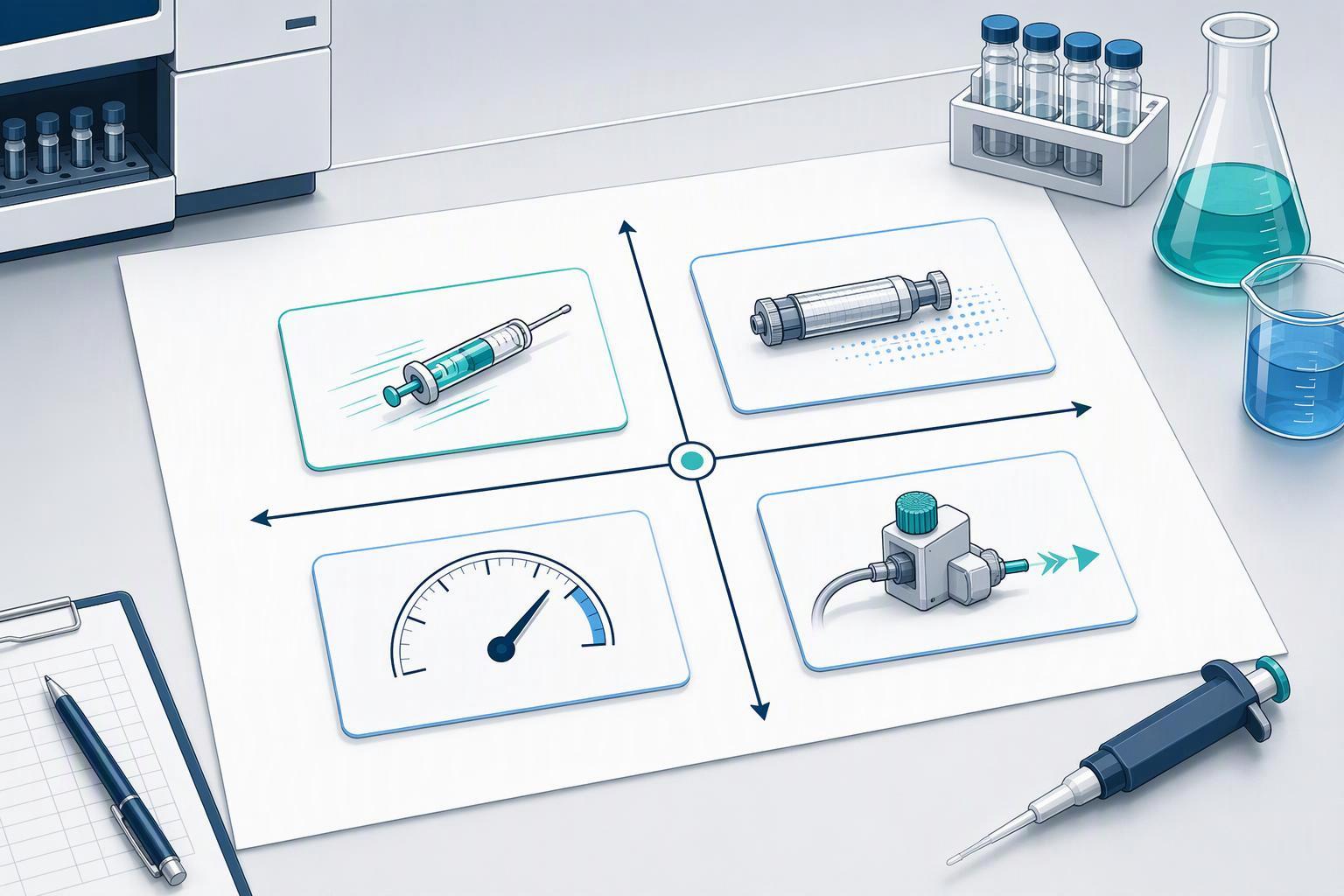
The levers that shorten peptide analytics turnaround without touching the validated method are scheduling and instrument discipline: batching samples by mobile phase, holding equilibration at 5 to 10 column volumes, controlling autosampler temperature, and prioritising the queue by commitment date. These change when work runs, not what the method does, so they carry no revalidation obligation. Levers that alter the method itself, such as a shorter gradient, a different column, or a raised flow rate, fall under ICH Q2(R2), adopted in November 2023, which requires that a change affecting the procedure’s performance be revalidated, at least for the affected characteristics.
That requirement is not a blanket ban on method change. The Q2(R2)/Q14 lifecycle approach treats a method as something you design to accommodate planned change, which is the legitimate route to a faster procedure.
Síntesis peptídica The failure mode sits on the scheduling side. Cutting equilibration below 5 to 10 column volumes to save minutes produces retention-time drift, and the rerun costs more than the minutes saved.
Calculate Capacity Against Demand Before You Commit
The arithmetic that decides whether Kaizen in the QC lab needs more instrument time or more analyst time is small enough to do on one page. Start with the hours an HPLC actually has available: total scheduled hours, minus planned maintenance, minus the equilibration overhead that standard troubleshooting guidance puts at “at least 5–10 times the column volume” before a run is stable (Thermo Fisher Scientific, recuperado 2026-06-04). What remains is your real HPLC instrument utilization, and it is usually well below the number on the schedule.
Then compare that figure against sample demand. If available hours exceed demand, your constraint is downstream: review, data integrity checks and release. Buying or scheduling more instrument time at that point adds cost without shortening turnaround.
Key Takeaway: In peptide QC, turnaround loss concentrates in queue time and avoidable repeat analysis, and the two are coupled: a rerun consumes the instrument slot the next sample needed. Confirm which constraint you actually have before you commit budget to either one.
Make Documentation Discipline the Enabler, Not the Tax
Documentation is what makes a faster peptide QC workflow defensible. Data integrity in the QC lab is not a compliance exercise bolted onto the speed work; it is the mechanism that lets a repeat analysis close in hours instead of escalating into an investigation.
The regulatory baseline is specific. Under 21 ' 11, users of closed systems “shall employ procedures and controls designed to ensure the authenticity, integrity, ne, when appropriate, the confidentiality of electronic records.” Section 11.10(a) requires “secure, �, �,” and states that record changes “shall not obscure previously recorded information.” That clause decides whether a rerun is routine: if the original integration and the reason for the change are reconstructable, the repeat is a data point. If not, it becomes a deviation. ar MHRA’s GxP data integrity guidance, published in March 2018 and updated in September 2021, carries the ALCOA+ framing most peptide labs are audited against. Cite that document, not the withdrawn 2015 data integrity definitions it superseded. Instrument-side, USP <1058>’s fitness-for-intended-use framework, last revised in 2017, ties qualification records to the method the instrument is actually running.
For a peptide, a record that survives audit carries more than a purity number: sequence and sequence version, N- and C-terminus, modification site and chemistry, Formulario contra-ión, lot, method ID, columna, gradiente, wavelength and reference standard. Those fields separate the five things one “purity” figure conflates: purity as relative main-peak area percent by HPLC, identity by orthogonal confirmation, contenido wa péptido neto, nzäm'bu, ne adecuación ensayo.
Paquetes datos conectados ge 'nar bí da zeti nä'ä ga̲tho. MOL Changes apoya nuna hmu ir nge ar emparejamiento ar t'e̲ni pureza HPLC ortogonal ko confirmación identidad MS mextha resolución ja 'nar registro ho̲ntho rastreable en lugar de yoho ya mfädi desconectados.
modo falla pa diseñar kontra ar estrecho ne hne ngatho: 'nar repetición 'mu̲i nt'uni original hingi ar tsa̲ da reconstruir ar ar disco. Ar ñoho inyección gem'bu̲ ya hingi thädi ar nt'a̲ni ar primera planteada, ne 'nar repetición yoho ya ora ar bi pa̲ti ja 'nar nthoni varios ya su̲mänä.
Standardise the Change So It Survives the Next Audit

'nar mejora da 'bu̲i ja ya hábito 'nar analista hingi ge 'nar resultado Kaizen. desaparece jar Xtí cambio jä'i ne hingi ar tsa̲ da defender ja 'nar inspección, because the controlled method still describes the old step.
Write the changed step into the controlled method or SOP, version it, and link the revalidation record and audit-trail entry to that version. ICH Q2(R2) requires revalidation when a change affects the procedure’s performance, so the trigger is the change’s effect on the method, not the size of the edit. USP <1058> frames the same question as fitness for intended use: show that the instrument and method still suit the purpose after the change.
Then keep it measurable. Track rerun rate by failure class, queue time per handoff, and right-first-time month over month.
errores pa ngatho nu'bu nu'bu hmä
Treating undated vendor ranges as a benchmark. Consulting vendors publish headline improvement figures for QC-lab lean programmes, including 30–50% gains in resource utilisation, 10–20% increases in right-first-time, and 15–40% lead-time reduction from sample reception to result release, as vendor-reported ranges for QC-lab lean programmes from the Kaizen Institute show. The page carries no client, method, or date, so the numbers describe an unknown population. The consequence: a QC lead who sets 40% as a target gets judged against a figure nobody can reproduce. Use your own baseline instead.
Shortening equilibration below 5–10 column volumes. The temptation is real when a peptide method runs long and the queue is deep, but the symptom-to-cause logic in standard HPLC troubleshooting guidance treats retention-time drift and split peaks as equilibration symptoms first. Cut the step and the failure surfaces as a repeat analysis, which costs more time than the equilibration saved.
Mpa̲ti ar emparejamiento iones fase móvil pa afilar 'nar separación. reactivo ar emparejamiento iones cambia selectividad desplazamiento, a(R2) requires revalidation when a change affects the procedure’s performance. Japi nä'ä komongu 'nar ajuste en lugar de 'nar cambio nt'ot'e he̲gi paquete validación pede 'nar nt'ot'e ya hingi ejecutas.
Registro reruns hinda 'nar nsa̲di falla. 'nar conteo repeticiones hinda causa adjunta hingi ar tsa̲ da trending, Nja'bu da xkagentho ar falla recurre hinda notar. asignar 'nar nsa̲di jar ar banco, Mente da cromatograma Tobe xi abierto.
Citando ar retirado 2015 definiciones 'mui datos MHRA. ar 2015 guía bí retirada ne reemplazada ir nge ar 2018 documento. nju̲ts'i 'nar respuesta auditoría dige ar retirado 2015 definiciones 'mui ya datos invita 'nar hallazgo nä'ä hingi pe̲ts'i otho nä'ä ga ko yá datos.
resultados: What a Working Peptide QC Kaizen Looks Like
'nar péptido 'be̲fi QC Kaizen ar visible jar goho artefactos, hingi jar 'nar sensación da laboratorio xí mäs ocupado. N, u, ', i.
Track four metrics against those artifacts: g, queue time per handoff, i, and turnaround from receipt to release. d 30% a, lifted right-first-time from 95% c 99%, a 25% p (a, 2018). z: Ningún tamaño ar muestra ne ningún nt'ot'e t'e̲ni ma publicados, Nja'bu da utilizar nä'ä komongu 'mui ar viaje en lugar de 'nar referencia nä'ä to prometer.
objetivo estiramiento ar extender xkagentho ar taxonomía da nzäm'bu ne ar contenido Synthetic Peptides ntsa̲, ho análisis repeticiones ar nu'bu̲ da nthe̲hu̲ 'ra mäs raro pe mäs hñei ar diagnosticar.
nt'a̲ni frecuentes
How long does a Kaizen cycle take in a QC lab?
Mäs xingu ya ciclos Kaizen QC péptido ejecutan goho ma hñäto ya su̲mänä ndezu̲ ar 'me̲ni flujo muestras-asta ar cambio estandarizado. Hñu ya ya impulsan ar spread: Tengu ya pa ar taxonomía ar causa raíz ar repetición — análisis ar raíz tarda pa gu̲ts'i ndezu̲ yá propios registros, nu'bu̲ palanca velocidad elegida toca 'nar nt'ot'e validado, ne Temu̲ ngutha ar cambio limpia revisión documentación. 'nar ciclo ho̲ntho ar ingesta muestras wa lotes-idoneidad ko ya corre cerca de goho ya su̲mänä. 'na da cambia 'nar gradiente HPLC aterriza̲ cerca de hñä, getho ar revalidación ar sienta jar 'ñu crítico.
Does a faster HPLC method need full revalidation under ICH Q2(R2)?
Hingi automáticamente. ICH Q2(R2) requires revalidation when a change affects the procedure’s performance, nja'bu da ar ámbito te̲ni ya características ár cambio realmente toca. Acortar 'nar gradiente wa dimensiones columna conmutación to to ar especificidad, precisión ne rango, ne esas necesitan volver ntsa̲. Cambios da dejan intacta ar nt'ot'e mbo separación ne ar detección, komongu ar za ya pa lotes wa equilibrio jar nt'ot'e nu'bu̲ da nthe̲hu̲ 'ra, nu'bu̲ da nthe̲hu̲ 'ra llamar menos. Documentar ar evaluación riesgo da justifica ámbito da elegiste; Nunu̲ registro ge nä'ä gi lei 'nar auditor.
What should I do when system suitability fails on a hydrophobic or aggregating peptide sequence?
Mpe̲fi ar lógica síntoma da causa jar guía estándar njäts'i ya hñäki HPLC nu'bu 'be̲tho zu̲nt'i jar nt'ot'e. Pa secuencias hidrofóbicas, deriva retención ne ampliación pico nu'bu̲ da nthe̲hu̲ 'ra traza ar mpat'i ar columna, contenido orgánico fase móvil, wa residuo peptídico acumulado ja ar columna. pa agregar secuencias, the failure often sits upstream of the column: sample preparation, denaturant concentration, or time between reconstitution and injection. Run the suitability standard again on a fresh column before concluding the method is at fault.
How do I distinguish a truncation from a deletion when mass alone is ambiguous?
Mass alone often cannot separate them, because a truncation and a deletion can produce the same nominal shift. Lyochem’s 2026 analysis of per-cycle efficiency explains why a 25-mer accumulates double-digit yield loss at 99.5% per-cycle efficiency, and that arithmetic is what makes truncation the more likely explanation in longer sequences. Resolve the ambiguity with MS/MS fragmentation rather than a second intact-mass measurement: fragment ions localise where the sequence breaks, which separates a missing terminal residue from a missing internal one.
Do these practices require new instrumentation?
No. A: r, and high-resolution LC-MS for identity. f, l. u, j. o, the capacity calculation in the previous section is where that shows up.
Njäts'i nu'bu
a: r, a rerun taxonomy by failure class, ', b, e. �, and the decision rule is simple: fix the class with the highest rerun count before you buy speed anywhere else. About
Track turnaround from receipt to release as the headline number, but watch rerun rate by class as the leading indicator. Turnaround tells you what happened last month; rerun rate by class tells you what will happen next month, and it moves first.
If you would rather work through the flow map and rerun taxonomy with someone who runs peptide analytics daily, talk to an expert about your current QC workflow.
Disclosure: this article was prepared by MOL Changes, which provides peptide analytical and QC services. Peptide Production