QC 연구실의 Kaizen이 샘플 흐름 맵으로 시작하는 방법
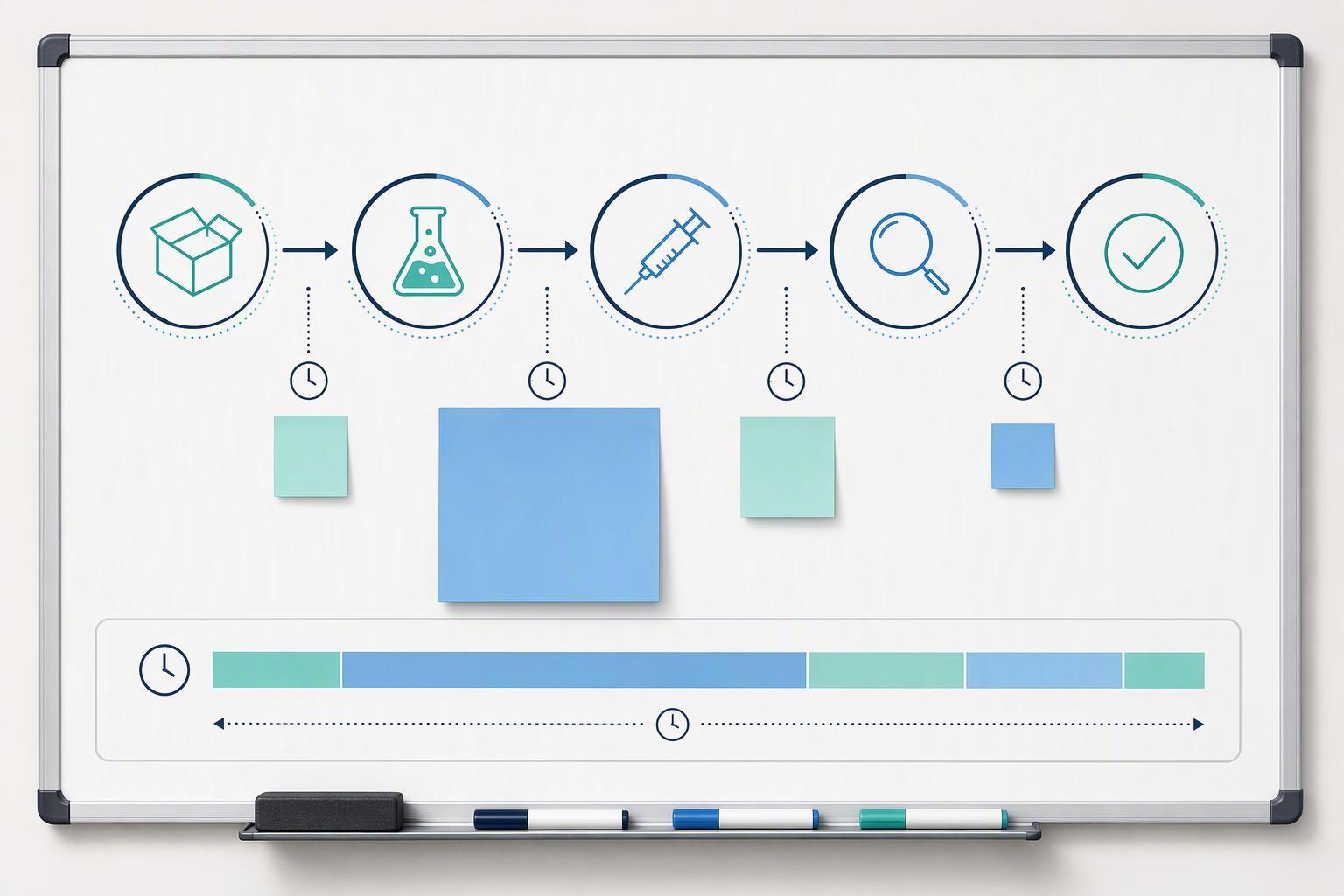
아무것도 바꾸기 전에, 현재 상태를 보이게 하라. 이 첫 번째 사례의 미시적 결과는 한 페이지 분량의 샘플 흐름 맵입니다.: 수령부터 준비까지 추적된 단일 펩타이드 샘플, 주입, 검토 및 결과 발표, 매 핸드오프마다 경과 시간과 대기 시간이 표시됨.
실제 경로를 직접 걷고 일주일 동안 각 핸드오프에 타임스탬프를 기록하여 구축하세요.. LIMS 보고서에만 의존하지 마십시오., 작업이 예약되면 시스템이 기록하기 때문에, 샘플이 실제로 기다리고 있을 때가 아닙니다..

이를 방지하는 실패 모드는 잘못된 목표를 겨냥한 개선 노력입니다.. 팀은 종종 장비 속도를 먼저 공격합니다., 그러나 예약 오버헤드는 실습 시간의 큰 부분을 차지합니다.: 에이 2018 Tunnell/MassBio 사례 연구에 따르면 샘플 일정 관리는 13% 제약 QC 실험실 운영 시간, 이름이 지정되지 않은 단일 클라이언트 사이트에서 측정됨, 따라서 그림을 보편적인 것이 아니라 방향적인 것으로 취급하십시오..
지도가 작동하는지 확인: 샘플이 작업된 것보다 오래 기다리는 핸드오프가 하나 이상 표시되어야 합니다.. 그렇지 않은 경우, 당신은 이상적인 프로세스를 매핑했습니다, 진짜는 아니야.
반복 분석 근본 원인 분류 체계 구축
분류 체계가 없는 재실행 로그는 방법 문제와 준비 문제를 구분할 수 없습니다., 따라서 어느 쪽도 수정하지 않고 반복 분석 근본 원인이 해결되지 않은 상태로 유지됩니다.. 4개 클래스가 대부분의 펩타이드 QC 반복을 포괄합니다..
|
실패 등급 |
일반적인 트리거 |
진단적 증거 |
정당한 행동 |
|---|---|---|---|
|
샘플 준비 |
소수성 또는 응집 서열; 불완전한 용해 |
피크 면적은 주입마다 달라지지만 면적의 합은 일정하게 유지됩니다. |
다시 실행 준비; 희석제 또는 초음파 처리 시간 변경 |
|
시스템 적합성 |
컬럼 노화; 이동상 드리프트 |
해결, 분석법 기준을 벗어난 테일링 또는 %RSD |
재평형을 이루다, 열 교체, 이동상을 다시 준비하세요 |
|
방법의 불안정성 |
이온쌍 시약 또는 기울기 감도 |
동일한 샘플에 대한 실행 간 선택성 변화 |
메소드 조건 재검증 |
|
정품OOS |
실제 배치 결함 |
새로운 준비 및 두 번째 컬럼에서 반복 가능한 결과 |
서비스 공식 조사 개시 |
메소드 불안정성은 샘플 문제로 잘못 분류되는 경우가 가장 많은 클래스입니다.. Waters는 이성질체가 주요 펩타이드 피크에서 분리되는지 여부에 따라 이동상 이온 쌍이 변화함을 보여주었습니다.: 포름산 하에서 란레오타이드 이성질체는 "주 피크로부터 잘 분리되었습니다", "TFA-이동 단계에서, 어깨봉만 나타났다 가게 주봉 바로 옆” (워터스, 역상 컬럼의 합성 펩타이드 불순물 분석, 2018).
Shimadzu의 캐리오버 진단은 시료에서 주입기를 분리합니다.: 인젝터에 대한 면적 포인트의 다양한 합으로 인한 피크 면적 변화, 샘플 불안정성을 나타내는 일부 피크 지점의 변화, 바늘과 샘플 루프를 제외하고 여전히 피크를 보여주는 널 주입 (시마즈, HPLC의 캐리오버 문제 해결). 표준 HPLC 문제 해결 지침의 동일한 증상-원인 논리에 따라 자동 샘플러 공기 흡입이 명명됩니다., 샘플 저하, 막힌 바늘, 씰 누출 및 느슨한 피팅, "적어도"에서 불충분한 균형과 함께 5-10 기둥 부피의 배” (써모 피셔 사이언티픽, HPLC 문제 해결).
불순물 식별로 분류가 더욱 선명해집니다.. 잘림은 "해당 커플링 주기가 실패했기 때문에 N-말단에서 하나 이상의 잔기가 누락된 라벨이 붙은 서열"입니다., 잘린 생성물은 더 짧고 소수성이 적기 때문에 "일반적으로 주 피크보다 일찍 용출됩니다.", "여러 절단 생성물이 함께 용출되어 크로마토그램에서 초기 숄더 '퍼즈' 패턴을 생성합니다." (리오켐, 펩타이드 불순물 프로파일링 설명, 2026). 초기 어깨는 합성 신호이다, 반복해도 지워지지 않습니다.
시스템 적합성 실패는 메서드 상태 판정입니다., 샘플 판결이 아님. 펩타이드 RP-HPLC 방법 전반에 걸친 융합 실습을 통해 Rs ≥의 분해능 설정 1.5 중요한 쌍의 경우, 테일링 인자 ≤ 2.0, 및 %RSD ≤의 반복 주입 정밀도 1-2% 피크 면적 또는 머무름 시간 (펩맥스, 펩타이드 순도를 검증하는 방법, 2026). 이는 실무에서 일반적으로 사용되는 값입니다., 규제 기준이 아님; USP <621> 신뢰할 수 있는 업스트림 소스입니다..
핵심 내용: 실행하기 전에 모든 반복을 분류하세요.. 준비 및 방법 수업은 벤치에 고정되어 있습니다.; OOS 클래스만이 공식적인 조사를 정당화합니다..
어떤 속도 레버가 합법적인지 결정하세요
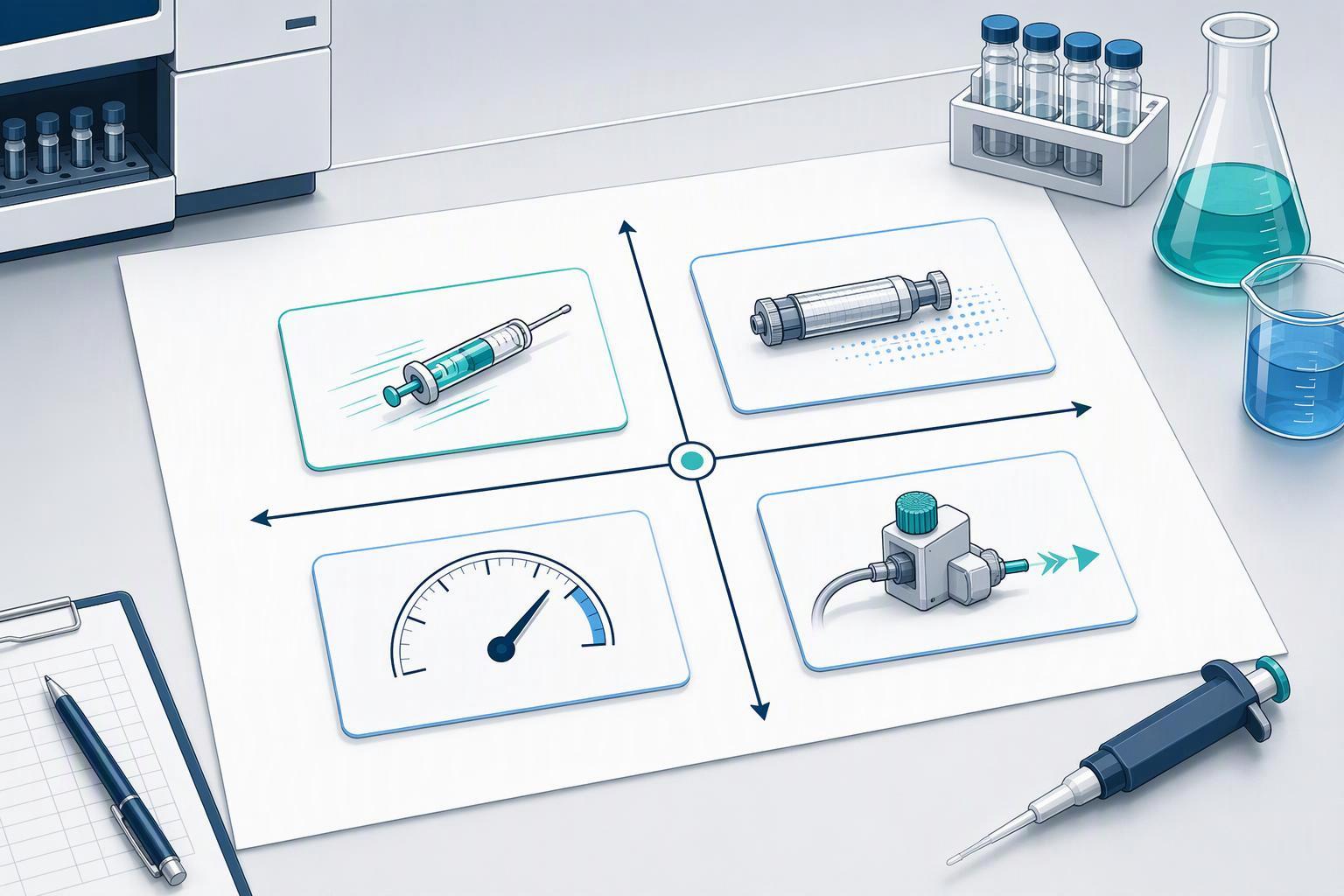
검증된 방법을 건드리지 않고 펩타이드 분석 소요 시간을 단축하는 수단은 일정 관리 및 기기 규율입니다.: 이동상별 샘플 배치, 평형 유지 5 에게 10 컬럼 볼륨, 자동샘플러 온도 제어, 약속 날짜별로 대기열의 우선순위를 지정합니다.. 작업이 실행되면 변경됩니다., 방법이 하는 일이 아니라, 따라서 재검증 의무가 없습니다.. 방법 자체를 변경하는 레버, 예를 들어 더 짧은 그라데이션, 다른 열, 또는 유속 증가, ~에 빠지다 나는 Q2(R2), 11월에 채택 2023, 절차의 성능에 영향을 미치는 변경 사항을 재검증해야 합니다., 적어도 영향을 받는 특성에 대해서는.
해당 요구 사항은 방법 변경을 전면적으로 금지하는 것이 아닙니다.. 2분기(R2)/Q14 수명주기 접근 방식 계획된 변경을 수용하기 위해 설계한 것으로 방법을 취급합니다., 이것이 더 빠른 절차를 위한 합법적인 경로입니다.
펩타이드 합성 실패 모드는 스케줄링 측면에 있습니다.. 아래 절단 평형 5 에게 10 분을 절약하기 위한 컬럼 볼륨으로 인해 머무름 시간 드리프트 발생, 재실행 비용은 절약된 시간보다 더 많습니다..
약정하기 전에 수요 대비 능력 계산
QC 실험실의 Kaizen에 기기 시간이 더 필요한지 분석자 시간이 더 필요한지 결정하는 산술 작업은 한 페이지에서 수행할 수 있을 만큼 작습니다.. Start with the hours an HPLC actually has available: total scheduled hours, minus planned maintenance, minus the equilibration overhead that standard troubleshooting guidance puts at “at least 5–10 times the column volume” before a run is stable (써모 피셔 사이언티픽, 검색됨 2026-06-04). What remains is your real HPLC instrument utilization, and it is usually well below the number on the schedule.
Then compare that figure against sample demand. If available hours exceed demand, your constraint is downstream: 검토, data integrity checks and release. Buying or scheduling more instrument time at that point adds cost without shortening turnaround.
핵심 내용: In peptide QC, turnaround loss concentrates in queue time and avoidable repeat analysis, and the two are coupled: a rerun consumes the instrument slot the next sample needed. Confirm which constraint you actually have before you commit budget to either one.
문서화 규율을 가능하게 하세요, 세금이 아니다
Documentation is what makes a faster peptide QC workflow defensible. Data integrity in the QC lab is not a compliance exercise bolted onto the speed work; it is the mechanism that lets a repeat analysis close in hours instead of escalating into an investigation.
The regulatory baseline is specific. 아래에 21 CFR 부분 11, users of closed systems “shall employ procedures and controls designed to ensure the authenticity, integrity, 그리고, when appropriate, the confidentiality of electronic records.” Section 11.10(이자형) requires “secure, 컴퓨터 생성, 타임 스탬프가 찍힌 감사 추적,” and states that record changes “shall not obscure previously recorded information.” That clause decides whether a rerun is routine: if the original integration and the reason for the change are reconstructable, the repeat is a data point. If not, it becomes a deviation. 그만큼 MHRA’s GxP data integrity guidance, published in March 2018 and updated in September 2021, carries the ALCOA+ framing most peptide labs are audited against. Cite that document, ~ 아니다 the withdrawn 2015 data integrity definitions it superseded. Instrument-side, USP <1058>’s fitness-for-intended-use framework, 마지막으로 개정된 날짜 2017, ties qualification records to the method the instrument is actually running.
펩타이드의 경우, a record that survives audit carries more than a purity number: sequence and sequence version, N- and C-terminus, 변형 부위 및 화학, 반대이온 형태, 많은, 메소드 ID, 열, 구배, wavelength and reference standard. Those fields separate the five things one “purity” figure conflates: purity as relative main-peak area percent by HPLC, identity by orthogonal confirmation, 함량 또는 순 펩티드, 안정, 및 분석 적합성.
Connected data packages are one way to hold that together. MOL 변경 사항 supports this pattern by pairing orthogonal HPLC purity measurement with high-resolution MS identity confirmation in a single traceable record rather than two disconnected reports.
The failure mode to design against is narrow and common: a rerun whose original result cannot be reconstructed from the record. The second injection then no longer answers the question the first one raised, and a two-hour repeat becomes a multi-week investigation.
다음 감사에서도 살아남을 수 있도록 변경 사항 표준화
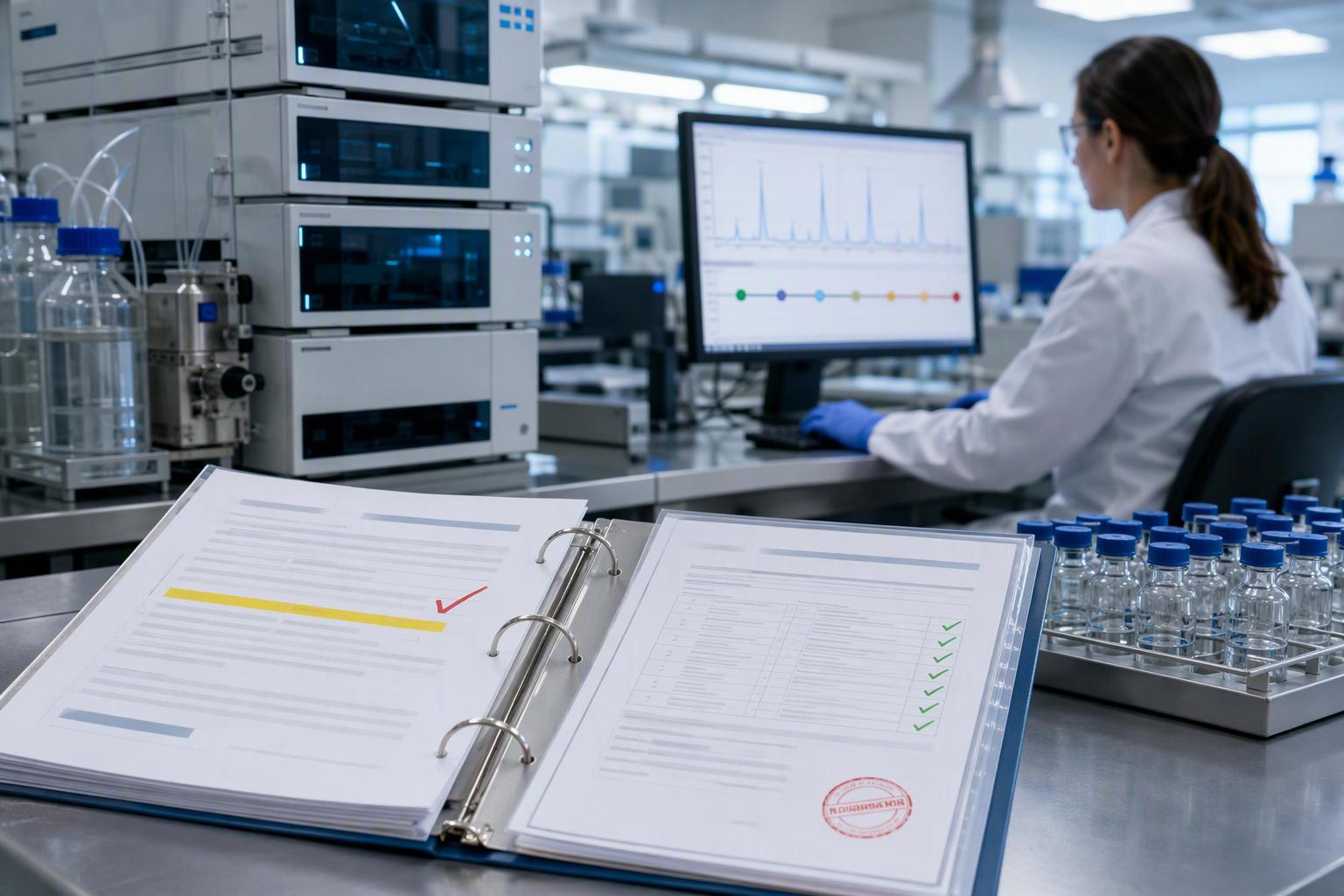
An improvement that lives in one analyst’s habit is not a Kaizen outcome. It disappears at the next staff change and cannot be defended in an inspection, because the controlled method still describes the old step.
Write the changed step into the controlled method or SOP, 버전을 매기세요, and link the revalidation record and audit-trail entry to that version. 나는 Q2(R2) requires revalidation when a change affects the procedure’s performance, so the trigger is the change’s effect on the method, not the size of the edit. USP <1058> frames the same question as fitness for intended use: show that the instrument and method still suit the purpose after the change.
Then keep it measurable. Track rerun rate by failure class, queue time per handoff, and right-first-time month over month.
피해야 할 일반적인 실수
Treating undated vendor ranges as a benchmark. Consulting vendors publish headline improvement figures for QC-lab lean programmes, including 30–50% gains in resource utilisation, 10–20% increases in right-first-time, and 15–40% lead-time reduction from sample reception to result release, ~처럼 vendor-reported ranges for QC-lab lean programmes from the Kaizen Institute show. The page carries no client, 방법, or date, so the numbers describe an unknown population. The consequence: a QC lead who sets 40% as a target gets judged against a figure nobody can reproduce. Use your own baseline instead.
Shortening equilibration below 5–10 column volumes. The temptation is real when a peptide method runs long and the queue is deep, but the symptom-to-cause logic in standard HPLC troubleshooting guidance treats retention-time drift and split peaks as equilibration symptoms first. Cut the step and the failure surfaces as a repeat analysis, which costs more time than the equilibration saved.
Changing mobile-phase ion-pairing to sharpen a separation. Ion-pairing reagent changes shift selectivity, 그리고 나는 Q2(R2) requires revalidation when a change affects the procedure’s performance. Treating it as a tweak rather than a method change leaves the validation package describing a procedure you no longer run.
Logging reruns without a failure class. A rerun count with no cause attached cannot be trended, so the same failure recurs unnoticed. Assign a class at the bench, while the chromatogram is still open.
Citing the withdrawn 2015 MHRA data integrity definitions. 그만큼 2015 guidance was withdrawn and replaced by the 2018 document. Building an audit response on the withdrawn 2015 data integrity definitions invites a finding that has nothing to do with your data.
결과: 작동하는 펩타이드 QC 카이젠의 모습
A working peptide QC Kaizen is visible in four artifacts, not in a feeling that the lab is busier. You should be able to open a flow map with wait times marked at every handoff, a rerun log that classifies each repeat analysis by failure class, a capacity calculation that names the single binding constraint, and a controlled record that reconstructs any rerun without interviewing the analyst who ran it.
Track four metrics against those artifacts: rerun rate by failure class, queue time per handoff, right-first-time, and turnaround from receipt to release. One reported QC lab transformation cut throughput time by 30% in three months, lifted right-first-time from 95% to above 99%, and raised analyst productivity by more than 25% without adding equipment or personnel (Tunnell Consulting, 2018). Treat that as a single unnamed site’s result: no sample size and no measurement method were published, so use it as a direction of travel rather than a benchmark you can promise.
The stretch goal is extending the same taxonomy to stability and content 합성 펩티드 테스트, where repeat analysis is usually rarer but harder to diagnose.
자주 묻는 질문
QC 실험실에서 Kaizen 주기는 얼마나 걸립니까??
Most peptide QC Kaizen cycles run four to eight weeks from sample-flow map to standardised change. Three things drive the spread: how long the repeat-analysis root-cause taxonomy takes to build from your own records, whether the chosen speed lever touches a validated method, and how fast the change clears documentation review. A cycle that only reorders sample intake or batches system-suitability runs lands near four weeks. One that changes an HPLC gradient lands near eight, because revalidation sits on the critical path.
더 빠른 HPLC 분석법은 ICH Q2에 따라 전체 재검증이 필요합니까?(R2)?
자동이 아님. 나는 Q2(R2) requires revalidation when a change affects the procedure’s performance, so the scope follows the characteristics your change actually touches. Shortening a gradient or switching column dimensions can affect specificity, accuracy and range, and those need re-testing. Changes that leave the separation mechanism and detection intact, such as adjusting run batching or equilibration time, generally call for less. Document the risk assessment that justifies the scope you chose; that record is what an auditor reads.
소수성 또는 응집성 펩타이드 서열에서 시스템 적합성이 실패하는 경우 어떻게 해야 합니까??
Work the symptom-to-cause logic in standard HPLC troubleshooting guidance before touching the method. For hydrophobic sequences, retention drift and peak broadening usually trace to column temperature, mobile-phase organic content, or accumulated peptide residue on the column. 시퀀스 집계의 경우, the failure often sits upstream of the column: 샘플 준비, denaturant concentration, or time between reconstitution and injection. Run the suitability standard again on a fresh column before concluding the method is at fault.
질량 자체가 모호할 때 잘림과 삭제를 어떻게 구별합니까??
Mass alone often cannot separate them, because a truncation and a deletion can produce the same nominal shift. Lyochem’s 2026 analysis of per-cycle efficiency explains why a 25-mer accumulates double-digit yield loss at 99.5% per-cycle efficiency, and that arithmetic is what makes truncation the more likely explanation in longer sequences. Resolve the ambiguity with MS/MS fragmentation rather than a second intact-mass measurement: fragment ions localise where the sequence breaks, which separates a missing terminal residue from a missing internal one.
이러한 관행에는 새로운 계측이 필요합니까??
아니요. The workflow runs on the inventory a peptide QC function already has: analytical HPLC or UHPLC for purity, and high-resolution LC-MS for identity. A complete peptide certificate of analysis also draws on ICP-MS for elemental impurity data and GC-MS for residual solvents, but those support release testing rather than the Kaizen cycle itself. The constraint is scheduling time on shared instruments, not acquiring new ones. If your LC-MS queue is the bottleneck, the capacity calculation in the previous section is where that shows up.
결론
You now have five working instruments: a sample-flow map, a rerun taxonomy by failure class, a legitimacy test for speed levers, a capacity calculation against demand, and a documentation standard that holds up under audit. Apply them in that order at the bench, and the decision rule is simple: fix the class with the highest rerun count before you buy speed anywhere else. 에 대한
Track turnaround from receipt to release as the headline number, but watch rerun rate by class as the leading indicator. Turnaround tells you what happened last month; rerun rate by class tells you what will happen next month, and it moves first.
If you would rather work through the flow map and rerun taxonomy with someone who runs peptide analytics daily, talk to an expert about your current QC workflow.
폭로: this article was prepared by MOL Changes, which provides peptide analytical and QC services. 펩타이드 생산