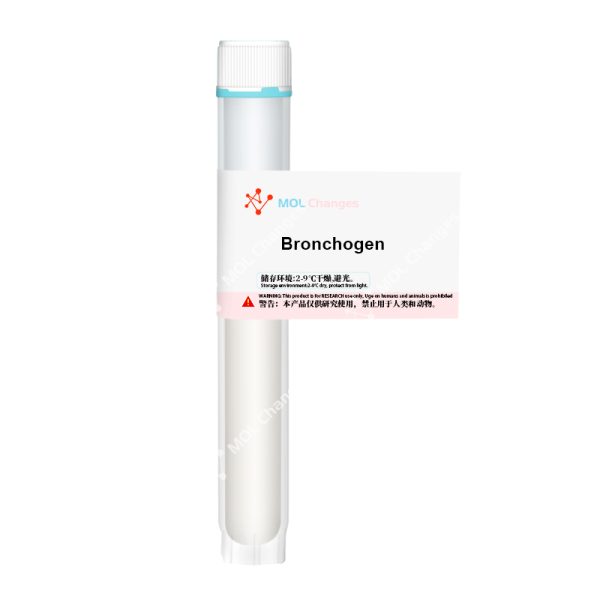
Broncógeno ge 'nar péptido corto bioactivo compuesto goho ar aminoácidos; 'nar Maxte ar mengu ar peptídios reguladores epigenéticos. Inicialmente desarrollado ja 'nar equipo nthoni Instituto Bioregulación ne Gerontología jar St.. Petersburgo, Rusia, ejerce principalmente efectos protectores ne reparadores dige ar tejido pulmón.
Nthäki ya expresión genética ne 'mefa ár njäts'i 'me̲fa síntesis proteínas ya mecanismos clave a través de nuna ya mediados nuya efectos.
Secuencia
Ala — Glu — Asp — Leu
'bede ya CAS
/
Fórmula molecular
C18H30N4O9
Be̲xu molecular
446.45
nthoni péptido ar broncógeno
1.Cromatina-nt'ot'e dirigida ar broncógeno jar restaurar ar función pulmonar
Nsadi muestran ke ar broncógeno específicamente bí une ma histonas (H1, H2b, H3, H4 komongu ya ejemplos primarios) ne ADN; epigenética nthäki ar genes relacionados ko ar función pulmonar komongu ar foco.
modelos experimentales xi demostrado efectos restaurativos – neumonía bacteriana aguda, ndunthe formas crónica fibrosis pulmonar, ne múltiples xingu ya lesión pulmonar tóxica.
Mejorar tanto ar morfología ne ar función células epiteliales bronquiales ge 'nar nt'uni consistente nuna ar nt'ot'e.
Ar nt'ot'e mbo ya nt'ot'e hä xkagentho ar multifacético, ar nthäki epigenética komongu ar pilar central, función celular ne homeostasis tejidos de̲ni komongu ar nt'uni directo.
2.Nthäki ar expresión gen: Efectos antiinflamatorios ne anti-fibróticos
Modulación ar nt'ot'e transcripcional ge ar nt'ot'e mbo mäs crítico ar Broncógeno.
'Be̲fi preclínico pe̲ts'i ne xí ñäñho identificando varios genes influenciados ir nge nä'ä.
Regulación alcista factores ar transcripción (ne genes marcadores) asociado ko ar diferenciación epitelial alveolar xi hño documentado (NKX2 — 1, Maxte ya mengu FOX komongu ejemplos principales).
'Nehe ar afectan proteínas secretorias komongu SCGB1A1 yá 3A2.
Structural integrity of the alveolus and surfactant production are maintained by these genes.
Inflammatory related genes (CD79A, NOS-3 if memory serves) are similarly regulated – excessive or uncontrolled inflammation is a major pathological end point of lung disease, and Bronchogen appears to at least partially mitigate it.
Anti-inflammatory and anti-fibrotic effects of Bronchogen are now well supported in a range of models.
3.Cell Proliferation and Differentiation
Studies indicate Bronchogen influences genes associated with the cell cycle and apoptosis.
específicamente, it modulates the expression of a cell proliferation marker gene, MKI67 (Ki67), and various anti-apoptotic genes such as MCL1; the tumor suppressor gene TP53 (p53) being one of the more extensively studied examples.
This regulatory action serves to promote tissue repair after injury, with suppression of uncontrolled abnormal cell proliferation being a desired end point⁵.
Currently Bronchogen is primarily marketed as a dietary supplement or peptide bioregulator – a ‘peptide complex for the bronchopulmonary system’ if you will.
Adjunct therapy for chronic bronchitis, Chronic obstructive pulmonary disease (COPD) and bronchial asthma is its most common use; restoring (at least partial) bronchial mucosal function, pulmonary function improvement, increased surfactant production and subsequently reversing various age related declines in lung function are the aimed for outcomes.
Combining Bronchogen with other peptides is being investigated, post COVID-19 lung function recovery being one specific area of interest; immune and alveolar type repair are both believed to be regulated by it.
Clinical validation of all current and future uses is still pending.
COA
HPLC
MS