What the KRAS G12D Deal and Biotech Supply Chains Actually Involve
ක්රියාත්මකයි 2026-09-28, Merck entered an exclusive global license agreement with SciBrunch Therapeutics for SPR2015, an investigational oral KRAS G12D (ON) inhibitor. Merck paid $400 million upfront against a stated total potential value of $2.13 බිලියන, and took worldwide exclusive rights to develop, manufacture and commercialize the compound (Merck & Co. newsroom release, 2026-09-28). The asset is preclinical: a molecular glue with nanomolar antiproliferative activity in mutant cell lines, not yet tested in humans.
Two details frame the transaction. පළමුව, the licensor is young and concentrated: SciBrunch is headquartered in Shanghai and was founded in late 2024 (Merck & Co. newsroom release, 2026-09-28). දෙවනුව, Merck will book a $400 million pre-tax charge, ගැන $0.13 per share, in its Q3 2026 results (RTTNews, 2026-09-28).

ද $1.73 billion difference between the $400 million upfront and the $2.13 billion headline is milestone headroom, not a published payment schedule. ලෙස one specialist trade analysis of the terms points out, 18.8% of the advertised total is committed money, and the milestone split, royalty rate and territorial carve-outs were not disclosed (Small Molecule News, 2026-09-29).
The founder’s prior out-licensing track record is part of the deal’s context: chairman and CEO Tao Hu previously led the global exclusive licensing of preclinical oncology program UA022 to AstraZeneca in 2023, and he and co-founder Yang Zhang came from WuXi AppTec, with Hu having earlier worked at Merck and Amgen in the US (Small Molecule News, 2026-09-29).
Why This Deal Matters for Biotech Supply Chains
That $400 million upfront is best read as a statement about competition, not about the asset’s maturity. Revolution Medicines’ zoldonrasib (RMC-9805) is already in Phase 1/1b in KRAS G12D-mutant solid tumors with 2026 data and a Phase 3 first-line pancreatic trial, and it received FDA Breakthrough Therapy designation in January 2026 (Revolution Medicines, 2026-01-08). Paying that price for a preclinical entry reflects competition for differentiated RAS-pathway candidates (Pharmaceutical Technology, 2026-09-28).
That structure moves chemistry, manufacturing and controls work earlier. Because Merck acquired manufacturing rights at the preclinical stage, synthetic routes, analytical methods and specifications will likely need transfer ahead of first-in-human studies, ස්ටීරියෝ රසායන විද්යාව සමඟ, impurity profile and solid-form control central to comparability (Pharmaceutical Technology, 2026-09-28). Where that work runs is not neutral: the same analysis notes FDA is adding resources for foreign inspections, including more Phase 1 and early-stage trials (Pharmaceutical Technology, 2026-09-28). Cross-border tech transfer documentation becomes a live constraint at the point of transfer, not at filing.
The volume behind deals like this is large and rising. Vision Life Sciences reports roughly $136 billion across about 157 disclosed China out-licensing deals in 2025, against about $51.9 බිලියන හරහා 94 deals in 2024, with roughly $60 billion in Q1 2026 තනියම (Vision Life Sciences, පළ කළා 2026-06-27). Treat those as ranges: publishers define deal value differently, and the figures are disclosed totals rather than audited sums.
Three stakeholders read this differently. Large pharma sponsors gain an earlier claim on a differentiated candidate but inherit the transfer burden sooner. China-origin biotechs licensing out gain upfront capital and lose direct control of the route and method package. Synthesis and analytical partners serving both absorb the work: ක්රමය සංවර්ධනය, specification setting and documentation that now sit before first-in-human studies rather than after.
What This Demands of Synthesis and Analytical Partners
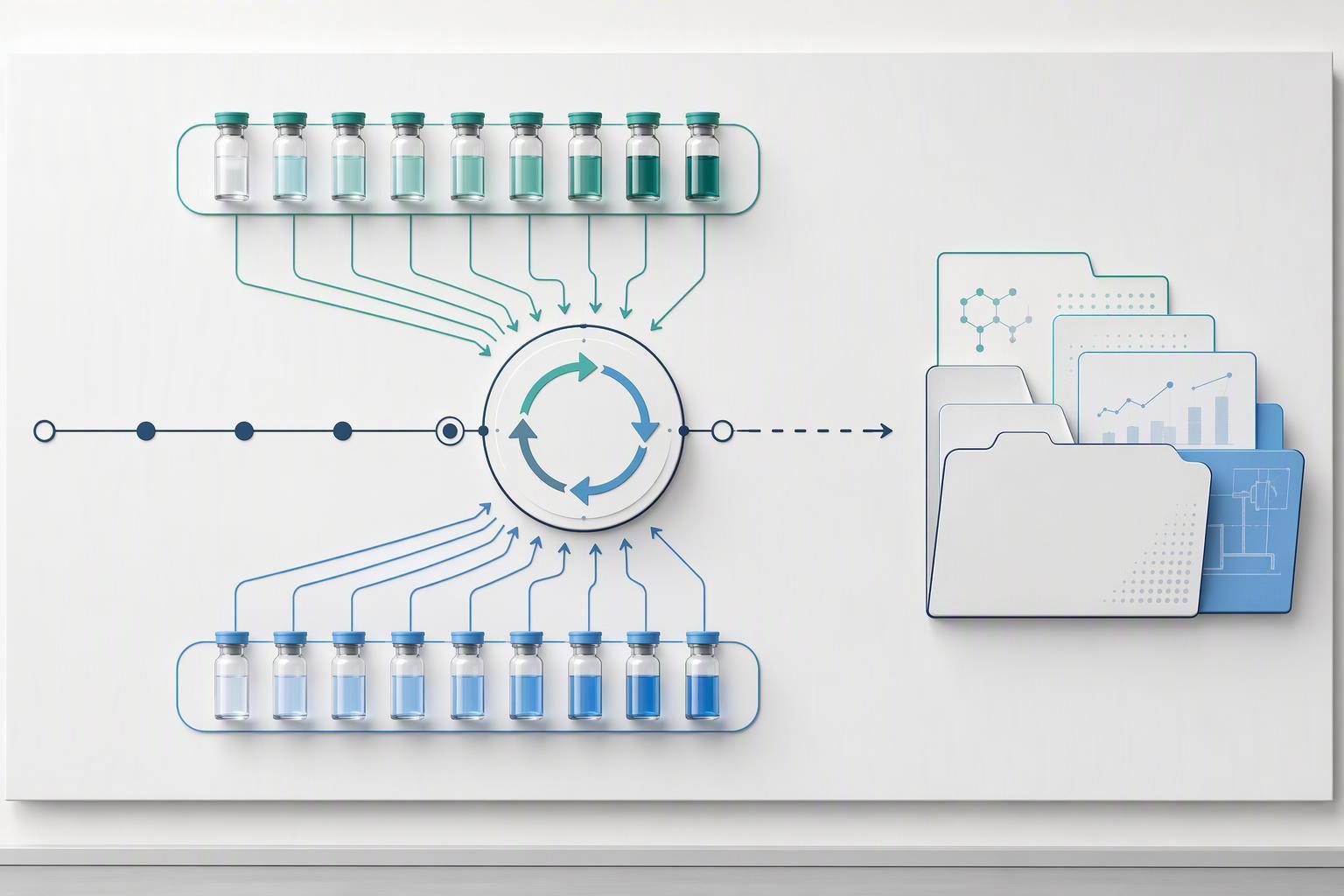
A molecular glue stabilizes a ternary complex rather than occupying the KRAS pocket (Thoracic Cancer review of KRAS G12D inhibitor design, දෙසැම්බර් 2025), so stereochemistry, impurity profile and solid form become comparability levers that must hold across sites and scales.
What travels in a transfer package is the method, the reference materials, the specification and the raw data. What often does not travel is the tacit knowledge behind them, which is why the receiving lab has to re-satisfy I Q2(R2) Validation of Analytical Procedures (final, මාර්තු 2024). Analytical method transfer is quoted by CDMOs at $150,000 දක්වා $400,000 per package, with repeat qualification at $20,000 දක්වා $100,000 per method (Drug Patent Watch CDMO price benchmarking, මාර්තු 2026). Treat those as vendor-adjacent estimates with high vendor bias, not market rates.
“High purity” in a filing is defined by ICH Q3A(R2) Impurities in New Drug Substances, where the thresholds sit in the PDF rather than the landing page. A certificate of analysis reporting one number without the impurity profile behind it says little about whether that profile survives scale-up. On difficult sequences, GenScript reports 93.81% success in its NeoPre dataset (1,030 delivered of 1,098 attempted) on its technical advances page. That is one supplier’s measured performance on its own definition of “difficult,” not an industry rate.
A note on our evidence: no third-party benchmark, no auditable first-party performance data and no vendor case study were available for this analysis. What follows is a framework of criteria to apply, not validated results.
නිර්ණායකය
What to ask
What a weak answer looks like
Cycle time
Typical turnaround for a 40-analog SAR batch, and what drives variance?
A single best-case number with no variance range
Right-first-time purity
Against what specification, measured how, on how many batches?
“>95% purity” with no specification or batch count
Impurity-profile comparability
Automated Peptide Synthesizer How is the profile shown to hold from mg to kg?
A claim that profiles “stay consistent” with no data
Stereochemical control
Neuroscience Research Area Which stereocenters are critical, Biosynthesis Of Peptide Hormone and how is each controlled?
Diastereomer ratio quoted without method or detection limit
Method-development capability
Is method development run alongside synthesis or after it?
Analytical work quoted as a separate, later phase
Documentation and chain of custody
Can you show timestamps, handlers Bones And Joints Research and transfer purpose per lot?
A COA with no underlying raw data trail Cancer Apoptosis Research
IP හැසිරවීම
How are trade secrets ring-fenced across sites and borders?
Reliance on an NDA alone, with no operational controls Peptide Hormone Synthesis
Two rows carry more weight for a cross-border program. Chain-of-custody and data-integrity records, plus the licensing documents establishing title and scope, are what make a package portable between a China-origin licensor and a US licensee; China-side formalities can include technology export contract registration and, for covered data, CAC mechanisms (ජේ. Chang Law on licensing technology from China, ජනවාරි 2026). That is practitioner guidance, not settled regulatory text. The GMP paper trail that follows the API is governed separately under ICH Q7 Good Manufacturing Practice Guidance for Active Pharmaceutical Ingredients (final, සැප්තැම්බර් 2016), and the development story the route has to tell is set out in ICH Q11 Development and Manufacture of Drug Substances (final, නොවැම්බර් 2012), mapping to CTD Module 3 sections 3.2.S.2.2 through 3.2.S.2.6.
One pattern worth testing in a conversation: whether a partner runs method development alongside synthesis rather than after it. MOL Changes is one example of a partner structured that way. Ask every candidate the same question and compare the answers directly.
Shorter molecule optimization cycle time rarely comes from faster chemistry alone. It comes from analytical work running in parallel, a transfer package assembled before candidate nomination, and cross-border tech transfer documentation a receiving lab can act on without a phone call.
The Bigger Picture and What to Do Now
The Merck transaction fits a pattern that predates it: preclinical-stage, cross-border licensing in which manufacturing rights move early, before a candidate has a clinical readout. The same founder’s earlier preclinical oncology licensing with AstraZeneca followed that shape in 2023, and the 2026 clinical-stage KRAS G12D readouts sit at the other end of the same arc. Two consequences follow for anyone sourcing synthesis capacity. Transfer readiness has become a gating item rather than an administrative one, and the scrutiny that shapes site selection now includes foreign-origin inspection exposure, per FDA guidance on foreign inspection practices.
Four steps, ordered by urgency:
-
Audit your transfer package before candidate nomination. If the documentation set is not assembled by then, it becomes the critical path.
-
Qualify the potency assay early. Practitioner reporting in Drug Discovery News puts assay qualification at 6 දක්වා 12 මාස, which is longer than most programs plan for.
-
Confirm chain-of-custody and analytical-data ownership terms before the licensing boundary is crossed. These are harder to renegotiate afterward.
-
Budget the handover, don’t absorb it. Treat transfer cost and time as a line item, not a contingency.
Do NOT:
Assume a nominal purity percentage substitutes for impurity-profile comparability across scale.
Defer method transfer until after candidate nomination.
If you are evaluating partners for a program like this, talk to a technical expert about what your transfer package needs to contain.
හෙළිදරව් කිරීම: MOL වෙනස්කම් පෙප්ටයිඩ තත්ත්ව ප්රමිතීන් සඳහා වාණිජ උනන්දුවක් දක්වයි.
නිතර අසන ප්රශ්න
What did Merck actually buy, and at what stage?
Merck gained worldwide exclusive rights to develop, manufacture and commercialize SPR2015, an investigational oral KRAS G12D (ON) inhibitor (Merck & Co. newsroom release, 28 සැප්තැම්බර් 2026). SciBrunch Therapeutics received a $400 million upfront payment, and the total potential aggregate value of the transaction, including that upfront, reaches $2.13 බිලියන. The deal has closed.
Has SPR2015 been tested in humans?
නැත. Merck describes SPR2015 as a potent and selective investigational preclinical molecular glue with nanomolar antiproliferative activity in KRAS G12D-mutant cell lines (Merck & Co. newsroom release, 28 සැප්තැම්බර් 2026). Everything below concerns sourcing and supply practice, not medical advice.
What changes for a synthesis or analytical partner serving a program like this?
Transfer readiness moves earlier, and potency assay qualification becomes the long pole. A partner that cannot qualify an assay before the sponsor needs it slows the whole handover.
Does the deal change demand for peptide synthesis capacity?
One market-research estimate puts peptide synthesis at USD 732.58M in 2026, reaching USD 1,438.78M by 2035 (ප්රමුඛතා පර්යේෂණ, 2026), while a second estimate, on a different scope, gives USD 0.98B in 2026 rising to USD 1.54B by 2031 (වෙළඳපල සහ වෙළඳපල, 2026). Publisher scope definitions diverge by up to 3x, so treat no single figure as load-bearing.
නිගමනය
Merck’s $400 million KRAS G12D deal is best read as a data point about how early assets are valued, not as a verdict on the sector. The operational consequence is narrower and more actionable: transfer readiness is now a gating item in licensing diligence, and partners who cannot demonstrate it early slow a program down at exactly the moment speed matters most.
That shifts the evaluation criteria you should be applying. Cycle time, right-first-time purity against a stated specification, impurity-profile comparability across scale, method-development capability, documentation and IP handling are the questions worth asking before a program is signed, පසුව නොවේ. A flexible peptide synthesis partner is judged on those six points, and on how much of the evidence is already in hand rather than promised.
The forward-looking question is whether preclinical-stage manufacturing-rights transfer becomes the default rather than the exception. If it does, the partners who prepared for it will be the ones programs reach for first.
Talk to a technical expert or request a feasibility assessment to see how your program’s transfer readiness holds up against these criteria.