Cosa comportano effettivamente l’accordo KRAS G12D e le catene di fornitura biotecnologiche
SU 2026-09-28, Merck ha stipulato un accordo di licenza globale esclusivo con SciBrunch Therapeutics per SPR2015, un KRAS G12D orale sperimentale (SU) inibitore. La Merck ha pagato $400 milioni in anticipo rispetto ad un valore potenziale totale dichiarato di $2.13 miliardi, e ha preso i diritti esclusivi a livello mondiale per lo sviluppo, produrre e commercializzare il composto (Merck & Co. comunicato stampa, 2026-09-28). La risorsa è preclinica: una colla molecolare con attività antiproliferativa nanomolare in linee cellulari mutanti, non ancora testato sugli esseri umani.
Due dettagli inquadrano l'operazione. Primo, il licenziante è giovane e concentrato: SciBrunch ha sede a Shanghai ed è stata fondata tardi 2024 (Merck & Co. comunicato stampa, 2026-09-28). Secondo, Merck prenoterà una $400 milioni di euro al lordo delle imposte, Di $0.13 per azione, nel suo terzo trimestre 2026 risultati (RTTNews, 2026-09-28).

IL $1.73 miliardi di differenza tra il $400 milioni in anticipo e il $2.13 Il titolo da un miliardo è un margine fondamentale, non un programma di pagamento pubblicato. COME un'analisi commerciale specialistica dei termini sottolinea, 18.8% del totale pubblicizzato è denaro impegnato, e la divisione del traguardo, il tasso di royalty e le esclusioni territoriali non sono stati resi noti (Notizie sulle piccole molecole, 2026-09-29).
Il precedente track record di outlicensing del fondatore fa parte del contesto dell’accordo: il presidente e amministratore delegato Tao Hu ha precedentemente guidato la licenza esclusiva globale del programma di oncologia preclinica UA022 ad AstraZeneca in 2023, e lui e il co-fondatore Yang Zhang provenivano da WuXi AppTec, con Hu che aveva precedentemente lavorato presso Merck e Amgen negli Stati Uniti (Notizie sulle piccole molecole, 2026-09-29).
Perché questo accordo è importante per le catene di fornitura biotecnologiche
Quello $400 milioni in anticipo è meglio leggerlo come una dichiarazione sulla concorrenza, non sulla scadenza dell’attività. Zoldonrasib di Revolution Medicines (RMC-9805) è già in Fase 1/1b nei tumori solidi con mutazione KRAS G12D 2026 dati e una fase 3 studio pancreatico di prima linea, e ha ricevuto la designazione di terapia rivoluzionaria dalla FDA a gennaio 2026 (Farmaci rivoluzionari, 2026-01-08). Il pagamento di quel prezzo per un ingresso preclinico riflette la concorrenza per i candidati differenziati al percorso RAS (Tecnologia farmaceutica, 2026-09-28).
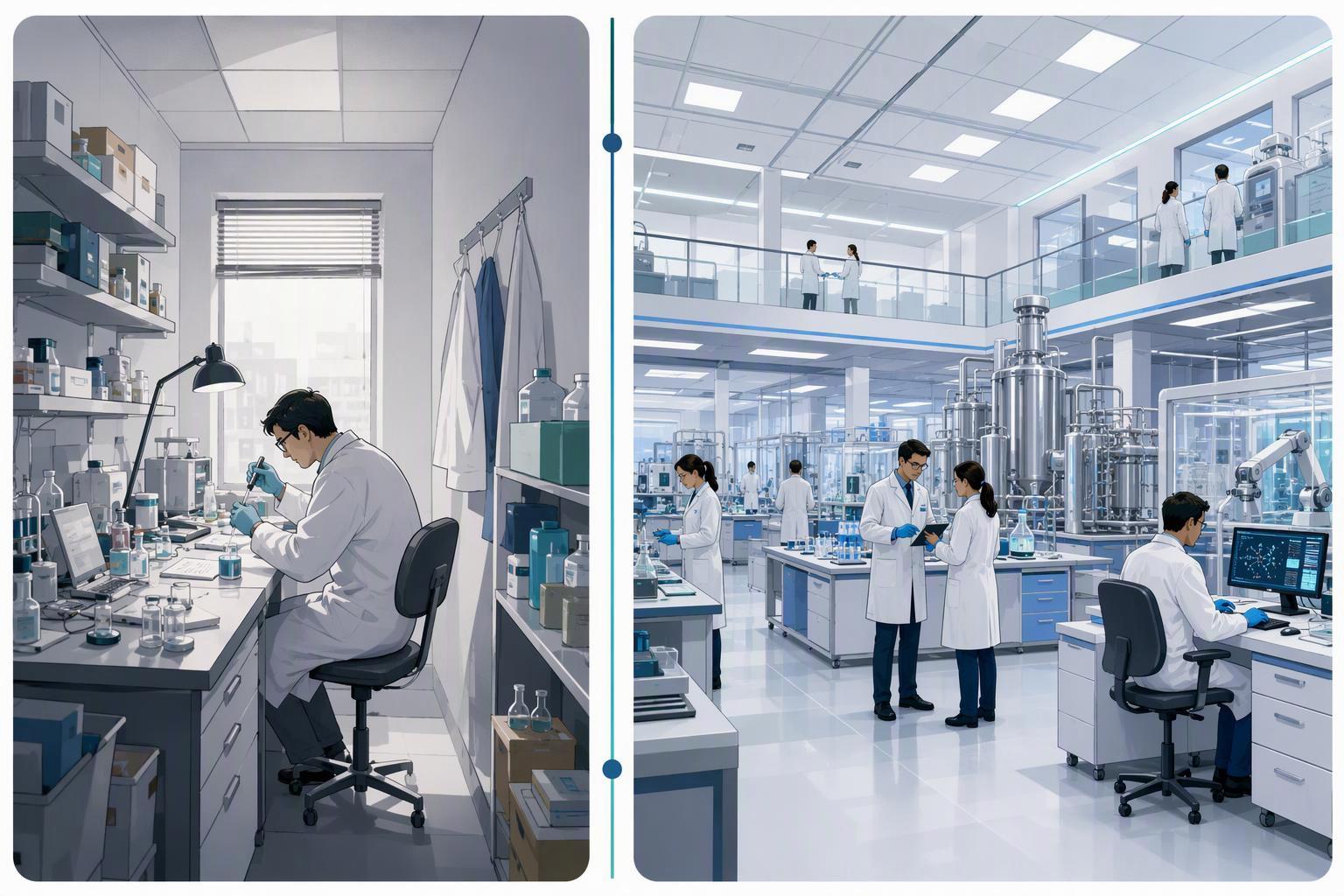
Quella struttura muove la chimica, la produzione e i controlli funzionano prima. Perché Merck ha acquisito i diritti di produzione nella fase preclinica, percorsi sintetici, i metodi e le specifiche analitiche dovranno probabilmente essere trasferiti prima dei primi studi sull’uomo, con la stereochimica, profilo delle impurità e controllo della forma solida fondamentali per la comparabilità (Tecnologia farmaceutica, 2026-09-28). Il luogo in cui si svolge questo lavoro non è neutrale: la stessa analisi rileva che la FDA sta aggiungendo risorse per le ispezioni straniere, inclusa più fase 1 e sperimentazioni in fase iniziale (Tecnologia farmaceutica, 2026-09-28). La documentazione relativa al trasferimento tecnologico transfrontaliero diventa un vincolo concreto al momento del trasferimento, non al deposito.
Il volume dietro operazioni come questa è ampio e in aumento. Vision Life Sciences riporta approssimativamente $136 miliardi in circa 157 ha reso noti gli accordi di out-licensing con la Cina 2025, contro circa $51.9 miliardi di diametro 94 si occupa di 2024, con approssimativamente $60 miliardi nel primo trimestre 2026 solo (Scienze della vita visiva, pubblicato 2026-06-27). Trattali come intervalli: gli editori definiscono il valore dell'offerta in modo diverso, e le cifre sono totali divulgati anziché somme verificate.
Tre stakeholder la leggono diversamente. I grandi sponsor farmaceutici ottengono una pretesa anticipata su un candidato differenziato, ma ereditano prima l’onere del trasferimento. Le società biotecnologiche di origine cinese che concedono licenze guadagnano capitale iniziale e perdono il controllo diretto del pacchetto di percorsi e metodi. I partner di sintesi e di analisi che servono entrambi assorbono il lavoro: sviluppo del metodo, l’impostazione delle specifiche e la documentazione che ora si trovano prima dei primi studi sull’uomo piuttosto che dopo.
Cosa questo richiede alla sintesi e ai partner analitici
Una colla molecolare stabilizza un complesso ternario anziché occupare la tasca KRAS (Revisione del cancro toracico del design dell'inibitore KRAS G12D, Dicembre 2025), quindi stereochimica, Il profilo delle impurità e la forma solida diventano leve di comparabilità che devono valere tra siti e scale diverse.
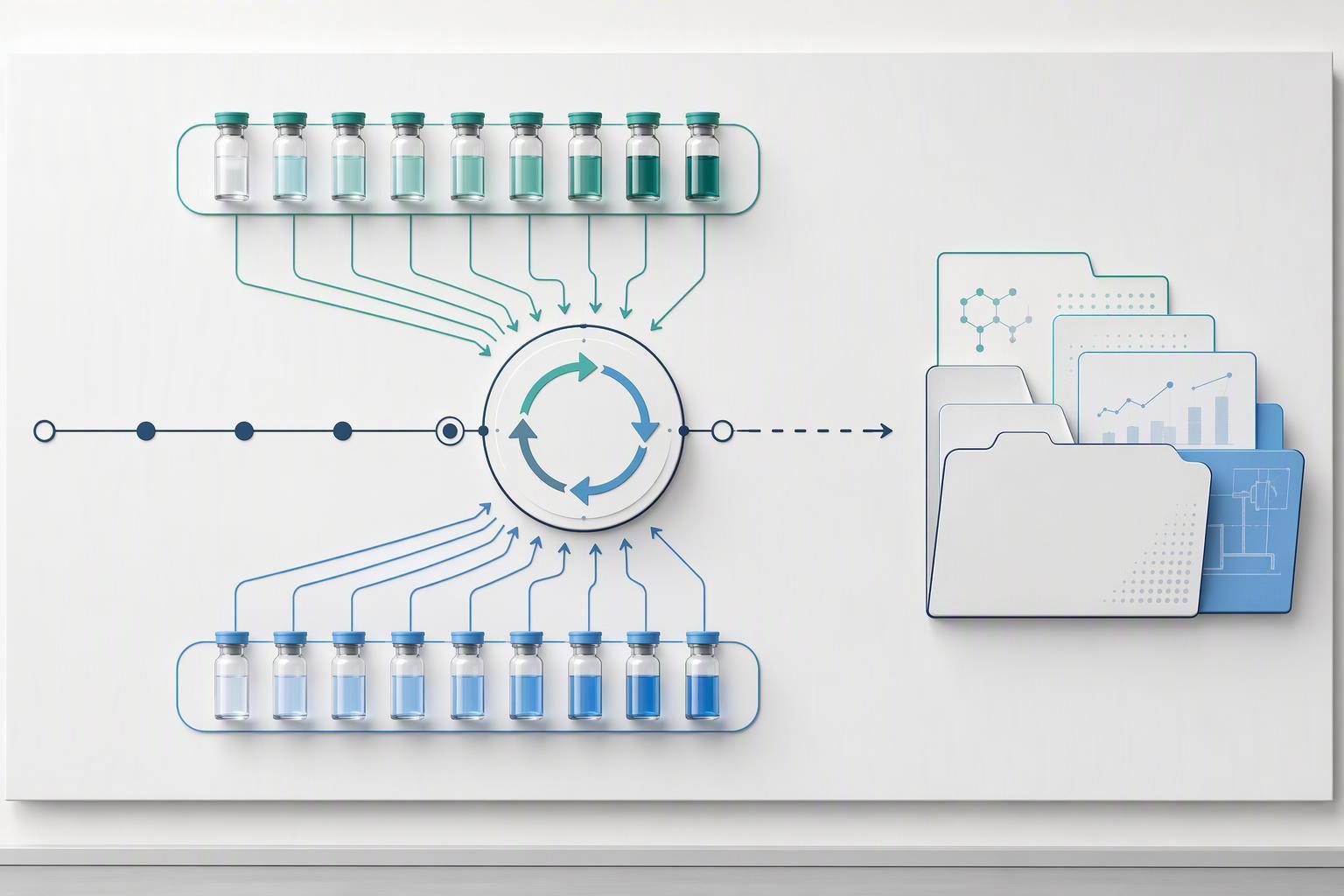
Ciò che viaggia in un pacchetto di trasferimento è il metodo, i materiali di riferimento, le specifiche e i dati grezzi. Ciò che spesso non viaggia è la conoscenza tacita che c'è dietro, ecco perché il laboratorio ricevente deve nuovamente soddisfare Io Q2(R2) Validazione delle procedure analitiche (finale, Marzo 2024). Il trasferimento del metodo analitico è citato da CDMO all'indirizzo $150,000 A $400,000 per confezione, con qualificazione ripetuta a $20,000 A $100,000 per metodo (Benchmarking dei prezzi CDMO per l'osservazione dei brevetti sui farmaci, Marzo 2026). Trattateli come stime adiacenti al fornitore con un'elevata distorsione del fornitore, non i tassi di mercato.
L'“elevata purezza” in un deposito è definita da Io Q3A(R2) Impurezze nelle nuove sostanze farmaceutiche, dove le soglie si trovano nel PDF anziché nella pagina di destinazione. A certificate of analysis reporting one number without the impurity profile behind it says little about whether that profile survives scale-up. On difficult sequences, GenScript reports 93.81% success in its NeoPre dataset (1,030 delivered of 1,098 attempted) on its technical advances page. That is one supplier’s measured performance on its own definition of “difficult,” not an industry rate.
A note on our evidence: no third-party benchmark, no auditable first-party performance data and no vendor case study were available for this analysis. What follows is a framework of criteria to apply, not validated results.
Criterio
Cosa chiedere
What a weak answer looks like
Cycle time
Typical turnaround for a 40-analog SAR batch, and what drives variance?
A single best-case number with no variance range
Right-first-time purity
Against what specification, measured how, on how many batches?
“>95% purity” with no specification or batch count
Impurity-profile comparability
Automated Peptide Synthesizer How is the profile shown to hold from mg to kg?
A claim that profiles “stay consistent” with no data
Stereochemical control
Neuroscience Research Area Which stereocenters are critical, Biosynthesis Of Peptide Hormone and how is each controlled?
Diastereomer ratio quoted without method or detection limit
Method-development capability
Is method development run alongside synthesis or after it?
Analytical work quoted as a separate, later phase
Documentation and chain of custody
Can you show timestamps, handlers Bones And Joints Research and transfer purpose per lot?
A COA with no underlying raw data trail Cancer Apoptosis Research
Gestione IP
How are trade secrets ring-fenced across sites and borders?
Reliance on an NDA alone, with no operational controls Peptide Hormone Synthesis
Two rows carry more weight for a cross-border program. Chain-of-custody and data-integrity records, plus the licensing documents establishing title and scope, are what make a package portable between a China-origin licensor and a US licensee; China-side formalities can include technology export contract registration and, for covered data, CAC mechanisms (J. Chang Law on licensing technology from China, Gennaio 2026). That is practitioner guidance, not settled regulatory text. The GMP paper trail that follows the API is governed separately under ICH Q7 Guida alle buone pratiche di produzione per gli ingredienti farmaceutici attivi (finale, settembre 2016), and the development story the route has to tell is set out in ICH Q11 Development and Manufacture of Drug Substances (finale, novembre 2012), mapping to CTD Module 3 sections 3.2.S.2.2 through 3.2.S.2.6.
One pattern worth testing in a conversation: whether a partner runs method development alongside synthesis rather than after it. MOL Changes is one example of a partner structured that way. Ask every candidate the same question and compare the answers directly.
Shorter molecule optimization cycle time rarely comes from faster chemistry alone. It comes from analytical work running in parallel, a transfer package assembled before candidate nomination, and cross-border tech transfer documentation a receiving lab can act on without a phone call.
Il quadro più ampio e cosa fare adesso
The Merck transaction fits a pattern that predates it: preclinical-stage, cross-border licensing in which manufacturing rights move early, before a candidate has a clinical readout. The same founder’s earlier preclinical oncology licensing with AstraZeneca followed that shape in 2023, e il 2026 clinical-stage KRAS G12D readouts sit at the other end of the same arc. Two consequences follow for anyone sourcing synthesis capacity. Transfer readiness has become a gating item rather than an administrative one, and the scrutiny that shapes site selection now includes foreign-origin inspection exposure, per FDA guidance on foreign inspection practices.
Quattro passi, ordered by urgency:
-
Audit your transfer package before candidate nomination. If the documentation set is not assembled by then, it becomes the critical path.
-
Qualify the potency assay early. Practitioner reporting in Drug Discovery News puts assay qualification at 6 A 12 mesi, which is longer than most programs plan for.
-
Confirm chain-of-custody and analytical-data ownership terms before the licensing boundary is crossed. These are harder to renegotiate afterward.
-
Budget the handover, don’t absorb it. Treat transfer cost and time as a line item, not a contingency.
Do NOT:
Assume a nominal purity percentage substitutes for impurity-profile comparability across scale.
Defer method transfer until after candidate nomination.
If you are evaluating partners for a program like this, talk to a technical expert about what your transfer package needs to contain.
Divulgazione: MOL Changes ha un interesse commerciale negli standard di qualità dei peptidi.
Domande frequenti
Cosa ha effettivamente comprato Merck?, e in quale fase?
Merck gained worldwide exclusive rights to develop, manufacture and commercialize SPR2015, un KRAS G12D orale sperimentale (SU) inibitore (Merck & Co. comunicato stampa, 28 settembre 2026). SciBrunch Therapeutics received a $400 million upfront payment, and the total potential aggregate value of the transaction, including that upfront, reaches $2.13 miliardi. The deal has closed.
SPR2015 è stato testato sugli esseri umani?
NO. Merck describes SPR2015 as a potent and selective investigational preclinical molecular glue with nanomolar antiproliferative activity in KRAS G12D-mutant cell lines (Merck & Co. comunicato stampa, 28 settembre 2026). Everything below concerns sourcing and supply practice, non un consiglio medico.
Cosa cambia per un partner di sintesi o di analisi al servizio di un programma come questo?
Transfer readiness moves earlier, and potency assay qualification becomes the long pole. A partner that cannot qualify an assay before the sponsor needs it slows the whole handover.
L’accordo modifica la domanda di capacità di sintesi peptidica?
One market-research estimate puts peptide synthesis at USD 732.58M in 2026, reaching USD 1,438.78M by 2035 (Ricerca sulla precedenza, 2026), while a second estimate, on a different scope, gives USD 0.98B in 2026 rising to USD 1.54B by 2031 (MercatieMercati, 2026). Publisher scope definitions diverge by up to 3x, so treat no single figure as load-bearing.
Conclusione
Merck’s $400 million KRAS G12D deal is best read as a data point about how early assets are valued, not as a verdict on the sector. The operational consequence is narrower and more actionable: transfer readiness is now a gating item in licensing diligence, and partners who cannot demonstrate it early slow a program down at exactly the moment speed matters most.
That shifts the evaluation criteria you should be applying. Cycle time, right-first-time purity against a stated specification, impurity-profile comparability across scale, method-development capability, documentation and IP handling are the questions worth asking before a program is signed, non dopo. A flexible peptide synthesis partner is judged on those six points, and on how much of the evidence is already in hand rather than promised.
The forward-looking question is whether preclinical-stage manufacturing-rights transfer becomes the default rather than the exception. Se lo fa, the partners who prepared for it will be the ones programs reach for first.
Talk to a technical expert or request a feasibility assessment to see how your program’s transfer readiness holds up against these criteria.