What does “peptide CDMO partner” mean when the relationship is integrated rather than transactional?
The difference is not how many services a vendor lists. It is who holds the knowledge about your molecule between stages.

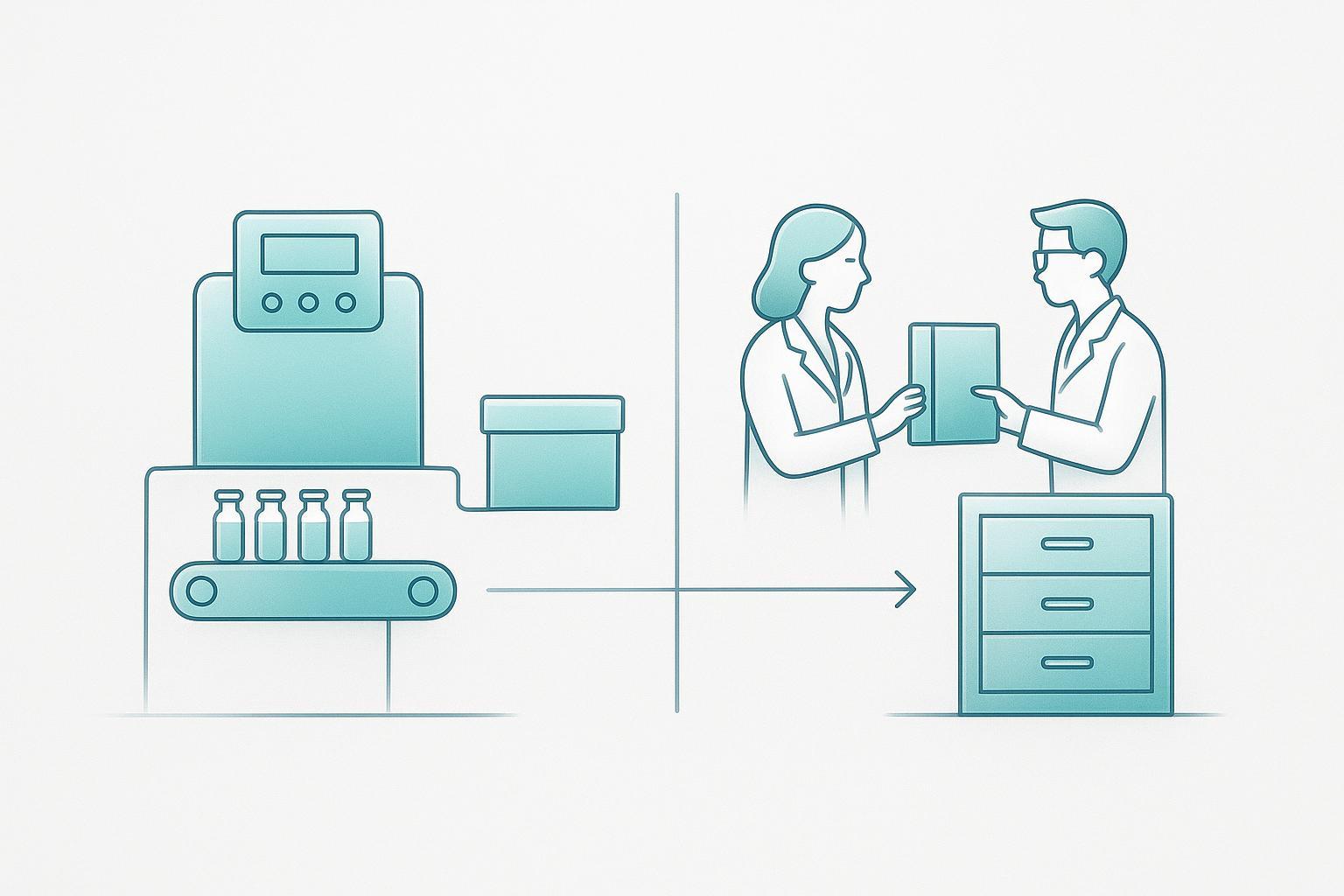
Услуге In transactional peptide sourcing, the vendor executes a single batch and the engagement ends, so each new phase restarts technology transfer. In integrated peptide development, one technical team stays on the molecule across phases, which is what makes continuity possible rather than merely promised.
Continuity is a set of verifiable conditions, not a relationship label. It requires pre-qualified backup supply, lot-to-lot analytical comparability under the same identity and purity standards, disclosed method detail and raw data, full batch traceability from vial back to synthesis records, and written change governance that requires notification before any material change to synthesis site, QC method, raw materials, пречишћавање, packaging or labelling. A vendor that treats any one of those as an assumption rather than a verified condition has not solved continuity, whatever the contract calls the relationship. Those five conditions form a continuity checklist you can take to your next vendor review.
Кеи Такеаваи: Transactional sourcing buys a batch and ends the engagement. An integrated peptide CDMO partner keeps one team and one knowledge chain on the molecule across every stage that follows.

Quick comparison: transactional sourcing vs an integrated peptide CDMO partner
That distinction is easier to see side by side, so the table below scores both models across the categories that decide a procurement.
|
Категорија |
Transactional peptide sourcing |
Integrated peptide CDMO partner |
|---|---|---|
|
Best for |
Defined, off-the-shelf sequences with no route development, no scale-up, and no regulatory filing attached |
Programs moving toward IND-enabling work, scale-up, or a commercial filing |
|
Who owns the synthetic route |
Supplier; you receive a certificate of analysis, not the route |
Shared; route knowledge stays with the program across stages |
|
Analytical method ownership |
Supplier’s in-house methods; you receive results, not raw data |
Methods and raw data transfer with the program |
|
Tech transfer burden on switch |
Full re-transfer: $300,000–$800,000+ и 6–12 months to first cGMP campaign (PeptideStaff, retrieved 2026-09-04) |
Lower, because the receiving site already holds the route and methods |
|
Change notification |
Route or site changes may reach you only as a new certificate |
Change control runs through a shared quality agreement |
|
DMF maintenance |
Separate DMF updates or amendments each time you move |
One DMF kept current across stages |
|
Scale-up path |
Re-sourced at each scale, often re-validated |
Continuous from milligrams to kilograms |
|
Cost profile |
Lower per gram at small scale |
GLP-1 API cGMP indicative pricing runs $2,500–$5,000/g at 1–10 kg, falling to $400–$800/g at 100+ kg (PeptideStaff, retrieved 2026-09-04) |
|
Our verdict |
Wins for one-off, Схоп non-filing quantities |
Wins once a program must survive a switch, a scale-up, or an inspection |
Two caveats on the numbers. The transfer and dual-sourcing figures are directional: PeptideStaff discloses no methodology, so treat them as planning ranges rather than quotes. And several major CDMOs now set minimum commercial batch commitments of 50–100 kg, which changes the economics for any program that cannot commit at that volume.
Стаге 1: Custom synthesis and modification — who owns the route?
Пептиде Синтхесис The integrated partner wins this stage, and the reason is not capacity. It is that route knowledge, not the batch, is the asset. A transactional supplier delivers vials and an invoice; an integrated partner delivers the synthesis route, the rationale behind each coupling and deprotection choice, and the record of what was tried and rejected.
Reported SPPS practical limits differ by source, and the disagreement matters more than any single figure. Neuland Labs puts the practical ceiling at roughly 30 да 40 аминокиселине, while a PharmaSource category guide reports 50 да 70 residues achievable with optimised chemistry. Both are describing solid-phase peptide synthesis under different assumptions about resin, coupling reagents and purification tolerance, which is exactly why a route should be judged against your sequence rather than against a headline number.
The failure mode is concrete. A 40-residue modified chain can synthesise acceptably at small scale and then aggregate during purification, collapsing yield at the point where the material is most expensive. Bachem’s knowledge centre notes that GLP-1 analogues typically run 30 да 40 amino acids or more, and that scale moves from milligrams and grams at discovery through kilograms in clinical development to multi-kilogram commercial campaigns. A route that has not been stress-tested against that progression is a route you will redevelop later, usually under time pressure.
Counterion exchange belongs in the same conversation. Trifluoroacetate is the default counterion left behind by standard reverse-phase purification, and swapping it for acetate or chloride changes the salt form, the residual TFA profile and the impurity picture your later analytical work will report. If the supplier controls that decision without telling you, your Stage 2 results will describe a material you did not intend to specify.
Verdict: the integrated partner wins on custom peptide synthesis and modification, because the route, its counterion strategy and the reasoning behind both transfer with the relationship. A transactional supplier can match the batch and still leave you with nothing to build on.
Стаге 2: Analytical testing — whose methods, whose raw data?
An integrated partner wins this stage because method ownership and raw-data access are what make a later switch survivable. A transactional supplier sends a certificate of analysis; an integrated partner can hand over the disclosed method details and raw data behind that certificate: the actual chromatogram, the column and gradient used, and orthogonal confirmation such as amino acid analysis. That distinction matters most when purity is hard to hold. Peptide API specifications usually cap individual impurities at ≤0.1%, and reaching >95% purity at kilogram scale often requires multi-step preparative HPLC plus controlled lyophilisation, which is why a process that works at 100 mg can fail at 10 kg. For pharmaceutical-grade material, expect ≥95% purity and ask for batch records showing >98% purity plus a full impurity profile. Confirm the technique set covers HPLC or UPLC, ЛЦ-МС, MALDI-TOF, анализа аминокиселина, LAL endotoxin testing per USP <85>, and sterility per USP <71>, and that methods are validated to ICH Q2(Р2) expectations. If the material is research-grade and no filing depends on it, a transactional COA is enough.
Стаге 3: Process development and scale-up — where the transactional model breaks
Transactional sourcing stops working here because scale changes the process, not just the batch size. A route that delivers a gram at high purity can fail at kilogram scale once chromatography load, solvent volumes and impurity profiles shift. The mg-to-kilogram progression in peptide manufacturing runs from milligram and gram discovery quantities through kilogram clinical supply to multi-kilogram commercial batches, and each step is a new process to qualify rather than a larger version of the last one.
Capacity planning has a second trap. As DataM Intelligence notes in its peptide CDMO market report, announced reactor volume does not immediately become customer-ready capacity, because new assets must clear construction, equipment commissioning, process qualification and validation first. Limited qualified commercial-scale capacity is a high-impact restraint on the market.
Directional stage-by-stage peptide manufacturing timelines from CDMO Hub put clinical GMP work at 3 да 6 months and commercial scale-up at 12 да 24 months or more, with validation and filing adding 6 да 12 months. Treat these as planning ranges, not commitments: the guide cites no methodology, and actual timelines depend on route complexity, impurity control strategy and the receiving site’s own qualification load.
Стаге 4: Change governance and the real cost of switching mid-program
An integrated peptide CDMO partner wins on switching cost, and the gap is wide enough to change a procurement decision. Published estimates put the cost of switching peptide CDMO partners mid-program at $300,000 да $800,000 or more, са Синтхетиц Пептидес 6 да 12 months to the first cGMP campaign and a further 10 да 20 percent added for dual sourcing. Those figures are directional and the methodology behind them is not disclosed, so treat them as a planning range rather than a quote.
The regulatory layer compounds the money. A transactional model means separate DMF updates or amendments each time a supplier, site or method changes, and analytical methods usually need revalidation on top of that. An integrated relationship keeps one DMF current instead.
Two mechanisms reduce that burden when they are planned in advance. ICH Q12’s change-management protocol, published 19 November 2019, lets a sponsor agree acceptance criteria prospectively, so an executed protocol carries less regulatory load than a full prior-approval submission. The FDA’s comparability-protocol framework works the same way: tests, studies and acceptance criteria are written before the change, and the manufacturer validates effects on identity, strength, quality, purity and potency before distribution.
Note the trigger point. Switching the drug substance site triggers a regulatory notification whenever the facility differs from the approved application, intermediate sites included. That is why written change governance before any material change belongs in the contract: notification ahead of any shift in synthesis site, QC method, raw materials, пречишћавање, packaging or labelling. Batch-record traceability across those changes should meet MHRA ALCOA data-integrity expectations, so the audit trail survives the switch even if the partner does not.
Стаге 5: What a written transfer package should contain
A written peptide tech-transfer package should contain four blocks: процес (synthetic route, conditions, reagents, critical parameters); аналитичке методе (ХПЛЦ, МС, release methods, reference standards); specifications (чистота, impurity limits, идентитета, content criteria); and materials and history (raw-material sources, prior batch records, known risks) (Global Biotech Laboratories, retrieved 2026-09-02). Incomplete packages typically miss critical process parameters, undocumented known issues, or unstated specifications.
За савет: Start with analytical method transfer. Methods must be reproduced and verified before they gate any batch, so sequencing it first removes the most common cause of stalled technical dialogue.
The documented sequence runs kickoff and gap assessment, documentation transfer, analytical method transfer, a non-GMP demonstration batch, then confirmation and scale (Global Biotech Laboratories, retrieved 2026-09-02). That source is a CDMO that sells transfer services, so treat its timeline, “a matter of weeks to a few months” for a well-prepared transfer with complete documentation and a dedicated technical lead, as vendor-favourable rather than neutral.
Must-have criteria vs red flags: how to score any peptide CDMO partner
A vendor that cannot answer the method question will not survive a switch. Score any peptide CDMO partner on the two lists below, and keep them apart: must-haves are what you require in writing before you sign, red flags are what you walk away from.
Must-haves
-
Disclosed method detail and raw data, not summaries
-
A written change-notification clause
-
Batch traceability from vial back to synthesis and QC records
-
A named technical lead, not a shared inbox
-
A stated scale-up path with qualification milestones
Red flags
-
COA-only responses to method questions
-
No documented change-control procedure
-
A transfer package missing critical process parameters
-
Capacity claims built on announced reactor volume, which does not immediately become customer-ready capacity
-
Single-site dependency with no pre-qualified backup
Treat the must-have list as a continuity checklist you can take to your next vendor review.
Who should choose which model
If your program is research-grade or screening-stage, with no filing dependency and a molecule you may abandon next quarter, transactional peptide sourcing is genuinely the right call. You get a catalog or custom quote, a certificate of analysis, and no relationship overhead. Nothing in an integrated peptide development model earns its premium at that stage.
Once a program heads toward IND-enabling work, the calculus flips. Method transfer and impurity profiling compound: each new phase restarts technology transfer, and the analytical history you built in the previous one has to be rebuilt by whoever takes the next stage. A partner who already holds the route, the methods and the raw data removes that restart.
Programs running on an incumbent supplier that is showing failure signals need a third path: an integrated partner plus a pre-qualified backup, with the cost of switching peptide CDMO partners mid-program budgeted before you need it, not after.
One edge case deserves honesty. If the molecule is a short unmodified peptide on a mature route, the continuity premium buys less. The route is commoditized, methods are standard, and a transactional supplier can hand over a complete package without much loss.
Where continuity does pay is across stages that share data. A partner that supports route development, analytical method ownership and scale-up under one quality system can be used to carry the same impurity profile from milligram screening into kilogram production, which helps when a regulator asks how a specified impurity was controlled at each stage. That is the mechanism, not a slogan: fewer handoffs, fewer re-validations, one traceable dataset.
Често постављана питања
Can I switch peptide CDMO partners mid-program?
Yes, but treat it as a project, not a purchase order. A mid-program switch is feasible; the constraint is the cost of switching peptide CDMO partners mid-program, which is directional at roughly $300,000 да $800,000 and six to twelve months once method revalidation and separate Drug Master File amendments are counted. Sequence matters more than speed: transfer and revalidate the analytical methods first, then qualify the new route, and only then commit a batch. Starting with the batch inverts the order and usually forces a repeat.
Can I use a transactional supplier and an integrated partner together?
Yes, and many programs do. The split that holds up is transactional sourcing for research-grade or non-filing material, with the integrated partner owning the filing-relevant route and methods. Two conditions make it work. First, budget the dual-sourcing premium, since running two supply paths costs more than either alone. Second, put written change governance before any material change in place, so a supplier swap on the screening side cannot silently alter what the filing depends on.
Which model gives better analytical control?
The integrated model, because raw-data access and method ownership are the levers, not the instrument list. Impurity control is where that shows: releasing a peptide above 95% at kilogram scale typically needs multi-step preparative HPLC, and pharmacopoeial expectations for related substances sit at or below 0.1% for individual impurities (USP, retrieved 2026-09-15). Ask any partner for batch records showing >98% purity plus a full impurity profile, and for the underlying chromatograms rather than the summary table.
Is announced peptide manufacturing capacity the same as available capacity?
бр. Announced reactor volume does not immediately become customer-ready capacity, because construction, commissioning, process qualification and validation all have to complete first. Read the current expansion announcements as pipeline, not availability: CordenPharma’s €500 million peptide plant near Basel targets commercial operations in H1 2028, Bachem’s Sisslerfeld facility is expected in 2030, and WuXi AppTec’s Taixing expansion has brought total SPPS reactor volume above 100,000 Л (DataM Intelligence, 2026). Plan against qualified lines, not headline litres. Производња пептида
Is transactional peptide sourcing still worth using?
Yes, within a boundary. Transactional peptide sourcing is the right model for research-grade material and early screening, where no filing depends on the route or the methods, and where speed and unit price dominate. It stops being adequate once the program needs IND-enabling work, impurity profiling against a defined threshold, or a validated scale-up path. The signal to watch is not batch size but dependency: the moment a regulatory submission rests on a route or a method, the transactional model no longer covers the risk.
Следећи кораци
Choose transactional peptide sourcing when you need a defined molecule at a defined specification and nothing downstream depends on the supplier’s knowledge. Choose an integrated peptide CDMO partner when the program moves from screening toward IND-enabling work and continuity of route, methods and data becomes the thing you are actually buying.
If you are re-evaluating a partner mid-program, the fastest way to test the relationship is to ask for the written transfer package described in Stage 5 and see how much of it exists. A partner that can produce it quickly is already operating the way you need. Абоут
Talk to our technical team if you want to walk through your program’s stage and the criteria that matter most at it.
Откривање: MOL Changes has a commercial interest in peptide quality standards and works with sponsors on the criteria described in this article.