Why a Sequence String Is Not a Peptide Specification

Peptide sequence notation limitations start with what a sequence string actually encodes: connectivity, the order in which residues are linked. It says nothing about the material you will pipette.
A peptide specification is a materials datasheet, not a name. Six fields decide whether two vials behave the same way: terminal chemistry, counterion and salt form, net peptide content, purity with its analytical method, handling history, and characterization plus batch traceability. None of them appear in a sequence.
Purity is the clearest example. HPLC purity is method-relative, not a material property: the reported percentage is main-peak area normalized to total integrated peak area under one specific method, and it establishes neither sequence, exact mass, salt form, water content, nor the absence of co-eluting species. Counterions behave the same way. They leave the covalent sequence untouched while changing stability, conformation, membrane interaction and biological activity, as reviewed in Mga biomolecule on counterion effects in peptide analysis and formulation (2025).
Key Takeaway: a sequence defines connectivity only; reproducibility depends on the full material definition.
So when you re-order “the same peptide,” you are not guaranteed the same material. Producing a peptide specification for reproducibility means writing down all six fields before the next lot arrives.
What You Will Need Before You Start
Gather these artifacts before you change anything in your method. If a study is already running, pull both the current and previous lot records so you can compare them side by side.
-
The current lot’s certificate of analysis, with the lot number visible. This is the document your peptide certificate of analysis batch traceability depends on.
-
The previous lot’s certificate of analysis, if your study is already underway.
-
The HPLC method description: column, mobile phase, gradient, and detection wavelength.
-
The mass spectrometry trace for the lot you are using.
-
Your reconstitution and storage log.
-
Your assay’s own acceptance criteria, written down before you start.
Assume you are comfortable reading a chromatogram and a certificate of analysis. Budget roughly an hour to assemble and read through everything.
One honest caveat: some of these fields are hard to obtain, and not every supplier documents them. Ask for what you need, and note what you cannot get.
Step 1: Write Down the Terminal Chemistry, Not Just the Sequence

By the end of this step you will have an explicit N-terminus, C-terminus and terminal modification record instead of an implied one, which is the first field a peptide specification for reproducibility has to carry.
The internal sequence can be identical while the termini change everything the assay sees. A free amine N-terminus and an acetylated one differ in charge and in how the peptide behaves at the surface of a plate; a free acid C-terminus and an amide differ in net charge and in stability against exopeptidases. Terminal labels and conjugation sites shift the same properties again. None of that is visible in a sequence string, which is why the EMA guideline on the development and manufacture of synthetic peptides treats terminal chemistry as a structural field in its own right: the guideline requires terminal chemistry to be explicitly shown in the structure rather than left to inference.
Verification: you can point to a line in the CoA or specification sheet that states each terminus by name.
Step 2: Identify the Counterion and Salt Form
Synthesis ng Peptide By the end of this step you will know which counterion your material carries, roughly how much of the vial it accounts for, and whether that difference is enough to move your assay. The peptide counterion and salt form is the first specification field that has nothing to do with the sequence and everything to do with behaviour.
TFA is the default solid-phase synthesis counterion, used as both cleavage agent and ion-pairing reagent, so material arrives as a TFA salt (Erckes et al., Pharmaceuticals 2025). It is held by strong electrostatic pairing and is not removed by initial lyophilization. The amount is not trivial: in a 2025 ETH Zurich study in Pharmaceuticals, TFA⁻ reached up to 35% of total weight across seven model peptides, against a stoichiometric expectation of about 25% (Erckes et al. 2025).
Counterions do not change the covalent sequence, but they change stability, conformation, membrane interaction and biological activity. Two practical consequences follow. TFA causes severe ESI-MS ion suppression through gas-phase ion pairing, and acetate has largely replaced it in peptide drug synthesis, where TFA negatively affected stability and activity (Mga biomolecule 2025). Exchange is also partial rather than absolute: three counterion-exchange cycles reduced residual TFA to 0.215 ± 0.023 mg per mg peptide salt from a starting 0.333 ± 0.008 mg/mg (Erckes et al. 2025). A comparative evaluation in the Journal ng Peptide Science found that reverse-phase HPLC and ion-exchange resin gave partial to almost complete exchange on lanreotide, while a deprotonation/reprotonation cycle removed it completely; the classical repeated-lyophilization-with-excess-HCl route requires pH below 1 and can degrade the peptide (Roux et al., J Pept Sci 2008).
Verification: the certificate of analysis names the counterion, and ideally its measured content, rather than leaving you to infer it from the synthesis method.
Step 3: Convert Gross Vial Mass to Net Peptide Content
By the end of this step, you will know the actual peptide mass in the vial rather than the mass printed on the label. Net peptide content is the fraction of the powder mass that is peptide; the remainder is counterion, water and residual salts. The arithmetic is simple and the error is not: 10 mg of powder at 70% net peptide content yields 7 mg of peptide, so ignoring net content overestimates concentration by roughly 43%, and a 10 mg vial may contain only 6 to 8 mg of actual peptide (ChemVerify, retrieved 2026-03-20).
Published typical net peptide content ranges run 60 to 85% for TFA salts, 70 to 90% for acetates and 75 to 90% for HCl, with short multi-basic peptides as low as 50 to 60% and long low-basic peptides at 80 to 90%. These figures come from a vendor testing lab, with no peer-reviewed upstream located, so treat them as expectations rather than a specification. Net peptide content must be determined by amino acid analysis, elemental nitrogen or UV, with the same page describing amino acid analysis as the gold standard.
Verification: you can state the peptide mass you actually weighed out, and show the peptide specification for reproducibility calculation that produced it.
Step 4: Read the Purity Figure With Its Method Attached
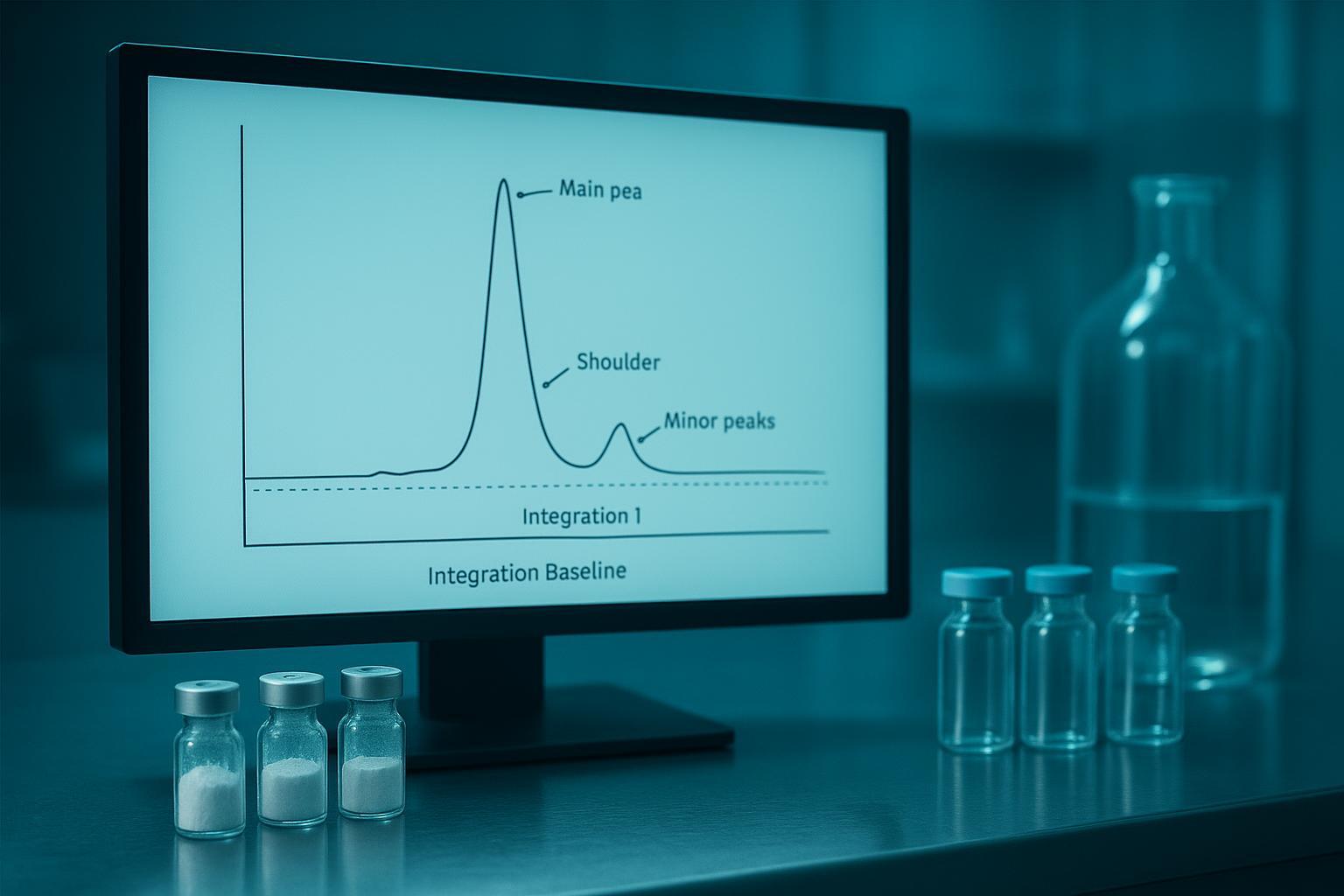
A peptide purity method HPLC MS result is a method-relative measurement, not a property of the material. The percentage you see is the main-peak area divided by the total integrated peak area under one specific method. Change the column or mobile phase and resolution shifts. Steepen the gradient and minor species compress into the main peak or separate out of it. Move the detection wavelength and relative response changes, because 214 to 220 nm reads the peptide bond broadly while 280 nm emphasizes aromatic residues. Even baseline placement and shoulder-splitting decisions move the number from an identical chromatogram.
That is why two suppliers can report different purity for material that behaves the same in your assay.
Pro Tip: always ask for the raw chromatogram and the integration method, not just the percentage.
What HPLC purity does not establish is equally important. It says nothing about sequence, exact mass, salt form, water content, or whether an unresolved species co-elutes with your main peak. Those gaps are what identity confirmation (Step 5) and lot traceability (Step 6) close.
The validation expectation behind the number comes from ICH Q2(R2) validation requirements, effective 2024-06-14. The guideline applies to new or revised analytical procedures for release and stability testing and, on a risk basis, to other control-strategy procedures. Its named purposes include assay or potency, kadalisayan, impurities, and identity, and its validation elements are accuracy, precision, specificity, detection limit, quantitation limit, linearity, and range. When a supplier reports purity, the useful question is which of those elements the method was validated for, and against what specification.
Verification: you can now name the method behind the number, and you know which questions to ask when you cannot.
Step 5: Confirm Identity and Characterization, Not Just Purity
By the end of this step you will hold two separate documents for one lot: a mass trace that confirms identity and a chromatogram that reports purity. They answer different questions. Mass spectrometry confirms the expected mass, while the peptide purity method HPLC MS reports how much of the integrated signal is the main species. Neither establishes the other, so a lot with 98% purity by area can still carry the wrong sequence.
Characterization therefore means identity by mass spectrometry, purity by HPLC, and secondary confirmation where the application warrants it. One interference problem complicates that reading. Trifluoroacetate interferes with physicochemical characterization including circular dichroism and FT-IR, shifts mass weighting, and has been shown to both increase and inhibit cell proliferation, increase cell and liver toxicity, and increase antibody-response activation, according to a 2025 ETH Zurich study in Pharmaceuticals. A separate overview of counter-ion effects in the International Journal of Molecular Sciences reports that TFA may interfere not only with physio-chemical characterization but also with in vivo experiments, where TFA stimulated glioma cell growth dose-dependently and, in MOG35–55 EAE, disease onset occurred about five days earlier with the TFA form than the acetate form.
Evidence suggests a characterization result obtained on a TFA salt is not interchangeable with one obtained on the acetate form. Where sterility or endotoxin status matters, ang USP <85> bacterial endotoxins test defines the limit against the individual monograph rather than a universal figure.
Step 6: Record Handling History and Batch Traceability
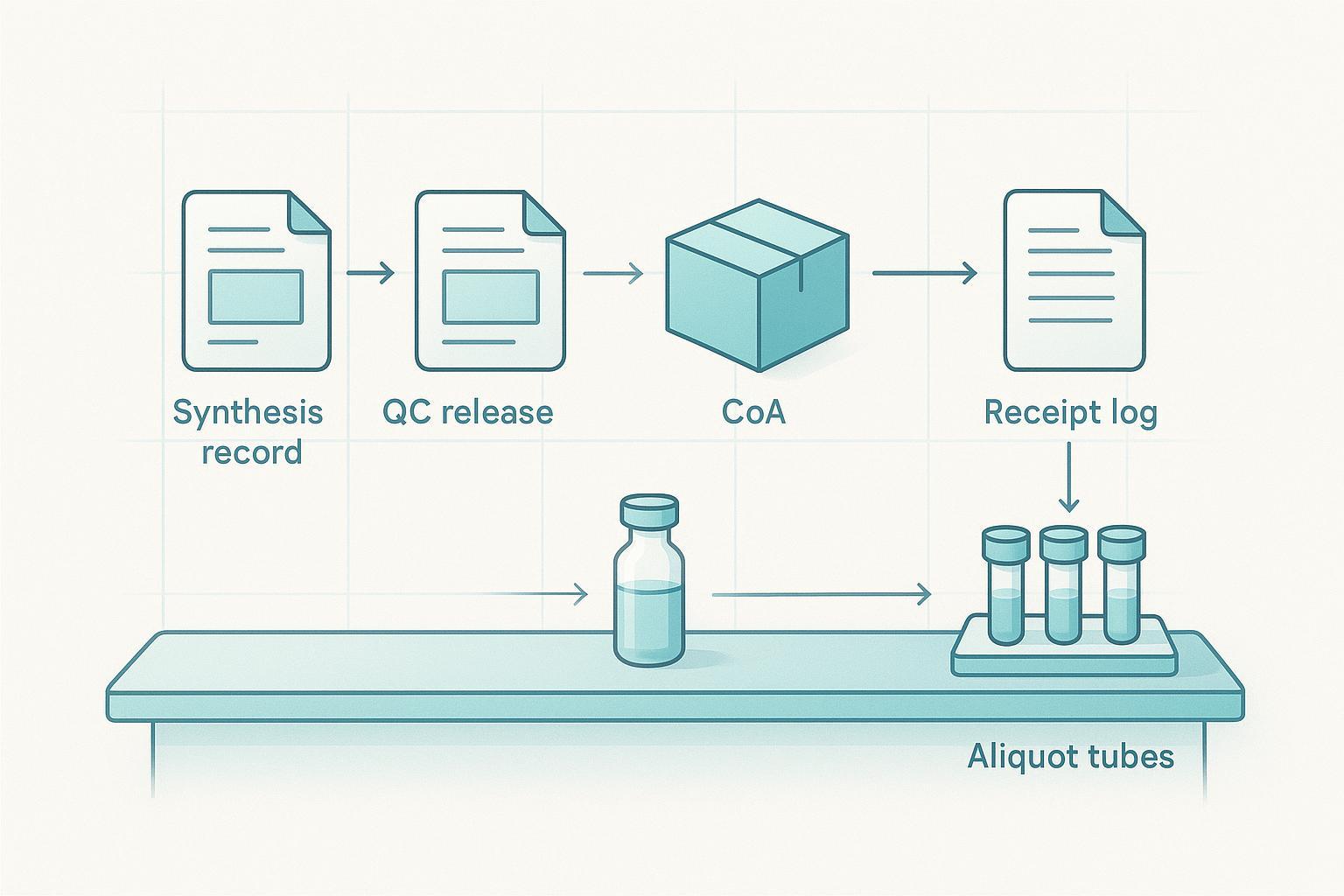
By the end of this step, you will have a lot-level record that turns a new lot into an experimental variable rather than a procurement event, which is the last piece of a peptide specification for reproducibility.
Handling history belongs in the methods record because it changes the material. Write down the reconstitution solvent and its grade, the aliquot size, the freeze-thaw count, and the storage temperature, then keep updating the count as the study runs. A vial that has been thawed six times is not the same reagent as one thawed once, even when the sequence, counterion, and purity figure are identical.
Traceability works the same way. Lot-to-lot assessment is a formal, precedented process for critical biological reagents: CLSI EP26 lot-change evaluation tests a candidate lot against the current lot using samples that span the measuring range and decision points, judged against predefined acceptance limits. FDA M10 requires lot-to-lot variability and comparability to be addressed when more than one kit lot is used in a single study, and the EBF recommends retaining enough old-lot material to bridge the two side by side. That retained material is what makes peptide certificate of analysis batch traceability auditable rather than nominal: without it, a mid-study change has nothing to be compared against.
The EMA guideline on synthetic peptides makes the same point from the other direction. It requires dimers, trimers, oligomers, and aggregates to be identified specifically rather than grouped under a single “high molecular weight impurities” label, so a lot record that reports only a total impurity figure cannot support a comparability argument.
⚠️ Warning: a mid-study lot change without a predefined acceptance limit is an uncontrolled variable.
Verification. You can trace any result back to a specific lot with a documented handling history: the lot number, the CoA it was released against, the solvent and aliquot record, and the freeze-thaw count all resolve to one entry.
Common Mistakes to Avoid
The most consequential mistake is weighing the gross label mass instead of the net peptide content. A vial labeled 10 mg may contain roughly 43% less peptide than the label implies once counterion and water content are accounted for, so a concentration calculated from the label overestimates the actual molar amount by that margin. That single arithmetic error propagates into every downstream dilution and can make a working assay irreproducible before any biological question is asked.
Comparing purity percentages from different HPLC methods. Two suppliers can report 95% at 98% for the same sequence while measuring different things, because gradient, Mga Sintetikong Peptide column chemistry, and detection wavelength all shift what the number captures. Ask for the method alongside the figure, and treat percentages from unmatched methods as non-comparable.
Assuming counterion exchange went to completion. Residual trifluoroacetate can persist after multiple exchange cycles rather than being eliminated, so a certificate that reports a salt form without residual counterion data leaves the actual composition open.
Treating a new lot as the same material. A matching sequence does not make two lots interchangeable; lot-specific characterization is what establishes continuity for a running study.
Accepting a grouped impurity label. Reporting “high molecular weight impurities” as a single figure hides the distinction between dimers, trimers, oligomers, and aggregates that the EMA guideline expects to be identified separately.
What Success Looks Like
If everything went correctly, you now hold a peptide specification for reproducibility that another lab can act on without asking you a single follow-up question. That record names the terminal chemistry, the counterion with its content where available, net peptide content and how it was determined, purity with its HPLC method and integration rules, an identity trace, and a lot-level handling and traceability record.
The measurable test is a lot change. Your assay’s own acceptance criteria should still be met when a new batch enters the study, and your concentration calculation should still match the delivered dose. If either drifts, the specification record is incomplete, not the experiment.
As a stretch goal, build those six fields into the LIMS or ELN entry for the experiment itself, so the specification travels with the data instead of living in a lab notebook margin.
Frequently Asked Questions
Is a peptide’s sequence enough to reproduce an experiment?
Hindi. A sequence string defines connectivity only. The terminal chemistry, counterion and salt form, net peptide content, purity method, handling history and lot identity all change the material, and therefore the result, while leaving the sequence identical. A peptide specification for reproducibility is the full record, not the string.
Why does the same peptide give different purity numbers from different suppliers?
Because the peptide purity method HPLC MS reports is method-relative. The percentage is main-peak area normalized to total integrated peak area under one specific method, so column and mobile phase, gradient steepness, detection wavelength, and baseline and shoulder-splitting decisions all move the number from an identical chromatogram. Compare purity figures only when the methods match.
How much does the counterion actually affect my results?
It does not change the covalent sequence, but it changes stability, conformation, membrane interaction and biological activity. If your assay is biological or mass-spectrometric, the counterion is part of the result, not a packaging detail.
What should I do when a new lot enters a running study?
Treat it as an experimental variable. Evaluate the candidate lot against the current lot using samples spanning the measuring range and decision points against predefined acceptance limits, and retain enough old-lot material for a side-by-side bridge. Document the comparison with the lot numbers and the specification fields that changed.
What if my supplier’s CoA does not report net peptide content?
Ask for it, and if it is unavailable, treat the gross label mass as an upper bound rather than the peptide mass. For TFA salts, assuming roughly 80% net peptide content when the value is absent is a documented fallback, but it is an assumption, not a measurement, and it should be recorded as one.
Konklusyon
You now hold a peptide specification for reproducibility rather than a sequence string: terminal chemistry, counterion and salt form, net peptide content, a purity figure with its method attached, identity confirmation, and the handling and batch records behind the material. That record is what lets a colleague at another bench, or the same bench a year later, order something equivalent instead of something merely similarly named.
The specification travels with the experiment. Keep it with the methods section, not in a purchase folder, so the next lot can be checked against the same fields rather than against memory. Produksyon ng Peptide
Make your next peptide order reproducible. Review the fields your current certificate of analysis actually reports, then compare them against the specification template before the next order goes out. See the specification template and review the CoA fields to see which entries are usually missing.
MOL Changes supplies research-use peptides and supports documentation requests for lot-specific analytical records. This article is informational and is not a product performance claim; peptide materials referenced here are for research use, not for diagnostic or therapeutic use.