Por qué una cadena de secuencia no es una especificación de péptido

Las limitaciones de la notación de secuencias de péptidos comienzan con lo que realmente codifica una cadena de secuencia: conectividad, el orden en el que se unen los residuos. No dice nada sobre el material que pipetearás..
Una especificación de péptido es una hoja de datos de materiales., no es un nombre. Seis campos deciden si dos viales se comportan de la misma manera: química terminal, forma de sal y contraión, contenido neto de péptidos, pureza con su método analítico, historial de manejo, y caracterización más trazabilidad de lotes. Ninguno de ellos aparece en una secuencia..
La pureza es el ejemplo más claro.. La pureza de HPLC es relativa al método, no es una propiedad material: el porcentaje informado es el área del pico principal normalizada al área del pico total integrada según un método específico, y no establece ninguna secuencia, masa exacta, forma de sal, contenido de agua, ni la ausencia de especies coeluyentes. Los contraiones se comportan de la misma manera.. Dejan intacta la secuencia covalente mientras cambian la estabilidad., conformación, interacción de membrana y actividad biológica, como se revisó en Biomoléculas sobre los efectos contraiones en el análisis y formulación de péptidos (2025).
Conclusión clave: una secuencia define solo la conectividad; La reproducibilidad depende de la definición completa del material..
Entonces, cuando reordenas “el mismo péptido,“No tienes garantizado el mismo material.. Producir una especificación de péptido para la reproducibilidad significa escribir los seis campos antes de que llegue el siguiente lote..
Lo que necesitará antes de comenzar
Reúna estos artefactos antes de cambiar algo en su método.. Si ya hay un estudio en marcha, extraiga los registros del lote actual y anterior para poder compararlos uno al lado del otro.
-
Certificado de análisis del lote actual., con el número de lote visible. Este es el documento del que depende la trazabilidad del lote de su certificado de análisis de péptidos.
-
Certificado de análisis del lote anterior., si su estudio ya está en marcha.
-
La descripción del método HPLC.: columna, fase móvil, gradiente, y longitud de onda de detección.
-
El trazo de espectrometría de masas del lote que está utilizando.
-
Su registro de reconstitución y almacenamiento.
-
Los propios criterios de aceptación de su ensayo., escrito antes de comenzar.
Suponga que se siente cómodo leyendo un cromatograma y un certificado de análisis.. Presupuesta aproximadamente una hora para ensamblar y leer todo.
Una advertencia honesta: Algunos de estos campos son difíciles de obtener., y no todos los proveedores los documentan. Pregunta por lo que necesites, y nota lo que no puedes conseguir.
Paso 1: Escriba la química terminal, No sólo la secuencia
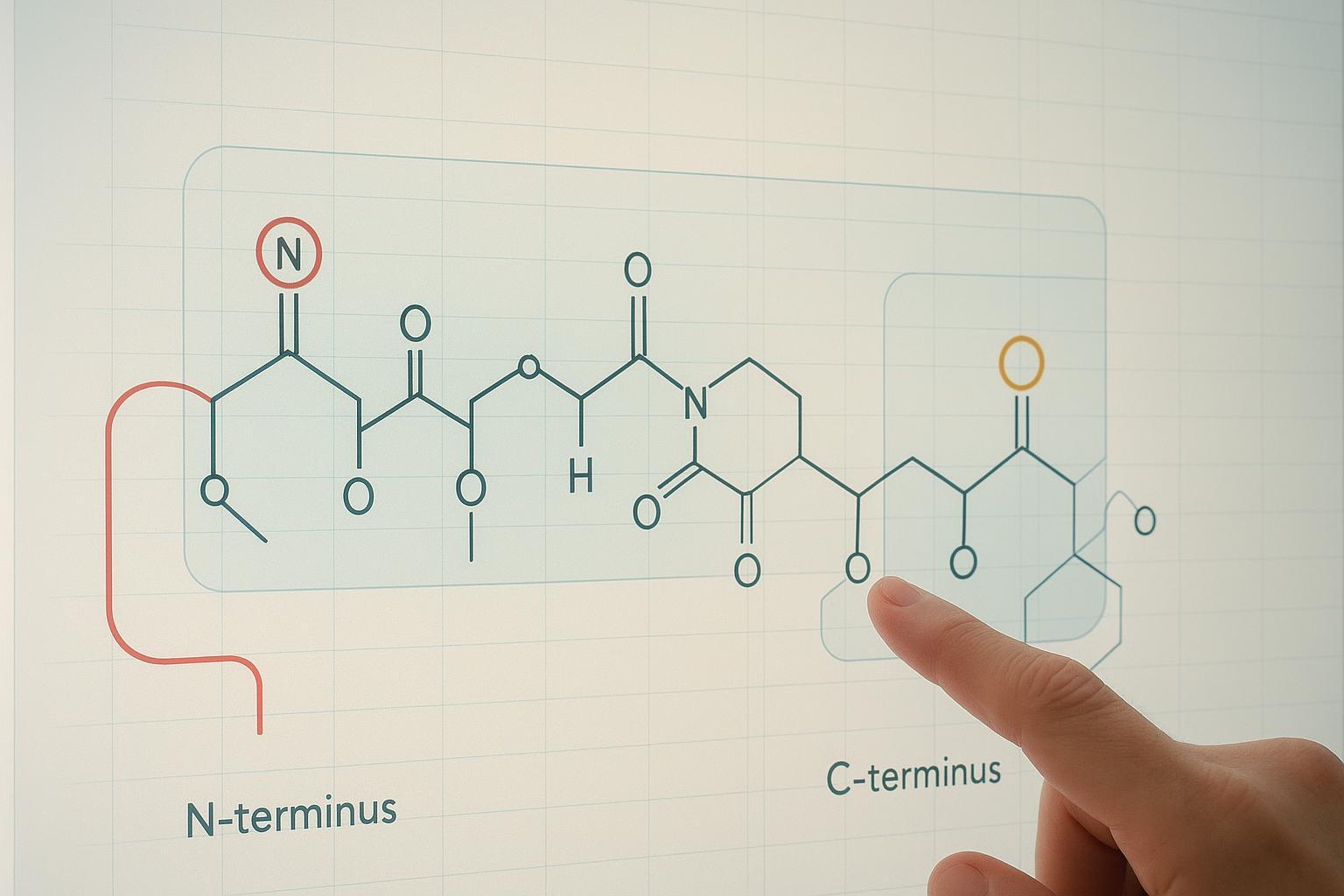
Al final de este paso tendrás un extremo N explícito, Registro de modificación de terminal y terminal C en lugar de uno implícito, ¿Cuál es el primer campo que debe incluir una especificación peptídica para la reproducibilidad?.
La secuencia interna puede ser idéntica mientras que los términos cambian todo lo que ve el ensayo.. Una amina libre N-terminal y una acetilada difieren en la carga y en cómo se comporta el péptido en la superficie de una placa.; un ácido libre C-terminal y una amida difieren en la carga neta y en la estabilidad frente a exopeptidasas. Las etiquetas terminales y los sitios de conjugación vuelven a cambiar las mismas propiedades. Nada de eso es visible en una cadena de secuencia., es por eso que la directriz de la EMA sobre el desarrollo y fabricación de péptidos sintéticos Trata la química terminal como un campo estructural en sí mismo.: La directriz requiere que la química terminal se muestre explícitamente en la estructura en lugar de dejarla a la inferencia..
Verificación: puede señalar una línea en el CoA o en la hoja de especificaciones que indica cada término por su nombre.
Paso 2: Identificar la forma de contraión y sal
Síntesis de péptidos Al final de este paso sabrás qué contraión lleva tu material., aproximadamente qué cantidad del vial representa, y si esa diferencia es suficiente para mover su ensayo. El contraión peptídico y la forma de sal es el primer campo de especificación que no tiene nada que ver con la secuencia y sí con el comportamiento..
TFA es el contraión de síntesis en fase sólida predeterminado, used as both cleavage agent and ion-pairing reagent, so material arrives as a TFA salt (Erckes et al., Productos farmacéuticos 2025). It is held by strong electrostatic pairing and is not removed by initial lyophilization. The amount is not trivial: en un 2025 ETH Zurich study in Productos farmacéuticos, TFA⁻ reached up to 35% of total weight across seven model peptides, against a stoichiometric expectation of about 25% (Erckes et al. 2025).
Counterions do not change the covalent sequence, but they change stability, conformación, interacción de membrana y actividad biológica. Two practical consequences follow. TFA causes severe ESI-MS ion suppression through gas-phase ion pairing, and acetate has largely replaced it in peptide drug synthesis, where TFA negatively affected stability and activity (Biomoléculas 2025). Exchange is also partial rather than absolute: three counterion-exchange cycles reduced residual TFA to 0.215 ± 0.023 mg per mg peptide salt from a starting 0.333 ± 0.008 mg/mg (Erckes et al. 2025). A comparative evaluation in the Revista de ciencia de péptidos found that reverse-phase HPLC and ion-exchange resin gave partial to almost complete exchange on lanreotide, while a deprotonation/reprotonation cycle removed it completely; the classical repeated-lyophilization-with-excess-HCl route requires pH below 1 and can degrade the peptide (Roux et al., J Pept Sci 2008).
Verificación: the certificate of analysis names the counterion, and ideally its measured content, rather than leaving you to infer it from the synthesis method.
Paso 3: Convertir la masa bruta del vial en contenido neto de péptidos
Al final de este paso, you will know the actual peptide mass in the vial rather than the mass printed on the label. Net peptide content is the fraction of the powder mass that is peptide; the remainder is counterion, water and residual salts. The arithmetic is simple and the error is not: 10 mg of powder at 70% net peptide content yields 7 mg de péptido, so ignoring net content overestimates concentration by roughly 43%, y un 10 mg vial may contain only 6 a 8 mg of actual peptide (ChemVerify, recuperado 2026-03-20).
Published typical net peptide content ranges run 60 a 85% for TFA salts, 70 a 90% for acetates and 75 a 90% for HCl, with short multi-basic peptides as low as 50 a 60% and long low-basic peptides at 80 a 90%. These figures come from a vendor testing lab, with no peer-reviewed upstream located, so treat them as expectations rather than a specification. Net peptide content must be determined by amino acid analysis, elemental nitrogen or UV, with the same page describing amino acid analysis as the gold standard.
Verificación: you can state the peptide mass you actually weighed out, and show the peptide specification for reproducibility calculation that produced it.
Paso 4: Lea la cifra de pureza con su método adjunto
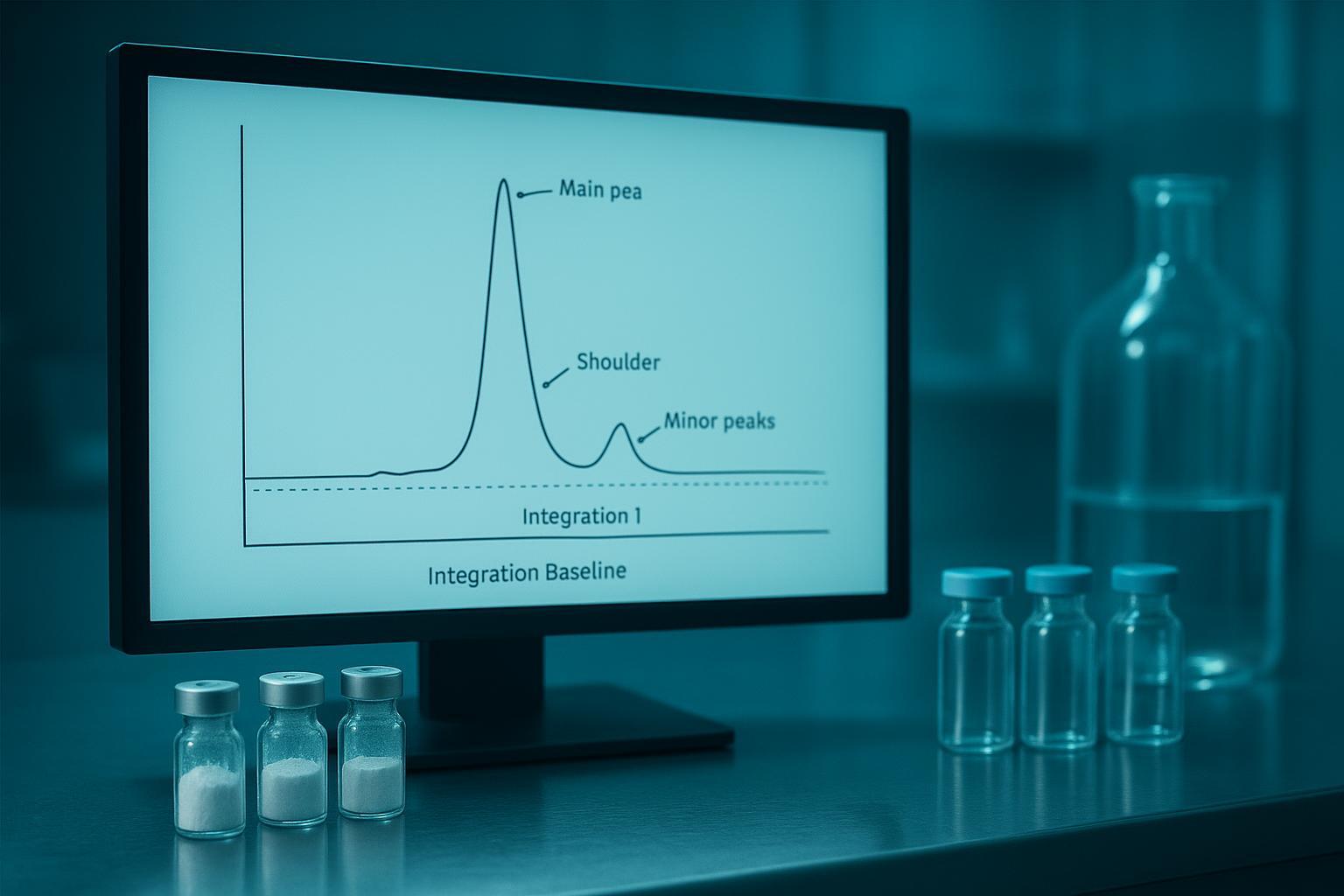
A peptide purity method HPLC MS result is a method-relative measurement, not a property of the material. The percentage you see is the main-peak area divided by the total integrated peak area under one specific method. Change the column or mobile phase and resolution shifts. Steepen the gradient and minor species compress into the main peak or separate out of it. Move the detection wavelength and relative response changes, because 214 a 220 nm reads the peptide bond broadly while 280 nm emphasizes aromatic residues. Even baseline placement and shoulder-splitting decisions move the number from an identical chromatogram.
That is why two suppliers can report different purity for material that behaves the same in your assay.
Para propina: always ask for the raw chromatogram and the integration method, not just the percentage.
What HPLC purity does not establish is equally important. It says nothing about sequence, masa exacta, forma de sal, contenido de agua, or whether an unresolved species co-elutes with your main peak. Those gaps are what identity confirmation (Paso 5) and lot traceability (Paso 6) close.
The validation expectation behind the number comes from Yo Q2(R2) validation requirements, eficaz 2024-06-14. The guideline applies to new or revised analytical procedures for release and stability testing and, on a risk basis, to other control-strategy procedures. Its named purposes include assay or potency, pureza, impurezas, and identity, and its validation elements are accuracy, precisión, especificidad, límite de detección, límite de cuantificación, linealidad, and range. When a supplier reports purity, the useful question is which of those elements the method was validated for, and against what specification.
Verificación: you can now name the method behind the number, and you know which questions to ask when you cannot.
Paso 5: Confirmar identidad y caracterización, No sólo pureza
By the end of this step you will hold two separate documents for one lot: a mass trace that confirms identity and a chromatogram that reports purity. They answer different questions. Mass spectrometry confirms the expected mass, while the peptide purity method HPLC MS reports how much of the integrated signal is the main species. Neither establishes the other, so a lot with 98% purity by area can still carry the wrong sequence.
Characterization therefore means identity by mass spectrometry, purity by HPLC, and secondary confirmation where the application warrants it. One interference problem complicates that reading. Trifluoroacetate interferes with physicochemical characterization including circular dichroism and FT-IR, shifts mass weighting, and has been shown to both increase and inhibit cell proliferation, increase cell and liver toxicity, and increase antibody-response activation, according to a 2025 ETH Zurich study in Pharmaceuticals. A separate overview of counter-ion effects in the International Journal of Molecular Sciences reports that TFA may interfere not only with physio-chemical characterization but also with in vivo experiments, where TFA stimulated glioma cell growth dose-dependently and, in MOG35–55 EAE, disease onset occurred about five days earlier with the TFA form than the acetate form.
Evidence suggests a characterization result obtained on a TFA salt is not interchangeable with one obtained on the acetate form. Where sterility or endotoxin status matters, el USP <85> bacterial endotoxins test defines the limit against the individual monograph rather than a universal figure.
Paso 6: Historial de manejo de registros y trazabilidad de lotes
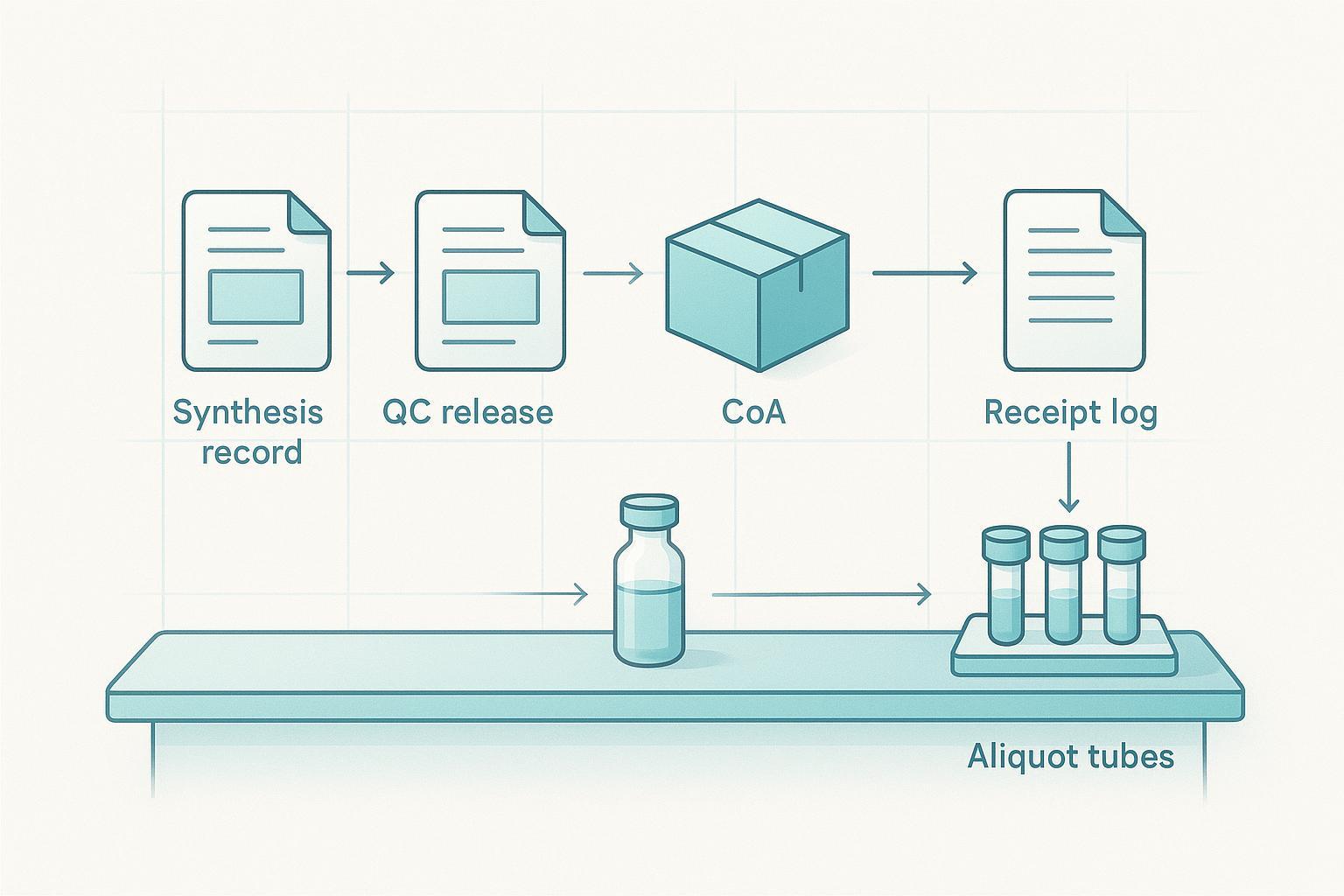
Al final de este paso, you will have a lot-level record that turns a new lot into an experimental variable rather than a procurement event, which is the last piece of a peptide specification for reproducibility.
Handling history belongs in the methods record because it changes the material. Write down the reconstitution solvent and its grade, the aliquot size, the freeze-thaw count, and the storage temperature, then keep updating the count as the study runs. A vial that has been thawed six times is not the same reagent as one thawed once, even when the sequence, contraión, and purity figure are identical.
Traceability works the same way. Lot-to-lot assessment is a formal, precedented process for critical biological reagents: CLSI EP26 lot-change evaluation tests a candidate lot against the current lot using samples that span the measuring range and decision points, judged against predefined acceptance limits. FDA M10 requires lot-to-lot variability and comparability to be addressed when more than one kit lot is used in a single study, and the EBF recommends retaining enough old-lot material to bridge the two side by side. That retained material is what makes peptide certificate of analysis batch traceability auditable rather than nominal: without it, a mid-study change has nothing to be compared against.
The EMA guideline on synthetic peptides makes the same point from the other direction. It requires dimers, trímeros, oligomers, and aggregates to be identified specifically rather than grouped under a single “high molecular weight impurities” label, so a lot record that reports only a total impurity figure cannot support a comparability argument.
⚠️ Advertencia: a mid-study lot change without a predefined acceptance limit is an uncontrolled variable.
Verificación. You can trace any result back to a specific lot with a documented handling history: the lot number, the CoA it was released against, the solvent and aliquot record, and the freeze-thaw count all resolve to one entry.
Errores comunes a evitar
The most consequential mistake is weighing the gross label mass instead of the net peptide content. A vial labeled 10 mg may contain roughly 43% less peptide than the label implies once counterion and water content are accounted for, so a concentration calculated from the label overestimates the actual molar amount by that margin. That single arithmetic error propagates into every downstream dilution and can make a working assay irreproducible before any biological question is asked.
Comparing purity percentages from different HPLC methods. Two suppliers can report 95% y 98% for the same sequence while measuring different things, because gradient, Péptidos sintéticos column chemistry, and detection wavelength all shift what the number captures. Ask for the method alongside the figure, and treat percentages from unmatched methods as non-comparable.
Assuming counterion exchange went to completion. Residual trifluoroacetate can persist after multiple exchange cycles rather than being eliminated, so a certificate that reports a salt form without residual counterion data leaves the actual composition open.
Treating a new lot as the same material. A matching sequence does not make two lots interchangeable; lot-specific characterization is what establishes continuity for a running study.
Accepting a grouped impurity label. Reporting “high molecular weight impurities” as a single figure hides the distinction between dimers, trímeros, oligomers, and aggregates that the EMA guideline expects to be identified separately.
Cómo se ve el éxito
If everything went correctly, you now hold a peptide specification for reproducibility that another lab can act on without asking you a single follow-up question. That record names the terminal chemistry, the counterion with its content where available, net peptide content and how it was determined, purity with its HPLC method and integration rules, an identity trace, and a lot-level handling and traceability record.
The measurable test is a lot change. Your assay’s own acceptance criteria should still be met when a new batch enters the study, and your concentration calculation should still match the delivered dose. If either drifts, the specification record is incomplete, not the experiment.
As a stretch goal, build those six fields into the LIMS or ELN entry for the experiment itself, so the specification travels with the data instead of living in a lab notebook margin.
Preguntas frecuentes
Is a peptide’s sequence enough to reproduce an experiment?
No. A sequence string defines connectivity only. The terminal chemistry, forma de sal y contraión, contenido neto de péptidos, purity method, handling history and lot identity all change the material, and therefore the result, while leaving the sequence identical. A peptide specification for reproducibility is the full record, not the string.
¿Por qué el mismo péptido da diferentes números de pureza de diferentes proveedores??
Because the peptide purity method HPLC MS reports is method-relative. The percentage is main-peak area normalized to total integrated peak area under one specific method, so column and mobile phase, gradient steepness, longitud de onda de detección, and baseline and shoulder-splitting decisions all move the number from an identical chromatogram. Compare purity figures only when the methods match.
¿Cuánto afecta realmente el contraión a mis resultados??
It does not change the covalent sequence, but it changes stability, conformación, interacción de membrana y actividad biológica. If your assay is biological or mass-spectrometric, the counterion is part of the result, not a packaging detail.
¿Qué debo hacer cuando un nuevo lote ingresa a un estudio en ejecución??
Treat it as an experimental variable. Evaluate the candidate lot against the current lot using samples spanning the measuring range and decision points against predefined acceptance limits, and retain enough old-lot material for a side-by-side bridge. Document the comparison with the lot numbers and the specification fields that changed.
What if my supplier’s CoA does not report net peptide content?
Ask for it, and if it is unavailable, treat the gross label mass as an upper bound rather than the peptide mass. For TFA salts, assuming roughly 80% net peptide content when the value is absent is a documented fallback, but it is an assumption, no es una medida, and it should be recorded as one.
Conclusión
You now hold a peptide specification for reproducibility rather than a sequence string: química terminal, forma de sal y contraión, contenido neto de péptidos, a purity figure with its method attached, identity confirmation, and the handling and batch records behind the material. That record is what lets a colleague at another bench, or the same bench a year later, order something equivalent instead of something merely similarly named.
The specification travels with the experiment. Keep it with the methods section, not in a purchase folder, so the next lot can be checked against the same fields rather than against memory. Producción de péptidos
Make your next peptide order reproducible. Review the fields your current certificate of analysis actually reports, then compare them against the specification template before the next order goes out. See the specification template and review the CoA fields to see which entries are usually missing.
MOL Changes supplies research-use peptides and supports documentation requests for lot-specific analytical records. This article is informational and is not a product performance claim; peptide materials referenced here are for research use, not for diagnostic or therapeutic use.