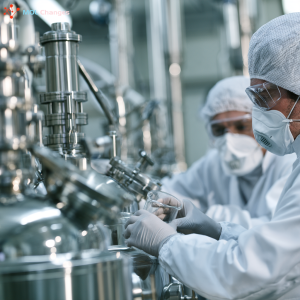
Why the Bottleneck Moved From the Model to the Bench
An AI co-scientist is a multi-agent system that generates and ranks research hypotheses; the bench-side interface is everything between a ranked candidate and a vial of characterized material. Model capability has outrun that interface, and the gap is where the gains are being lost.
Google’s own reported validations are the clearest illustration. Its multi-agent Gemini co-scientist proposed acute myeloid leukemia repurposing candidates that inhibited KG-1 viability at clinically relevant concentrations, epigenetic targets that showed activity in human hepatic organoids (p < 0.01), and a cf-PICI/phage-tail mechanism for antimicrobial resistance (Google Research, 2025-02-19). Read the fine print: the system produced hypotheses, not materials. Every one of those claims became a claim only after wet-lab work, and by the time the first peer-reviewed co-scientist results appeared in Nature, coverage was explicit that the lab validations, not the model, carry the evidentiary weight (IEEE Spectrum, 2026).

The pattern repeats across the field. An evaluation of six agentic discovery frameworks found that none fully supported any of 15 real-world task classes, and peptide-specific tasks had zero coverage, with systems biased toward small-molecule representations (review coverage, 2026-02-13).
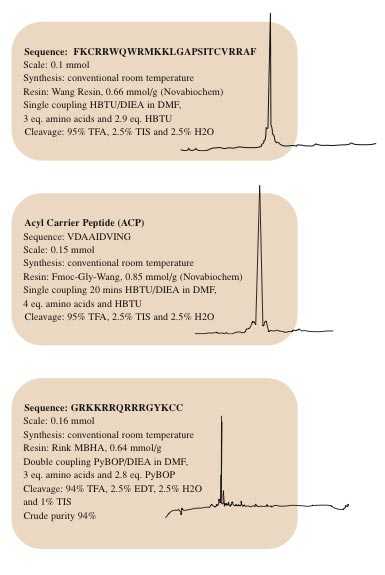
The physical layer is not a rounding error. The same 16-mer, six resins, a five-fold spread in crude purity: Barstar[75–90] ranged from 20% до 52% without a solubilizing tag and 41% до 72% with an ArgTag (SPPS resin study, 2025-11-21). Per-step efficiency compounds the same way: 99% over 30 residues gives roughly 74% overall yield, 98% gives about 55%, і 95% gives about 21% (manufacturing explainer, 2026-07-24). That last set is arithmetic illustration, not measured campaign data, and figures of this type vary by source.

Ключ на винос: A model that ranks candidates well still hands the bench a molecule whose synthesis feasibility, modification compatibility and analytical confirmation are undecided. AI-designed peptide synthesis feasibility is the constraint that sets what the loop can actually deliver.
Синтез пептидів across six synthesis resins plus pilot-scale PS-2CTC, two series per resin (without ArgTag / with ArgTag). Values without/with: 20/41, trace/24, 45/72, 52/58, 51/64, 34/64, 27/50. Source: PMC12645436, 2025.]
Synthesis Feasibility Is a Design Filter, Not a Post-Hoc Check
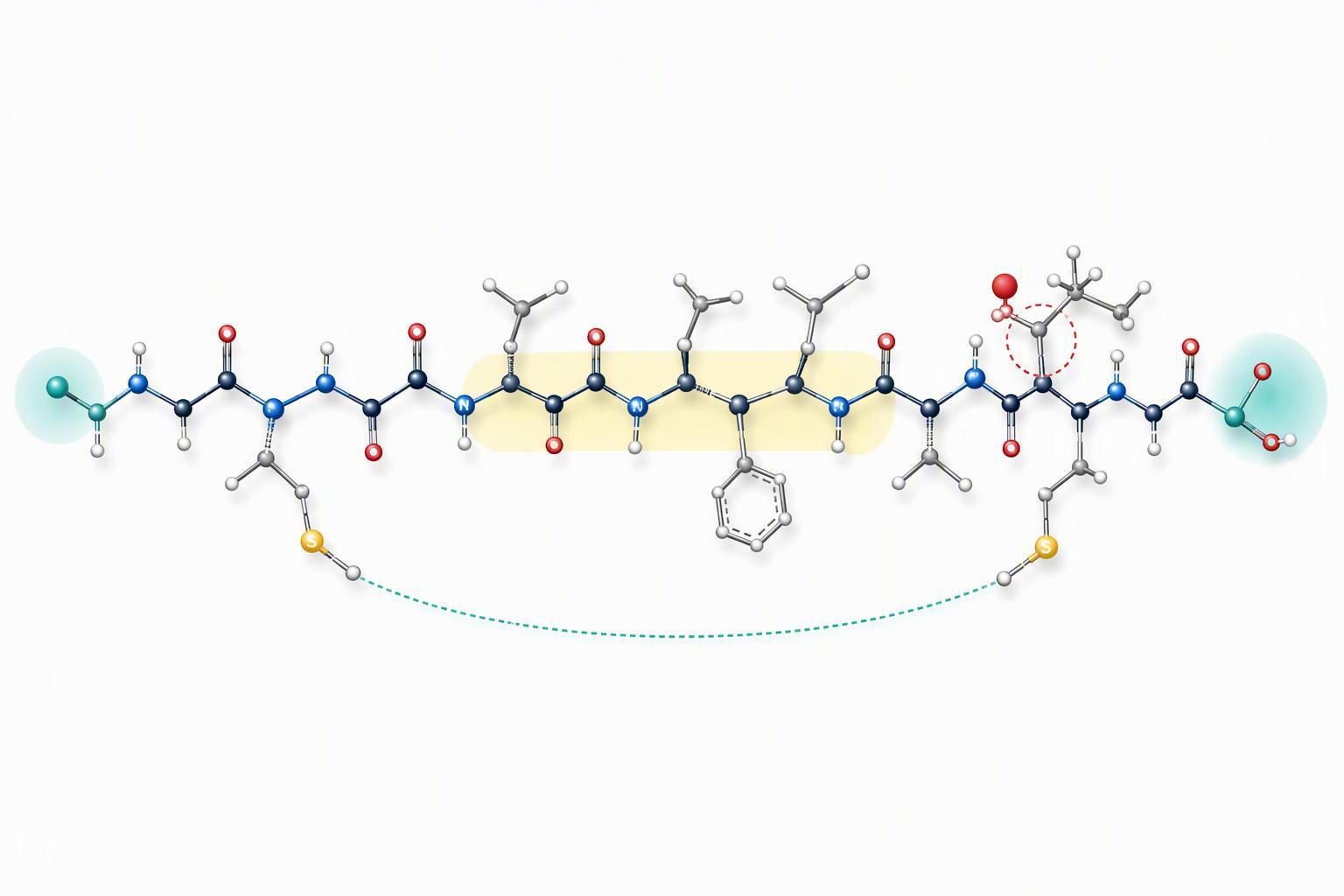
AI-designed peptide synthesis feasibility has to gate a candidate before anyone places an order, not explain the failure afterwards. Treat it as a design filter: a sequence-level screen that runs on the model output, in the same loop as the scoring function.
The practical ceiling most synthesis chemists work to is short. Above roughly 15 amino acids, solid-phase crude product carries large numbers of low-level by-products, and those by-products often exceed the target peptide in the crude (SPPS practical review, 2025). Above 35–40 residues, stepwise SPPS stops being the right route and convergent condensation or native chemical ligation takes over (same review, 2025).
The arithmetic explains why. At 95% per step, a 30-residue chain returns about a fifth of theory; over 100 residues, a 1% per-step loss leaves roughly an eighth of theory (Peptide synthesis explainer, 2026). Both figures are arithmetic illustration, not measured campaign data.
Synthesizability scores help here, with limits. SAscore was validated against chemist judgments at r² = 0.89 on forty molecules, a small set (RSC Chemical Science, 2025), and the literature frames such scores as early-warning proxies, not proof of manufacturability (Synthesizability filtering study, 2026).
Ключ на винос: Separate sequence-intrinsic feasibility problems (aggregation propensity, hydrophobic stretch, multi-disulfide topology, sterically hindered coupling) from route-dependent ones (protection strategy, resin choice, cleavage and purification conditions). The first is a design constraint; the second is a process choice.
Modification Constraints Belong in the Generation Step
Peptide modification constraints are a generation-time input, not a purification-time surprise. The intended chemistry and the real synthesis route have to be checked against each other before a model commits to a candidate, because a structure-only score cannot see the route. The models are still fitting patterns, not physics: peer-reviewed reviews of multi-agent peptide-design frameworks report that these systems are limited by sparse high-quality experimental data, weak handling of flexible and disordered peptides, and reliance on statistical patterns rather than physical chemistry (Briefings in Bioinformatics, 2024; Chemical Communications, 2026).
That gap is where a compatibility check earns its place. A candidate carrying lipidation, cyclization or a fluorescent tag should be run against a modification menu that covers the intended chemistry before an order is placed, not after a failed Синтетичні пептиди lot. In practice this is a short exchange: sequence in, intended modification named, route and feasibility read back. Where the menu stops, a capable CDMO or specialist supplier is the honest answer, and the arbiter is still the experiment.
One Readout Is Not Confirmation
Orthogonal analytical confirmation of peptides means using methods whose physical basis for separating or identifying a molecule is genuinely independent, not two runs of the same principle. A single reverse-phase HPLC trace tells you the lot elutes as one peak; it does not tell you what that peak is. The FDA’s own list of deficiencies in comparative peptide filings expects orthogonal chromatographic methods with different separation principles alongside UHPLC-HRMS/MS to confirm peak identity (FDA comparative-peptide-analysis guidance, 2022-09-20). ICH Q2(R2) sets the validation characteristics per procedure type and allows specificity to be demonstrated against a second, well-characterized procedure, including an orthogonal one (ICH Q2(R2), 2023-11-30). Q6B sets specifications from manufacturing-consistency lots, which is why acceptance criteria belong to the lot, not to the assay (ICH Q6B).
|
Impurity level |
Послуги Action required |
|---|---|
|
≥0.10% |
Report |
|
≥0.5% |
Identify |
|
≥1.0% |
Qualify |
|
>0.5% new impurity vs. reference product |
Not acc Shop eptable |
Thresholds per the FDA guidance (2022-09-20) and the EMA synthetic-peptide guideline (2025-12-04).
The recurring bench pattern: a candidate ranks well in silico, synthesizes as a low-recovery crude, purifies poorly, and yields a lot whose single-method readout looks acceptable while the orthogonal method disagrees.
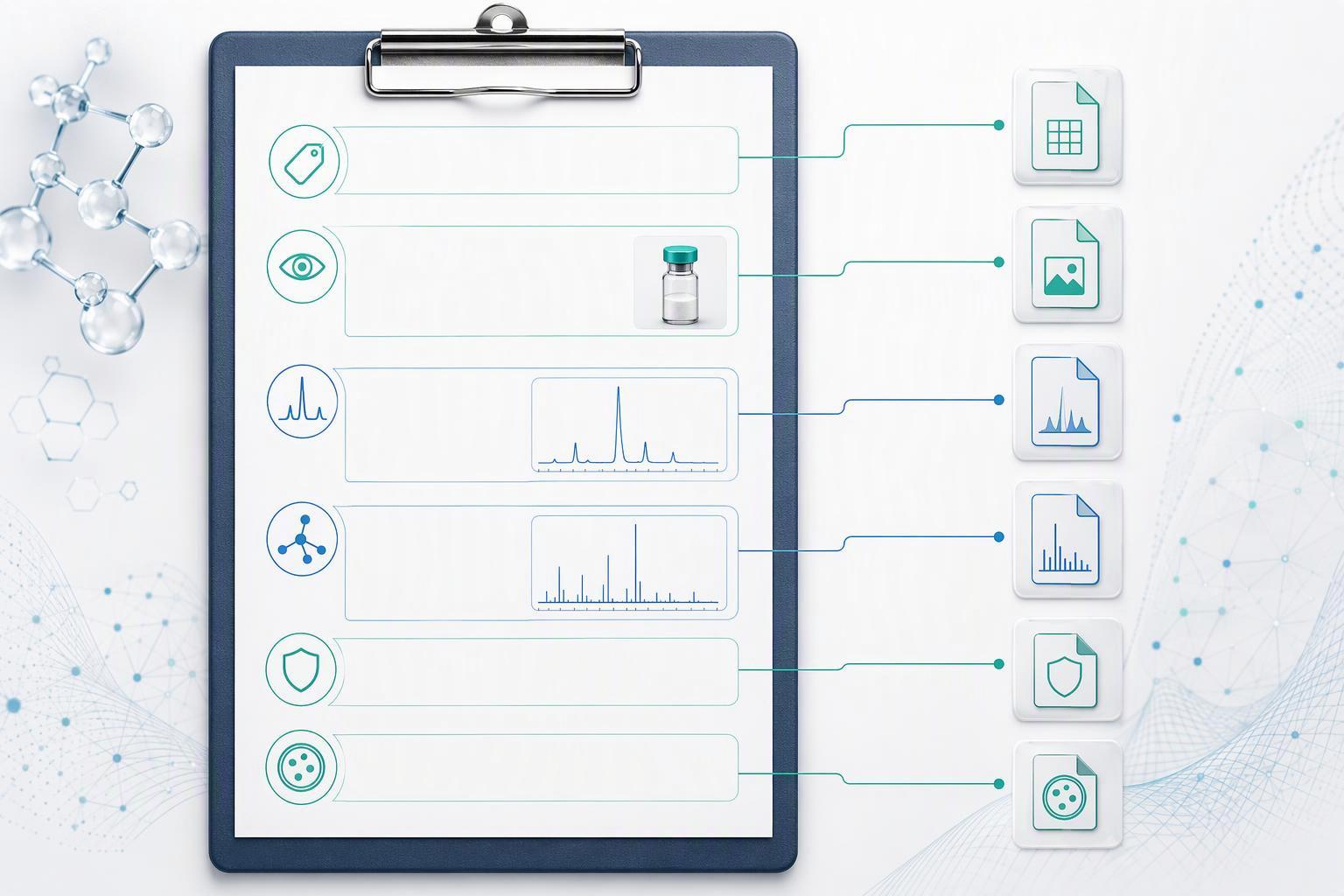
Identity and purity documentation should be traceable to raw data files per lot, and a CoA without the underlying chromatogram and mass spectrum is not verifiable. Виробництво пептидів
Batch Comparability Is a Design Input
Peptide batch-to-batch comparability is the ability to show that two lots of the same sequence meet the same specification, and it is decided long before QC opens a vial. A specification is not a purity number; it is tests, procedures and criteria, and the same thresholds apply lot to lot (FDA guidance on endotoxin limits). Route and resin choices are comparability variables: in a 2025 SPPS study, one sequence gave 27% crude purity on high-loading PS-2CTC resin at 0.75 mmol/g, rising to 50% at 0.69 mmol/g with the tag, while apolar PSAM-RAM gave roughly 20% and MBHA-RAM only trace product (same SPPS resin study). By-products fall into deletions, terminations and chemical modifications, and their profile shifts with the route.
No published 2025–2026 dataset gives a numeric lot-to-lot purity distribution for complex modified peptides versus simple linear peptides. What the record does fix is the release layer: sterility takes 14 days in two media at two temperatures before a sterility result exists, with no growth in either medium required (FDA Pharmaceutical Microbiology Manual), and endotoxin is judged against the 5 EU/kg parenteral limit, calculated as K/M (FDA guidance on endotoxin limits). A per-lot documentation set records lot number, appearance, purity by HPLC with chromatogram, identity by MS with spectrum, and endotoxin and sterility results, each traceable to its raw data file.
The Loop Rate Is Set by Analytical Turnaround, Not Inference Speed
The design-test-learn cycle for peptide discovery, the loop where a candidate is designed, synthesized, tested and fed back into the next round, is gated by calendar time on the bench, not by inference speed. In AI-driven small-molecule discovery, a design-make-test-analyze iteration commonly runs 4 до 8 weeks, while peptide service quotes put standard synthesis at 1 до 3 weeks and modified or longer peptides at 2 до 6 weeks, with primary assay turnaround of 3 до 5 днів, 5 days with ADME, and under 10 days with in vivo PK (BioIndustry Association, retrieved 2026-09-12). Those are vendor and service-level statements, not a controlled benchmark. AstraZeneca’s under-5-day design-to-test-data target and sub-2-hour prototype cycle show what the same loop looks like when the wet-lab steps are engineered for speed (IRBM, retrieved 2026-09-11).
The calendar time a synthesis request actually consumes follows the same shape: standard peptides of 2 до 30 amino acids at above 80% purity typically arrive in 10 до 15 business days, express orders in 5 до 7 днів, and complex or multiply modified sequences in 3 до 4 weeks. Shortening the loop means buying back those weeks, not shaving milliseconds off a model run.
But Models Will Design Around Chemistry — Do They Not Already?
Partly, and the concession matters. SAscore-class synthesizability filters are standard practice, and the 2025–2026 literature treats accessibility scores as useful early-warning proxies. But the same literature is explicit that they are proxies, not proof of manufacturability, with the physical experiment remaining the arbiter. The proxy is also thinner than its reputation: SAscore was validated on forty molecules, and it is structure-only rather than route-based. On the model side, a review of six agentic frameworks found zero peptide-task coverage across six frameworks, with a bias toward small-molecule representations, and the underlying scoring is largely fitting patterns, not physics. Better filters raise the hit rate. They do not remove feasibility, modification compatibility, orthogonal confirmation and comparability as design inputs.
Next Steps: Treat the Interface as the Design Surface
AI-designed peptide synthesis feasibility, modification compatibility, orthogonal confirmation and batch comparability are design inputs, not downstream checks, and the loop rate is set by analytical turnaround rather than inference speed. The starting sequence is short. Screen candidates against sequence-intrinsic feasibility rules before you order anything. Check the intended modification against the route that will actually run it. Require orthogonal confirmation with per-lot raw-data traceability. Specify comparability criteria in the order itself, not in a follow-up email after the first lot arrives.
MOL Changes is a specialized peptide R&D organization integrating organic chemistry and biology, offering custom synthesis from sequence design to large-scale production, with production in Class 100 ultra-sterile cleanroom environments and QC by MS, ВЕРХ, AAA, ендотоксин, counterion, optical rotation and UV content. MOL Changes has a commercial interest in peptide quality standards. Development-stage material characterization is not a clinical claim, and formulation or dosing decisions belong with qualified professionals.
Send a sequence for a feasibility read. You get a route assessment and a realistic timeline before you commit to an order, which is the cheapest way to find out whether a candidate can exist in a vial. про
Часті запитання
Don’t synthesizability filters already solve this?
Partly, and that is the honest answer. Filters are useful proxies, not certificates. A 40-molecule validation set showed that predicted synthesizability and bench outcomes diverge often enough that a filter can rank candidates but cannot clear one. Treat a passing score as permission to try, never as evidence the molecule exists.
Our program is already committed to candidates that fail feasibility. Now what?
Re-sequence the route before you re-design the molecule. By-product accumulation becomes the dominant constraint above roughly 15 residues, and the route itself changes above 35 до 40 residues, where convergent ligation starts to pay. Many “infeasible” sequences are feasible on a different assembly strategy.
Won’t models simply get better and design around chemistry?
Capability is improving; coverage is not. Six major evaluation frameworks contained zero peptide coverage, so the frameworks were not evaluated on peptides. Better models help, but peptide modification constraints are physical, not informational, and no benchmark currently measures them.
Does batch comparability matter at research scale, or only at manufacturing?
It matters as soon as two lots feed one experiment. Comparability is a specification question: define impurity thresholds and the analytical methods that measure them before you compare results across lots, not after a replicate disagrees.