
Why research-grade peptide supplier verification has become a procurement problem
The gray market scaled faster than its paperwork. Chainalysis recorded gray-market peptide crypto inflows rising from $12M to $32M in Q1 2026, a 159% quarter-over-quarter jump and the sixth consecutive quarter of growth (Chainalysis, 2026-06-04). Volume like that normally forces documentation standards to mature. Here it did not.
Finnrick, a peptide testing laboratory in Texas, analysed thousands of independently purchased products and found that roughly one third failed basic quality checks, with the proportion broadly unchanged across the 12 si 14 months of data collection (The Guardian, 2026-04-06). A stable failure rate is the harder signal: the market grew, the error rate did not move.
That leaves research-grade peptide supplier verification as the buyer’s job. The failures Finnrick reports fall into three categories, identity, purity and quantity, and they form the spine of the framework below.

What research-grade and development-grade material actually means
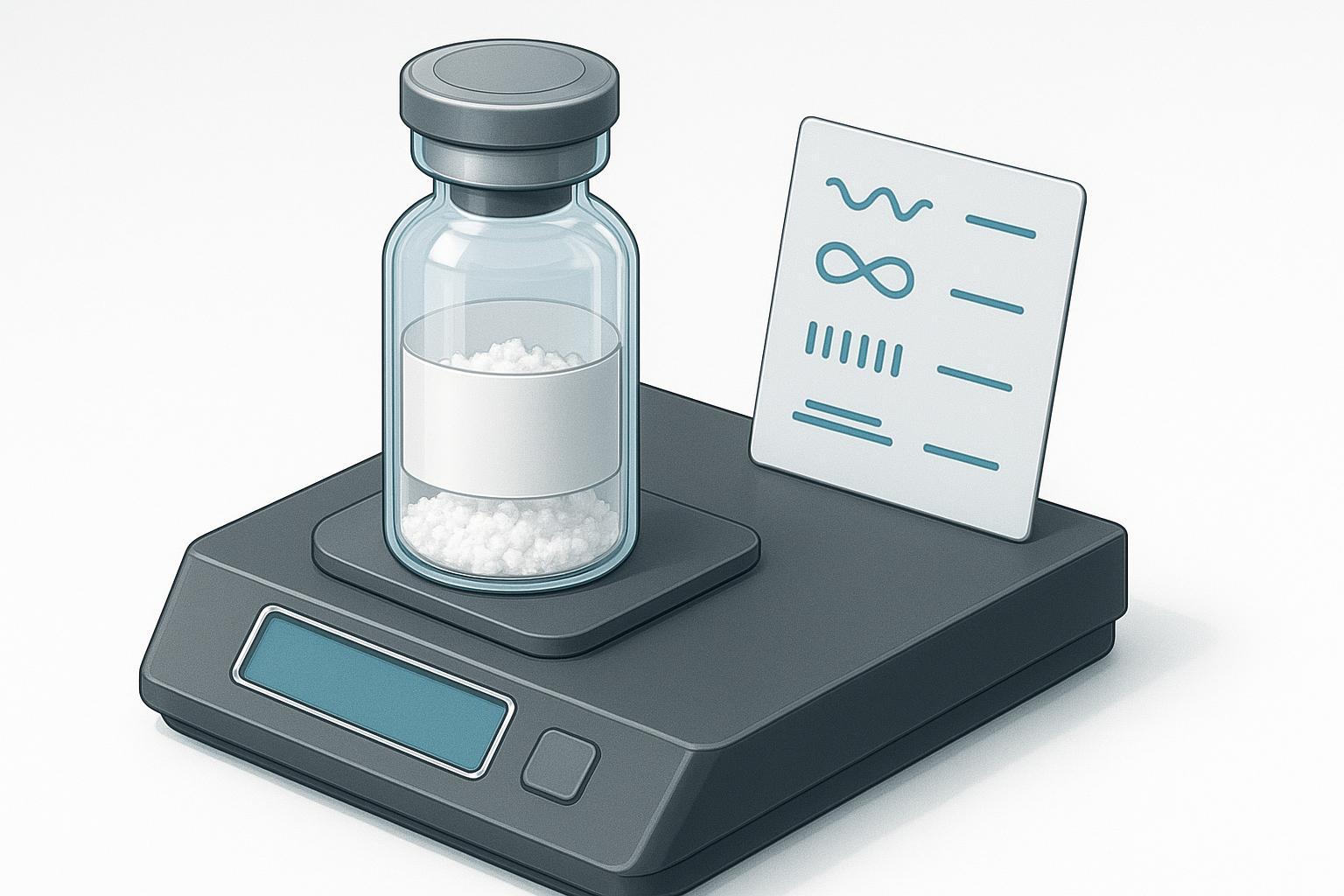
“Research-grade” and “development-grade” describe the same practical distinction: how much of a specification is documented and how far the material has travelled toward a regulated use. Research-grade material is sold for laboratory investigation, with identity and purity characterized but not qualified for human or veterinary use. Development-grade material sits further along the same path, where the supplier holds additional process and release documentation because the material is intended to feed a development program.
Neither label is a regulatory category. “Pharmaceutical grade” is the clearest example of a term with no fixed regulatory meaning in a marketing context: it signals an aspiration, not a status, and it should never substitute for a specification you can read.
The specification itself is where the confusion starts, because it bundles the three separate measurements behind a peptide specification: chromatographic purity, peptide content, and the counterion, water and residual salt fraction. Purity is a relative peak-area ratio within one chromatogram. Peptide content is the mass fraction of actual peptide in the vial, measured by amino acid analysis, quantitative NMR or an assay method, not by standard purity HPLC. Counterions, bound water and residual salts are non-peptide mass that raises the weighed amount without ever appearing as an impurity peak.
That gap is large enough to change how you calculate a dose. In a worked breakdown of what a lyophilized vial actually contains, the target peptide accounts for roughly 78% of total mass, the counterion around 12%, bound water about 6% and residual salts about 4%. HPLC purity can legitimately read 99% while a “10 mg” vial holds closer to 7.8 mg of peptide, which overstates molarity computed on the label by roughly 22%. Counterion, water and salts commonly account for 15 si 25% of total mass without moving the chromatographic purity number at all.
⚠️ Ikilọ: A certificate of analysis for identity and purity does not establish sterility, endotoxin status, correct fill quantity or long-term stability unless those attributes were separately tested. Third-party testing is also sample-based rather than batch-wide: a lab certifies the vial or aliquot it received, and the result represents every vial in the lot only if the sampling plan was designed to be representative and documented (Peptides.so, retrieved 2026-05-16).
Igbesẹ 1: Confirm the material is identity-tested, not just purity-tested
A purity percentage and an identity confirmation are two different measurements, and a CoA that reports only the first has not established the second. Intact mass by ESI/LC-MS compares the deconvoluted observed monoisotopic mass against the theoretical value, which confirms molecular mass and composition. What it does not do matters just as much: a correct intact mass does not prove sequence order, does not rule out sequence isomers or isomeric substitutions such as Leu/Ile or Asp/isoAsp, and does not report counterion content or salt state (Creative Proteomics, 2025-05-10).
That distinction gives you a pass/fail check on peptide identity testing. Does the CoA state an observed mass against a theoretical mass with the deviation given? On Q-TOF or Orbitrap instruments, mass accuracy below 5 ppm is achievable, and a measured monoisotopic mass should land within 10 ppm of theoretical, eyi ti o jẹ 0.02 Da at 2,000 Ati; a deviation above 20 ppm warrants investigation (Creative Proteomics, 2025-05-10). Where a supplier claims sequence-level identity, MS/MS b/y fragmentation should be reported, because intact mass alone cannot support that claim.
Igbesẹ 2: Read the purity number against its method
A purity percentage is a ratio, and the denominator is set by the method. Purity is calculated as main-peak area divided by total detected peak area, standardly at 214 nm, which is the peptide bond absorbance (Creative Proteomics, 2025-05-10). Change the column, the gradient, the detection wavelength or the integration threshold and you change what counts as a separate impurity, which is why a bare “99% pure” is unfalsifiable without method disclosure (Creative Proteomics, 2025-05-10).
That gives you a pass/fail check on any peptide purity data you are handed. Ask for the lot-specific chromatogram, then confirm the disclosed method lets you inspect peak shape and minor peaks yourself. On a 4.6 × 150 mm column, a well-behaved peptide elutes as a single symmetrical Gaussian peak with a width at half-height of 0.1 si 0.3 iseju. Shoulders, split peaks or a rising baseline are the impurity signals worth chasing, and mass shifts point at their likely source: +16 Da for methionine or tryptophan oxidation, −18 Da for asparagine deamidation, −113 Da for an isoleucine or leucine deletion, −57 Da for a glycine deletion.
Awọn iṣẹ One limit is worth stating plainly: diastereomers and epimers share the target’s mass, so MS cannot separate them from the correct sequence. A mass-confirmed identity is not the same as a stereochemically clean one.
Igbesẹ 3: Check net peptide content, not just the label weight
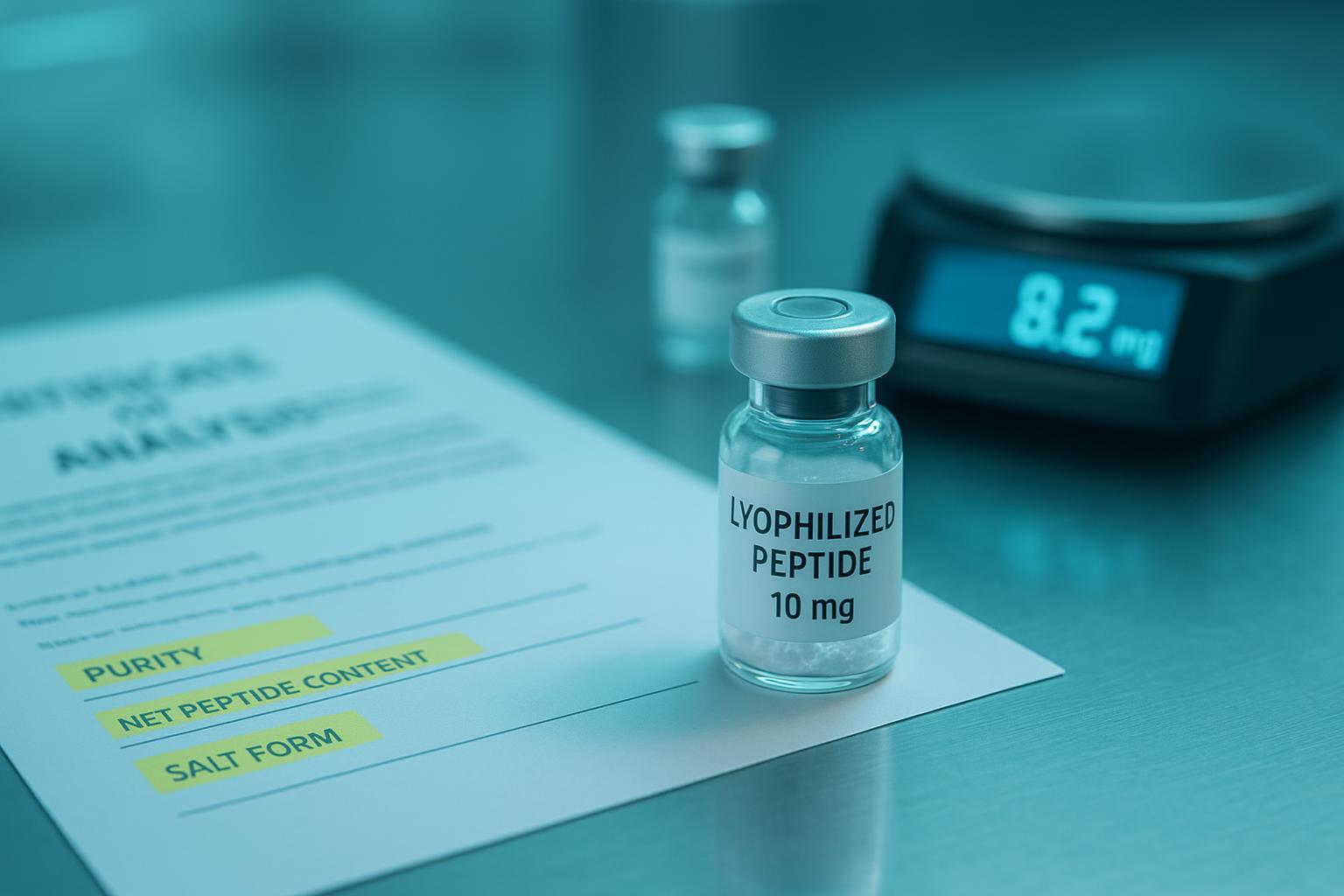
Underdosing is the failure mode a purity chromatogram cannot show you. Across 12,118 tests carrying a measured net-content figure, 7.16% (868 vials) came in below 95% of the labelled amount, roughly 26 times more common than a purity failure (Peptigrity’s Purity Index snapshot, retrieved 2026-08-25). Purity and content are separate measurements, and only one of them appears on most peptide certificates of analysis.
A documented case of a 99.80%-pure sample assaying 24% under label makes the gap concrete: the Mazdutide vial read 99.80% pure while assaying 15.18 mg against a 20 mg label, a −24.1% content shortfall.
Salt form explains part of the spread. A vial labelled 10 mg of TFA salt holds roughly 9.5 mg of peptide, and the salt-form mass spread across the same Itaja peptide shows why that must be declared: MOTS-c as free base, acetate and TFA salt spans 2,174.6, 2,234.64 ati 2,288.6 Ati, a 114-dalton range.
Pass/fail check: does the CoA state net peptide content per vial and name the salt form? If either field is missing, you cannot confirm what the vial contains.
Igbesẹ 4: Verify the lot chain — vial, CoA and shipping label
A certificate of analysis is only evidence for the lot it names, and that lot has to be traceable to the vial in your hand. Run the check as a pass or fail: the lot number on the vial, the lot number on the CoA and the lot number on the shipping documentation must match, and the CoA must name the testing laboratory and the date of analysis. Any gap breaks the chain.
The deeper limit is that third-party testing is sample-based, not batch-wide proof. A laboratory certifies the vial or aliquot it received, so the result may not represent every vial in the lot unless the sampling plan was representative and documented. If the supplier selected the sample or custody was uncontrolled, the result is not equivalent to independent market surveillance. That distinction is what third-party peptide testing can and cannot certify, and it is also why lot-to-lot consistency claims need retained records behind them, not a single report.
Igbesẹ 5: Apply intended-use controls as a supplier-side test
A research-use-only label does not settle what a product is for. Ninu FDA’s August 2026 warning letter to NuScience Peptides, the agency wrote that despite labeling stating “for laboratory, research, and analytical use” and “not intended for human or veterinary use,” website evidence established the products were intended to be drugs for human use, because bacteriostatic water was marketed alongside a “peptide calculator” that provides the means to prepare an injectable drug.
That is the supplier-side test: what the company sells next to the peptide, and how it frames the page. The accessory-bundling evidence in the August 2026 letters shows the pattern twice, with reconstitution solvent sold beside a “peptide guide” and a calculator. The principle predates peptides. Ninu the Agena Bioscience warning letter, as analysed by Mintz, FDA held that research-use-only disclaimers were “ineffective to override the totality of the objective evidence collected about the test and its intended use.”
Pass: the product page describes the material, its test data and its handling, and nothing else. Fail: reconstitution solvents, dosing calculators or administration guides sit in the same catalogue, or the page carries implied treatment or before-and-after framing. A supplier selling BPC-157 research use only material that also sells you the means to inject it has answered the intended-use question itself.
|
Checkpoint |
Evidence required |
Ibi ti o han |
Pass majemu |
|---|---|---|---|
|
Identity confirmation |
Akopọ Peptide Mass spectrometry data identifying the peptide sequence |
CoA, method section |
A method is named and a result is reported |
|
Purity method disclosure |
The chromatographic method behind the percentage |
CoA, method section |
Method stated, not just a number |
|
Apapọ peptide akoonu |
Peptide mass versus total vial mass |
CoA, quantitative fields |
Both figures reported |
|
Salt form declared |
Acetate, trifluoroacetate or free base |
CoA or specification sheet |
Stated explicitly |
|
Lot-chain match |
Vial lot equals CoA lot equals shipping label lot |
Vial, CoA, packaging |
All three agree |
|
Intended-use controls |
No solvents, calculators or dosing guides bundled |
Catalogue, product page |
Absent |
|
Limitation disclosure |
Tests not performed, stated as not performed |
CoA, supplier correspondence |
Disclosed rather than omitted |
Igbesẹ 6: Test how the supplier communicates limitations
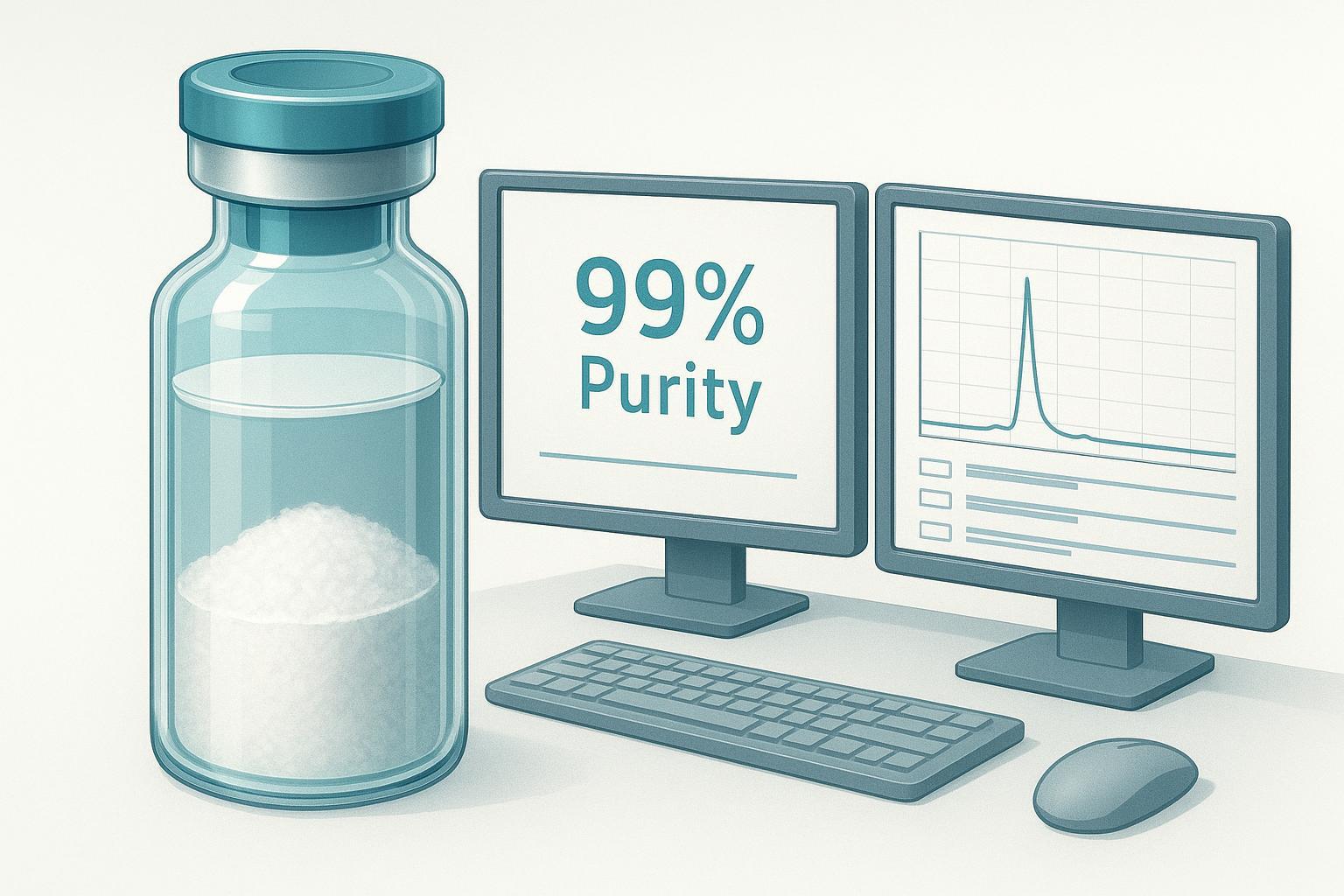
A supplier that never names a gap in its own data is not the safer choice. Ask directly which tests were not performed Awọn Peptides sintetiki on the lot, and whether the answer distinguishes what a certificate of analysis can and cannot establish.
That distinction matters because chromatographic purity, peptide content and counterion or water content are three separate measurements, produced by different methods. Creative Proteomics notes that a peptide reported at 98% chromatographic purity may contain only about 80% peptide by mass once TFA counterions, adsorbed water and residual synthesis solvents are subtracted. The scale of that gap is not marginal: Certik Labs puts typical lyophilized synthetic peptide specifications at roughly 5 si 15% water by weight and 10 si 25% residual TFA or counterion by weight for TFA salts.
Pass/fail check: the supplier states which tests were not performed, and separates what its documentation proves from what it does not. Transparent communication here looks like an explicit “not tested” line, not silence.
One honest caveat: sterility and residual-solvent data are genuinely not applicable to some research materials. A supplier that says so, and explains why, is disclosing a limitation rather than hiding one.
Common mistakes in research-grade peptide supplier verification
The most common error is treating a purity percentage as a complete quality signal. Each mistake below has a documentary fix you can apply to a CoA before you place an order.
Accepting a purity number with no method disclosure. A figure like 98.7% is meaningless without knowing whether it came from HPLC, MS, or an in-house estimate. The fix: reject any CoA that does not name the method and the detector. Igbesẹ 1 covers what a compliant identity test looks like.
Assuming a correct intact mass proves the sequence. Mass confirms molecular weight, not arrangement. Two peptides can share a mass and differ in sequence. The fix: require a sequence-level method, not mass alone.
Treating a third-party CoA as batch-wide proof. When the supplier controls which sample goes to the lab, the result describes that sample, not the batch. The fix: ask how the sample was drawn and whether the lab received it directly.
Reading a “10 mg” label as 10 mg of peptide. Label weight includes counterions and residual moisture. A 10 mg vial may hold well under 10 mg of the target peptide. The fix: check whether the CoA reports net peptide content separately.
Treating an RUO disclaimer as sufficient intended-use control. A “research use only” line does not override a page that markets dosing or human use. The fix: read the disclaimer against the surrounding copy.
Fun Italologo: The fastest single check is whether the CoA’s lot number matches the vial in hand. If it does not, stop there.
What a complete analytical package looks like
Assemble the elements the previous steps test for and you get one document set, not a folder of loose PDFs. A lot-specific chromatogram that names its method and column. An intact mass result stated as observed versus theoretical, with the deviation shown. Net peptide content and salt form, since the label weight alone does not tell you how much peptide is in the vial. Lot-chain documentation that ties vial, certificate and shipping label to the same number. And a plain statement of what was not tested, which is the field most packages omit.
That last item is the one that separates a documentation system from a marketing asset. A supplier whose package contains all six elements is describing its material; a supplier whose package contains five is describing its material selectively.
Gbigba bọtini: You are buying the package, not the purity number. A 98% figure with no method, no mass result and no lot chain is a claim. The same figure inside a complete package is evidence you can audit. Ṣiṣejade Peptide
MOL Changes is one example of a supplier whose documentation package is built around these elements, with QC across HPLC, MS and sterility testing in a Class 100 cleanroom. Treat it as a reference point for what the assembled package looks like when you request one, and apply the same checklist to every supplier you shortlist.
Regulatory context the reader should track
Enforcement is active and it reads product pages, not just labels. FDA’s public warning-letter database shows four peptide sellers cited in the August 2026 batch of peptide warning letters, all issued 2026-08-24 and all classified “Unapproved New Drugs/Misbranded”: TXP Innovations LLC (dba Tex Peptides), Royal Peptides LLC, NuScience Peptides LLC and Peak Performance Peptides.
The legal theory FDA applied in the 2026 letters is introduction of unapproved new drugs into interstate commerce under FD&C Act §§ 301(d) ati 505(a), 21 U.S.C. 331(d) ati 355(a). Drug status attaches under § 201(g)(1) where an article is intended to treat disease or affect body structure or function, and “new drug” status under § 201(p) follows because the products are not GRASE for the labelled conditions. Intent is inferred from what the seller publishes.
That matters for two reasons. Ni akọkọ, BPC-157 is not approved as a drug in the US, and it is not among the products actually named in the NuScience letter, which lists GLP-1 and GLP-2 analogues, retatrutide, survodutide, mazdutide, PT-141, tesamorelin and bacteriostatic water. Keji, the marketing patterns regulators read as intended-use evidence include implied treatment claims, before/after framing and injury-recovery promises, assessed against the totality of labelling, website copy, testimonials and distribution context. A “BPC-157 research use only” disclaimer does not neutralise copy that promises tissue repair.
One caveat worth stating plainly: the FDA 503A bulks-list status of BPC-157 is reported by secondary trackers rather than a primary FDA page read for this guide, so treat that specific point as unconfirmed.
Frequently asked questions
Does a certificate of analysis prove a peptide is safe to use?
Rara. A peptide certificate of analysis documents the tests that were run, and those tests address identity, purity and quantity. It does not establish sterility, endotoxin status, correct fill volume or long-term stability unless each of those was separately tested and reported. Treat the document as a record of analytical scope, not as an assurance about what the material is suitable for.
How do I tell a research-grade supplier from a reseller?
Look for five things: a lot-specific chromatogram with the method disclosed, an intact mass with a stated deviation, net peptide content and salt form, matching lot numbers across vial, CoA and shipping documentation, and an explicit list of tests not performed. A reseller typically supplies a purity percentage and a generic CoA that carries no lot number. Nipa
Is a 99% purity result good enough?
Not on its own. Purity is a relative peak-area ratio measured within a single chromatogram, so the number depends on the column, gradient, detection wavelength and integration threshold used to produce it. The same sample that reads 99.80% pure can still assay well below its label claim, which is why net peptide content has to be read alongside the percentage.
Why does the same peptide show different molecular weights across suppliers?
Salt form and counterion content. The free-base, acetate and TFA forms of one peptide carry different masses, and counterions, bound water and residual salts can make up a substantial share of total vial mass without lowering the chromatographic purity number at all. When two suppliers report different masses for the same sequence, compare the declared salt form before assuming one is wrong.
What should a supplier disclose when a test was not performed?
Name the test, state plainly that it was not performed, and say what that means for how the material can be used. Ailesabiyamo, endotoxin and residual-solvent data are genuinely not applicable to some research materials, and saying so is a documentation strength rather than a gap. Silence on the same point is the thing to treat as a finding.
Ipari
Verification of a research-grade peptide supplier comes down to a sequence you can run in one sitting: confirm identity testing, read the purity number against its method, check net peptide content, match the lot chain across vial, CoA and shipping label, apply intended-use controls, and watch how the supplier answers when a test was not performed. The value of that sequence is not that it produces a preferred vendor. It is that it produces your own acceptance criteria, written down, so the next quotation you receive can be judged against a standard you set rather than a claim someone made.
If you want to run the sequence against a live example, request the analytical documentation package for a specific lot, or speak with a technical specialist about which tests apply to your intended use. MOL Changes supplies research-grade peptides from a Class 100 cleanroom with in-house HPLC, MS and sterility QC, and has a commercial interest in peptide quality standards being read closely.
Ayẹwo nipasẹ [Name], Ph.D., Analytical Chemistry.