Tại sao việc xác minh nhà cung cấp peptide cấp độ nghiên cứu lại trở thành một vấn đề mua sắm
Thị trường chợ đen mở rộng nhanh hơn quy mô giấy tờ của nó. Chainalysis ghi nhận dòng tiền điện tử peptide trên thị trường xám tăng từ 12 triệu USD lên 32 triệu USD trong Q1 2026, Một 159% bước nhảy vọt trong quý và là quý tăng trưởng thứ sáu liên tiếp (Phân tích chuỗi, 2026-06-04). Khối lượng như thế thường buộc các tiêu chuẩn tài liệu phải hoàn thiện. Ở đây nó không.
Finnick, một phòng thí nghiệm thử nghiệm peptide ở Texas, đã phân tích hàng nghìn sản phẩm được mua độc lập và nhận thấy rằng khoảng một phần ba các lần kiểm tra chất lượng cơ bản không thành công, với tỷ lệ hầu như không thay đổi trong suốt 12 ĐẾN 14 tháng thu thập dữ liệu (Người bảo vệ, 2026-04-06). Tỷ lệ thất bại ổn định là tín hiệu khó hơn: thị trường tăng trưởng, tỷ lệ lỗi không di chuyển.
Điều đó khiến việc xác minh nhà cung cấp peptide cấp độ nghiên cứu là công việc của người mua. Những thất bại mà Finnrick báo cáo chia thành ba loại, danh tính, độ tinh khiết và số lượng, và chúng tạo thành cột sống của khung bên dưới.

Vật liệu ở cấp độ nghiên cứu và cấp độ phát triển thực sự có ý nghĩa gì
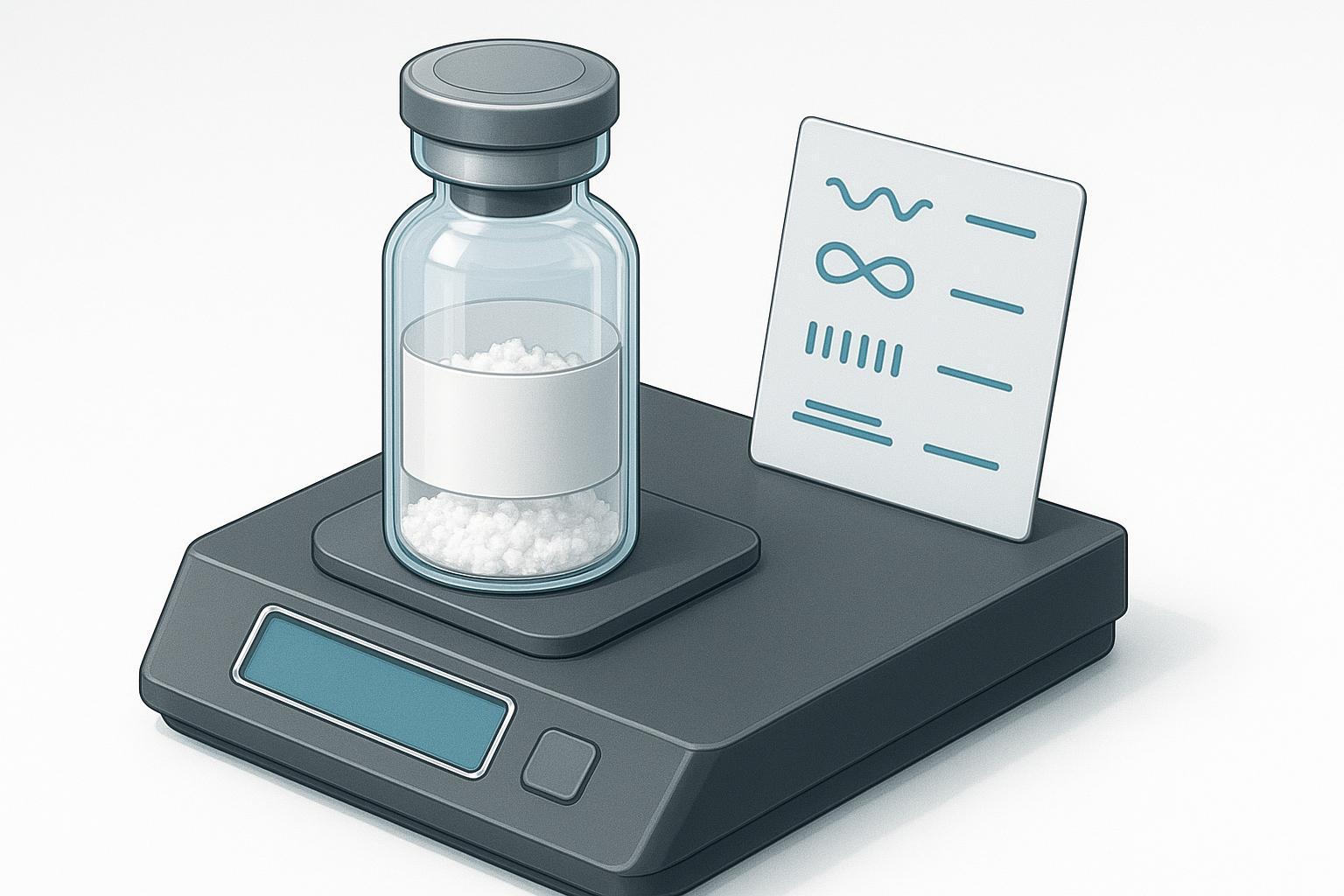
“Cấp nghiên cứu” và “cấp phát triển” mô tả sự khác biệt thực tế giống nhau: bao nhiêu thông số kỹ thuật được ghi lại và vật liệu đã đi được bao xa đến mức sử dụng được quy định. Vật liệu cấp nghiên cứu được bán để điều tra trong phòng thí nghiệm, có đặc điểm nhận dạng và độ tinh khiết nhưng không đủ tiêu chuẩn dùng cho người hoặc thú y. Vật liệu cấp phát triển nằm xa hơn trên cùng một con đường, trong đó nhà cung cấp nắm giữ tài liệu quy trình và phát hành bổ sung vì nguyên liệu này nhằm mục đích cung cấp cho chương trình phát triển.
Không có nhãn nào là danh mục quy định. “Cấp dược phẩm” là ví dụ rõ ràng nhất về một thuật ngữ không có ý nghĩa quản lý cố định trong bối cảnh tiếp thị: nó báo hiệu một khát vọng, không phải là một trạng thái, và nó không bao giờ nên thay thế cho thông số kỹ thuật mà bạn có thể đọc.
Bản thân thông số kỹ thuật là nơi bắt đầu sự nhầm lẫn, bởi vì nó bó ba phép đo riêng biệt đằng sau thông số kỹ thuật peptide: độ tinh khiết sắc ký, hàm lượng peptit, và sự phản đối, phần nước và muối dư. Độ tinh khiết là tỷ lệ diện tích pic tương đối trong một sắc ký đồ. Hàm lượng peptide là phần khối lượng của peptide thực tế trong lọ, được đo bằng phân tích axit amin, NMR định lượng hoặc phương pháp xét nghiệm, không phải bằng HPLC độ tinh khiết tiêu chuẩn. phản biện, nước liên kết và muối dư là khối không phải peptit làm tăng lượng đã cân mà không bao giờ xuất hiện dưới dạng đỉnh tạp chất.
Khoảng cách đó đủ lớn để thay đổi cách bạn tính liều. Trong bản phân tích thực tế về những gì thực sự chứa trong một lọ đông khô, peptide mục tiêu chiếm khoảng 78% tổng khối lượng, sự phản đối xung quanh 12%, nước liên kết về 6% và lượng muối dư khoảng 4%. Độ tinh khiết HPLC có thể đọc được một cách hợp pháp 99% trong khi lọ “10 mg” giữ gần hơn 7.8 mg peptit, phóng đại nồng độ mol được tính toán trên nhãn gần như 22%. phản công, nước và muối thường chiếm 15 ĐẾN 25% tổng khối lượng mà không làm thay đổi số độ tinh khiết sắc ký.
⚠️ Cảnh báo: Giấy chứng nhận phân tích về danh tính và độ tinh khiết không chứng minh được tính vô trùng, tình trạng nội độc tố, correct fill quantity or long-term stability unless those attributes were separately tested. Third-party testing is also sample-based rather than batch-wide: a lab certifies the vial or aliquot it received, and the result represents every vial in the lot only if the sampling plan was designed to be representative and documented (Peptides.so, đã lấy lại 2026-05-16).
Bước chân 1: Xác nhận tài liệu đã được kiểm tra danh tính, không chỉ được kiểm tra độ tinh khiết
A purity percentage and an identity confirmation are two different measurements, and a CoA that reports only the first has not established the second. Intact mass by ESI/LC-MS compares the deconvoluted observed monoisotopic mass against the theoretical value, which confirms molecular mass and composition. What it does not do matters just as much: a correct intact mass does not prove sequence order, does not rule out sequence isomers or isomeric substitutions such as Leu/Ile or Asp/isoAsp, and does not report counterion content or salt state (Proteomics sáng tạo, 2025-05-10).
That distinction gives you a pass/fail check on peptide identity testing. Does the CoA state an observed mass against a theoretical mass with the deviation given? On Q-TOF or Orbitrap instruments, mass accuracy below 5 ppm is achievable, and a measured monoisotopic mass should land within 10 ppm of theoretical, đó là 0.02 Da at 2,000 Và; a deviation above 20 ppm warrants investigation (Proteomics sáng tạo, 2025-05-10). Where a supplier claims sequence-level identity, MS/MS b/y fragmentation should be reported, because intact mass alone cannot support that claim.
Bước chân 2: Đọc số độ tinh khiết theo phương pháp của nó
A purity percentage is a ratio, and the denominator is set by the method. Purity is calculated as main-peak area divided by total detected peak area, standardly at 214 bước sóng, which is the peptide bond absorbance (Proteomics sáng tạo, 2025-05-10). Change the column, độ dốc, the detection wavelength or the integration threshold and you change what counts as a separate impurity, which is why a bare “99% pure” is unfalsifiable without method disclosure (Proteomics sáng tạo, 2025-05-10).
That gives you a pass/fail check on any peptide purity data you are handed. Ask for the lot-specific chromatogram, then confirm the disclosed method lets you inspect peak shape and minor peaks yourself. On a 4.6 × 150 mm column, a well-behaved peptide elutes as a single symmetrical Gaussian peak with a width at half-height of 0.1 ĐẾN 0.3 phút. Shoulders, split peaks or a rising baseline are the impurity signals worth chasing, and mass shifts point at their likely source: +16 Da for methionine or tryptophan oxidation, −18 Da for asparagine deamidation, −113 Da for an isoleucine or leucine deletion, −57 Da for a glycine deletion.
Dịch vụ One limit is worth stating plainly: diastereomers and epimers share the target’s mass, so MS cannot separate them from the correct sequence. A mass-confirmed identity is not the same as a stereochemically clean one.
Bước chân 3: Kiểm tra hàm lượng peptide ròng, không chỉ trọng lượng nhãn
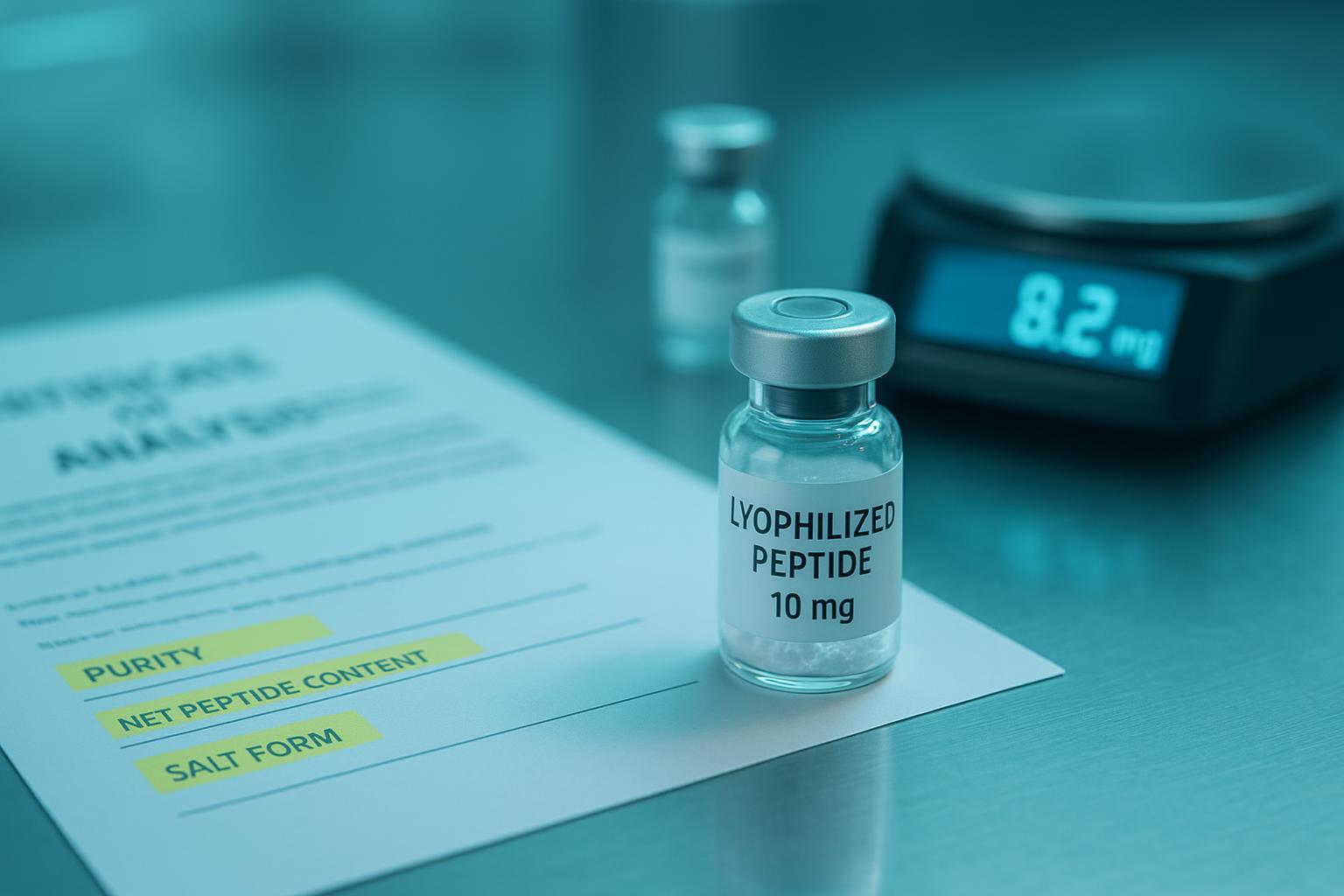
Underdosing is the failure mode a purity chromatogram cannot show you. Across 12,118 tests carrying a measured net-content figure, 7.16% (868 vials) came in below 95% of the labelled amount, đại khái 26 times more common than a purity failure (Peptigrity’s Purity Index snapshot, đã lấy lại 2026-08-25). Purity and content are separate measurements, and only one of them appears on most peptide certificates of analysis.
MỘT documented case of a 99.80%-pure sample assaying 24% under label makes the gap concrete: the Mazdutide vial read 99.80% pure while assaying 15.18 mg against a 20 mg label, a −24.1% content shortfall.
Salt form explains part of the spread. Một lọ có nhãn 10 mg of TFA salt holds roughly 9.5 mg peptit, and the salt-form mass spread across the same Cửa hàng peptide shows why that must be declared: MOTS-c as free base, acetate and TFA salt spans 2,174.6, 2,234.64 Và 2,288.6 Và, a 114-dalton range.
Pass/fail check: does the CoA state net peptide content per vial and name the salt form? If either field is missing, you cannot confirm what the vial contains.
Bước chân 4: Xác minh chuỗi lô - lọ, CoA và nhãn vận chuyển
A certificate of analysis is only evidence for the lot it names, and that lot has to be traceable to the vial in your hand. Run the check as a pass or fail: the lot number on the vial, the lot number on the CoA and the lot number on the shipping documentation must match, and the CoA must name the testing laboratory and the date of analysis. Any gap breaks the chain.
The deeper limit is that third-party testing is sample-based, not batch-wide proof. A laboratory certifies the vial or aliquot it received, so the result may not represent every vial in the lot unless the sampling plan was representative and documented. If the supplier selected the sample or custody was uncontrolled, the result is not equivalent to independent market surveillance. That distinction is what third-party peptide testing can and cannot certify, and it is also why lot-to-lot consistency claims need retained records behind them, not a single report.
Bước chân 5: Áp dụng các biện pháp kiểm soát mục đích sử dụng như một thử nghiệm từ phía nhà cung cấp
A research-use-only label does not settle what a product is for. TRONG Tháng 8 của FDA 2026 warning letter to NuScience Peptides, the agency wrote that despite labeling stating “for laboratory, nghiên cứu, and analytical use” and “not intended for human or veterinary use,” website evidence established the products were intended to be drugs for human use, because bacteriostatic water was marketed alongside a “peptide calculator” that provides the means to prepare an injectable drug.
That is the supplier-side test: what the company sells next to the peptide, and how it frames the page. The accessory-bundling evidence in the August 2026 letters shows the pattern twice, with reconstitution solvent sold beside a “peptide guide” and a calculator. The principle predates peptides. TRONG the Agena Bioscience warning letter, as analysed by Mintz, FDA held that research-use-only disclaimers were “ineffective to override the totality of the objective evidence collected about the test and its intended use.”
Vượt qua: the product page describes the material, its test data and its handling, and nothing else. Thất bại: reconstitution solvents, dosing calculators or administration guides sit in the same catalogue, or the page carries implied treatment or before-and-after framing. A supplier selling BPC-157 research use only material that also sells you the means to inject it has answered the intended-use question itself.
|
Checkpoint |
Yêu cầu bằng chứng |
Nó xuất hiện ở đâu |
Điều kiện đạt |
|---|---|---|---|
|
Xác nhận danh tính |
Tổng hợp peptit Mass spectrometry data identifying the peptide sequence |
CoA, method section |
A method is named and a result is reported |
|
Purity method disclosure |
The chromatographic method behind the percentage |
CoA, method section |
Method stated, not just a number |
|
Hàm lượng peptide ròng |
Peptide mass versus total vial mass |
CoA, quantitative fields |
Both figures reported |
|
Salt form declared |
Acetate, trifluoroacetate or free base |
CoA or specification sheet |
Stated explicitly |
|
Lot-chain match |
Vial lot equals CoA lot equals shipping label lot |
Vial, CoA, bao bì |
All three agree |
|
Intended-use controls |
No solvents, calculators or dosing guides bundled |
Catalogue, product page |
Vắng mặt |
|
Limitation disclosure |
Tests not performed, stated as not performed |
CoA, supplier correspondence |
Disclosed rather than omitted |
Bước chân 6: Kiểm tra cách nhà cung cấp truyền đạt những hạn chế

A supplier that never names a gap in its own data is not the safer choice. Ask directly which tests were not performed Peptide tổng hợp on the lot, and whether the answer distinguishes what a certificate of analysis can and cannot establish.
That distinction matters because chromatographic purity, peptide content and counterion or water content are three separate measurements, produced by different methods. Creative Proteomics notes that a peptide reported at 98% chromatographic purity may contain only about 80% peptide by mass once TFA counterions, adsorbed water and residual synthesis solvents are subtracted. The scale of that gap is not marginal: Phòng thí nghiệm Certik puts typical lyophilized synthetic peptide specifications at roughly 5 ĐẾN 15% water by weight and 10 ĐẾN 25% residual TFA or counterion by weight for TFA salts.
Pass/fail check: the supplier states which tests were not performed, and separates what its documentation proves from what it does not. Transparent communication here looks like an explicit “not tested” line, not silence.
Một lời cảnh báo trung thực: sterility and residual-solvent data are genuinely not applicable to some research materials. A supplier that says so, and explains why, is disclosing a limitation rather than hiding one.
Những lỗi phổ biến trong xác minh nhà cung cấp peptide cấp nghiên cứu
The most common error is treating a purity percentage as a complete quality signal. Each mistake below has a documentary fix you can apply to a CoA before you place an order.
Accepting a purity number with no method disclosure. A figure like 98.7% is meaningless without knowing whether it came from HPLC, bệnh đa xơ cứng, or an in-house estimate. Cách khắc phục: reject any CoA that does not name the method and the detector. Bước chân 1 covers what a compliant identity test looks like.
Assuming a correct intact mass proves the sequence. Mass confirms molecular weight, not arrangement. Two peptides can share a mass and differ in sequence. Cách khắc phục: require a sequence-level method, not mass alone.
Treating a third-party CoA as batch-wide proof. When the supplier controls which sample goes to the lab, the result describes that sample, not the batch. Cách khắc phục: ask how the sample was drawn and whether the lab received it directly.
Reading a “10 mg” label as 10 mg peptit. Label weight includes counterions and residual moisture. MỘT 10 mg vial may hold well under 10 mg of the target peptide. Cách khắc phục: check whether the CoA reports net peptide content separately.
Treating an RUO disclaimer as sufficient intended-use control. A “research use only” line does not override a page that markets dosing or human use. Cách khắc phục: read the disclaimer against the surrounding copy.
Để biết tiền boa: The fastest single check is whether the CoA’s lot number matches the vial in hand. If it does not, stop there.
Một gói phân tích hoàn chỉnh trông như thế nào
Assemble the elements the previous steps test for and you get one document set, not a folder of loose PDFs. A lot-specific chromatogram that names its method and column. An intact mass result stated as observed versus theoretical, with the deviation shown. Net peptide content and salt form, since the label weight alone does not tell you how much peptide is in the vial. Lot-chain documentation that ties vial, certificate and shipping label to the same number. And a plain statement of what was not tested, which is the field most packages omit.
That last item is the one that separates a documentation system from a marketing asset. A supplier whose package contains all six elements is describing its material; a supplier whose package contains five is describing its material selectively.
Chìa khóa mang đi: You are buying the package, not the purity number. MỘT 98% figure with no method, no mass result and no lot chain is a claim. The same figure inside a complete package is evidence you can audit. Sản xuất peptit
MOL Changes is one example of a supplier whose documentation package is built around these elements, with QC across HPLC, MS and sterility testing in a Class 100 phòng sạch. Treat it as a reference point for what the assembled package looks like when you request one, and apply the same checklist to every supplier you shortlist.
Bối cảnh pháp lý người đọc nên theo dõi
Enforcement is active and it reads product pages, not just labels. FDA’s public warning-letter database shows four peptide sellers cited in the August 2026 batch of peptide warning letters, all issued 2026-08-24 and all classified “Unapproved New Drugs/Misbranded”: TXP Innovations LLC (dba Tex Peptides), Royal Peptides LLC, NuScience Peptides LLC and Peak Performance Peptides.
The legal theory FDA applied in the 2026 letters is introduction of unapproved new drugs into interstate commerce under FD&C Act §§ 301(d) Và 505(Một), 21 U.S.C. 331(d) Và 355(Một). Drug status attaches under § 201(g)(1) where an article is intended to treat disease or affect body structure or function, and “new drug” status under § 201(P) follows because the products are not GRASE for the labelled conditions. Intent is inferred from what the seller publishes.
That matters for two reasons. Đầu tiên, BPC-157 is not approved as a drug in the US, and it is not among the products actually named in the NuScience letter, which lists GLP-1 and GLP-2 analogues, retatrutide, survodutide, mazdutide, PT-141, tesamorelin and bacteriostatic water. Thứ hai, the marketing patterns regulators read as intended-use evidence include implied treatment claims, before/after framing and injury-recovery promises, assessed against the totality of labelling, website copy, testimonials and distribution context. A “BPC-157 research use only” disclaimer does not neutralise copy that promises tissue repair.
One caveat worth stating plainly: the FDA 503A bulks-list status of BPC-157 is reported by secondary trackers rather than a primary FDA page read for this guide, so treat that specific point as unconfirmed.
Câu hỏi thường gặp
Giấy chứng nhận phân tích có chứng minh peptide an toàn khi sử dụng không?
KHÔNG. A peptide certificate of analysis documents the tests that were run, and those tests address identity, độ tinh khiết và số lượng. It does not establish sterility, tình trạng nội độc tố, correct fill volume or long-term stability unless each of those was separately tested and reported. Treat the document as a record of analytical scope, not as an assurance about what the material is suitable for.
Làm cách nào để phân biệt nhà cung cấp cấp nghiên cứu với người bán lại?
Look for five things: a lot-specific chromatogram with the method disclosed, an intact mass with a stated deviation, net peptide content and salt form, matching lot numbers across vial, CoA and shipping documentation, and an explicit list of tests not performed. A reseller typically supplies a purity percentage and a generic CoA that carries no lot number. Về
là một 99% độ tinh khiết kết quả đủ tốt?
Not on its own. Purity is a relative peak-area ratio measured within a single chromatogram, so the number depends on the column, độ dốc, detection wavelength and integration threshold used to produce it. The same sample that reads 99.80% pure can still assay well below its label claim, which is why net peptide content has to be read alongside the percentage.
Tại sao cùng một peptide lại có trọng lượng phân tử khác nhau giữa các nhà cung cấp?
Salt form and counterion content. The free-base, acetate and TFA forms of one peptide carry different masses, và phản biện, bound water and residual salts can make up a substantial share of total vial mass without lowering the chromatographic purity number at all. When two suppliers report different masses for the same sequence, compare the declared salt form before assuming one is wrong.
Nhà cung cấp nên tiết lộ điều gì khi thử nghiệm không được thực hiện?
Name the test, state plainly that it was not performed, and say what that means for how the material can be used. vô trùng, endotoxin and residual-solvent data are genuinely not applicable to some research materials, and saying so is a documentation strength rather than a gap. Silence on the same point is the thing to treat as a finding.
Phần kết luận
Verification of a research-grade peptide supplier comes down to a sequence you can run in one sitting: confirm identity testing, read the purity number against its method, check net peptide content, match the lot chain across vial, CoA và nhãn vận chuyển, apply intended-use controls, and watch how the supplier answers when a test was not performed. The value of that sequence is not that it produces a preferred vendor. It is that it produces your own acceptance criteria, viết ra, so the next quotation you receive can be judged against a standard you set rather than a claim someone made.
If you want to run the sequence against a live example, request the analytical documentation package for a specific lot, or speak with a technical specialist about which tests apply to your intended use. MOL Changes supplies research-grade peptides from a Class 100 phòng sạch với HPLC trong nhà, MS và QC vô trùng, and has a commercial interest in peptide quality standards being read closely.
Được đánh giá bởi [Tên], Ph.D., Hóa phân tích.