1. Coupling efficiency and difficult sequences — where digital twins in peptide manufacturing earn their place first
Peptide Product Manufacturer Copper Tripeptide-1 The evidence that peptide coupling efficiency modeling can work at this density is strongest in flow synthesis. A deep-learning model trained on 35,000 deprotection reactions from an automated fast-flow synthesiser predicted deprotection outcomes with under 6% error (Mohapatra et al., ACS Central Science, 2020). The same data stream carries a second signal: reading aggregation from deprotection peak shape, where a Gaussian fit to each deprotection peak (average R² 0.97) and a resin-mass-corrected peak angle give an onset point for aggregation (flow-SPPS data analytics, 2024).
Regulators have noticed the direction of travel. Regulatory submissions containing AI/ML components rose from 1 u 2016 do 132 u 2021 (Niazi, Farmaceutika, 2025), and CDER’s count of AI-component submissions grew substantially across 2016 do 2023, spanning manufacturing as well as clinical phases (FDA CDER, current page). CDER also published a discussion paper on AI in drug manufacturing in March 2023 under its FRAME initiative (FDA CDER, 2023).
2. Impurity formation — what digital twins in peptide manufacturing can flag, and what analytical testing still has to prove
Peptide impurity prediction earns second place because it changes which analytical method you run next, not because it replaces the method. A model can rank the likely impurities for a given sequence and deprotection chemistry; it cannot assign a level that goes into a specification.

The chemistry is well enough understood to model at the mechanism level. Aspartimide formation at Asp-Gly depends strongly on the deprotection base: in a model hexapeptide at 60 °C, 20% piperidine gave 17% aspartimide while 25% dipropylamine gave 4%, i kod 90 °C piperidine gave 20% (Personne et al., ACS Omega, 2023). Racemization follows two routes, oxazol-5(4H)-one formation during activation and direct alpha-proton abstraction, with histidine’s known propensity to racemise through its imidazole ring and C-terminal cysteine epimerising during anchoring and repeated piperidine treatment (Duengo et al., 2023).
|
Klasa nečistoća |
Likely driver |
Model can flag? |
Confirming method |
|---|---|---|---|
|
Aspartimid |
Base strength, temperatura, Asp-Gly motif |
Da, direction and rank |
LC-MS of crude |
|
Epimers (D-aminokiseline) |
Activation route, Njegovo, C-terminal Cys |
Djelomično, by residue |
Chiral GC-MS |
|
Nizovi brisanja |
Incomplete coupling |
Da, from coupling data |
LC-MS/MS with sequence coverage |
|
Oksidacija, deamidacija |
dekoltea, sušenje, skladištenje |
Weakly |
Mapiranje peptida |
|
Protuion, zaostalo otapalo |
Downstream processing |
HPLC, GC, Karl Fischer |
That confirming column is not optional. USP’s peptide reference-standard approach specifies identity by NMR, LC-MS/MS with sequence coverage and amino acid analysis, chirality by chiral GC-MS, and purity by HPLC area plus counter-ion, zaostalo otapalo, water by Karl Fischer and residue on ignition (USP, 2023).

Use predictions to guide experiments and process understanding. Set acceptance limits from the relevant quality and safety requirements, Types Of Peptides analytical capability and justified process knowledge; observed batches alone must not define what is acceptable.
3. Cleavage and crude isolation — the step where digital twins in peptide manufacturing help least
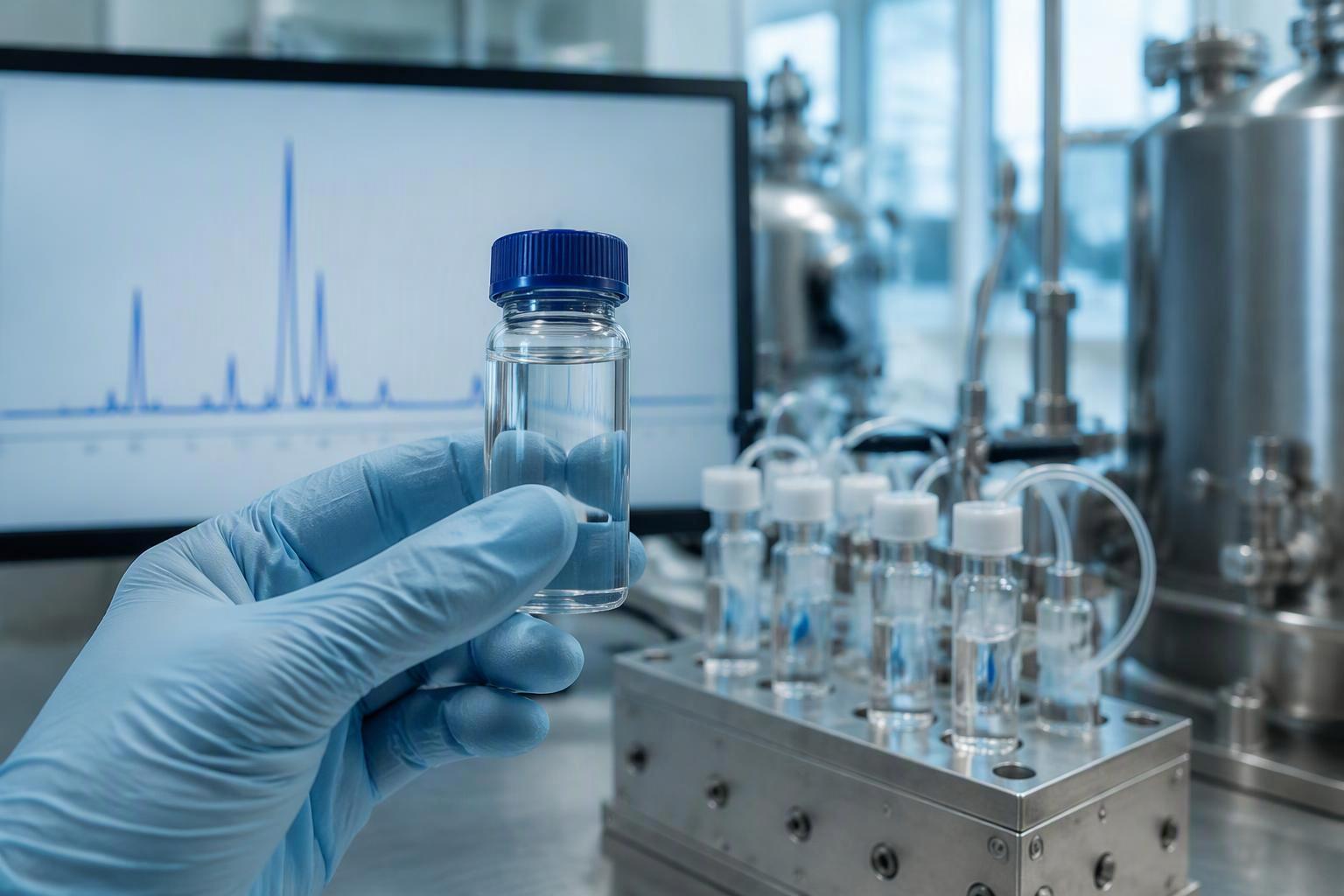
The risks are real but not well predicted. Our process-development documentation for GMP peptide synthesis lists oxidation and deamidation occurring during cleavage, pročišćavanje, drying or storage, and aggregation with high-molecular-weight species among the peptide-related impurities to control. It also notes that closely related variants can co-elute or remain difficult to identify by a single method. Those are empirical problems, answered by orthogonal analytics and tighter pooling rules rather than by a predictive model.
Where a model does help is upstream. If the coupling model in item 1 has already told you the crude will be complex, you can plan the cleavage and isolation workload accordingly. That is a planning benefit, not a prediction of the cleavage itself.
4. Preparative purification — where digital twins in peptide manufacturing meet column data that decides
Peptide purification process optimization is the target where a model and column data have to be used together, and where the column data usually wins. The decision is the gradient slope, load ratio, column dimensions and resin batch, and the published transfer rule is empirical.
The standard analytical-to-preparative gradient rule starts the shallow gradient 12 percentage points below the analytical elution concentration and runs 0.1% acetonitrile per minute. Across loads from 0.75 do 200 mg on a 9.4 mm I.D. semi-preparative column, average recovery was 90.7% (preparative RP-HPLC of peptides, 2006). A model can interpolate between load points like these; it cannot substitute for running them on your column and your resin batch.
Callout: Model output supports process decisions. It does not replace release testing or a qualified person’s judgement.
5. Podaci, validation and governance — the preconditions before digital twins in peptide manufacturing are trustworthy
Traceable, reliable inputs and validated processing are needed for consequential model use. LIMS or MES are possible implementations, not universal prerequisites. Determine Part 11 applicability and control the system for its intended use.
The governing references are specific. ICH Q13’s section on process models requires validation for intended use against predetermined acceptance criteria using statistically sound approaches, with uncertainty in both measurement and prediction accounted for (ICH Q13, 2022); FDA’s adoption of Q13 in 2023 made that guidance applicable to drug substance manufacture (FDA, 2023). ICH Q8(R2)’s definition of design space sets the boundary: working inside the space is not a change, moving outside it is (ICH Q8(R2), 2009). I Q9(R1) on risk-based decision-making governs how much modeling effort a given unit operation deserves (FDA, 2023). Part 11’s audit-trail requirement means model inputs and outputs must be captured with time-stamped trails that do not obscure prior records (21 CFR dio 11, current text). FDA-e 2004 PAT framework, which is explicitly voluntary, is the frame for the sensor layer (FDA, 2004).
|
Precondition |
Governing reference |
What it asks of a peptide process twin |
|---|---|---|
|
Defined intended use |
ICH Q13 |
Acceptance criteria set before validation, ne poslije |
|
Bounded operating space |
ICH Q8(R2) |
Model valid within its demonstrated domain; approved design space is a separate regulatory concept |
|
Proportional effort Synthetic Peptide Manufacturer |
I Q9(R1) |
More validation where risk is higher |
|
Traceable records |
21 CFR dio 11 |
Audit trails on every input and output |
|
Sensor layer |
FDA PAT (voluntary) |
Real-time data where it earns its place |
EMA-e 2025 AI Observatory report lists pharmaceutical process models, including digital twins, among the topics raised in applicant meetings from 2023 do 2025 (EMA, 2025).
Callout: Dodatak 22 on AI was a draft under public consultation in 2025, not in-force text. Do not treat it as a requirement.
6. How to evaluate a partner’s digital-twin claims — a checklist for peptide R&D donositelji odluka
Ask for batch data, not a platform demo. A partner who cannot show a model’s predictions against measured results on a named sequence, at a named scale, has not demonstrated a twin. The questions below follow ICH Q13’s fitness-for-intended-use framing, which asks for acceptance criteria to be defined before a model is used rather than reconstructed after it (ICH Q13, 2022).
|
Pitanje za postaviti |
Zašto je to važno |
What a weak answer looks like |
|---|---|---|
|
Which sequence and scale was the model built on? Buy Peptide |
Models are configuration-specific |
“It generalises across sequences” |
|
What were the acceptance criteria, set when? |
Q13 requires them before validation |
Criteria described after the fact |
|
Can you show predicted versus measured crude purity? |
One relevant performance test; include prospective evaluation and uncertainty |
A dashboard with no measured overlay |
|
How are inputs captured and audited? |
Dio 11 applies to model records |
“Our platform handles compliance” |
|
What is the model’s stated operating range? |
Q8(R2) design space logic |
No stated limits |
|
Which decisions does it change? |
The selection criterion for this whole list |
Vague claims about “optimization” |
Two of these deserve a harder push than they usually get. On inputs, ask which variables come from your own batch records and which are literature defaults: a coupling model fed generic rate constants is a hypothesis about your process, not a description of it. On coverage, ask what the model does not represent. A twin that predicts coupling efficiency but says nothing about co-eluting deletion variants has a defined blind spot, and a partner who names it is more credible than one who claims none.
The CoA-level evidence is where the conversation should end. Zatražite kromatogram, mass spectrum and amino-acid analysis behind a claimed prediction, because purity alone does not confirm identity, and closely related variants can co-elute or resist identification by a single method. A partner who can produce that package on request is describing a model; one who cannot is describing software.
We built our own process-development work around that evidence standard. MOL Changes’ peptide synthesis, purification and analytical QC generate the batch-specific chromatogram, mass and amino-acid data such an evaluation depends on, and we treat modeling as decision support rather than as a validated twin.
Decision rule: a claim that cannot be tied to a named sequence and a measured result is a sales claim, not a model. What the model cannot tell you: whether the partner’s chemistry team can act on what the model flags, which only a technical conversation reveals. If you are weighing a modeling proposal, we are glad to discuss a worked example on one of your sequences and the batch data behind it.
Zaključak
For each unit operation, the wet-lab measurement still decides. Coupling data decides whether to recouple; the chromatogram decides whether an impurity is real; the crude profile decides the cleavage workup; the load-versus-recovery run decides the gradient. The model’s job is to tell you which of those to run first and what to expect, and to do that it needs validated inputs, a stated operating range and an audit trail.
Pharma 4.0 peptide process development works when the model and the bench are designed together, not when one is asked to stand in for the other. Start with the unit operation where your data is densest and your decisions are most frequent. If you want a second view on where a twin would earn its place in your process, or on a partner’s claims, our team is happy to look at your batch data with you.
Publisher disclosure: MOL Changes supplies peptide services and has a commercial interest in this topic. Service ranges and capability statements are supplier claims; availability and performance for a specific construct require project-specific evidence.